Q All right. You describe rather accurately your objectives, but what was the reason for your objection?
The most important thing, it appeared to you, was food supplies, and the rest would came later, is that correct? In that case you objected not to the plan, but to the period at which the plan should be fulfilled. You wanted food first and territory second, is that it?
ANo, that isn't the way it is stated. It is stated just as I have read it out. There were no secrets concerned, but it was just the way I read it.
QPlease read it once more, or please tell me once more just where you disagreed.
AWith reference to these long discussions about persons and annexation of territory, with reference to that, "The Reichsmarshal emphasized the most important points of view which wouldhave to be the decisive factors for us, namely, securing of the food supplies, the securing of the economic situation, and the securing of highways and communications, etc." In other words, railroads and so forth were also discussed.
This means that I wanted to stop an unlimited discussion duo to the intoxication of victory, and wanted to confine it to merely practical matters.
QIt is understandable that evidently this does not play so important a part. However, the objection you just gave does not mean that you objected to the annexation of the Crimea to the German Reich, or the annexation of other regions, isn't that correct?
AIf you only spoke German then, from the sentence which says, "opposed to that, the Reichsmarshal emphasized..." you would understand everything that is implied. In other words, I didn't say here, "I protest against the annexation of the Crimea," or, "I object to annexing the Baltic States." For that I had no reason. Had we been victorious, then after the declaration of peace we would have been able to gather how far we could use these territories or not, but at that moment we hand't finished the war, we hadn't won the war, and consequently I personally confined myself to practical problems.
QI understand you. In that case, you considered the annexation of these regions a step to come later. As you said yourself, after it was won you would have seized these provinces and annexed them.
AAs an old hunter, I acted according tothe principle of not sharing the bearskin before it was shot.
QI understand. And the bearskin should be divided only when the territories were seized completely, is that correct?
AJust how one could be able to use the skin could only be ascertained definitely after the bear was shot.
QLuckily, this did not happen.
AFor you.
QAnd so, summing this up on the basis of the replies which you gave to my question, it has become quite clear, and I think you will agree, that -
AThe one and only decisive aim of the war was to eliminate the danger which Russia represented to Germany.
QAnd to seize the Russian territories.
AI have tried repeatedly to make this point clear, namely that before the beginning of the war this was not discussed. I said that it was not discussed, but that the Fuehrer gathered from the attitude of Russia that there was a vital threat against Germany, and that he wished to eliminate that threat, and that he felt that to be his duty. What might have been done in peace, after a victorious war, is an entirely new question which at that time was not discussed in any shape or form. But, by that I do not want to say that we did not expect anything but a victorious war in the East or that we did not have any wishes regarding territorial gains.
Q. I would not like to return to the question of the so-called primitive war but nevertheless, since you touched on the subject, I would like to ask you the following.
You remember the testimony of Field Marshall Milch, who stated neither Goering nor he wanted war with Russia. Do you remember that testimony of your witness, Field Marshal Milch?
A.Yes, certainly quite exactly.
Q.You do remember. In that case why did you not want war with Russia, when you saw the so-called Russian threat?
A.Firstly, I have emphasized that that danger appeared to the Fuehrer to be of considerable extent and to be so close and secondly, in connection with the question put by my defense counsel, I have clearly and exactly stated my reasons why I believed that as far as the time factor was concerned, that danger was not at that time so close and why I thought that other measures of security should be taken first.
Q.But you do not deny the testimony of your witness?
A.Milch was of a somewhat different opinion than I myself. He considered it a serious danger to Germany due to the fact that a war on two fronts was about to begin. He was not so much of the opinion that Russia did not represent a danger but he was of the opinion that in spite of that danger one should take the risk raid not use attack as a preventative measure against that danger. I as far as the same factor was concerned, was of the same opinion.
Q.On the basis of your reply to questions during several sessions, there appeared to have been no country which you did not regard as a threat.
A.Most countries did not represent a danger to Germany but I personally have always considered Russia the greatest threat after 1933.
Q.Well, of course, by "most of the countries" you mean your allies, is that right?
A.No, I am thinking of most of the countries. If you would ask me again I would say that the danger to Germany, as far as my own opinion was concerned, appeared to me to originate from Russia's urge to advance westward and naturally I also saw a certain amount of threat coming from the two western countries, England and France and I saw a further danger in that same connection, in the event of Germany being involved in a was, as coming from America.
As far as the other countries were concerned, on the other hand, I did not expect them to be am immediate threat to Germany, at least as far as small countries were concerned. They would not be an immediate threat but might be, if they were used as bases in a war against Germany by the large countries.
Q.Naturally small countries were not of the same threat because you had already occupied the small countires. That has been previously established.
A.No, a small country, as such, does not represent a threat to me but if another large country uses the small one against me, then the small country too can grow into a threat and danger.
Q.I would not like to discuss the same thing further as it does not relate to the question. The basic question here is Germany's intentions with regard to the territory of the USSR and to that question you have already answered quite affirmatively and decisively.
I shall go on to the next question.
QDo you admit that as the Plenipotentiary for the Four-Year Plan you were in direct charge of the preparations and of the working out of plans for the economic exploitation of all the occupied territory, as well as being in charge of the realization of these plans?
AI have already admitted that I assumed responsibility for the economic policy in the occupied territory and the measures which I had taken for the exploitation and use of that territory.
QCould you tell me how many million tons of grain and other products were exported from the Soviet Union to Germany during the war?
AI cannot give you the figure. How could I know that from memory? But I am sure it is by no means as large as it was stated here.
QOn the basis of your own documents I have the figure but we will pass on to that question later.
I would like to return to the same conference which has already been mentioned. You remember the document submitted by the Soviet Prosecution, the conference of the 16th of August, 1941, U.S.S.R. 170. On 16 August, 1941, there was a conference of commissars of the occupied regions and of the representatives of the military command. You stated at this conference -- and I would like to remind you of some of the things you said.
AMay I have a look at that record?
QYou want to see the minutes of the meeting? Certainly. The point is that it is quite a long document. It might take too much time to read the whole thing. I will ask you to only look at page 111 of this stenographic record. There is marked with pencil, especially the citations which I plan to quote here. On page 111, it states the following:
"Gentlemen: Fuehrer asks me to give as the general plenipotentiary the plan on a scale and on a basis which he has not given to anyone so far. He also empowered me --"
AJust one moment. May I mention the Four Year Plan?
QYes. I knew that. Evidently the translation has not reached you. I mentioned the Four Year Plan.
"He gave me social powers with regard to every phase of our economic structure, with regard to what country was concerned, both inside the country, inside the Party and with regard to the Armed Forces."
Is it correct you were given such special rights and prerogatives with regard to the citing on such subject?
AUnder the Four Year Plan I received plenipotentiary powers when it was formulated and for the first time authority was given without any limitation as far as the economic sphere was concerned. The highest authority in the Reich and the highest authority of the Armed Forces and the Party had to receive orders from me. After the beginning of the war these powers were extended to the economic structure of the occupied countries.
QIn that case I have stated and interpreted what wasstated at the conference correctly.
A Absolutely, even if it is wrongly translated in German.
QThe next citation indicates with regard to your special prepogatives and rights, the instructions which you gave as well as the orders you issued were compulsory for the other participants of the conference held on the 16th of August.
AYes.
QIn that case, when you used such expressions as "squeeze out, get all that is possible out of the territory", such sentences in the directives issued became orders for your subordinates, is that not correct?
ANaturally, they were then out into their proper form. These conference utterances made during direct discussions, needless to say, were not worded properly and were then -
QIn general, I agree with you.
AYou are referring to the passage:
"I may repeat you certainly were not sent there to look after the welfare and work for the welfare of the population."
Is that the piece you are referring to?
QLook at page 112.
AYes, that is just what I am reading.
QIt states here:
"I repeatnow, you are sent there not to work for the welfare of the population, but for the purpose of extracting everything possible out of those territories.
That is what I expect from you."
AYou have left out a sentence -- "So that the German nation --"
QPlease -- that is right.
AOne minute.
"So as to exploit it to theutmost so that the German nation can live.
That is what I expect you to achieve."
Before that it states, however, and this is the sentence I would like to read:
"In theoccupied territories these people have eaten themselves full and our nation has starved."
QAnd further you do not deny that these words belong to you:
"You are sent there not to work for the welfare of the population but to extract every possible --"
AYou have to read that in connection with the preceding part. That certainly is not what was said.
QDo you deny your own words as stated here?
ANo, I am not emphasizing that I did not say that but I am defending myself against the way you are underlining certain things and pulling them out of their context and I am stating they belong in the whole structure of the tiling.
QThese phrases in the document are very expressive.
THE PRESIDENT:General Rudenko, could you take slight pauses between your question and answer, between the answer and your question In order that the translators may get it more accurately.
GENERAL RUDENKO:Certainly, I will be glad to do that, Mr. President. BY GENERAL RUDENKO:
QI draw your attention to the following extract on page 113, which is also underlined. Here are some of your orders.
"I will do one thing. I shall make you fill the quotas which I demand from each territory. If you cannot fullfil such quotas, in that case, I will reorganize and place there the agencies whichunder all circumstances will be able to make you fullfil these quotas, regardless of whether you like it or not."
Do you see that extract? Is it correct that this is what you said at the conference?
A That quotation has not been translated by the interpreter as it is written down here in the original.
The interpreter who is translating your words into German is using certain expressions which are not contained in this document. Squeeze out . . .
QI would like to cite . . .
AIt says there "to get from and obtain." To get from and obtain, and to squeeze out, is a hell of a difference in German.
QTo get out and to squeeze out is about the same thing. And what about the phrase "I will place agencies there which under all circumstances will be able to make you place my orders." Have you found that place?
AGet from and not squeeze out of.
QDid you have any discussion with the commissars of the occupied territories, and whom do you refer to by "special agency"?
AThis doesn't only concern the commissioners of the Eastern territories; the commissioners from all territories were present there. This concerned the supplies of food which were to be raised by those various countries, and we were concerned with the whole food organization in the entire European theatre which we had occupied. Shortly before that meeting I had been told, and this was perfectly understandable as it always is in connection with such matters, that everybody was holding back so as to have the other pers pushed to the foreground, So as to bring the whole thing on to a brief factor, I didn't want these chaps to get the better of me in this connection, and since I knew that they were only offering me half I wanted one hundred percent more so that we would meet in the middle.
QI ask you; these demands which you have given to theparticipants in the conference, were they not mercilessly exploiting the occupied territories?
ANo, this concerns in the first place food supplies, this conference, I mean.
QBut I talk about plunder. Plunder can consist of plundering food supplies from the occupied territories?
A I have just said I was responsible for the feeding of practically the whole territory.
Some of it was territory for subsidiary food supplies, and others produced more and a certain solution had to be found, and that was ninety percent the subject matter of that conference, namely, to find out how much the individual commissioner had to supply. And in the course of that conference that I used same rather sharp simple and lively words is something that I do not by any means deny. Later on exact figures were obtained and settled on, namely, what had to be supplied, and that was in fact the outcome of that meeting.
QI want to draw your attention to page 116. It states here as follows, quoting you, page 118, please; have you found the place?
AYes.
Q "Once upon a time it appeared to me that war was somewhat simple. At one time this was called plunder; this meant taking that which one has conquered. At present, however, the forms and the terms have changed. For the reason" -- have you found the place?
AYes, I have found it and I said exactly that during that conference. I emphasize once more that . . .
QThat is just what I wanted to establish; that you really said that.
AI did say that, and now I should like to give you the reason that this is a statement where I wanted to say that originally war fed war. Today you call it probably something different, but in practice it must remain the same thing.
QAll right. I draw your attention to page 119. There, addressing the ether participants of the conference you state:
"You must be present wherever anything is obtainable which the German people need; like hunting dogs you must follow it up and with a commitment of life must you bring everything to Germany." Have you found that place?
AYes, I have found it.
QDid you say so.
AI certainly assume that I did say it, yes.
Q You did say that. This sentence is naturally a logical develop-
ment, and the conclusion to be drawn from your directives means plunder and plunder all you can?
ANo, it does not. Just after that it goes on to say that directives were issued that soldiers could go shopping.
that they could but as much as they possibly could and as much as they could carry . . . .
Q.I might remind you of this quotation too. However, I will refer to that sentence again. You state, "Soldiers may purchase as much as they want, what they want, and what they can take by all means."
A.As much as they can carry, yes, and that was necessary because the custom authorities had issued limiting orders saying that a soldier could only carry a small parcel, and that appeared wrong to me, namely, that the soldier who had fought should have the least benefit from victory.
Q.In that case you did not deny that the cited extract from your speech of the 6th of August 1942 belonged to you and was made by you?
A.I don't deny that at all.
Q.I do not -- let us go on to the next question. Do you admit that as the Plenipotentiary of the Four Year Plan you were directing the forced labor of millions of citizens of the occupied territories, and that defendant Sauckel was your immediate subordinate in this activity? Do you admit that?
A.Formally he was my immediate subordinate, but he was also directly subordinate to the Fuehrer, and I have already emphasized that so far as I was informed I will bear part of the responsibility; and of course of these measure I was informed.
Q.I want to draw your attention to your other remarks of the same conference. You will find that on page 101 and 102.
A.That has already been read to the Tribunal.
Q.I would like to ask you now if you found the place?
A.I have found it.
Q.You have found it. It states here that at this conference -- quoting you -- "I do not want to catch Gauleiter Sauckel by the ear; he does not need that for his misdemeanors. What he has accomplished in such a short period of time regarding the speedy recruitment of manpower from all over Europe and regarding importing and making this manpower available is a unique achievement Further, on page 103, you say, "These are merely small numbers."
Here he talks "about 500,000.
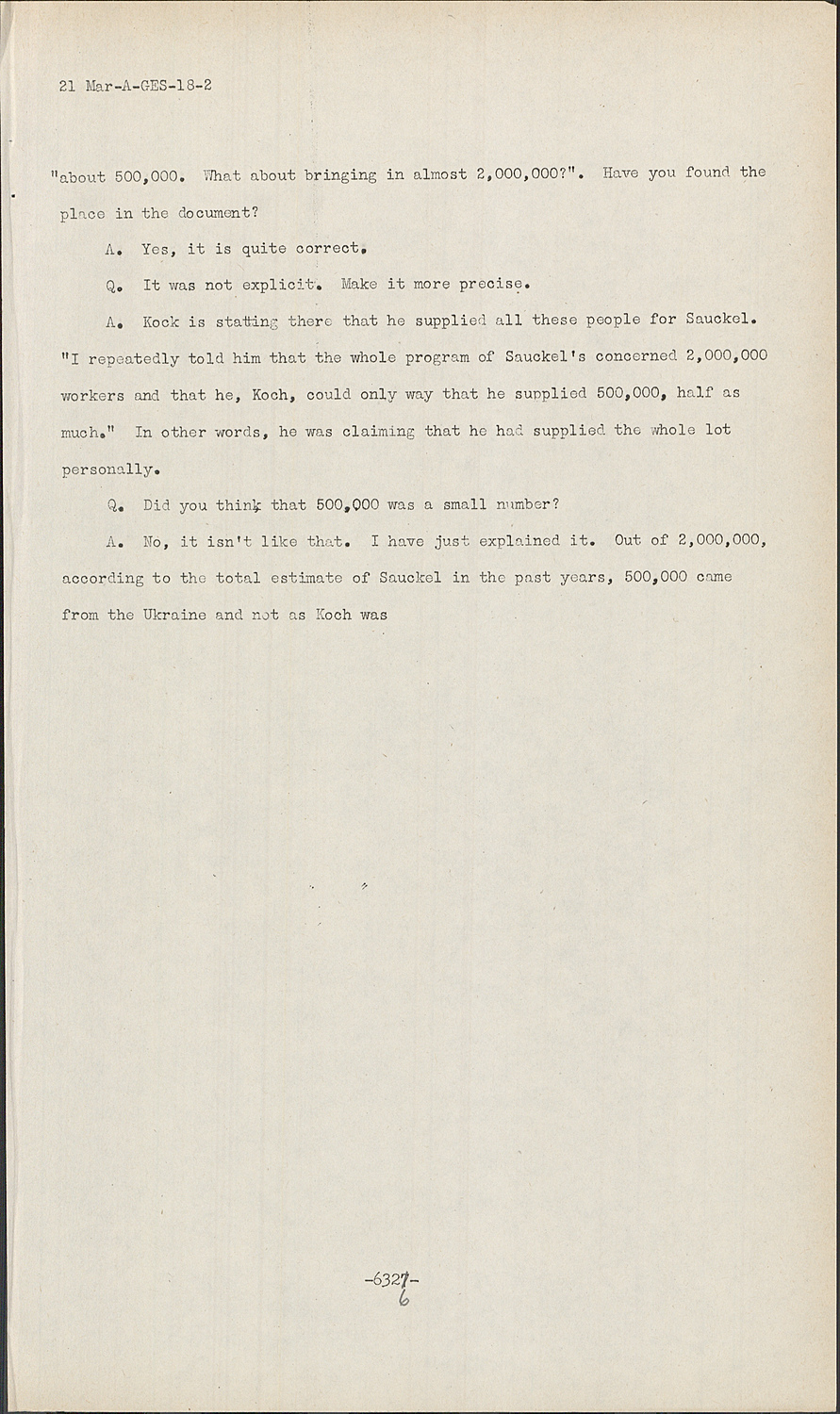
What about bringing in almost 2,000,000?". Have you found the place in the document?
A.Yes, it is quite correct.
Q.It was not explicit. Make it more precise.
A.Kock is stating there that he supplied all these people for Sauckel. "I repeatedly told him that the whole program of Sauckel's concerned 2,000,000 workers and that he, Koch, could only way that he supplied 500,000, half as much." In other words, he was claiming that he had supplied the whole lot personally.
Q.Did you think that 500,000 was a small number?
A.No, it isn't like that. I have just explained it. Out of 2,000,000, according to the total estimate of Sauckel in the past years, 500,000 came from the Ukraine and not as Koch was saying that he had supplied the whole number of these workers alone.
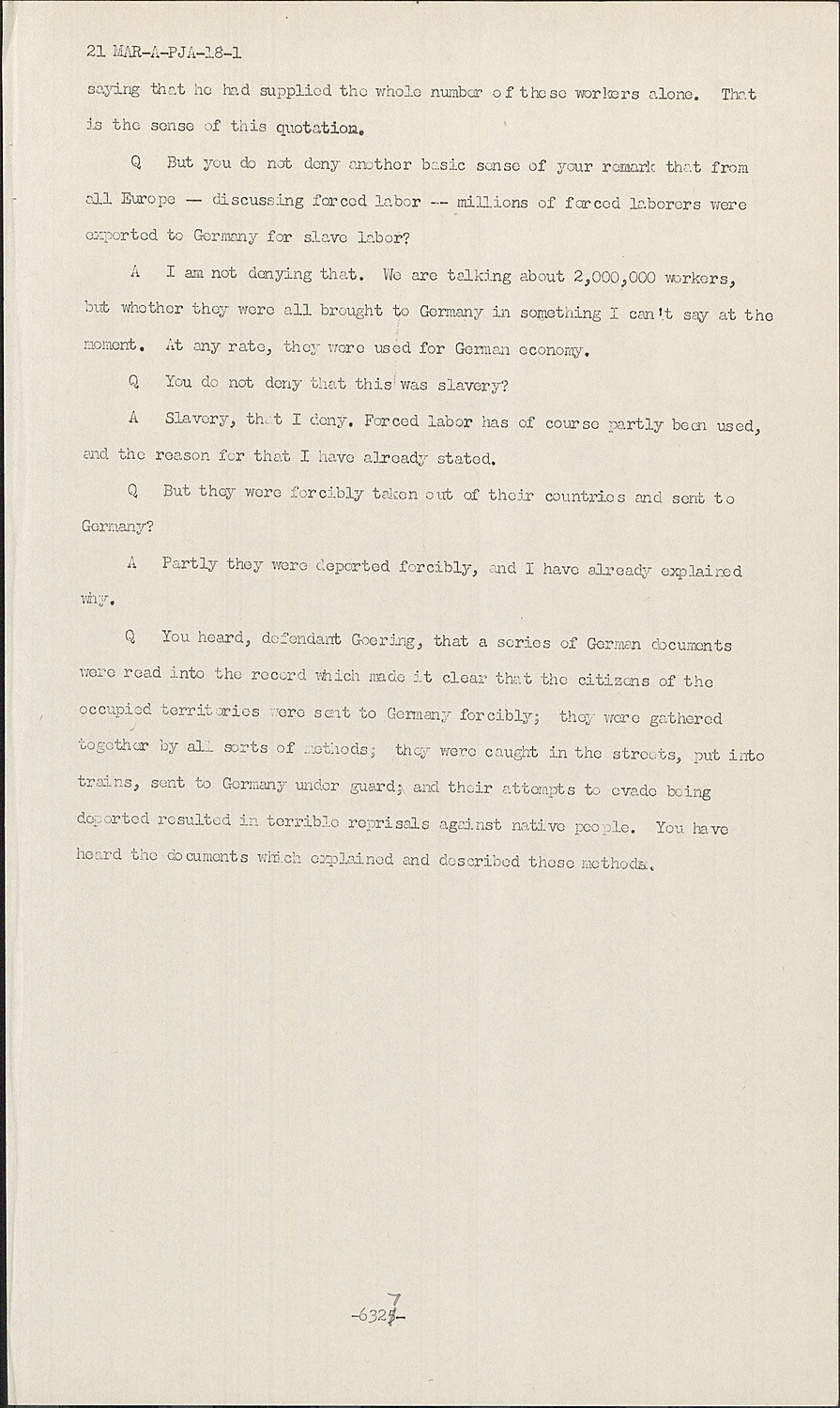
That is the sense of this quotation.
QBut you do not deny another basic sense of your remark that from all Europe -- discussing forced labor -- millions of farced laborers were exported to Germany for slave labor?
AI am not denying that. We are talking about 2,000,000 workers, but whether they were all brought to Germany in something I can't say at the moment. At any rate, they were used for German economy.
QYou do not deny that this was slavery?
ASlavery, that I deny. Forced labor has of course partly been used, and the reason for that I have already stated.
QBut they were forcibly taken out of their countries and sent to Germany?
APartly they were deported forcibly, and I have already explained why.
QYou heard, defendant Goering, that a series of German documents were read into the record which made it clear that the citizens of the occupied territories were sent to Germany forcibly; they were gathered together by all sorts of methods; they were caught in the streets, put into trains, sent to Germany under guard; and their attempts to evade being departed resulted in terrible reprisals against native people. You have heard the documents which explained and described these methods.
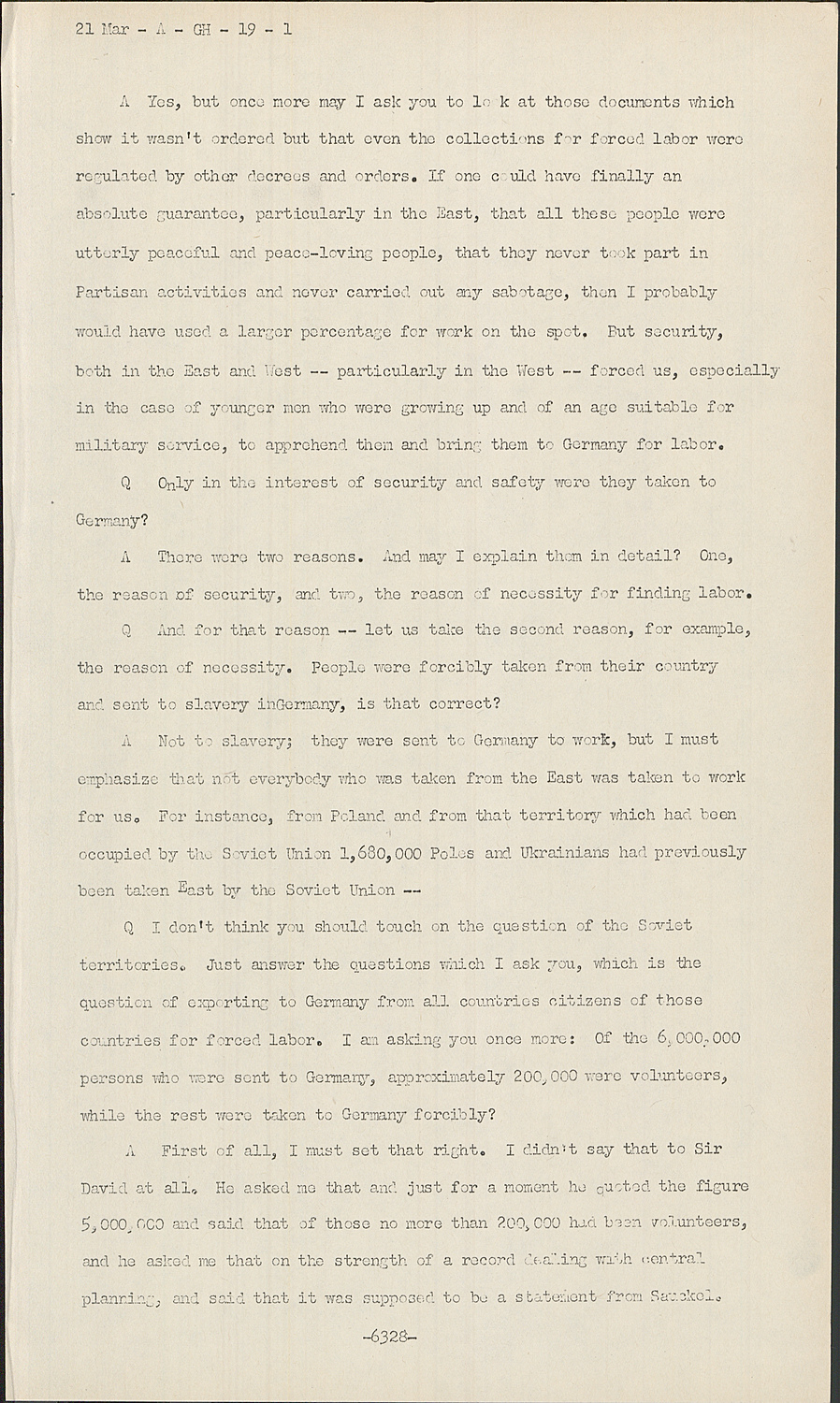
A Yes, but once more may I ask you to look at those documents which show it wasn't ordered but that even the collections for forced labor were regulated by other decrees and orders.
If one could have finally an absolute guarantee, particularly in the East, that all these people were utterly peaceful and peace-loving people, that they never took part in Partisan activities and never carried out any sabotage, then I probably would have used a larger percentage for work on the spot. But security, both in the East and West -- particularly in the West -- forced us, especially in the case of younger men who were growing up and of an age suitable for military service, to apprehend, them and bring them to Germany for labor.
QOnly in the interest of security and safety were they taken to Germany?
AThere were two reasons. And may I explain them in detail? One, the reason of security, and two, the reason of necessity for finding labor.
QAnd for that reason -- let us take the second reason, for example, the reason of necessity. People were forcibly taken from their country and sent to slavery inGermany, is that correct?
ANot to slavery; they were sent to Germany to work, but I must emphasize that not everybody who was taken from the East was taken to work for us. For instance, from Poland and from that territory which had been occupied by the Soviet Union 1,680,000 Poles and Ukrainians had previously been taken East by the Soviet Union -
QI don't think you should touch on the question of the Soviet territories. Just answer the questions which I ask you, which is the question of exporting to Germany from all countries citizens of those countries for forced labor. I am asking you once more: Of the 6,000,000 persons who were sent to Germany, approximately 200,000 were volunteers, while the rest were taken to Germany forcibly?
AFirst of all, I must set that right. I didn't say that to Sir David at all. He asked me that and just for a moment he quoted the figure 5,000,000 and said that of those no more than 200,000 had been volunteers, and he asked me that on the strength of a record dealing with central planning, and said that it was supposed to be a statement from Sauckel.
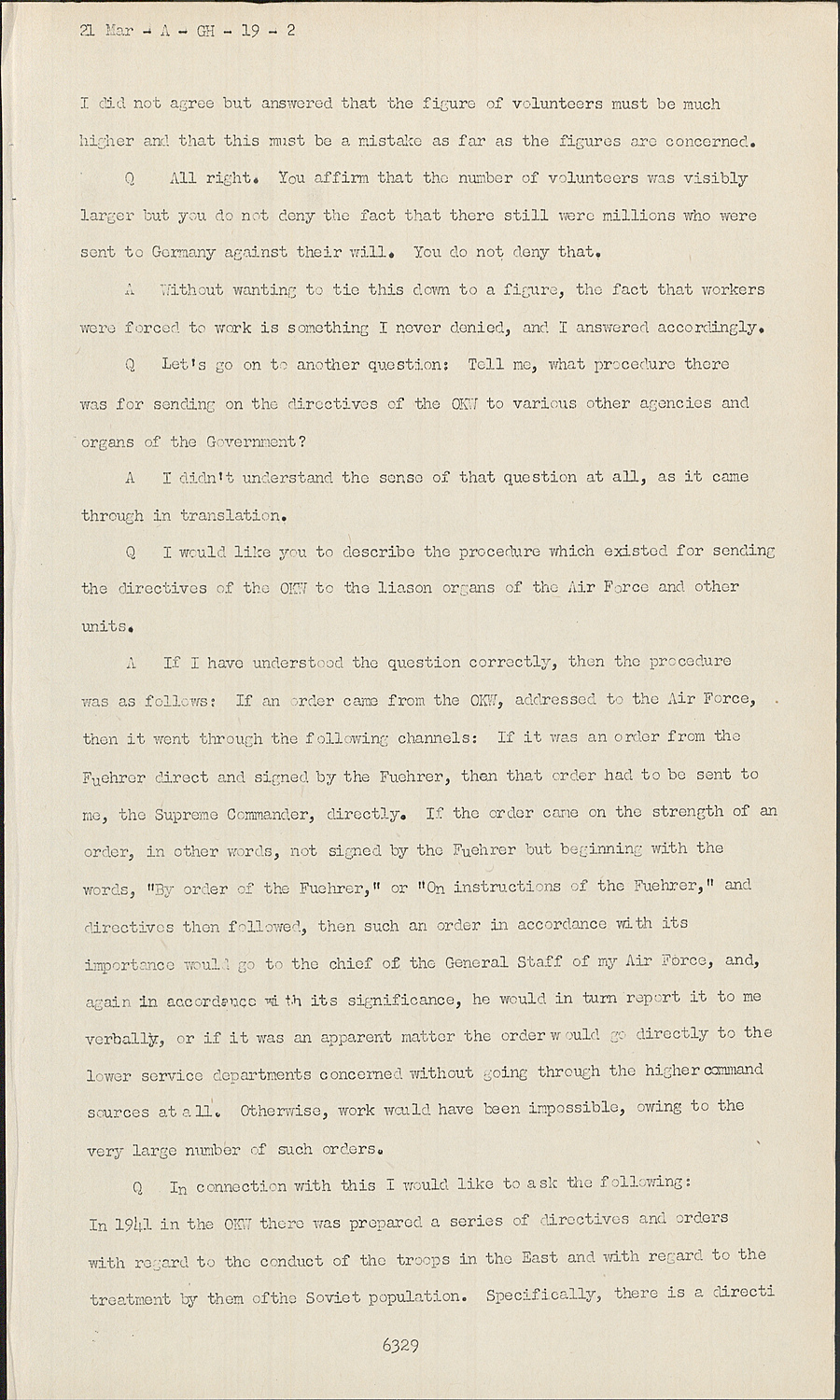
I did not agree but answered that the figure of volunteers must be much higher and that this must be a mistake as far as the figures are concerned.
QAll right. You affirm that the number of volunteers was visibly larger but you do not deny the fact that there still were millions who were sent to Germany against their will. You do not deny that.
AWithout wanting to tie this down to a figure, the fact that workers were forced to work is something I never denied, and I answered accordingly.
QLet's go on to another question: Tell me, what procedure there was for sending on the directives of the OKW to various other agencies and organs of the Government?
AI didn't understand the sense of that question at all, as it came through in translation.
QI would like you to describe the procedure which existed for sending the directives of the OKW to the liason organs of the Air Force and other units.
AIf I have understood the question correctly, then the procedure was as follows: If an order came from the OKW, addressed to the Air Force, then it went through the following channels: If it was an order from the Fuehrer direct and signed by the Fuehrer, then that order had to be sent to me, the Supreme Commander, directly. If the order came on the strength of an order, in other words, not signed by the Fuehrer but beginning with the words, "By order of the Fuehrer," or "On instructions of the Fuehrer," and directives then followed, then such an order in accordance with its importance would go to the chief of the General Staff of my Air Force, and, again in accordance with its significance, he would in turn report it to me verbally, or if it was an apparent matter the order would go directly to the lower service departments concerned without going through the higher command sources at all. Otherwise, work would have been impossible, owing to the very large number of such orders.
QIn connection with this I would like to ask the following: In 1941 in the OKW there was prepared a series of directives and orders with regard to the conduct of the troops in the East and with regard to the treatment by them ofthe Soviet population. Specifically, there is a directi about military jurisdiction in the Barbarossa Region -- Document C-150 --which has already been submitted to the Tribunal.
According to this directive, the German officers had the right to shoot any person suspected of action unfavourable to the Germans, without bringing that person to court. This directive also stated that the German soldiers could not be punished for crimes which they committed against the local population. Such directives must have been known to you -- they must have been reported to you
AI would have to see that, from the distribution slip. May I see the document, please?
QYou would like to see the exhibit -
AI want to see whether that document went straight to me or first of all to my officers.
QPlease look at the date, 13th of May, 1941.
AActually it didn't go straight to me. It says on the distribution chart, "OB. D.L. Leadership Staff, General Quartermaster." In fact, so far as my troops were concerned, I issued extremely sharp orders and that was the reason why I have asked for the Supreme Judge of the Air Force to be called as a witness and have now sent him an interrogotory.
QYou do know about this directive, however?
AI have seen it here, and have subsequently asked for the witnesses, since this order did not go directly to the Supreme Commander but went to the departments which I have just mentioned. Nevertheless, if the department acted accordingly, then I do of course formally bear the responsibility -or share it. But we are here concerned with an order from the Leader and Supreme Commander of the Armed Forces, which troops could not have any argument about it.
QBut you do agree that the importance of the document was such that you should have known about it?
ANo, otherwise it would have gone directly to my address, to the Supreme Commander, and not to the subordinate department, Air Force Leadership Staff or General Quartermaster. And from those departments -- whether they believed that the importance of the document was such or not, I don't know. The matter was reported to me, so that they had to get my personal orders and instructions.
But anyway in this case this did not occur, since that document did not affect us as much as it did the Army.
QBut the document was sent to your department and circulated there.
AI have just emphasized it was between the two service departments.
QBut someone must have reported to you about this document.
ANo, it did not have to be reported to me. I explained a little earlier that if every order and every directive were reported to me which came through in the shape of an order but did not require my interference, then I should be drowned in paper; and that is the reason why only the most important matters were brought to me and reported to me.
I cannot take it upon my oaht here whether that document was not mentioned in a verbal report to me. It is possible. And formally I am assuming responsibility even for the departments who were subordinate to me.
Q I would like to be more precise about it. You say that the most important things, or the important things, were usually reported to you; correct?
AThat is correct.
QI would like to draw your attention to the document before you, third and fourth points of the order, of this directive. The third point says:
"Actions of civilians against German armed forces must be suppressed by the armed forces locally and immediately and through the utilization of the most extreme measures, including extermination of persons so guilty."
Fourth paragraph: "Thus, no time should be lost -
AJust a moment.
QThe fourth point or paragraph.
AYou habe sent me three documents, and I am trying to find out which one; I am trying to sort them out.
QAll right.
AI shall repeat paragraph three because it has been repeated quite erroneously in the German.
"In the case of all hostile attacks of civilian persons against the armed forces, extreme measures must be taken by the troops and must result in the destruction of the attacker."
QAnd Point Four?
AThen we come to Number Four and it is the paragraph where it says that where measures of that kind have been omitted or were originally not possible, the suspicious elements will be taken to an officer at once, who will decide whether they are to be shot. That is probably what you meant, isn't it?
QThat is all. This is just what I had in mind. Could it be assumed that this document, from your point of view, is important enough to have been reported to you?
AIt is actually important, but it was not absolutely necessary for it to be reported since the Fuehrer order made it so absolutely clear that a subordinate leader and even a supreme commander of a part of the armed forces could not alter such a clear and strict order.
Q I draw your attention once more to the date in the right hand corner.
It states there, Fuehrer headquarters, 13 May 1941.
AYes.
QTherefore, it means that this was more than a month before the German attack on the Soviet Union? Already, then, directives were formulated about applying military jurisdiction and court martials within the regions covered by the Plan Barbarossa, and you did not know about this document?
AIf a plan for the mobilization is made, then one must, particularly with reference to special cases, lay down what must be done since in accordance with experience, the Fuehrer thought that a special threat from the East would take place immediately, and that is the reason why these measures were laid down which were to be taken if the resistance and the fight behind the lines, behind the front would take place. This was, in other words, a preparatory order in the event that such matters occured. That must always and at all times be done in such connections.
QAnd the officers were given the right to shoot civilians without bringing them to trial?
AAn officer could hold a court martial on the spot, but, according to this paragraph, he could also, when he was of the opinion and had evidence that the opponent was making attacks from the rear, have himshot on the spot. That has always occurred, even before.
QYou thing that the officer was to form the trial and issue the verdict right on the spot?
AThat is laid down in the articles of war, that whenever he has a unit of his own, he is entitled to appoint a court martial at any time.
QBut you do agree that there is no question of any trial here? It states that he alone could decide what to do with the civilian.
AHe could act alone or use a court martial on the spot. All he needed was another two people whom he had to call together, and then he could hear the case and decide the matter in two orfive minutes, if the evidence of the attack was available.
QIn five minutes or two minutes, you say, and then he could shoot the person?