It is an instruction dated the 14th of December 1942, in which again the human and political position and attitude is particularly stressed. As far as the treatment of the civilian population is concerned, in the beginning it is emphasized, and I would like to mention it, that German behaviour would never give the impression that the Ukraine could have no hope for the future, that directives by German departments and offices would have to be executed but would have to be given great thought. It said further that the peoples of the East have always seen in Germany the bearer and the exponent of a legal order, which in some cases may be a trifle harsh, out which is not an expression of arbitrary decision; that possibly matters might warrant harshness, but they would be investigated, examined, and justice would reign; the impression of arbitrary deportment was not to be considered.
The article further says:
"Elementary schools with a four-year term should be kept open completely, followed by trade schools training for practical life. The German administration needs men for veterinary science, trade, farming and geological research who cannot be supplied from the German population. For that purpose the Ukrainian youth can be taken off the streets and indoctrinated to the fact that they have to contribute to the reconstruction of their country. Thereby, it would be inadmissible for German offices to confront the population with scornful remarks. Such an attitude is not worthy of a German.
"Germany became, by means of its armed forces, master over wide regions of the East. Every German who has been sent by her has therefore to be conscious of the obligation which he takes upon himself in the Fast as representative of the German Reich and of the German people. By appropriate bearing and deeds one becomes master, but not by obtrusive, shocking manners. One does not lead people by insolent talk, and one does not gain authority by exhibiting contempt for others."
Then, several other questions are dealt with in this directive, but I do not wish to take up the time of the Tribunal with these details. I was especially interested in showing in what sense I wanted to make known the position and the view of the civil administration, and in order that this directive might not remain on the desks of the offices of the several governments, I decreed that it was to be read in all offices.
DR. THOMA:Mr. President, now I would like to turn to the special accusation of the Soviet Delegation and to bring in the special document as applied to the Special Purpose Staff of Rosenberg. Therefore, I will submit to the defendant Documents USSR-375, 161-PS, 076-PS, USSR-375, USSR-7, 39, 41, 49, and 51, and finally 81. All of these are USSR documents.
THE PRESIDENT:Are any of these in your document books?
DR. THOMA:The documents of the USSR, the ones I mentione last, I do not have in a special document book.
I ascertained this morning whether these documents had been submitted to the Tribunal, starting with 39 and so on.
THE PRESIDENT:I thought perhaps you were referring to them now. They aren't in your books.
DR. THOMA:No. 161 is in Document Book 3, page 34. Nothing else is found in the document books.
THE PRESIDENT:Very well.
A (Continuing) The document 161-PS treats instructions for the bringing back of certain archives from Estonia and Lithuania. The Soviet Prosecution, therefore, contended that this was a plundering of cultural objects in these countries. I would like to state that the instructions which I read from Document 1065 stated in an unequivocal manner that these objects were to remain in the country. That took place.
I would like to refer to the date of that document, which is the 23rd of August 1944. When the battles were raging in this territory and when the cultural objects and archives were to be safeguarded and secured to protect them from combat activities, it was said that the archives mentioned here were to be safeguarded on Estonian country estates. That is, they were to remain in the country but were to be safeguarded against combat activity.
As far as I know, later, some of these archives were brought to Germanyl and I believe they were secured in Schloss Hoechstedt in Bavaria.
Document 076-PS is being used by theprosecution as proof for a plundering of the library at Minsk. We are concerned with instructions of the rear army region, and a report which was given to the local authorities. From this report we can see that a number of destructions had taken place in some libraries. However, that was as a result of troops having been quartered there, because the City of Minsk had been destroyed and the billeting facilities were overburdened.
Then, under No. 1, and again under other paragraphs, it is shown that posters were put up, and that these things which were confiscated would not be touched after that. Then, it is added that any further taking away would have to be considered as plundering.
Under number two I would like to point out that the securing measures are concerned with the fact that the most valuable part came from the library of a Polish nobleman, which the Soviet authorities had taken to the occupied territory and had incorporated into the library there. However, that was long before the all-purpose staff, or other German departments, were active in that area.
There are a number of other documents, 035-PS and several others, which have been submitted to the High Tribunal and which deal with the taking back of cultural objects from the Ukraine. The date on these documents -- that is the year 1948 -- shows that these cultural treasures had remained, as had been ordered in the countries. Then, when combat activity made it necessary, as document 035-PS says, at page 3.5, the corresponding infantry regiment was interested in the evacuation of valuable things since the armed forces could not protect this area sufficiently and bombardment by artillery was to be counted on.
DR. THOMA:I would like to submit this document under Ro./37.
A (Continuing) Then the infantry dividion was to give all possible protection.
DR. THOMA:May I have the document again? I would like to submit it to the High Tribunal.
A (Continuing) Therefore, the evacuation took place practically under artillery bombardment, and cultural objects which had come from Kharkov were transported away to the German Reich at that time during actual combat.
Now I would like to deal in detail with the documents which the Soviet Prosecution has presented regarding Estonia and Lithuania. In that connection I would like to submit just a few concrete details.
On page 1 of document USSR 39 it states that from the beginning of the occupation of the Estonian Soviet Republic, the Germans tried to cut off the independence of the Estonian people and tried to establish a new order as to culture, art, and science. They intended to exterminate the civilian population, or to deport these people for forced labor to Germany, and to pillage estates and villages.
I would like to remark in that connection, first of all, that there was an independence for 20 years, beginning with the attack in 1919 by the Soviet Union, and this independence was terminated by the marching in of the Soviet Union in 1940.
GENERAL RUDENKO:Mr. President, it seems to me that the document which is now being looked over by, the defendant Rosenberg naturally gives him a basis for replying to the concrete accusations while he was Minister of the Eastern Regions. However, I do think that that which the defendant Rosenberg has just now begun to mention consists of straight fascist propaganda and has very little connection with the question discussed, or with the accusations.
DR. THOMA:Mr. President, if the defendant makes a few introductory remarks, I ask that he be not interrupted right away. We will deal with actual facts and citations.
A (Continuing) So far as point 2 is concerned, I would like to re-
mark-
THE PRESIDENT:Is this document that he is dealing with a document that he wrote himself or had anything to do with? I haven't got the document before me.
DR. THOMA:The document is submitted by the USSR, and it accuses Rosenberg of having destroyed these territories. Therefore, I think he is entitled to state his position.
THE PRESIDENT:But when you say "his position", can't he say what he did in connection with the document or the subject of the document? I mean, when you say "state his position", it is such a very wide phrase, it may mean almost anything. If you ask him what he did in connection with the subject of the document it is different, but it is more concrete and special. BY DR. THOMA:
QWhat do you have to say in reply to the Soviet accusation in this respect?
ATo refute the contention that I destroyed culture and art and science in Estonia. I must say that one of the first directives of the Eastern Ministry was to establish, in these three countri es, administrations of their own people, and, so far as German occupation troops were concerned, to have then serve as a supervisory measure. The limitations were proscribed by war, and, of course, they were given accordingly. They applied to spheres of armament, to police security, and they applied to political positions in general.
A complete cultural autonomy was granted to all three of these Baltic states. Their art and their theaters were active all through these years of occupation. The university at Dorpat worked in most of its departments, and the same is true of Riga. The judicial sovereignty of these countries was subordinated only to the local directorates, as they were called, and all departments and offices were established. The entire school system remained untouched, I personally visited these regions twice, and can say only that the commissars who were competent there did everything to maintain the autonomy and the independence of the people, even though they repeatedly critized the German administration.
However, in the course of war, we could not, of course, recognize a complete state sovereignty.
On page 2 of this document there are some penal measures mentioned, referring back to 1942, that anyone who committed these demeanors--that is, of anyone refused to work, or if some employee came to work intoxicated, measures were taken by the directorates, and directives were issued to this effect.
When this directive was made known, of course, the German civilian administration was not entirely pleased, Reich Commissar Lohse at once recalled it, and we asked the Reich Minister of Communications to have this impossible official removed. This, of course, took place immediately and he was called home. The matter of his having been called homo was to be made known through the, press, although I cannot say whether it actually did happen.
On page 5 of this document, in paragraph 2, it is set forth that the Germans had destroyed historical buildings, that they had searched the universities and had destroyed a university which had a grand history of more than three hundred years, and which was one of the oldest seats of higher learning.
I would like to add that as far as the buildings are concerned they date to the Seventeenth and other centuries.
They were constructed by Germans exclusively, and a German group would not be interested in destroying arbitrarily the houses which their own people had built.
And Point 2: This university, which is three hundred years old, Dorpat, was a German university.
THE PRESIDENT:That is quite irrelevant. The question is whether it was destroyed.
A (continuing) In the year 1942 I was at the city of Dorpat. A large part of the city had been destroyed through combat activity, but the university buildings were still standing. At that time I had the opportunity to learn that the all-purpose staff had confiscated ten to twelve thousand volumes in the Ukraine and restored them to their rightful owners at Dorpat, and I consider it out of the question that an arbitrary destruction of this old German university could have taken place on the part of German troops. I can assume only that it was the result of actual combat, if this destruction actually took place.
As far as the other details of the document are concerned, I cannot define my position. It deals with many shootings of a police nature and it deals with natters of combat activity, and of course I cannot make any statements, since it goes back to the time of retreat.
As far as the document USSR 41 is concerned, it deals with the reports of the extraordinary state commission. I would like to say only that headquarters was not at Riga, but he had his permanent seat at Berlin.
In paragraph 4 it says that the Germans confiscated the country of Lithuania; they took the property of the Lithuanian peasants for their own and exterminated men, women and children.
I would like to a dd this that not a single peasant estate was given to the German barons of former times. The German agrarian administration might have done this, which according to my opinion was a matter of legislation. In young Lithuanian and Estonian Republics some of this old property was expropriated. It could have been returned to the German population; but I signed a law in March of either 1942 or 1943 -- that was the "Reprivatisierungs Gesetz" -- that the Estonian peasants who had received German property at that time could keep this property, and they received it with solemn ceremony.
On the part of the Soviet Union, a collectivization took place of all of this property, and that is why this collectivization was made retroactive and the former proprietors as of 1919 were reinstated to their property.
I would like to mention that, on the question of Lithuania, on page 2 it is stated that through more than three years duration the Germans made it their task, as far as factories, homes, museums, etc., are concerned, to destroy all of these buildings. I myself was in a Lithuanian museum, saw a great Lithuanian exhibition of art, attended the performances of the Lithuanian theater. All of this was carried on in the Lithuanian language, with just a few German artists. Factories were not destroyed; instead they were enlarged through the bringing in of German machinery.
Of course some protests arose from the proprietors, for the uncertainty of their own property was to be dealt with. But in any event there was never any destruction. There was an increase in productive capacity.
And finally, as far as archives and libraries are concerned, I have already discussed that when I spoke about document 035.
As far as the extermination of 170,000 civilians is concerned, I cannot take any position to the fact that police stations and security measures are concerned. I would like to point out that the local authorities looked into the matter that 40,000 Estonians and more than 40,000 Lithuanians were deported to Soviet Russia after Soviet Russia occupied these countries, and that a large number of Lithuanians and Estonians volunteered to fight the Red Army, and that on the return march hundreds of thousands of Estonians and Lithuanians asked to be taken into the Reich and many of them actually did come into the Reich.
The entire population of Lithuania was about two million people. That on the part of the German authorities 170,000 Lithuanians were to have been shot, that seems to be improbable to the highest degree.
As far as other destruction is concerned--destruction because of actual combat--I am not able to define my position any further.
The third document, USSR 7, treats with the reports of the extraordinary commission about Lithuania. On page 1, paragraph 2, it states that Rosenberg tried to Germanize the people, to exterminate their own national culture.
Lithuania became a part of the German eastern provinces.
In Lithuania the question of peasants was treated the same way as in Estonia and Latvia, although there was one difference, that here Lithuania had a larger number of German peasants on a small scale who, at the end of 1939, were taken into the German Reich, and when the Germans marched into Lithuania they were returned to their original settlements.
They were to be recolonized in a concentrated manner as far as possible; and that corresponds to the facts.
I cannot agree with anything else that is down here. As far as the extermination of national culture is concerned, that does not look true to me at all.
I know that collaborators of my office were very much concerned in working with the representatives of the Lithuanian folkdom, and that many themes were written and that much reform was carried on in these countries.
I cannot imagine that any arbitrary destruction could have taken place.
I remember that in the capital city of Kaunas administrative officers came to me and said that they had worked in the towns for five days, even though the city was being bombarded by Soviet artillery.
That, of course, many build ings were destroyed in that activity, I can see that; but I am not able to make any observations of personal experience.
Now I am passing to document USSR 51. In time note of the Commissar for Foreign Affairs, dealing with the 6th of January 1942, destruction of cultural values of these three Baltic states is mentioned.
I would like to refer to what I have already said to the documents that I discussed just now.
On page 2, column 1, it is stated that the Germans murdered the population and pillaged.
I would like to reiterate the expositions that I have already made.
On page 6, column 1, at the beginning, it says that the Germans in their rage, as fax' as the three Baltic countries are concerned, destroyed monu ments, literature, schools.
But that is not in accordance with the facts.
The note of the commissar of the 27/4/42, which has been read here repeatedly and in detail, on page 1, column 1, makes the same assertion that the pillaging of the soil had taken place.
I would again like to refer to the statements I have just made.
On page 7 it is stated that the Germans had the objective and actually carried through the plundering of soil and that there was no compensation made.
I would like to say -- I do not wish to make any lengthy statements about the laws of the new agrarian order (the laws which were to strengthen the agrarian movement) -- Leica (?), who has been granted as a witness, can give expert testimony.
After the Soviet Prosecution accused me and then withdrew its accusa tion that I was a former Czarist spy, I do not need to reply to that.
As far as the various quotations are concerned which have been submitted, I cannot check them in detail.
But in one case it is possible for me to give an explanation on this point at this time.
I am concerned with page 9, column 1, at the top, where the commissar deals with the so-called "Twelve Commandments" on the demeanor of Germans in the East, There is a quotation from which it can he concluded only that it is a quotation from a German directive or out of a German directive The twelve commandments were submitted by the Soviet prosecution to the high Tribunal, under USSR 89.
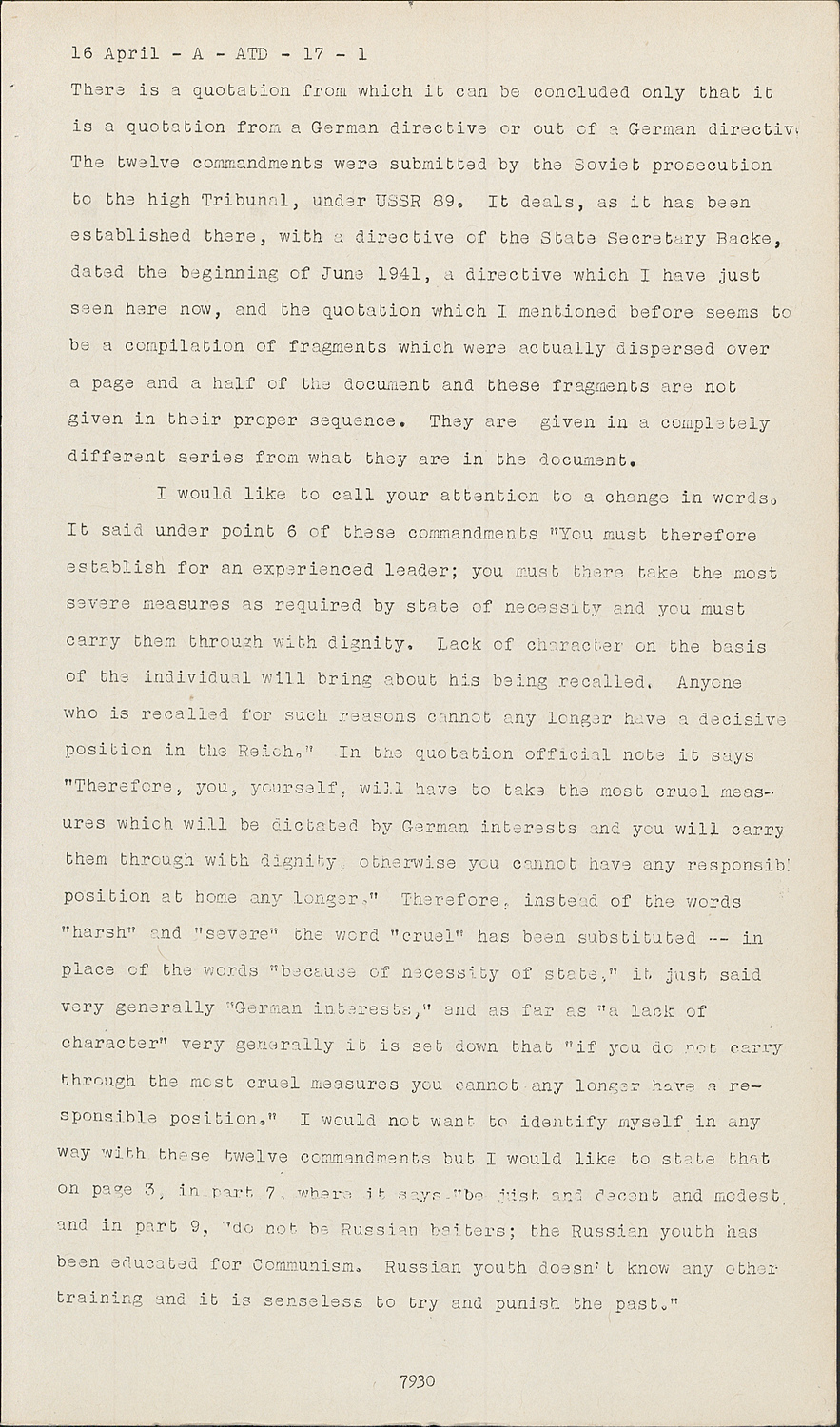
It deals, as it has been established there, with a directive of the State Secretary Backe, dated the beginning of June 1941, a directive which I have just seen here now, and the quotation which I mentioned before seems to be a compilation of fragments which were actually dispersed over a page and a half of the document and these fragments are not given in their proper sequence. They are given in a completely different series from what they are in the document.
I would like to call your attention to a change in words. It said under point 6 of these commandments "You must therefore establish for an experienced leader; you must there take the most severe measures as required by state of necessity; and you must carry them through with dignity. Lack of character on the basis of the individual will bring about his being recalled. Anyone who is recalled for such reasons cannot any longer have a decisive position in the Reich." In the quotation official note it says "Therefore, you, yourself, will have to take the most cruel measures which will be dictated by German interests and you will carry them through with dignity otherwise you cannot have any responsible position at home any longer". Therefore, instead of the words "harsh" and "severe" the word "cruel" has been substituted -- in place of the words "because of necessity of state," it just said very generally "German interests," and as far as "a lack of character" very generally it is set down that "if you do not carry through the most cruel measures you cannot any longer have a responsible position." I would not want to identify myself in any way with these twelve commandments but I would like to state that on page 3 in part 7, where it says "be just and decent and modest and in part 9, "do not be Russian baiters; the Russian youth has been educated for Communism. Russian youth doesn't know any othertraining and it is senseless to try and punish the past."
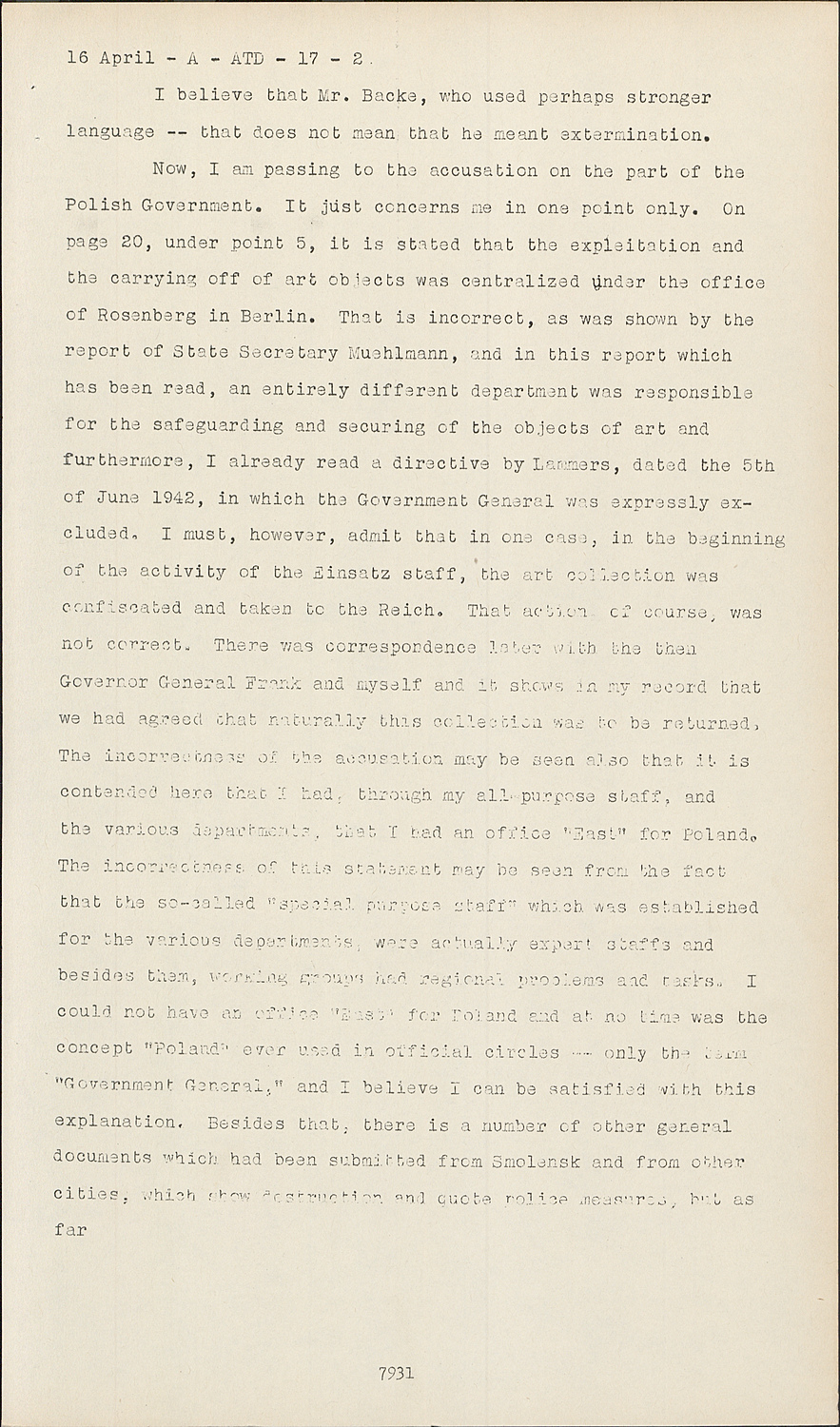
I believe that Mr. Backe, who used perhaps stronger Now, I am passing to the accusation on the part of the Polish Government.
It just concerns me in one point only. On page 20, under point 5, it is stated that the expleitation and the carrying off of art objects was centralized under the office of Rosenberg in Berlin. That is incorrect, as was shown by the report of State Secretary Muehlmann, and in this report which has been read, an entirely different department was responsible for the safeguarding and securing of the objects of art and furthermore, I already read a directive by Lammers, dated the 5th of June 1942, in which the Government General was expressly excluded. I must, however, admit that in one case, in the beginning of the activity of the Einsatz staff, the art collection was confiscated and taken to the Reich. That action of course, was not correct. There was correspondence later with the then Governor General Frank and myself and it shows in any record that we had agreed that naturally this collection was to be re turned. The incorrectness of the accusation may be seen also that it is contended here that I had, through my all purpose staff, and the various departments, that I had an office "East" for Poland. The incorrectness of this statement may be seen from the fact that the so-called "special purpose staff" which was established for the various departments, were actually expert staffs and besides them, working groups had regional problems and tasks. I could not have an office "East" for Poland and at no time was the concept "Poland" ever used in official circles -- only the term "Government General," and I believe I can be satisfied with this explanation. Besides that, there is a number of other general documents which had bean submitted from Smolensk and from other cities, which show destruction and quota police measures, but as far as these points are concerned, I cannot testify here.
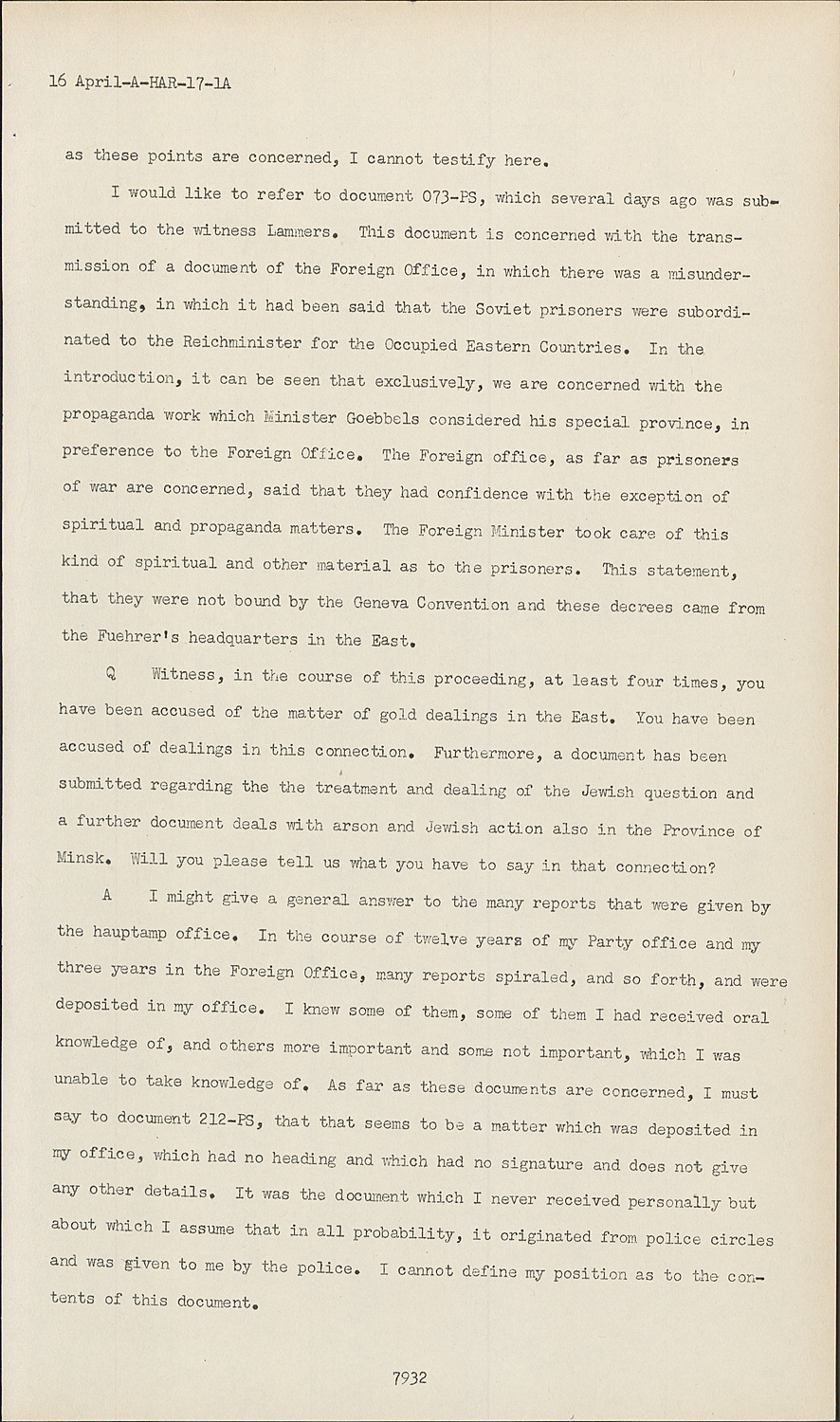
I would like to refer to document 073-PS, which several days ago was sub mitted to the witness Lammers.
This document is concerned with the trans mission of a document of the Foreign Office, in which there was a misunder standing, in which it had been said that the Soviet prisoners were subordi nated to the Reichminister for the Occupied Eastern Countries.
In the introduction, it can be seen that exclusively, we are concerned with the propaganda work which Minister Goebbels considered his special province, in preference to the Foreign Office.
The Foreign office, as far as prisoners of war are concerned, said that they had confidence with the exception of spiritual and propaganda matters.
The Foreign Minister took care of this kind of spiritual and other material as to the prisoners.
This statement, that they were not bound by the Geneva Convention and these decrees came from the Fuehrer's headquarters in the East.
QWitness, in the course of this proceeding, at least four times, you have been accused of the matter of gold dealings in toe East.
You have been accused of dealings in this connection.
Furthermore, a document has been submitted regarding the the treatment and dealing of the Jewish question and a further document deals with arson and Jewish action also in the Province of Minsk.
Will you please tell us what you have to say in that connection?
AI might give a general answer to the many reports that were given by the hauptamp office.
In the course of twelve years of my Party office and my three years in the Foreign Office, many reports spiraled, and so forth, and were deposited in my office.
I knew some of them, some of them I had received oral knowledge of, and others more important and some not important, which I was unable to take knowledge of.
As far as these documents are concerned, I must say to document 212-PS, that that seems to be a matter which was deposited in my office, which had no heading and which had no signature and does not give any other details.
It was the document which I never received personally but about which I assume that in all probability, it originated from police circles and was given to me by the police.
I cannot define my position as to the con tents of this document.
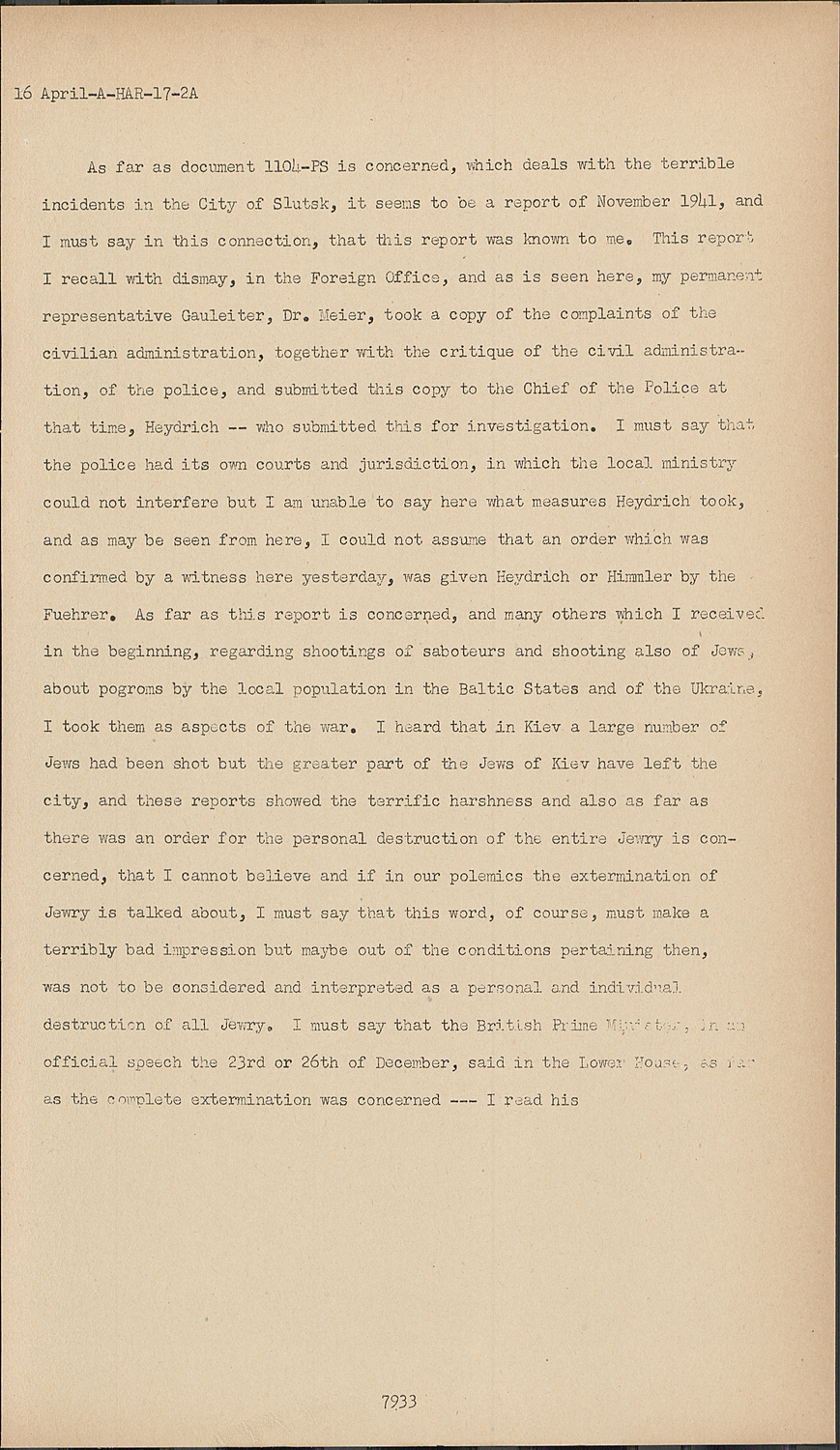
As far as document 1104-PS is concerned, which deals with the terrible incidents in the City of Slutsk, it seems to be a report of November 1941, and I must say in this connection, that this report was known to me.
This report I recall with dismay, in the Foreign Office, and as is seen here, my permanent representative Gauleiter, Dr. Meier, took a copy of the complaints of the civilian administration, together with the critique of the civil administra tion, of the police, and submitted this copy to the Chief of the Police at that time, Heydrich -- who submitted this for investigation.
I must say that the police had its own courts and jurisdiction, in which the local ministry could not interfere but I am unable to say hare what measures Heydrich took, and as may be seen from here, I could not assume that an order which was confirmed by a witness here yesterday, was given Heydrich or Himmler by the Fuehrer.
As far as this report is concerned, and many others which I received in the beginning, regarding shootings of saboteurs and shooting also of Jews, about pogroms by the local population in the Baltic States and of the Ukraine, I took them as aspects of the war.
I heard that in Kiev a large number of Jews had been shot but the greater part of the Jews of Kiev have left the city, and these reports showed the terrific harshness and also as far as there was an order for the personal destruction of the entire Jewry is con cerned, that I cannot believe and if in our polemics the extermination of Jewry is talked about, I must say that this word, of course, must make a terribly bad impression but maybe out of the conditions pertaining then, was not to be considered and interpreted as a personal and individual destruction of all Jewry.
I must say that the British Prime Minister, in as official speech the 23rd or 26th of December, said in the Lower House, as far as the complete extermination was concerned --- I read his speech but I did not assume that when he talked about Prussian officers that he meant all National Socialist Officers.
Regarding document No. 135-R, I would like to say the following. It is dated 18th June 1943. On the 22nd of June, I returned from an official visit to the Ukraine. After this official visit I found a number of notes about discussions. I found many letters and, above all, I found the Fuehrer decree which I had heard about orally, which dated from the middle of June 1943, in which the Fuehrer instructed me to be guided about basic principles as far as the giving of lives was concerned and I am not to concern myself too much with the admnistration in the East. I was impressed when I returned from this journey and I did not read this document, but I cannot assume that this document was not mentioned to me by my subordinates--my subordinates were very conscientious and I can assume only that in the course of their reporting to mo, they told me that another great complaint between tha police and civilian administration was again at hand, for many complaints of that nature had arisen in the past and I heard that it is possible, and said "Please give this to Gauleiter Meier; give this to the police officer as a liaison officer so he can investigate these matters," but otherwise those terrible details would have remained in my memory. I cannot say any more to this matter. When I was questioned about this matter, I said what I have said now.
DR. THOMA: Now I wish to submit to the Tribunal as Exhibit RO-13 a memorandum by Koch to Rosenberg as to complaints about the critique of Rosenberg and justification of his policy in the Ukraine, dated 16 March, 1943 and a letter by Dr. Rosenberg to Dr. Lammers, dated 12 October, 1944 in which he states he wishes to resign.
May it please the Tribunal, RO-13, Memorandum Koch to Rosenberg -
THE PRESIDENT:What is the number?
DR. THOMA:RO-13 192-PS, document book number two, page 14. I would like to read this to the Tribunal personally and I would like to make some introductory remarks.
THE PRESIDENT:It is a very long thing, Dr. Thoma. You do not need to read it all surely,
DR. THOMA:I shall, not read all of it, your Honor. But I have the opportunity of presenting State Secretary Riecke as a representative of the Eastern Ministry and that witness, when he appears before the Court will show that the best officials which the German Reich had at its disposal were used in the East and that these officials were very conscientious in checking on complaints.
In addition to what we heard today many terrible things have been pictured to the Tribunal and in four or five years many terrible things did happen in th East. The question now is just what -
THE PRESIDENT:The Tribunal are simply asking you not to read the whole of the document which covers many pages. That means you can go ahead and read the essential parts of it.
DR. THOMA:Therefore, I would like to assert that each and every comparing which was received by the Eastern Ministry was followed up.
"Various decrees issued recently by the Reich Minister for the Occupied Eastern Territories in which my work was critisized in an exceptionally severe and offensive manner and which have resulted in obscuring interpretation of policies as well as my legal position, have induced me to present the following report to you, Mr. Reich Minister, in the form of a memorandum".
Now, remarks follow which show that the Eastern Ministry investigated every the most modest complaints.
He said for instance:
"Thus your Ministry reports to me with the decree of 12 January 1943 that Anna Prichno of Smygalovka, an Eastern worker, had complained that her parents who remained in the Ukraine could not pay their taxes. I am not only asked to cancel these taxes or to reduce than by half but to 'report on my action'." On page 13:
"Lately numerous single complaints from Eastern workers employed in the Altreich have been passed on to me and on each single case I have been asked to give a report, usually on such short notice that it was impossible to comply with the request."
On page 15 and 16:
"Hence, I found it strange (as Gauleiter Koch says) to have the decree of 1/41 of November 22, 1941, state that the Ukrainians were strongly permeated with German blood, which fact was to account for their remarkable cultural and scientific achievements. But when on top of this a secret decree of July 1942, to which I will refer more closely at the end of this section, declares that very many points of contact exist between the German and Ukrainian people I find it no longer only strange but I am astonished. This decree demands not only correct but amiable manners in dealing with Ukrainians Subsequent to that I would like to quote several other quotations.
"In the following I would like to give a few more examples of lack of reserve towards Ukrainians. For instance, by decree of 18 June, 1942, I was informed that you were procuring 2.3 million marks worth of Ukrainian schoolbooks, charged to my budget without even contacting; me about it previously."
THE PRESIDENT:Do you think it necessary to read all this? I am not quite sure how far you have gotten because I have been reading on.
DR. THOMA:Mr. President, may I make a remark please? I have already made my selection. However, I will try to be more brief.
On this page you will find at least one complaint about the conscientiouness with which Rosenberg followed these complaints up. It is elaborated upo but I will be very brief.
"It is not necessary that your Ministry stress as it does by many written and oral messages over and over again that any violence in recruiting of work has to be discontinued."
And then there is one further very brief remark:
"And if mere decrees are issued against flogging I will make myself ridiculous. These hangings were very few."
And now we come to a very important point which I would like to call to the attention of the Tribunal, Gauleiter Koch reported to the Fuehrer and said:
"Nobody has ever asked me, as a former Gauleiter, that I should submit to him articles I write for none but the Fuehrer can absolve me of the political responsibility for an article signed with my full name.
"Finally, in addition to these explanations of the jurisdiction of my responsibilities. I would like to reiterate the relations between the Fuehrer and the Reich Commissioners. As an old Gauleiter I am used to consulting with my Fuehrer directly in all my problems, and requests and this right in my capacity as Oberpresident has never been denied me even by my superior minister. However, I have gained the impression that steps were taken by the Minister of the East to deny me this right. By decree of August 1942, the subordinate officers are requested not to report directly to the Fuehrer, "I must state here that in my position as an old Gauleiter the Fuehrer has repeatedly given me his political directives and that occasionally he oven expressed his political viewpoint on the Ukraine."
On page 15 he says:
" I have stated expressly that I must reject responsibility for labor recruitment for Rosenberg has ordered that an amiable recruiting system is to be followed."
At the end he says:
"My position has been curtailed and it can only be refered to the Fuehrer."
There was a conflict in front of Hitler at the Reichschancellory between Rosenberg, Bormann and Koch and the result was that Bormann supported Koch and he was upheld and Rosenberg was notified to Limit himself to essentials only.
On the strength of that the defendant tried to resign, BY DR. THOMA: