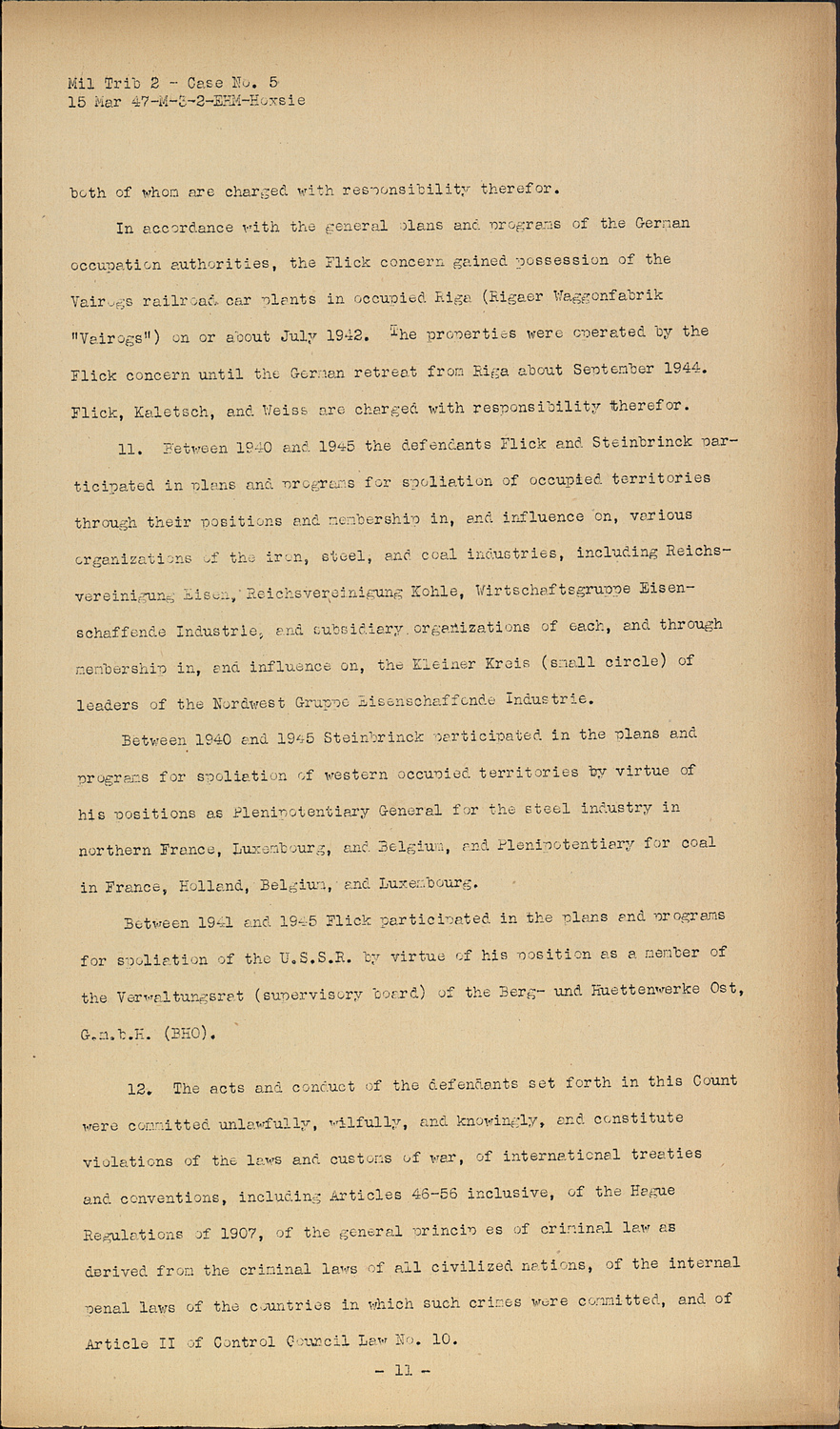
In accordance with the general plans and programs of the German occupation authorities, the Flick concern gained possession of the Vairogs railroad car plants in occupied Riga (Rigaer Waggonfabrik "Vairogs") on or about July 1942. The properties were operated by the Flick concern until the German retreat from Riga about September 1944. Flick, Kaletsch, and Weiss are charged with responsibility therefor.
11. Between 1940 and 1945 the defendants Flick and Steinbrinck participated in plans and programs for spoliation of occupied territories through their positions and membership in, and influence on, various organizations of the iron, steel, and coal industries, including Reichsvereinigung Eisen, Reichsvereinigung Kohle, Wirtschaftsgruppe Eisenschaffende Industries, and subsidiary organizations of each, and through membership in, and influence on, the Kleiner Kreis (small circle) of loaders of the Nordwest Gruppe Eissnschaffonde Industrie.
Between 1940 and 1945 Steinbrinck participated in the plans and programs for spoliation of western occupied territories by virtue of his positions as Plenipotentiary General for the steel industry in northern France, Luxembourg, and Belgium, and Plenipotentiary for coal in France, Holland, Belgium, and Luxembourg.
Between 1941 and 1945 Flick participated in the plans and programs for spoliation of the U.S.S.R. by virtue of his position as a member of the Verwaltungsrat (supervisory board) of the Berg- und Huettenwerke Ost, G.m.b.H. (BHO).
12. The acts and conduct of the defendants set forth in this Count were committed unlawfully, wilfully, and knowingly, and constitute violations of the laws and customs of war, of international treaties and conventions, including Articles 46-56 inclusive, of the Hague Regulations of 1907, of the general principles of criminal law as derived from the criminal laws of all civilized nations, of the internal penal laws of the countries in which such crimes were committed, and of Article II of Control council Law No. 10.
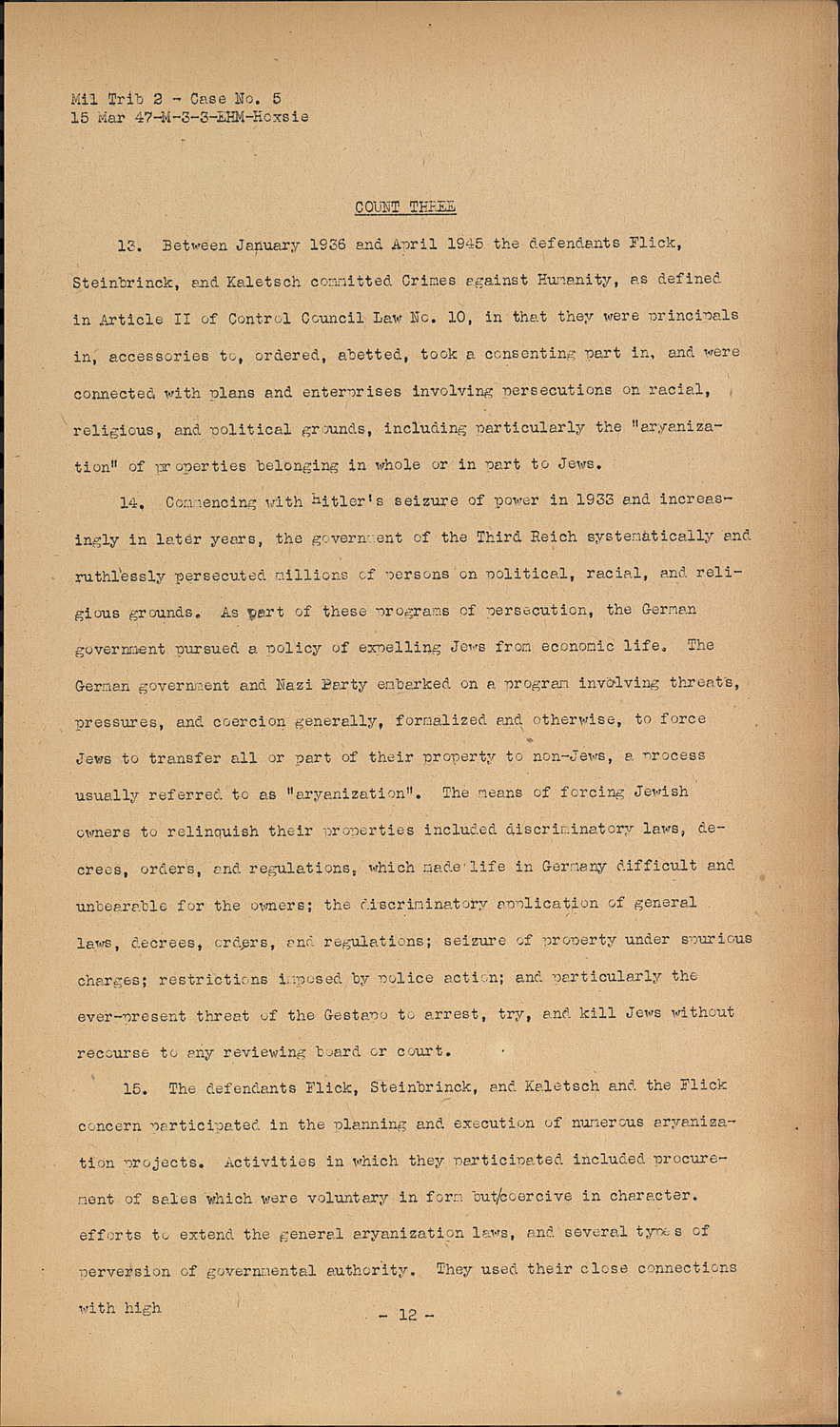
Mil Trib 2 - Case No. 5 13.
Between January 1936 and April 1945 the defendants Flick. Steinbrinck, and Kaletsch committed crimes against Humanity, as defined in Article II of Control Council Law No. 10, in that they were principals in, accessories to, ordered, abetted, took a consenting part in, and were connected with plans and enterprises involving persecutions on racial, religious, and political grounds, including particularly the "aryanization" of properties belonging in whole or in part to Jews.
14. Commencing with hitler's seizure of power in 1933 and increasingly in later years, the government of the Third Reich systematically and ruthlessly persecuted millions of persons on political, racial, and religious grounds. As part of these programs of persecution, the German government pursued a policy of expelling Jews from economic life. The German government and Nazi party embarked on a program involving threats, pressures, and coercion generally, formalized and otherwise, to force Jews to transfer all part of their property to non-Jews, a process usually referred to as "aryanization". The means of forcing Jewish owners to relinquish their properties included discriminatory laws, decrees, orders, and regulations, which made life in Germany difficult and unbearable for the owners: the discriminatory application of general laws, decrees, orders, end regulations; seizure of property under spurious charges; restrictions imposed by police action; and particularly the ever-present threat of the Gestapo to arrest, try, and kill Jews without recourse to any reviewing board or court.
15. The defendants Flick, Steinbrinck, and Kaletsch and the Flick concern participated in the planning and execution of numerous aryanization projects. Activities in which they participated included procurement of sales which were voluntary in form but/coercive in character, efforts to extend the general aryanizations laws, and several types of perversion of governmental authority. They used their close connections with high Mil.
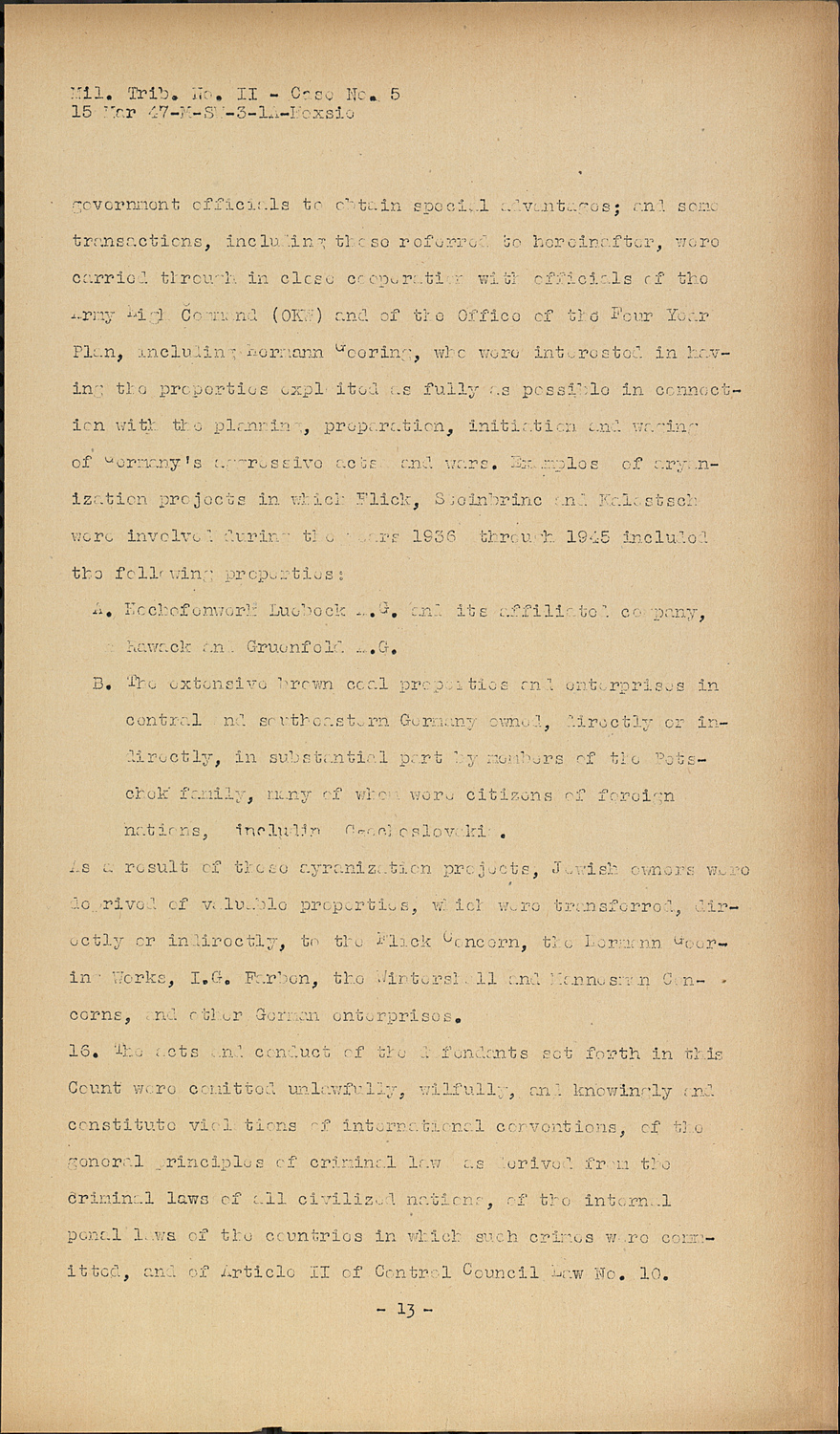
Trib. No. II - Case No. 5 government officials to obtain special advantages and some transactions, including these referred to herein after , were carried through in close cooperation with officials of the Army high command (OKW) of the office of the Four year plan, including Hermann Goering, who were interested having the properties exploited as fully as possible in connection with the planning, preparation, initiation of Germany's aggressive acts and wars. Examples of aryanization projects in which Flick, Steinbrinc and Kalestsch were involved. During the wars 1936 through 1945 included the following properties.
A.Hechefenwerk Luebeck A.G. and its affiliated company, Rawack and Gruenfold A.G.
B.The extensive brown coal properties and enterprises in central and south eastern Germany owned,directly or in directly, in substantial part by members of the Pets chek family, many of whom were citizens of foreign nations, including Czechoslovaki.
As a result of these ayranization projects, Jewish owners were derived of valuable properties, which were transferred, directly or indirectly, to the Flick concern, the Hermann Goering works, I.G. Farben,the Wintershel concerns, and other German enterprises. 16. The acts and conduct of the defendants set forth in this count were comitted unlawfully,wilfully, and knowingly and constitute violations of international conventions, of the general principles of criminal law as derived from the criminal laws of all civilized nations, of the internal penal laws of the countries in which crimes were committed, and of Article II of Control Council Law No. 10.
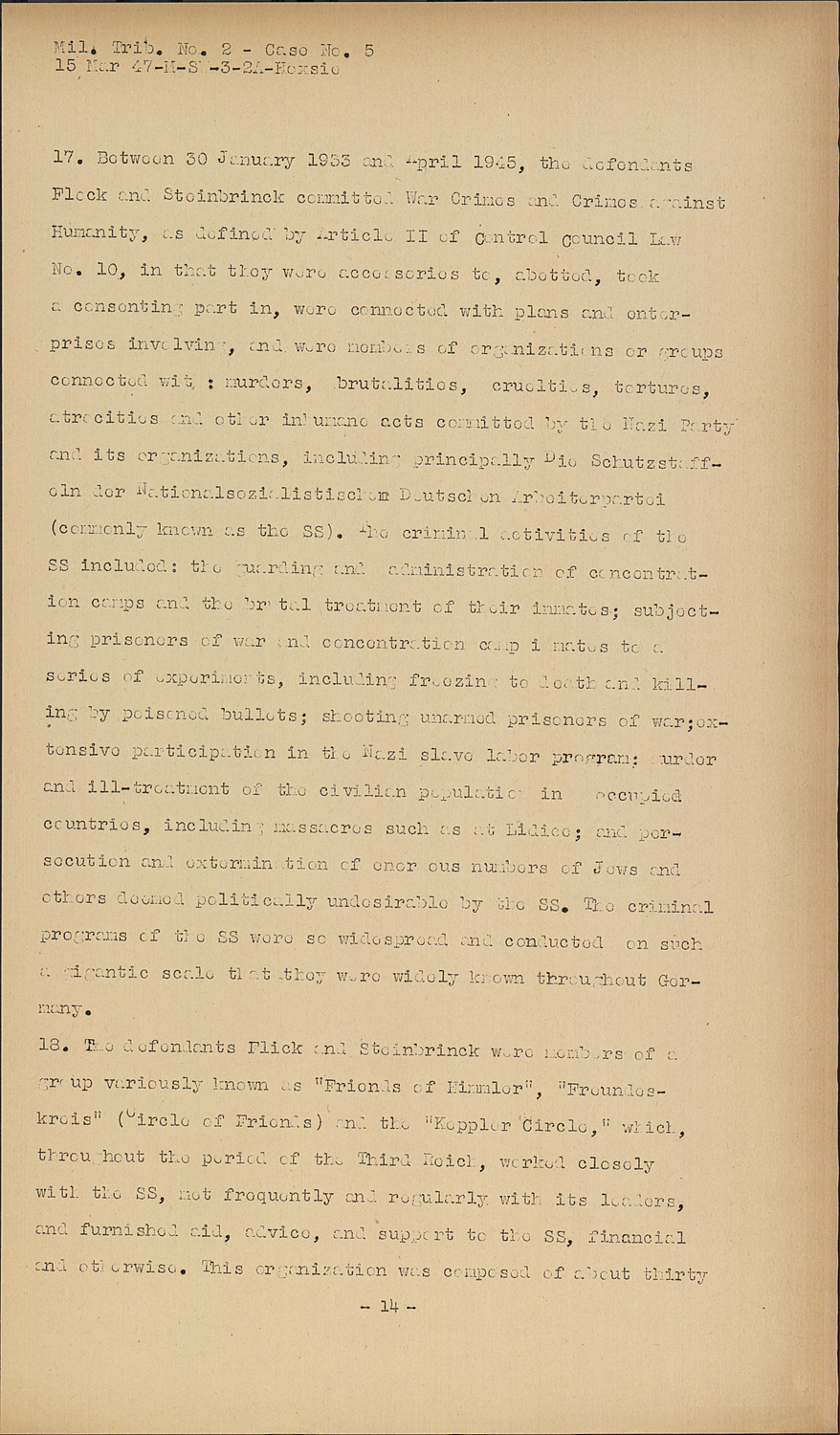
Mil. Trib. No. 2 - Case No. 5 17. Between 30 January 1933 and April 1945, the defendants Fleck and Steinbrinck committed War Crimes and Crimes against Humanity, as defended by Article II of Control Council Law No. 10, in that they were accessories to, abetted, took a consenting part in, were connected with plans and enterprises involving, and were members of organizations or groups connected with: murders, brutalities, cruelties, tortures, atrocities and other inhumane acts committed by the Nazi Party and its organizations, including principally Die Schutzstaffeln der Nationalsozialistisc*en Deutschen Arbeiterpartei (commonly known as the SS). The criminal activities of the SS included: the guarding and administration of concentration camps and the brutal treatment of their immates: subjecting prisoners of war and concentration camp immates to a series of experiments, including freezing to death and killing by poisoned bullets; shooting unarmed prisoners of war; extensive participation in the Nazi slave labor program: Murder and ill-treatment of the civilian population in occupied countries, including massacres such as at Lidice; and persecution and extermination of enermous numbers of Jews and others deemed politically undesirable by the SS. The criminal programs of the SS were so widespread and conducted on such a gigantic scale that they were widely known throughout Germany. 18. The defendants Flick and Steinbrinck were members of a group variously known as "Friends of Himmler", "Freundeskreis" (Circle of Friends) and the "Keppler Circle," which, throughout the period of the Third Reich, worked closely with the SS, met frequently and regularly with its leaders, and furnished aid, advice, and support to the SS, financial and otherwise. This organization was composed of about thirty Mil.

Trib. No. II - Case No. 5 German business, leaders, and a number of SS leaders, including Reinrich Himmler, head of the entire SS from 1929 to 1945, Karl Wolff, Himmler's adjutant, Obergruppenfuehrer and holder of other high positions in the SS; Oswald Pohl, Chief of the SS Main Economic and Administrative Department;
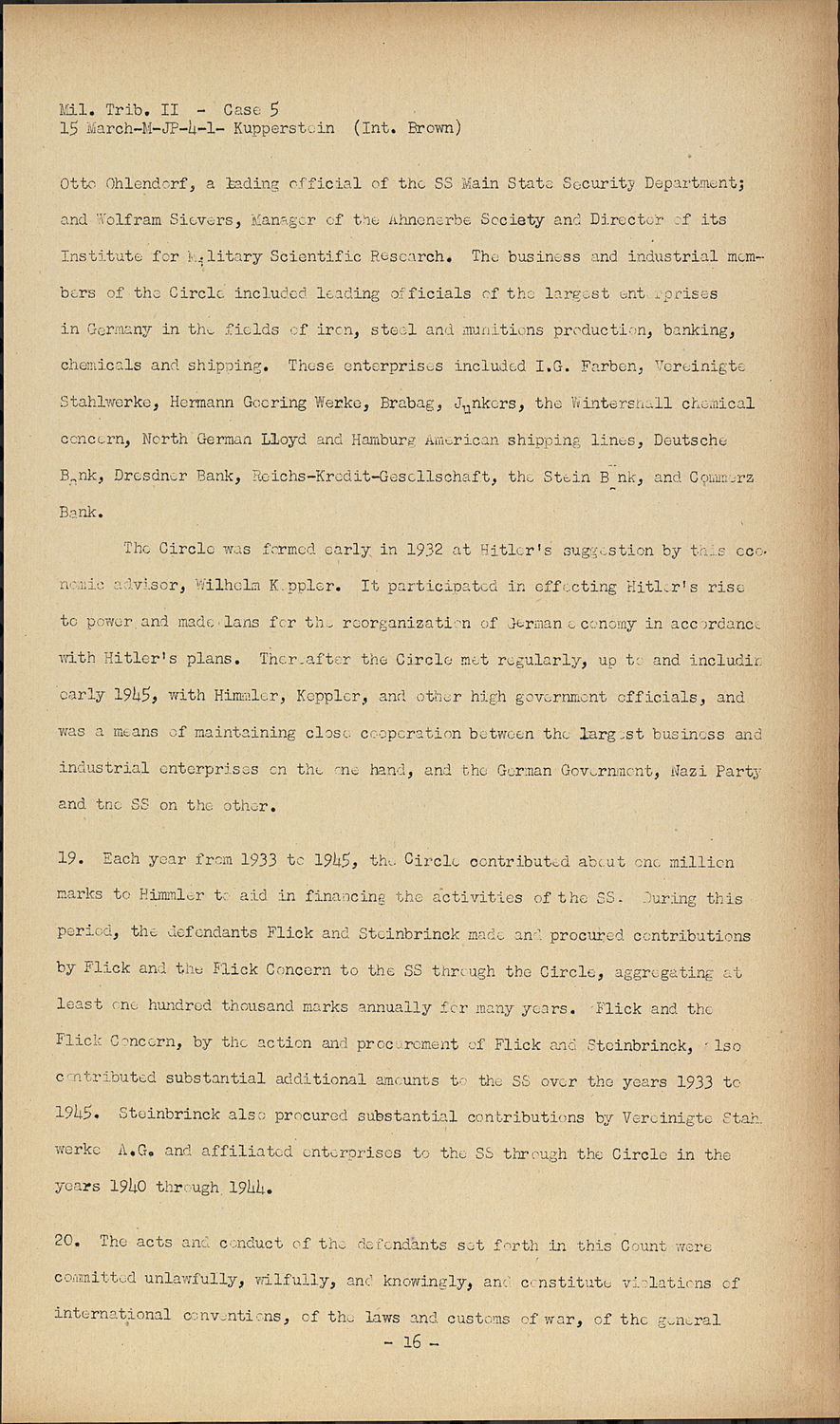
Mil. Trib. II - Case 5 Otto Ohlendorf, a lading official of the SS Main State Security Department; and Wolfram Sievers, Manager of the Ahnenerbe Society and Director of its Institute for Military Scientific Research. The business and industrial members of the Circle included leading officials of the largest enterprises in Germany in the fields of iron, steel and munitions production, banking, chemicals and shipping. These enterprises included I.G. Farben, Vereinigte. Stahlwerke, Hermann Gearing Werke, Brabag, Junkers, the Wintershall chemical concern, North German Lloyd and Hamburg American shipping lines, Deutsche Bank, Dresdner Bank, Reichs-Kredit-Gesellschaft, the Stein Bank, and Commerz Bank.
The Circle was formed early in 1932 at Hitler's suggestion by this economic advisor, Wilhelm Kepplor. It participated in effecting Hitler's rise to power and made lans for the reorganization of German economy in accordance with Hitler's plans. There after the Circle met regularly, up to and including early 1945, with Himmler, Keppler, and other high government officials, and was a means of maintaining close cooperation between the largest business industrial enterprises on the one hand, and the German Government, Nazi Part, and the SS on the other. 19. Each year from 1933 to 1945, the Circle contributed about one million marks to Himmler to aid in financing the activities SS. During this period the defendants Flick and Steinbrinck made and procured contributions by Flick and the Flick Concern to the SS through the Circle, aggregating at least one hundred thousand marks annually for many years. Flick and the Flick Concern, by the action and procurement of Flick and Steinbrinck, also contributed substantial additional amounts to the SS over the years 1933 to 1945. Steinbrinck also procured substantial contributions by Vereinigte Stah werke A.G. and affiliated enterprises to the SS through the Circle in the years 1940 through 1944. 20. The acts and conduct of the defendant set forth in this Count were committed unlawfully, wilfully, and knowingly, and constitute violations of international conventions, of the laws and customs of war, of the general Mil.
Trib. II - Case 5 principles of criminal law as derived from the criminal laws of all civilized nations, of the internal penal laws of the countries in which such crimes war committed, and of Article II of Control Council Law No. 10.
COUNT FIVE 21. The defendant Steinbrinck is charged with membership, subsequent to 1 September 1939, in Die Schutzstafflen der Nationalsozialistischen Deutschen Arbeiterpartei (commonly known as the "SS"), declared to be criminal by the International Military Tribunal, and Paragraph 1 (d) of Article II of Control Council Law No. 10.
WHEREFORE, this Indictment is filed with the Secretary General the Military Tribunals and the charges herein made against the above named defendants are hereby presented to the Military Tribunals.
/s/ Telford Taylor /t/ TELFORD TAYLOR Brigadier General, USA Chief of Counsel for War Crime, Acting on Behalf of the United States of America.
Nuremberg, 8 February 1947 Mil.
.Trib. II - Case 5 The term "Flick Concern", as used in this Indctment refers to the business enterprises controlled, influenced and in substance largely owned.
By Friedrich Flick. Many additions and changes took place during the years 1933 to 1945 both in the physical plants included in the concern and in the legal structure in which they were contained. Corporate reorganizations with the Concern were almost constantly in progress. From 1940 to 1945 the general nature of the corporate structure was not fundamentally changed although certain changes took place in intercorporate stockholdings and companies were added to operate plants in occupied territories.
The Flick Concern constituted the largest privately owned and controll enterprise in Germany for the production of iron, steel products and armaments. It was surpassed in productive capacity in the industry only by the stateHermann Goering Works and by Vereinigte Stahlwerke AG (United Steel Works), in which the government held a substantial interest. The Concern owned and operated soft coal, hard coal, and iron mines; blast furnaces and smelting, coking, and chemical plants, including plants for production of synthetic fuel; rolling mills; and fabricating plants for manufacture of finished products, such as ammunition, armorplate, gun carriages, armored cars and trucks and other panzer materials, airplanes and airplane parts, and railroad cars, parts and locomotives.
From at least 1937 until April 1945 the Flick Concern was largely owned directly or indirectly, by a parent holding company known as Friedrich Flick Konmanditgesellschaft (FKG), a limited partnership of which Friedrich Flick was the only personally liable partner. At first Flick was the sole owner of FKG. In form most of the ownership of FKG was subsequently transferred to Flick's sons, but it was in substance treated by Flick as his own property, and, as the only general partner, he was in complete control of FKG at all times from 1937 to 1945. The most important ...../.. Mil.
Tribunal II-Case No. 5.
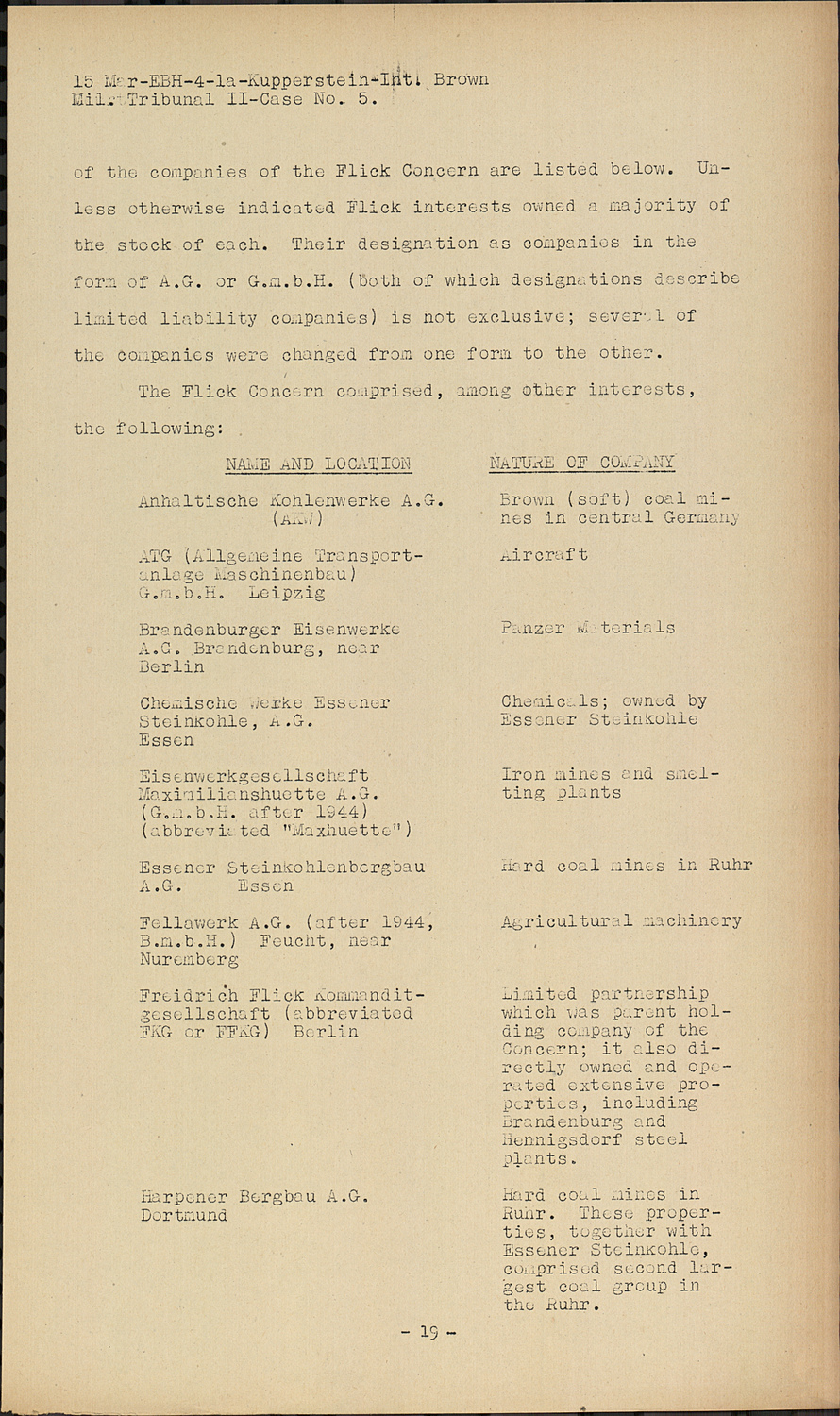
of the companies of the Flick Concern are listed below. Unless otherwise indicated Flick interests owned a majority of the stock of each. Their designation as companies in the form of A.G. or G.m.b.H. (both of which designations describe limited liability companies) is not exclusive; several of the companies were changed from one form to the other.
The Flick Concern comprised, among other interests, the following:
NAME AND LOCATION NATURE OF COMPANY Anhaltische Kohlenwerke A.G. Brown (soft) coal mi (AKW) nes in central Germany ATG (Allgemeine Transport- Aircraft anlage Maschinenbau) G.m.b.H. Leipzig Brandenburger Eisenwerke Panzer Materials
A.G.Brandenburg, near Berlin Chemlsche Werke Essener Chemicals; owned by Steinkohle, A.G. Essener Steinkohle Essen Eisenwerkgesellschaft Iron mines and smel Maximilianshuette A.G. ting plants (G.m.b.H. after 1944) (abbreviated "Maxhuette") Essener Steinkohlenbergbau Hard coal mines in Ruhr
A.G.Essen Fellawerk A.G. (after 1944, Agricultural machinery B.m.b.H.) Feucht, near Nuremberg Freidrich Flick Kommanddit- Limited partnership gesellschaft (abbreviated which was parent hol FKG or FFKG) Berlin ding company of the Concern; it also di rectly owned and ope rated extensive pro perties, including Brandenburg and Hennigsdorf steel plants.
Harpener Bergbau A.G. Hard coal mines in Dortmund Ruhr.
These proper ties, together with Essener Steinkohle, comprised second lar gest coal group in the Ruhr.
Mil. Tribunal II-Case No. 5.
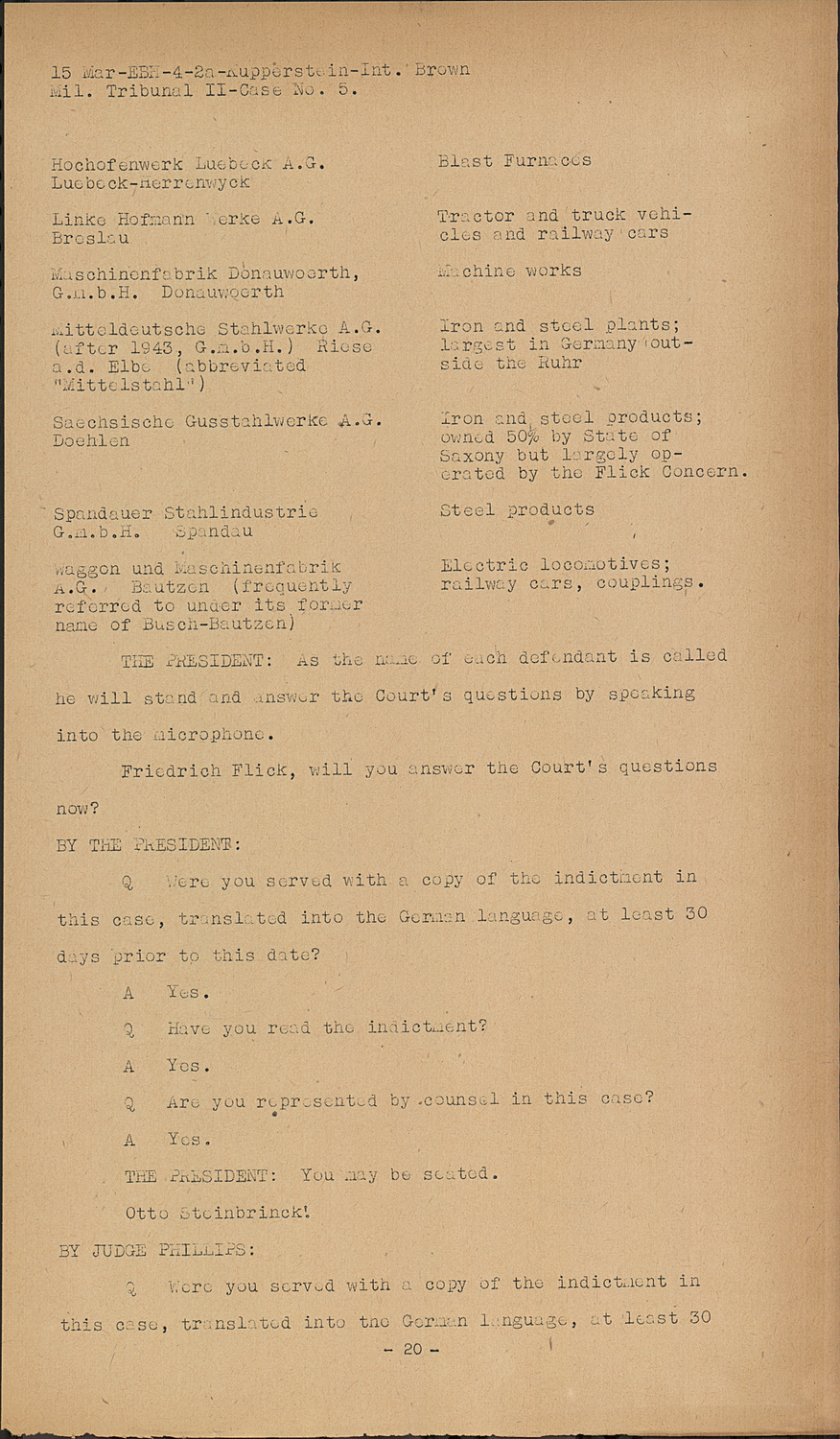
Hochofenwerk Luebeck A.G. Blast Furnaces Luebeck-HerrenwycK Linke Hoffann Werke A.G. Tractor and truck vehiBreslau cles and railway cars Maschinenfabrik Donauwoerth, Machine works G.m.b.H. Donauwoerth Mitteldeutsche Stahlwerke A.G. Iron and steel plants; after 1943, G.m.b.H.) Riese largest in Germany outa.d. Elbe (abbreviated side the Ruhr "Mittclstahl") Saechsische Gusstahlwerke A.G. Iron and steel products; Doehlen owned 50% by State of Saxony but largely op erated by the Flick Concern.
Spandauer Stahlindustrie Steel products G.m.b.H. Spandau Waggon and Maschinenfabrik Electric locomotives; A.G. Bautzen (frequently railway cars, couplings. referred to under its former name of Busch-Bautzen)
THE PRESIDENT:As the name of each defendant is called he will stand and answer the Court's questions by speaking into the microphone.
Friedrich Flick, will you the Court's questions now? BY THE PRESIDENT:
QWere you served with a copy of the indictment in this case, translated into the German language, at least 30 days prior to this date?
AYes.
QHave you read the indictment?
AYes.
QAre you represented by counsel in this case?
AYes.
THE PRESIDENT:You may be seated.
Otto Steinbrinck!
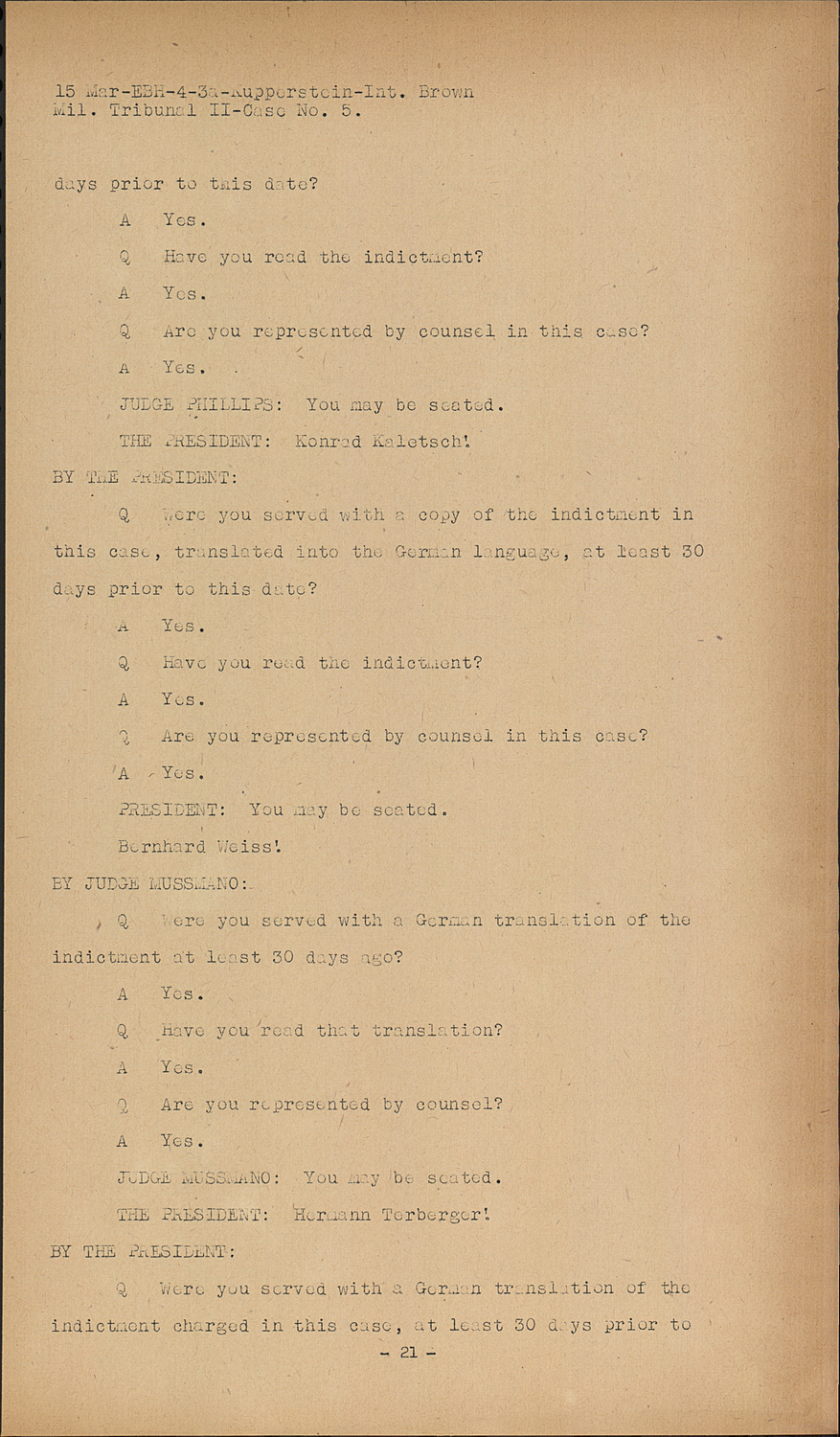
QWere you served with copy of the indictment in this case, or translated into the German language, at least 30 Mil.
Tribunal II-Case No. 5.
days prior to this date?
AYes.
QHave you read the indictment?
AYes.
QAre you represented by counsel in this case?
AYes.
JUDGE PHILLIPS:You may be seated.
THE PRESIDENT:Konrad Kaletsch. BY THE PRESIDENT :
QWere you served with a copy of the indictment in this case, translated into the German language, at least 30 days prior to this date?
AYes.
QHave you read the indictment?
AYes.
QAre you represented by counsel in this case?
AYes.
PRESIDENT:You may be seated.
Bernhard Weiss. BY JUDGE MUSSMANO:
QWere you served with a German translation of the indictment at least 30 days ago?
AYes.
QHave you read that translation?
AYes.
QAre you represented by counsel?
AYes.
JUDGE MUSSMANO:You may be seated.
THE PRESIDENT:Hermann Terberger! BY THE PRESIDENT:
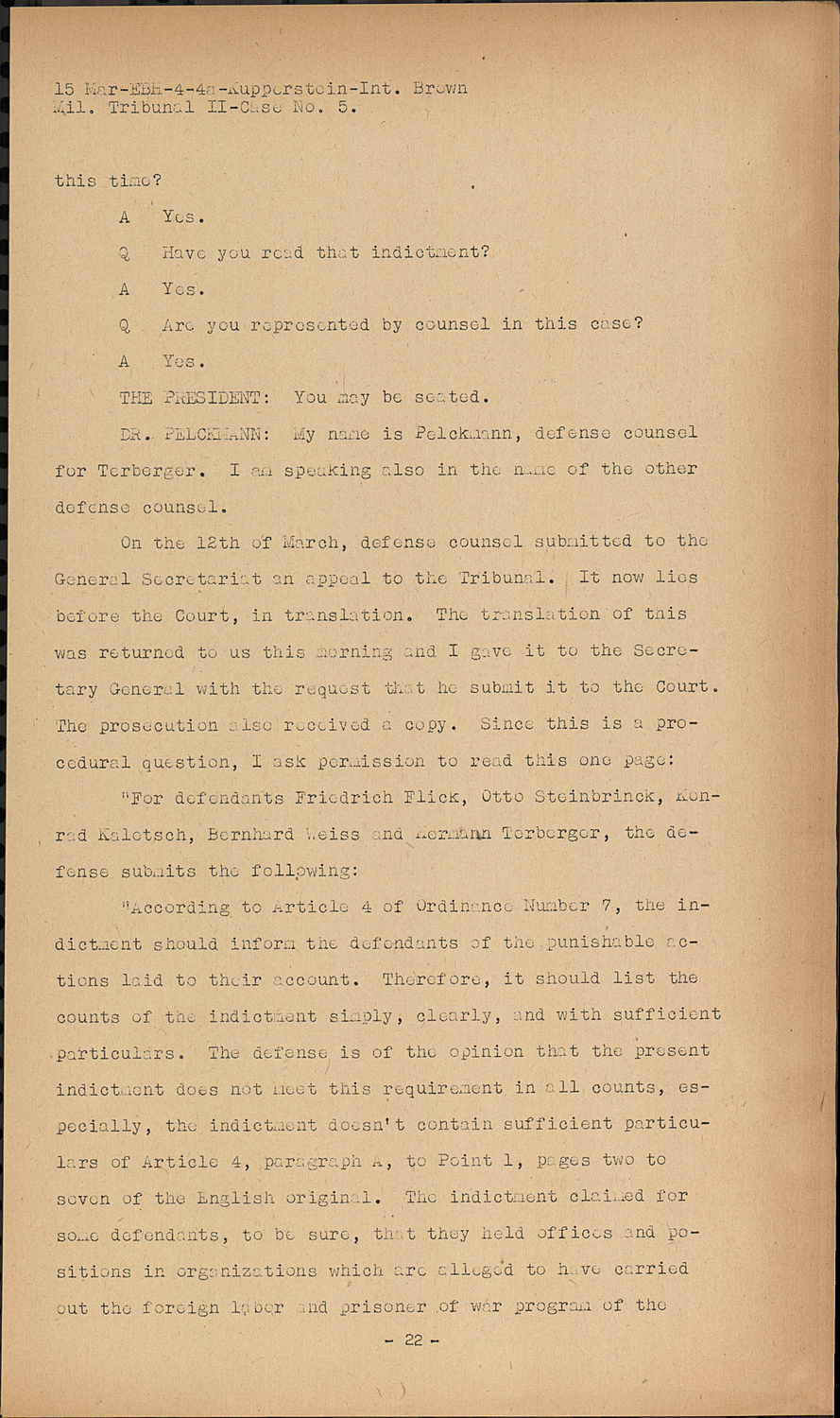
QWere you served with a German translation of the indictment charged in this case, at least 30 days prior to Mil.
Tribunal II-Case No. 5.
this time?
AYes.
QHave you read that indictment?
AYes.
QAre you represented by counsel in this case?
AYes.
THE PRESIDENT:You may be seated.
DR. PELCKMANN:My name is Pelckmann, defense counsel for Terberger. I am speaking also in the name of the other defense counsel.
On the 12th of March, defense counsel submitted to the General Secretariat an appeal to the Tribunal. It now lies before the Court, in translation. The translation of this was returned to us this morning and I gave it to the Secretary General with the request that he submit it to the Court. The prosecution also received a copy. Since this is a procedural question, I ask permission to read this one page:
"For defendants Friedrich Flick, Otto Stelnbrinck, Kenrad Kaletsch, Bernhard Weiss and Hermann Terberger, the defense submits the following :
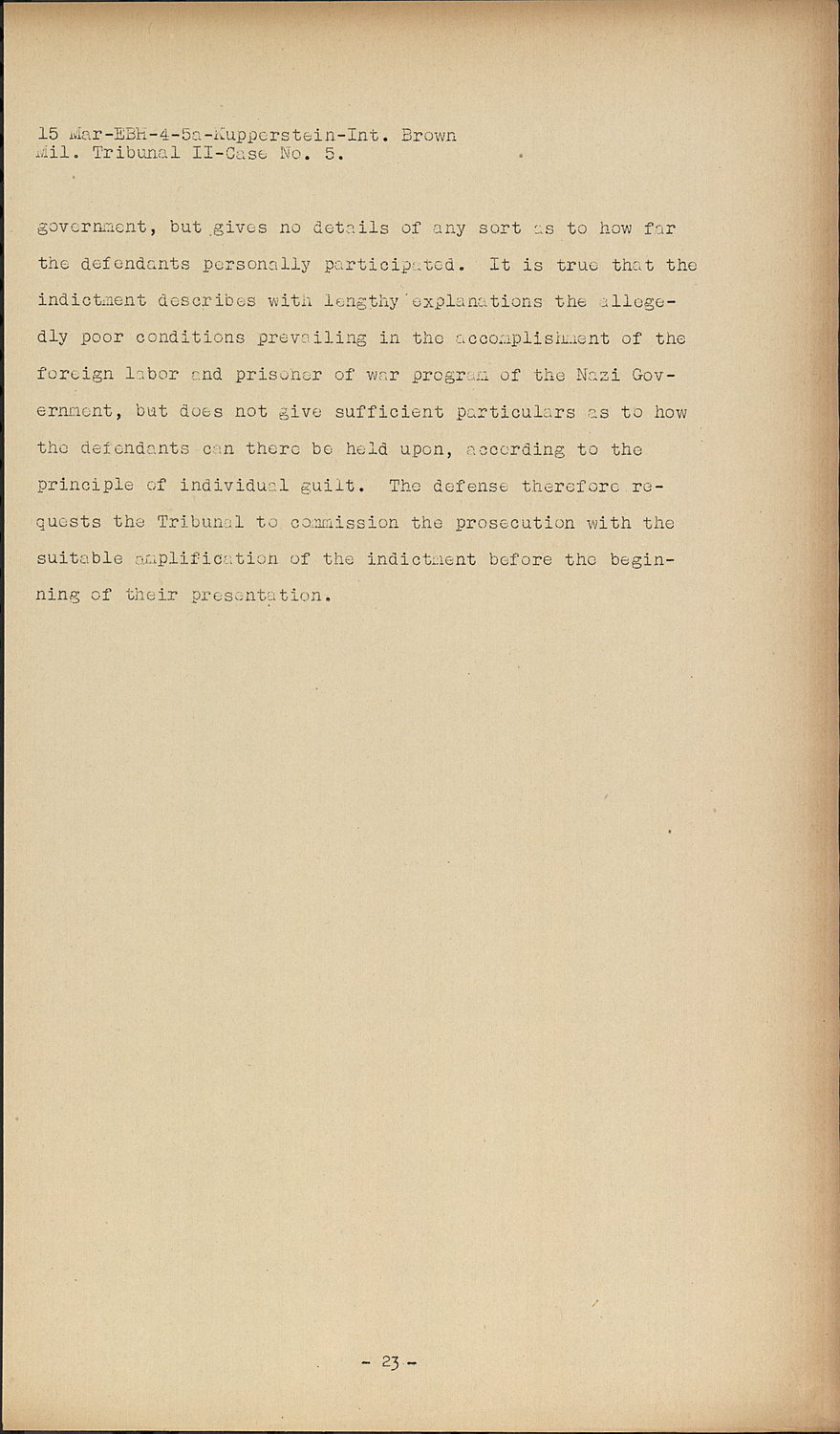
"According to Article 4 of Ordinance Number 7, the indictment should inform the defendants of the punishable actions laid to their account. Therefore, it should list the counts of the indictment simply, clearly, and with sufficient particulars. The defense is of the opinion that the present indictment does not meet this requirement in all counts, especially, the indictment doesn't contain sufficient particulars of Article 4, paragraph A., to Point 1, pages two to seven of the English original. The indictment claimed for some defendants, to be sure, that they held offices and positions in organizations which are alleged to have carried out the foreign labor and prisoner of war program of the Mil.
Tribunal II-Case No. 5.
government, but gives no details of any sort as to how far the defendants personally participated. It is true that the indictment describes with lengthy explanations the allegedly poor conditions prevailing in the accomplishment of the foreign labor and prisoner of war program of the Nazi Government, but does not give sufficient particulars as to how the defendants can there be held upon, according to the principle of individual guilt. The defense therefore requests the Tribunal to commission the prosecution with the suitable amplification of the indictment before the beginning of their presentation.
Mil. Trib. 2 Case No. 5 Should the Tribunal not acquiese to our request, the Defense requests that it be furnished with the documents on which the indictment is based, immediately. That is, in sufficient time before the beginning of the main proceedings. And that they be granted a delay of at least four to six weeks before the beginning of the Prosecution's case in order to work over these documents. There follow then the signatures of the five defense counsel.
THE PRESIDENT:Does the Prosecution wish to be heard on the point?
MR. ERVIN:The prosecution will endeavor to supply the Defense Information Center with documents as soon as they are available, As to the sufficiency of the indictment, I believe the notion could be postponed until later action.
THE PRESIDENT:May the Court ask the Chief of Counsel on what date he will be prepared to proceed with the trial of this case?
MR.ERVIN:Prosecution hopes to be ready to proceed on the third of April.
THE PRESIDENT:The third?
MR. ERVIN:The third of April.
THE PRESIDENT:Well, on the date set for trial, the defendants will be required,respectively,to plead to this indictment. Thereupon, any preliminary motions or applications such as the one just presented to the Court will be heard and disposed by the Tribunal. The case will be assigned to one of Tribunals by a proper court order, and Counsel for the Defense will be notified of that assignment as soon as it has been made. Counsel is warned at this time that the trial of the case-that is, the taking testimony--will proceed immediately after the disposition of the motions or applications here pending ; and that no delay or continuance will be granted. If it is thought more advisable to notice these applications for disposition before that date, the Tribunal to which the case is assigned undoubtedly will assemble and hear those applications for further particulars before the date set for trial.
Mil. Trib. 2 Case No. 5 But let it be understood that there will be no delay in the commencement of the trial for any reason--at least any reason so far assigned.
Not, to recapitulate: These petitions which attack the indictment or any others of that kind will either be heard by special arrangement before the date for trial, or will be heard by the Tribunal on the first day of trial, and before any testimony is taken. On the first day of trial, the defendants will be required to enter their please respectively to the indictment.
Do you anticipate, Mr. Ervin, that the Tribunal which will probably hear this case will be organized and authorized to proceed by the third of April?
MR. ERVIN:That is why I stated a little while ago that we hope to proceed on that date. We have no further information as to the arrival of the Third member of the Tribunal. If he will be here on schedule I should think it might be organized in time to proceed.
THE PRESIDENT:What day of the week is the third?
DR.SIEMERS (Counsel for the Defendant, Weiss): Your Honors, I believe it would be a very good thing if the proposal just made should be carried out, namely, that there should be no delay during the course of the trial. However, if no delay is to occur during the course of the trial, them in my opinion the Defense Counsel must have opportunity to see the documents on which the indictment is based-not only after the case begins, but at least early enough before the beginning of the case to be able to examine them. Furthermore, Your Honors, the wish on the part of the Prosecution to postpone the discussion of this point does not agree with the Defense Counsel. I believe we should have a rulling on this point today, and should precisely on what date we shall receive these documents. It is impossible for us to prepare our case if we Defense Counsel have neither the documents nor the Bill of Particulars. In regard to all the defendants, there is no single case mentioned in the entire indictment--there are only generalizations.
Mil. Trib. 2 Case No.5 If, therefore, the trial is to get off to a good start at the beginning of April, I believe that today it must be clarified; how the presentation of these documents to us and this Bill of Particulars is to be attended to...
Let me mention in addition that it is my personal opinion that if trial is to begin on the third of April, this day is perhaps not a very suitable one. The fourth of April is a holiday; the next day is a Sunday; and the seventh of April is Easter. Therefore, there would have to be an additional recess. I do not know whether, under these circumstances, the Prosecution not be aggreable to choosing a day that lies after April (the third). But, as I said before, what is more important to me is the first point I brought up.
THE PRESIDENT:Under the American judicial system it is not necessary for the Prosecution to present to the Defense in advance all of the proof which it intends to offer. The law merely contemplates that the indictment shall fairly and adequately advise the defendants of the nature of the charge laid against them. This may very from the continental system--I am inclined to think it does. But this being an American court, we will follow the American rule. You are entitled to knew fairly and fully what you are accused of, but it is not necessary to provide you in advance with the proof which will be brought before the court in support of those accusations.
Now, the question here is whether or not the indictment in its present form does fairly and adequately advise you of the nature of the charge and in a manner which will permit you to properly defend. The document Books permit me to observe, are merely the evidence of the allegations in the indictment. Mr. Ervin, may I ask you, is there any practical way in which the motions and applications which have been filed for Bills of particulars can be disposed of before the date of trial, having in mind that the Tribunal to which this case may be assigned is not yet officially in existence?
MR. ERVIN:I should think that the actions could be disposed of by other Tribunal since they are pre-trial motions. The Ordinance 7 which provides the order of proof which shall take place at the Mil Trib 2 Case No. 5 trial begins and, therefore, I think that the provision about substituting a court after a trial has begun could not apply to a pre-trial motion testin testing the sufficiency of the indictment, or asking for a Bill of Particulars.
THE PRESIDENT:You would be on the opinion, then, that this or any other presently sitting Tribunal could hear and dispose of these preliminary motions?
MR. ERVIN:Yes, I would, Your Honor.
THE PRESIDENT:Does the counsel for the defense agree with that?
DR. SIEMERS:Your Honors, let me say something regarding the basic principle Court under consideration here. If the indictment is read before this court, then, so far as I am informed, according to American Law the defense counsel should have the opportunity to take--to adopt procedural attitude toward the indictment. It can not be possible for the prosecution to present the indictment without giving Defense Counsel on opportunity to express its point of view toward the indictment. If the present court is not competent in this case, then it could not be competent to hear the reading of the indictment.
Let me point out one point, one matter. I know that, according to American law, the prosecution is not under obligation to present all its evidence at this moment; and when I spoke before it was not my opinion that the Prosecution was under this obligation. I simply made the suggestion that for practical reasons the Prosecution should, make accessible to us all the documents or, at least, the important parts of them--so that no later delay will result. When I made this suggestion I did it on the legal ground that the indictment should contain sufficient particulars, but, however, does not contain any particulars; and, from the practical point of view, I based my suggestion on the fact that before the trial under IMT in which I participated, the Prosecution made available a considerable amount of the documentation before the beginning of the proceedings in order to avoid precisely such a delay.
MIL TRI II - Case 5
MR. ERVIN:If it pleases the Tribunal, the prosecution in this case wish to follow exactly the same course and beginning Monday morning we will start providing the Defense Information Center with copies of documents we are to rely on in our case in chief. One of the principal reasons why we have not done. As before is that copies have not been duplicated in sufficient numbers as yet. As soon as that process takes place we will begin to supply them with documents so that by the time the trial starts they should have the bulk of the matter to be relied on.
THE PRESIDENT:With that assurance by the Office of the Chief of Counsel your objection is apparently not.
DR. SIEMERS:I thank the prosecutor. I should be the more thankful if the prosecution should express such an opinion regarding the first part of our submission - namely, whether or not the indictment contains sufficient particulars. It would be considerably more easy for us to complete our defense if we know details regarding the individual counts of the indictment. Thus to make an example: If we knew in what individual points the defenddants are being accused of exploiting foreign labor, in what camps such exploitation took place - if we knew in detail what we are to understand under the term exploitation in the occupied territories - I ask the court to inform me regarding this.
THE PRESIDENT:This is right where we started. I asked counsel whether he would concede the authority of this Tribunal, or some other presently sitting Tribunal, to hear your motion, or your application, knowing that his Tribunal or probably no presently sitting Tribunal will be the one which will finally try the case. I don't want counsel to raise the question of jurisdiction of the ultimate Tribunal upon the ground that some other Tribunal has already heard a motion for a bill of particulars. So I would like you to plainly state upon the record whether or not you concede the jurisdiction of this or some present Tribunal to hear these applications and determine your rights to a bill of particulars.
DR. SEIMERS:It is quite agreeable to me if the ruling is passed by MIL TRI II - Case 5.by this or another sitting Tribunal rather than the court that will finally try the case.
I believe the other defense counsel are of the same opinion.
THE PRESIDENT:You are sure, of course, that you may speak for the other counsel in the court?
DR. SIEMERS:Yes.
THE PRESIDENT:Well, I think this tribunal has probably jockeyed itself into the position of volunteering to do a job from which we do not shrink. The other Tribunals are equally busy, I suppose, and I have not the courage to ask if one of them would volunteer to hear these motions, so we will do it. The question is when.
MR. ERVIN:If the court please, the written motion was handed to us in court this morning. I would suggest that we could probably agree with defense counsel to make a written submission to you of the points rather than have an oral argument, if that would be more convenient to the Tribunal.
THE PRESIDENT:I think that is a good suggestion; and then if that docs not satisfactorily dispose of the matter we can set it down for argument on the motion at some future time, and soon.
MR. ERVIN:If it is agreeable with defense counsel I will arrange to confer with him Monday morning and perhaps we can bring a proposal to the court next week.
THE PRESIDENT:Perhaps in that conference you can agree to furnish some of the particulars - perhaps enough even to satisfy the counsel. But if you come to an impasse and cannot do that the court is ready to hear the motion at any convenient date. I would say the earliest date, however, would be a week from next Monday. What date would that be? The 22nd -- The 24th. Yes, the 24th.
Are there any other preliminary matters to come before the court?
The court suggests that April 3rd is not entirely an appropriate time, but that April 8th would be a more suitable date to set, at least tentatively, for the opening of this trial. Subject to the right of the court always to MIL TRI II - Case 5.change its mind -- the date of April 8th will be set for the opening of this trial.