Court No. II, Case No. IX.
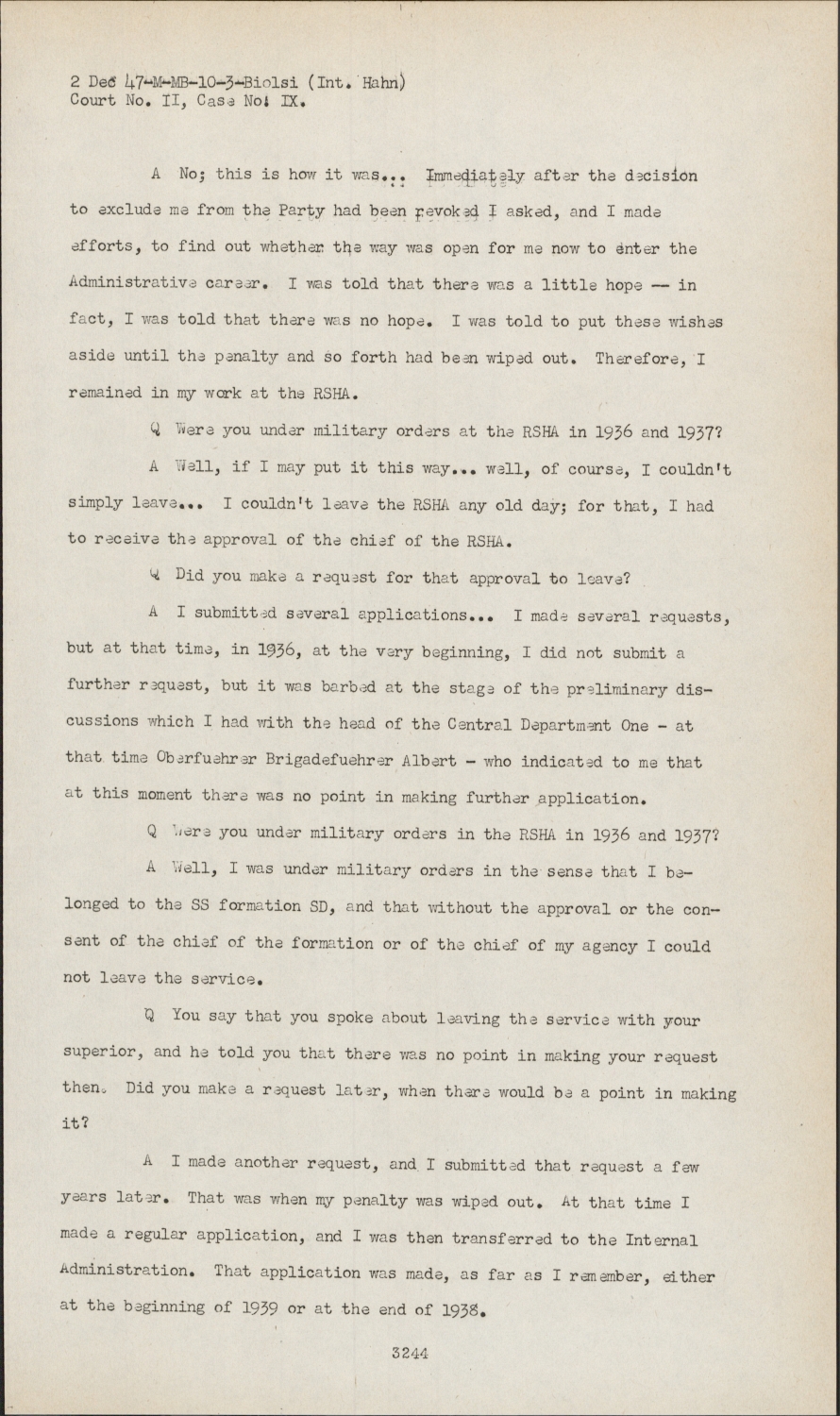
ANo; this is how it was... Immediately after the decision to exclude me from the Party had been revoked I asked, and I made efforts, to find out whether the way was open for me now to enter the Administrative career. I was told that there was a little hope -- in fact, I was told that there was no hope. I was told to put these wishes aside until the penalty and so forth had been wiped out. Therefore, I remained in my work at the RSHA.
QWare you under military orders at the RSHA in 1936 and 1937?
AWell, if I may put it this way... well, of course, I couldn't simply leave... I couldn't leave the RSHA any old day; for that, I had to receive that approval of the chief of the RSHA.
QDid you make a request for the approval to leave?
AI submitted several applications... I made several requests, but at that time, in 1936, at the very beginning, I did not submit a further request, but it was barbed at the stage of the preliminary discussions which I had with the head of the Central Department One - at that time Oberfuehrer Brigadefuehrer Albert - who indicated to me that at this moment there was no point in making further application.
QWere you under military orders in the RSHA in 1936 and 1937?
AWell, I was under military orders in the sense that I belonged to the SS formation SD, and that without the approval or the consent of the chief of the formation or of the chief of my agency I could not leave the Service.
QYou say that you spoke about leaving the service with your superior, and he told you that there was no point in making your request then Did you make a request later, when there would be a point in making it?
AI made another request, and I submitted that request a few years later. That was when my penalty was wiped out. At that time I made a regular application, and I was then transferred to the Internal Administration. That application was made, as far as I remember, either at the beginning of 1939 or at the end of 1938.
Court No. II, Case No. IX.
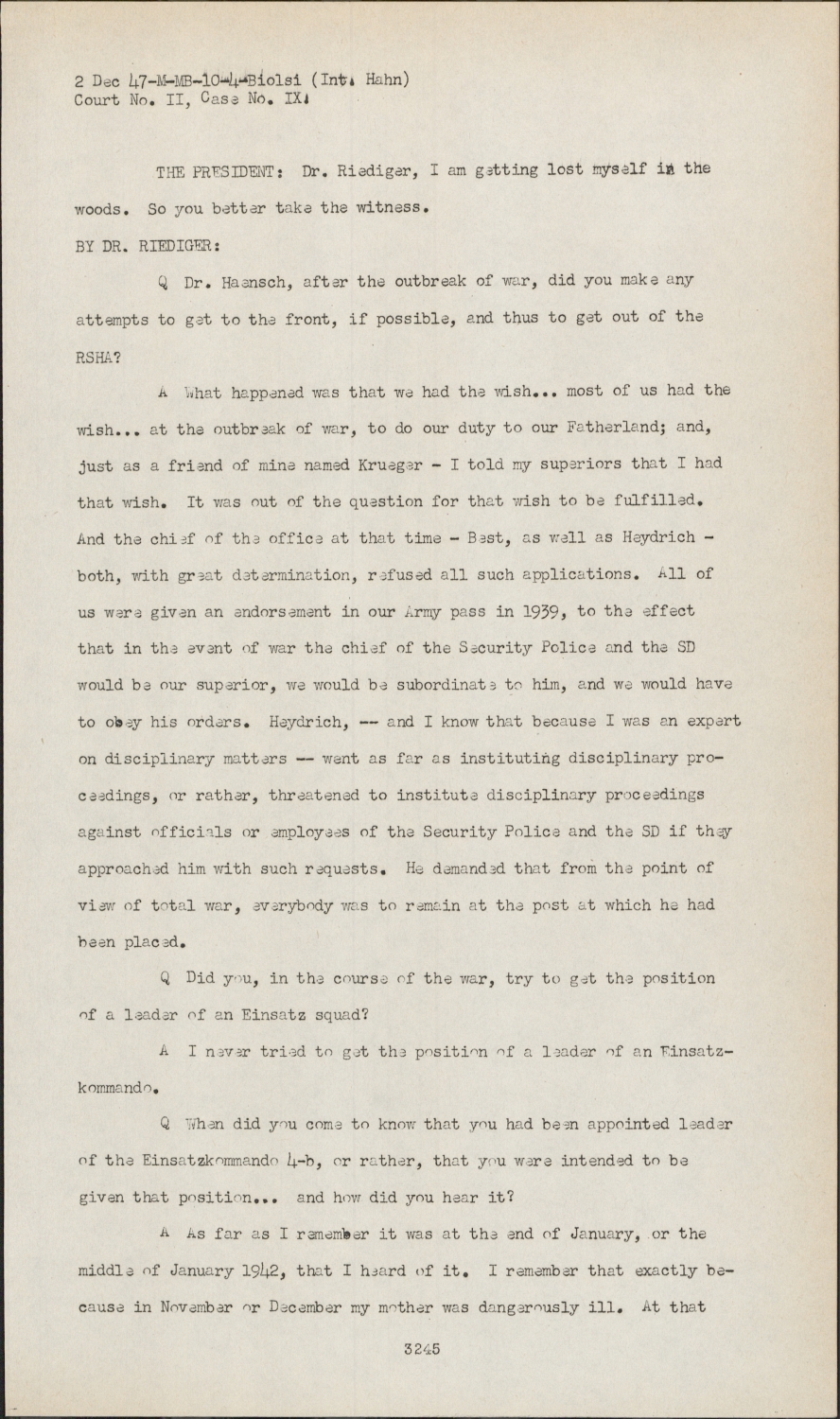
THE PRESIDENT:Dr. Riediger, I am getting lost myself in the woods. So you better take the witness. BY DR. RIEDIGER:
QDr. Haensch, after the outbreak of war, did you make any attempts to get to the front, if possible, and thus to get out of the RSHA?
AWhat happened was that we had the wish... most of us had the wish... at the outbreak of war, to do our duty to our Fatherland; and, just as a friend of mine named Krueger - I told my superiors that I had that wish. It was cut of the question for that wish to be fulfilled. And the chief of the office at that time - Best, as well as Heydrich both, with great determination, refused all such applications. All of us were given an endorsement in our Army pass in 1939, to the effect that in the event of war the chief of the Security police and the SD would be our superior, we would be subordinate to him, and we would have to obey his orders. Heydrich, -- and I know that because I was an expert on disciplinary matters -- went as far as instituting disciplinary proceedings, or rather, threatened to institute disciplinary proceedings against officials or employees of the Security Police and the SD if they approached him with such request. He demanded that from the point of view of total war, everybody was to remain at the post at which he had been placed.
QDid you, in the course of the war, try to get the position of a leader of an Einsatz squad?
AI never tried to get the position of a leader of an Einsatzkommando.
QWhen did you come to know that you had been appointed leader of the Einsatzkommando 4-b, or rather, that you were intended to be given that position... and how did you hear it?
AAs far as I remember it was at the end of January, or the middle of January 1942, that I heard of it. I remember that exactly because in November or December my mother was dangerously ill. At that Court No. II, Case No. IX.
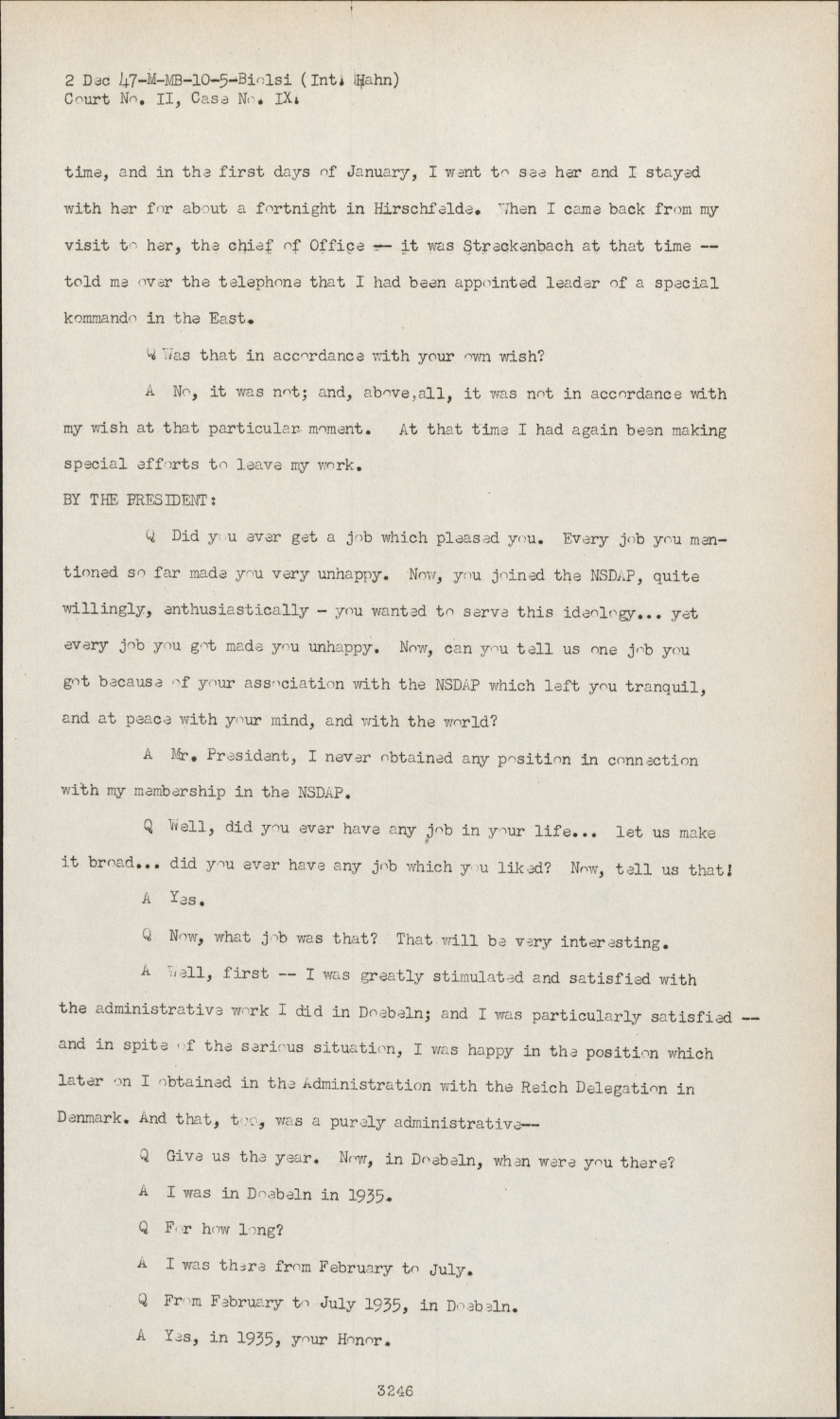
time, and in the first days of January, I went to see her and I stayed with her for about a fortnight in Hirschfelde. When I came back from my visit to her, the chief of office -- it was Streckenbach at that time -told me over the telephone that I had been appointed leader of a special kommando in the East.
QWas that in accordance with your own wish?
ANo, it was not; and, above, all, it was not in accordance with my wish at that particular moment. At that time I had again been making special efforts to leave my work. BY THE PRESIDENT:
QDid you ever get a job which pleased you. Every job you mentioned so far made you very unhappy. Now, you joined the NSDAP, quite willingly, enthusiastically - you wanted to serve this ideology... yet every job you got made you unhappy. Now, can you tell us one job you got because of your association with the NSDAP which left you tranquil, and at peace with your mind, and with the world?
AMr. President, I never obtained any position in connection with my membership in the NSDAP.
QWell, did you ever have any job in your life... let us make it broad... did you ever have any job which you liked? Now, tell us that!
AYes.
QNow, what job was that?
AWell, first -- I was greatly stimulated and satisfied with the administrative work I did in Doebeln; and I was particularly satisfied -and in spite of the serious situation, I was happy in the position which later on I obtained in the Administration with the Reich Delegation in Denmark. And that, too, was purely administrative-
QGive us the year. Now, in Doebeln, when were you there?
AI was in Doebeln in 1935.
QFor how long?
AI was there from February to July.
QFrom February to July 1935, in Doebeln.
AYes, in 1935, your Honor.
Court No. II, Case No. IX.
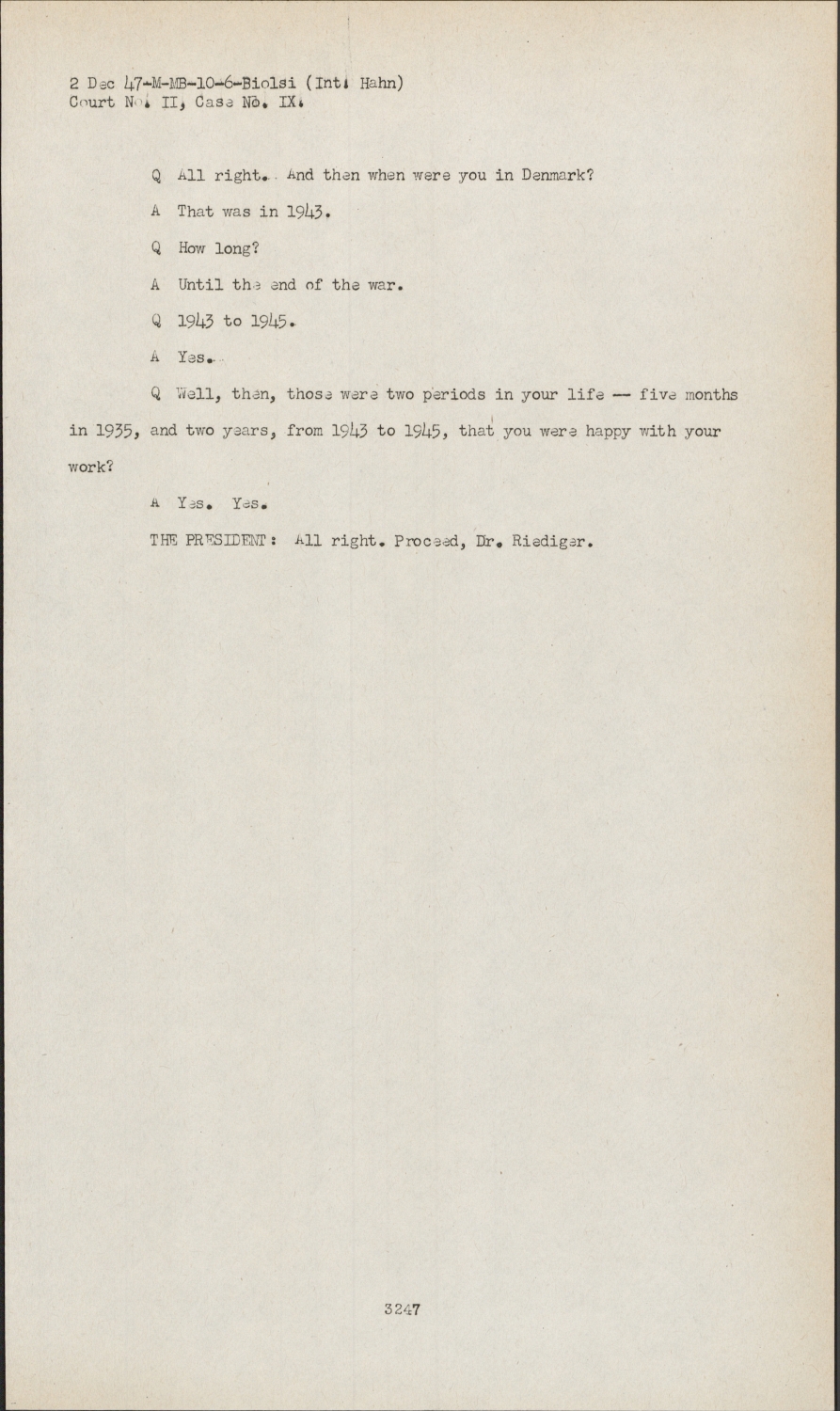
QAll right. And then when were you in Denmark?
AThat was in 1943.
QHow long?
AUntil the end of the war.
Q 1943 to 1945.
AYes.
QWell, then those were two periods in your life -- five months in 1935, and two years, from 1943 to 1945, that you were happy with your work?
AYes. Yes.
THE PRESIDENT:All right. Proceed, Dr. Riediger.
BY DR. REIDIGER:
QWhen you were informed about your appointment, what steps did you take. and what did you know at the time about functions of the Einsatzkommandos?
AUntil that time I know nothing beyond the fact that formations of the Security Police and of the SD, and sofar as I know the military units were with the troops in the East. As for details about their functions and their task, I know nothing of those.
QDo You know the reports of the RSHA or the Einsatzkommandos, did you know of those during the time that you were working for the RSHA?
ANo, I didn't. Those reports on the events, and those reports from the Last I didn't know; as I gather from the documents here the various and sections of this one didn't receive of those reports.
QDid anybody, or who in Berlin informed you about the purpose of the Einsatzgruppen?
AAfter I had been informed over the telephone by Strenckenbach that I was to be sent to a commando in the East, I immediately asked him to see me and talk to me. Once again I must mention briefly that at the time the order to go to the East was in no way opportune, for in the meantime I had tried somehow or other another agency to achieve to be requested by another unit to go to the front, as I had come to realize that that was an opportunity for getting out of the RSHA.
The only possibility, in fact, was if another agency asked for me which was strong enough to support such a request.
At that time, I think in December 1941, among other things, I could on my colleague Six, and asked him to let me know as such as he heard of anything to the effect that some other agency needed an administrative official. in the same way friends of mine were making attempts through other means to help me to find a way of getting out of the RSHA.
To clarify this point as to why I was not feeling happy, and as to why I think I could not have felt happy in my work, perhaps I may make the following statement: I believe every referendar works as and official and defense counsel had more freedom or actions; more freedom in organization than I had, for the work of an expert on disciplinary matters of the RSHA was that of power-investigating activities, I had no authority to make any decisions.
QYou have testified that you had discussed the matter with Streckenbach, and I am now asking you what he told you about the work that you would have to do with the special commando.
Now what was it that Streckenbach told you?
ADuring our short discussion when I called on him, Streckenbach told me that the task of a commando involved authority at the front and it was to protect fighting troops in the front area, and the word was spoken there, and it was repeated to me at later time, by Heydrich Streckenbach said that the commando was part of the Army.
He said that I myself would always have to have my headquaters at a place where the Army had its headquarters. The work of a commando as such, so he told me, was based on decrees and orders received from the Army to the Einsatzgruppe. He told me that those orders had to be obeyed, and that I was to see to it that those orders were obeyed. As such orders were a novel to me, I asked Streckenbach in the course of our talk for further information. Above all, I asked him whether he wanted of our talk for further information.
Above all, I asked him whether he wanted me to take this position as a permanent position. I had a vague person pointed out, told me about the dangerous elements which threatened the German troops in the Last from the Partisans. He said it was the task of the kommando to deal with such saboteurs, and obstructionists and partisans, and were to deal with them jointly with the Army, and to contact activities.
Streckenbach pointed out to me that the executive work of the kommando was in the hands of experts, that is to say, experts trained of the men of the Gestapo and of the Crinimal Police. At the express instructions of Heydrich he drew attention to the fact that I was to stay in the East for a short time, and at the upmost three months. That therefore I was to leave things as they had been, and that I was to handle them as they had been handled up to then. Strechenbach also drew my attention to the fact that in particular, in case of executive decisions I was to rely on the investigations of the experts who had the necessary experience in the Last. In connection with my work as to disciplinary matters, Streckenbach also pointed out to me that in the Last the fight against the illegal elements and to fight against the saboteurs and obstructionists, formal court proceedings such as we were accustomed to carrying out in the Homeland, in the police courts, or another courts, didn't exist in the East, but that a decree by the highest neutral authority, that is, by the OKA, that by that decree matters in the East had been settled in a different way; that the chiefs or chief of the executive department or kommandos and the Armies proceed in accordance with these decrees, or, rather the decrees by the highest political authorities.
Sofar as I recall that is what Streckenbach told me when I had my first talk with him, and during that talk I asked him for information, and, he particularly impressed on me that there was close contact, and that close contact had to be maintained with the Army authorities in question.
QDid you not with Streckenbach discuss the question of going somewhere also at the front, and why?
AThat at a later time. I talked to Streckenbach again, and the second time I went to see him it was very different. After our first talk, I heard the next day, that the chief of Einsatzgruppe-C was Thomas. There had been a considerable amount of tension between Thomas and myself before. He used to be the Oberabschnittsfuchrer in Wiesbaden -
anyhow, it was somewhere in the West, and in disciplinary matters, which had arisen, because in the agency there there had been tension of a certain unpleasantness.
He suggested to me openly to ask Streckenbach when I called on him again, after I had heard that Thomas was the chief and that I didn't like it, if it were possible to use me in some other Eisantzgruppen in Streckenbach's group. Streckenbach saud, no, that it could not be done, and it was taken that he told me that the SK-IV-B was destined to be for me by Heydrich. There had been special reasons. On the one hand my positions in the East was only to be held by me for a short time, and, it was to serve the purposes of acquainting myself with conditions in the East, and Streckenbach said particularly in my position as an expert in disciplinary matters, as for that time I had to deal with the disciplinary matters only, and as I was to stay there only a short time things were to be left as they were.
In particular in the executive sphere, and in the case of SK-IV-B, it was easy to proceed in that way, because there the higher officials were already installed as chief of the executive department.
QThen was it that you left for the East to join the SK-IV-B.
ASofar as I remember I left for the East during the last days of February, in 1942. It was either on the last day of February, or the day before the last day.
QPrior to your departure, did you talk only with Streckenbach, or also with Heydrich, or any of the other gentlemen, and if so, what were you told about your job?
AWell, it was Streckenbach alone who at the end of January told me I was to go to the East, and he added that my written marching orders would be sent to me later. For the moment I was to continue in my old job. My predescessor was on leave, and during this time at Heydrich's request, he was to return to the commando.
I only got an opportunity to talk to Heydrich when I reported my departure to him, and that was when I received my marching orders, and, sofar as I remember it was only a week or ten days before I left that I received my marching orders.
QNow, I was interested in hearing what Heydrich told you about your work in SK-IV-B?
AEssentially, Heydrich told me the same that Streckenbach had already told me. He emphasized the fact that I was to deal with the job of front security. That it was the Army which was in command, and that orders and decrees from who Army to the Einsatzgruppe had to be obeyed; that those orders and decrees had to be carried out exactly, and at that point Heydrich made particular refrence to the activities of bands of organized resistance, and he mentioned the dagers which threatened the German troops. In his usual brief manner he told me of the urgency where lives of every German soldier needed special protection, and that I was always to remain conscious of the fact that in such situation the lives of fathers of German families and and the lives of the German men were at stake. He also told me - I can not at the moment fully recall, but he drew my attention to the wartime laws; he told me about the laws which I would get from the Army, and, he told me that the orders would have to be obeyed. He told me he was to receive no complaint; if I didn't obey orders, he said, that I need not tell you as an expert in disciplinary matters, that you just like every soldier at the front were subject to the laws of war, and that any delay or any dereliction of duty is subject to heavy penalty. That is substantially what Heydrich told me.
QAnd did you go anywhere to report your departure?
AYes, I just remembered it, Heudrich said with reference to the Executive field that I was not to make any change, and I was to rely on the findings in that connection, he said, by just call on Karl Mueller. I never had anything to don with Mueller, as Chief of Department I, and I would have no reason to report my departure to him Now, I did go Mueller who received me, just by the door of his office, the door that led from the anti-chambre to the main office.
He just spoke a few brief words to me. He was rather rude. I thought that he didn't like the idea that as an expert in disciplinary matters was sent up there, for he said something to the effect that it was his officials, men who has been trained by him who worked out there, and they were all men who had the necessary expert knowledge.
QYou said that you left Berlin for the East at the end of February. When was it that you arrived at SK-IV-B?
ASofar as I remember the only earliest stage when I could have arrived was 15th of March. what happened was - - - - - I didn't go by myself.
Court No. II, Case No. IX.
Q.The Prosecution has mentioned that it was as early as 16 January 1942 that you were the Fuehrer of SK-IV-B Einsatzcommando, that is to say, that you had arrived at the front at that time. Could you give us any special reasons to show that at that time and even at a subsequent time you were still in Berlin. Could you tell for how long after that day you remained in Berlin?
A.Yes, I can say for one things, at the beginning of January I spent a fortnight with my parents, stayed with my mother who was sick, and went to Hirschfelde for that purpose. Secondly, I can remember for certain that within the last few days of January, either on the 25 of January, or 27 of January, a friend introduced me and invited me for the first time to beginning at a birthday party of a Herr Sattler, who was then the president of the central grain office. I also know for certain that in February I attended a party that was given by a family who lived in our house. And at the wish of my parents, before I went to Russia, I had a photograph taken at Berlin, the Berlin Seylendorf, that was, and as I had mentioned before, II didn't leave alone, I went together with Obersturmbannfuehrer Dr. Weinmann. Frau Dr. Weinmann, the witness for Dr. Weinmann, testified to that.
Q.Did you at the end of February 1942, go straight to the East, or were there any other interruptions or delays?
A.There were interruptions, and there were very long interruptions, that was Lemberg and Roff and Kiev. You must remember what the conditions were like at that time in Lemberg and Roff. There were certain German soldiers on leave. They had been there for a number of days. There had been some of them down there for weeks and could not go on, which was due to the climate, due to frost, due to the state of the railways, the trains were unable to keep up with all of this traffic, at least for four days, that is the minimum. I don't know how much you have investigated, or did I ask you to make an investigation, but it could be possible to find that the communications, postcards, and letters were lost unless they had been looted.
Q.And when in your estimate did you actually arrive at SK-IV-D?
A.As I said, the earliest stage I could have arrived was the 15th of March.
Dr. REIDIGER: Mr. President, there is only one more question I want to ask on this point before the recess. BY DR. REIDIGER:
Q.Witness, could you no explain to us why in the report of 16th of January 1942, Einsatzgruppe II-A, on page 61 of the English text, and page 64 of the German text, that is Exhibit No. 42, NO-3405, and the later reports of 26 February 1942, Document Book I, page 86 in the English text, and page 18 of the German text, Exhibit NO. 22, No-3340, and, in particular, in the report of 6 March 1942, Document Book II-C, page 61 of the English, and page 65 of the German text, Exhibit number being 80, NO-3240, why in all of these documents you are referred to as "Fuehrer SK IV-B?"
A.Yes, I can explain this now. When I was interrogated by Mr. Wartenberg, I could not explain that point. I just didn't know what to say to that assertion, or to that fact. I could merely believe or assume that my name must have been misused, but now I have come to another explanation, and, I think that is a true explanation, I have discovered that not only in my case such incorrect statements have appeared in the documents. I heard the order for me to go to the front, that I know for certain. That order I knew at the end of January. I knew at that birthday party at Dachlers, at that time I knew about that order. At that time I knew II was to be sent to the East, therefore, I assume the personnel department, or the expert on personnel matters immediately and automatically passed on the order to the agency within this Office IV-B, and that there automatically the name was entered without bothering to find out whether the person concerned was or had actually arrived at the front, or not.
This is not only the case with me but it happened to Dr. Weinmann, and also I refer to a few other comrades of mine, or any other cases, where it was alleged that they had actually assumed their new position which didn't occur that day mentioned in such reports.
THE PRESIDENT:Do I understand, witness, that while you were attending this party in Berlin, some one sent your name to headquarters, and because of this information picked up at the party you were officially designated as being in Russia?
THE WITNESS:Well, Mr. President, that is a misunderstanding.
THE PRESIDENT:I understood you to say as your explanation, that it is a conjecture on your part as to how your name could have been mentioned as leading a commando in Russia, although you were still in Berlin, that your conjecture is you were seen at the party, and your name was sent in, and there through some carelessness it was entered in the records, that you were leading a commando in Russia?
THEWITNESS: yes, after the order was issued, -- well, the order was in January, that was , at the end of January, and after that order was issued, the personnel department in the RSHA apparently informed the agency which made up these reports, and that agency simply entered my name as leader of the commando on the reports without making sure whether the person concerned had actually arrived in Russia, or not.
THE PRESIDENT:What has this got to do with the party?
THE WITNESS:To make an explanation of the other.
THEPRESIDENT: yes, what has this got to do with the party. You drag in a party in your explanation, as to how this misunderstanding occurred, and, it is very difficult for me to comprehend how some one attending a party, like a party in Germany, or like a party anywhere else in the world, how can the fact of a person at a party who was drinking cocktails, which was four-thousand miles away in Russia, I don't understand, what the party has to do with this misunderstanding?
THE WITNESS:Your, I believe the misunderstanding must have occurred, and that the birthday party had nothing whatsoever to do with it. A little while ago I was asked whether I could show any proof for substantiating the statement that in January and February I was in Berlin, and now I can remember among other things that at the end of January that was that birthday party, the date that I attended it. THE PRESIDENT: Then the point you want to tell us is that the fact you were at a party proves that you were not in Russia in January, and, the fact that you were at the party has nothing to do with the mistake made in the headquarters of the RSHA in its listing you as being in Russia at the time, is that correct?
THE WITNESS:Yes.
THE PRESIDENT:Very well.
THEWITNESS: yes, that is correct.
THE PRESIDENT:The Tribunal will be in recess until 1:50 P.M.
THE MARSHAL:The Tribunal is in recess until 1350 hours.
(Recess until 1350 hours, 2 December 1947.)
AFTERNOON SESSION (The hearing reconvened at 1345 hours, 2 December 1947).
THE MARSHAL:The Tribunal is again in session.
WALTER HAENSCH - Resumed
DR. HOFFMANN:Hoffmann for the Defendant Nosske.
Your Honor, you will remember that for this afternoon the Defendant Nosske was excused from attendance in court, so that I might confer with him. I made a mistake by not ordering Nosske to come to 57 at eleven o'clock sharp, but fifteen minutes later. Thus, from an administrating point of view I cannot talk to him any more this afternoon. I ask you now, your Honor, to help me get the chance to talk to him this afternoon in spite of this mistake this afternoon.
THE PRESIDENT:Well, we can remedy a mistake, and especially for Dr. Hoffmann it is a pleasure to do so. The marshal will be instructed to speak with the person in charge of Room 57 and see to it that Dr. Hoffmann may communicate and confer with his client Nosske this afternoon, in view of the fact that Nosske is the next defendant ready to go into the witness stand.
DR. HOFFMANN:Thank you, Your Honor.
THE PRESIDENT:You are welcome.
DR. RIEDIGER:Your Honor, may I beg on behalf of the Defense-Counsels for the Defendants Blume and Sandberger that the two defendants be excused from attendance in court this afternoon, and may I also ask you to arrange that Blume and Sandberger be sent to Room 57? Both need this spare afternoon in order to prepare their defense, Blume and Sandberger.
THE PRESIDENT:Is that in connection with their document books?
DR. RIEDIGER:Yes, Your Honor.
THE PRESIDENT:Yes. The defendants Blume and Sandberger will be excused from attendance in court for the purpose indicated by counsel.
THE PRESIDENT:Dr. Riediger, before you proceed with the examination of the witness as to his activities in Russia, let us have in a very succinct form just what he was to do in Russia.
EXAMINATION BY THE PRESIDENT:
QNow, Witness, as I recollect what you stated, you were instructed by Stahlecker and later by Heydrich that you were to go into Russia and that you were to fight saboteurs, partisans and obstructionists, and that you were also to offer protection to the German Army. Did that constitute your mission in Russia, briefly put, of course?
AYour Honor, the mission which was given to me by Streckenbach and by Heydrich too, was an assignment at the front for the security of the front. That is to say, to guard the rear of the German troops immediately in the front area from elements which endangered the security of the individual German soldier and the front area.
QWhat was said to you about Jews, gypsies and Communist functionaries?
AYour Honor, Jews and gypsies, Streckenbach and Heydrich never mentioned to me. The word never occurred. The mission was not given to me down to the last detail....
QWhat was said to you by Streckenbach and Heydrich regarding Jews, Communist functionaries and gypsies?
AJews, if I may repeat this, your Honor, Jews and gypsies were never mentioned. The word was never mentioned even.
QIn this whole conversation with these two men the word "Jews" was never mentioned?
ANo, it was not mentioned.
QDid they not say that Jews were active Communists and in offering security to the Army it was necessary to be on guard against the Jews?
ANo, your Honor, this was never mentioned. If I may repeat, the individual persons or elements who might endanger the security of the troops was never mentioned at all by Streckenbach in any way, nor did Heydrich do so, but I was told that corresponding orders existed with the Army, and that the mission of the commando was already fixed, and it was pointed out that it was permanent. That was during the second discussion with Streckenbach.
QDid you know that Jews were active Communists; did you know that from other sources?
ANo, your Honor. If I am to reply to this question now, at the time it was never mentioned; the word was never mentioned ......
QI asked you if you knew from other sources that the Jews in Eastern Russia, or in Western Russia, Eastern Europe, were very active Communists; did you know that from other sources?
ANo, I cannot say that in this form. At the time, as I said, it was never mentioned, and I would like to say every Russian citizen who was a Belshevist was inclined and suitable to be specially radical in action.
QWas anything said to you about the Fuehrer Order which called for a liquidation-
ANo.
QWell, I didn't finish the sentence, but you apparently know what I am referring to.
What was the Fuehrer Order? What was the Fuehrer Order? You answered before I finished the question, so, therefore, you are familiar with it. Now, what was the Fuehrer Order? Tell me.
AWell, your Honor, I want to say the following.
QTell me what the Fuehrer Order was.
AWell, the Fuehrer Order, as I heard of it here and got to know it here, says that Jews, I don't remember the exact wording now, it was mentioned here that Jews and gypsies and dangerous elements were to be killed.
QAnd when said you first learn of the Fuehrer Order?
AI heard about the Fuehrer Order - about the existence of the Fuehrer Order - for the first time here from Mr. Wartenberg. The question was never asked or never addressed to me whether I knew the Fuehrer Order, but Mr. Wartenberg told me the fact that the Fuehrer Order Existed.
QAnd when was that?
A that was during an interrogation. It must have been the last interrogation, I believe on 23rd July.
Q '47, A '47, yes.
QSo that although the order was issued in June of 1941 or perhaps even in May, but at any rate in that period, six years went by before you learned of it, is that right?
AYes, your Honor, that is right.
QIn your conversation with Thomas, was nothing said about the order to liquidate Jews?
ANo, nothing was mentioned.
QHow long were you in Russia?
AI was in Russia actually seven to eight weeks altogether. From the middle of March until about middle of July I was in Russia, but there were interruptions.
QAnd, during all this time did you have conversations with your subkommando leaders?
AYour Honor, I can only say that not even once I was told anything about the existence of such a Fuchrer Order.
QDid you have conversations with your subkommando leaders?
That was the question.
AYes, yes.
QAnd did you discuss with them what had to be done?
AWell, your Honor, there was the established mission-
QNow, please answer the question. Did you discuss with your subkommando leaders what you had to do?
AWell, I for my part -
Q yes or no.
AOf course, we talked -
QVery well.
AAbout -
QThat is all. Now you have answered the question. when you arrived in Russia were you told about the orders which were pending, and which had been executed by your predecessor in the course of his duties?
ANo, nothing was mentioned. As orders I merely got to know those orders which the Army had issued concerning the civilian population.
QYou told us that in Berlin you were instructed that you would go to Russia and there would find detailed orders. Did you say that?
AYes, I said that decrees and orders by the Army existed, yes.
QWell, now, your commando had been in existence prior to your arrival there?
AYes.
QAnd who was the previous commando leader?
AMy predecessor was Sturmbannfuehrer Braune.
QBraune? Did you talk with him when you arrived?
QYes, I talked to him.
QAnd did he tell you about the orders which he had received and which he was putting into effect?