APerhaps they didn't talk about it because it seemed obvious that it was in connection with the murder of German soldiers.
QWas it so obvious that you immediately came to the conclusion right on the spot that that's the reason why they were shot?
AIt was pretty close, yes.
QDid you, right at the time it happened, know that that was the reason?
AI don't quite get the question.
QYou say that it was so obvious why these men were killed that, therefore, it wasn't necessary to make any inquiry. Did you know right at the time of the execution why these 20 or 30 were killed?
AI heard about this execution in Tarnopol afterwards, Your Honor.
QDid you when you first heard about it immediately know that that was the reason the men were executed?
AFor me it seemed obvious, yes.
QThen when I asked you just 15 minutes ago why these men were killed, why didn't you immediately give that answer instead of requiring about 15 to 20 minutes of talking back and forth to have you give what to you was so obvious immediately when you heard about the execution? Why didn't you tell us that at once?
AYour Honor, I was first asked by you whether I have heard.
QI asked you if you knew why these men were executed and you said no, didn't I?
AI think you asked me what I was told and thereupon I told you what I assumed at that time.
QMiss Gross, will you please go back in your notes if you can and read to us the first part of the interrogation, when the witness was being questioned as to why these individuals were executed. Were you here at that time?
(Reporter indicates "no")
THE PRESIDENT:No, it was before that. And who was the reporter proceeding you, Gallagher?
Would you please have call Mr. Gallagher and tell him what we are seeking and whether he can find it in his notes?
QWhat did your work consist of with Einsatzkommando IV-B?
AI was expert, that is, I was responsible for the SD work.
QAnd what did the SD work consist of?
AI had to gather extensive information about all spheres of public life in the area in which we were stationed and to report about it.
QYou were to gather intelligence, weren't you?
AIntelligence about the situation in the domestic life - that is, economics, administration, etc.
AYou had to make reports on conditions among the population?
AYes, sir.
QNow among the population there were many who were hostile to the Germans, weren't there?
AYes.
QThere were Partisans, there were saboteurs, and there were looters, and there were bearers of Bolshevism?
AYes. And all these were scheduled for execution when it was determined that they were such?
AWell, yes.
QYes. So, therefore, you had to make reports on the potential enemies of the German forces?
ANo, not that.
QWell, why not?
ABecause that was the police executive mission to deal with all questions which concerned the enemy. All such questions were already handled by the police in Germany and the same was done in the assignment.
QYou were liaison officer with the Army, too, weren't you?
AYes, with the 49th Mountain Corps.
QAnd you conferred with them on intelligence, didn't you?
AI only functioned as liaison officer once. And, at that time I conferred with G-2 of the Army.
QAnd what is G-2 of the Army doing? It gathers intelligence with regard to the enemy, doesn't it?
AYes.
QSo, therefore, you had to report on the forces which were opposed to the German Army, didn't you?
ANo, Your Honor, this is the way it is. The "Barbarossa" order, which was the basic order and it has already been cited here, had ordered that the liaison from the Einsatzkommandos to the Army would run via G-2. That was the man who was the liaison agency of the Army.
QWhen you did this work in Germany you prepared yourself for your activities in Russia, is that correct?
AIn what field prepared myself - in what field?
QWhen you were in Russia you did the same kind of work which you did in Germany - SD work?
AYes.
QAnd that included counter-intelligence, did it not?
ANo, not at that time any more. Counter-intelligence, if I remember correctly, since 1938 or the beginning of 1939 was taken away from the SD completely.
QSo you were trained in counter-intelligence work, weren't you?
ASpecifically I was only informed about the field of plant security, not about the entire counter-intelligence field. The SD intelligence was only of an informational nature, not connected with police or executive missions. Police prosecution of sabotage and espionage, which are the main components of counter-intelligence, were completely in the hands of the State Police from the very beginning.
QBy intelligence is meant all information appertaining to the enemy which may be of assistance to ones own forces. That's right, isn't it?
AI do not know, Your Honor, I can only speak of what we called SD work. That's what I did in the assignment. SD work means that I would have to gather intelligence about the situation in the various domestic spheres within the indigenous population, that is, Russian population - questions of law, administration, culture, science, and economics, especially economic problems were uppermost during the advance in Russia.
QWhen executions occurred there was bound to be some reaction among the population, wasn't there?
AIt can be assumed theoretically but I never received any report about that. I was never able to determine that.
QYou hastened to exclude yourself before the question was put to you. I only asked you whether when an execution occurred if there wasn't some reaction among the population to it?
AThat depended on two matters, Your Honor. First of all how the execution was carried out. I am speaking theoretically ' whether there was the possibility that the large population learned about it. And, second the question of information service. If such a reaction existed on the part of the population it doesn't mean that I heard about it or had to hear about it.
QYou are very anxious to tell us that you knew nothing about it and the question hasn't been put to you.
ANo, I am saying, your Honor, during the time that I was in this assignment I did not know of any reaction of the people to these executions or, rather, I was not able to determine any such reaction. I heard nothing about this through my intelligence channels.
QBefore 4-B marched into a town and seized the Jews and executed them it would be known in the town if it wasn't too large a place, wouldn't it?
AOne would have to assume that, yes.
QAnd then when you came to write up your report on the morale of the population you would have to make some reference to the fact that there was terror and fright in the town because of the execution, wouldn't you?
AWell, your Honor, I didn't hear about the fact that Kommando 4-B marched into a town and then seized the Jews.
QWere you in the town of K-l-o-c-z-o-w?
AYes, Kloczow.
QWell, however it is pronounced.
AI went through Kloczow when we advanced.
QWhat happened in that town? How many did 4-B kill in that town?
AI cannot say, your Honor.
QWell, was it a large number of a small number?
AI didn't spend any time in Kloczow. I drove through it.
QWell you spent as long a time as the Kommando spent in there. How many did the Kommando kill in Kloczow?
AIn Kloczow?
QYes, how many did the Kommando kill in Kloczow?
AI do not know. I assume that they killed none because I think I read in some situation report that the group staff of Einsatzgruppen C was active in Kloczow. And in this connection it is mentioned that the Kommando 4-B - I hope I am repeating this correctly - that is had passed by Kloczow.
If I understand this expression correctly in the report then this refers to the fact that Kloczow was by-passed by the forces of Kommando 4-B or rather that Kommando 4-B searched the town of Kloczow for material left behind by the Bolchivists.
QYou are trying to adjust your explanation to the report. I want you to tell me what you know that 4-B did in Kloczow.
AI can't tell you anything about that, your Honor.
QDid the group staff conduct any executions in Kloczow?
AI do not know. I just referred to the group staff because I saw this incident in the report. When I went through Kloczow I did not come into contact with the group staff. The Group staff must have come to Kloczow after the Kommando because the group staff was still in Lemberg at that time.
QWhat did 4-B do in Kloczow?
AI can only tell you according to the situation report which I just quoted.
QDon't tell me about the situation report. I want you to tell me what you know. I can read the situation report. What did you do in Kloczow?
AI drove through Kloczow, entered at one end and drove out the other --
QAnd what did the Kommando do in Kloczow?
AI do not know.
QWell you were with the Kommando, weren't you?
AWith the last vehicle of the Kommando which had left Lemberg I drove through Kloczow.
QDidn't the Kommando stop at all?
AAccording to what I read in the situation report I must assume that parts of the Kommando did stop there.
QAnd what did they do? What did they do when they stopped there?
AI can only judge this according to the situation report.
QWhat did you do in Kloczow?
AI do not know. I wasn't there.
QWell you were in Kloczow.
AI drove through your Honor.
QThe Kommando always remained intact did it not?
AOn the march it often fell apart. That was unavoidable and there were interruptions of hours between various parts so that parts would come up later. I just want to give you an example, When we crossed the Djnepr River in order to get near the bridge there was a distance of 4 kilometers and I needed ten hours for this while others immediately able to cross the bridge.
QDidn't you tell us in the early part of your direct examination that 4-B was a unit which did not separate?
AI said that in view of the distribution into sub-kommandos, your Honor.
QWell, now after you went through Kloczow you say that part of the Kommando remained there and that you went straight on, is that right?
ANo. That's not the way it was. Your Honor.
QWell, tell us just what happened in Kloczow? Did any part of your Kommando remain after you went through?
ANo.
QThen you remained with the Kommando all the time it was in Kloczow?
AYour Honor, may I briefly describe this?
QPlease tell me if you remained with the Kommando all the time it was in Kloczow?
AParts of the Kommando came through Kloczow before me. That is to say the first parts must have come through Kloczow about a day before me. The advance took place in groups and I came with the last few vehicles.
QThen 4-B did separate occasionally, didn't it?
AI did not exclude, your Honor, that during the advance because the conditions of War made it necessary that the Kommando would separate temporarily for hours or days.
But it was not so - -
QSo it was possible for part of this Kommando to have performed executions in Kloczow before you arrived, wasn't it?
ATheoretically this would have been possible if such a thing had been ordered by the Kommando leader.
QAnd there were times when parts of this unit would be separated for hours and some times for days, is that what you tell us now?
AYes.
QSo, this is - - -
AFor hours or one day.
QWell, you said days just a moment ago, didn't you? Hours and days. Did you say that?
AYes, but not many days.
QHow many days?
AOne or two.
QWell, days would be more than one day, wouldn't it?
AYes, one or two days.
QWell, when you say days you mean more than one day, don't you?
AYes.
QSo, therefore, you didn't tell us the truth when you said in the very early part of your examination that the unit never separated, did you?
AI think I still said the truth because, if I may repeat my words as I think I remember them, this does not exclude the fact that small parts of the Kommando in order to carry out definite missions were briefly or temporarily separated from the Kommando.
QYes, you adjust your answer according to the particular situation. At the time you were describing this other situation it was to your benefit to say that the unit did not separate. Now, since you assume it will be to your benefit to say that it does separate, you said it did separate. That's the way you are answering these questions, isn't it?
ANo, one does not exclude the other. The situation has been that it was reported that other Kommandos were separated into two or three sub-Kommandos which operated independently, that is, one Kommando was hundreds of kilometers away from another Kommando. This was not the case in our Kommando. We were not separated that way.
QYou were in charge of an advance Kommando on two occasions weren't you?
AYes, your Honor.
QAnd what did you do when you were in charge of this advance Kommando?
AI tried to join the combat troop as quickly as possible or rather to arrive at the new garrison as quickly as possible.
QHow many men did you have?
AAbout six to eight men, including myself.
QWhen you were in charge of this group you were prepared to meet any situation weren't you?
AYes, I was prepared. Whether my forces would have sufficed I do not know.
QIf you met Partisans you would fight them, wouldn't you?
AIf they had forced me to fight, of course, but for my part I wouldn't have looked for it with the strength of 8 men.
QWell, suppose your men gained knowledge that a group of Partisans was in the town, not a large group, would you try to locate them?
ANo, not as a leader of an advance Kommando with 8 men.
QWell, suppose you learned there were four Partisans in a town, and they were in a house, would you send your eight men there and try to capture them?
ANo.
QSuppose you had learned there were some saboteurs who were about to set fire to some houses, four people. Would you go and try to arrest them?
AMy own house in which I was staying?

QNo, a house in the town. They were saboteurs and they assumed you were going to take over this house for your quarters and they were going to burn it. Would you go and arrest them?
AI can't decide this generally.
QWell, no this isn't general. This is a specific question. You are marching through a town with six to eight men and you learn that there are some saboteurs contrary to German regulations and against the German forces and you know they are going to blow up a house and you know where these four men are. Would you go and arrest them?
ANo.
QSuppose that you knew that there were some Bolshevist functionaries, men in charge of the Communist Party, four of them, and they are about to hold a meeting in a house, and they are going to preach to the population and ask them to oppose the German forces, there are only four, would you go and arrest them?
AIn such case, when there was really a danger I would inform the competent military commander about it, the local commander.
QNo, I am asking you what you would do, you are coming through a town and you know of this Bolshevist meeting, four men are going to Call the population together and to sell them the Communist doctrine, they are going to spread Bolshevism, would you go and arrest these four men?
AAs the leader of the advance kommando, I would not.
QDid you take an oath to Hitler?
APlease?
QDid you take an oath to Hitler?
AYes, as a soldier.
QDid you take an oath as a soldier in the German armed forces?
AYes, in the year 1934.
QDid you believe in the German cause?
AIn what connection, your Honor?
QWell, the German cause. You were in the German armed forces, you were marching into Russia. You know that you had marched into other countries. Did you believe generally in the policies of the Reich?
AI believed that it was necessary to try to do away with the threat of Europe by Bolshevism.
AI believed that it was necessary to try to do away with the threat of Europe by Bolshevism.
QYes, and yet you are going through a town and you learn of some people who are going to blow up a house in which German soldiers are going to be quartered, you know that four Bolshevist functionaries, who are listed to be executed according to the orders, are about to attempt to proselyte the whole population against the German forces, and yet you do nothing?
What kind of a soldier are you?
AI already said that in such a case where there was an immediate danger and in which I myself had only eight men at my disposal, I would inform the competent military commander about this case.
QLet's suppose there is no competent military commander around. This is a town and here are these four men standing on the corners asking the people to come into this great mass meeting, and these four are going to make speeches against Hitler, against the German armed forces to resist the invasion, would you arrest these four people?
AThere was no such case during my assignment.
QIf there was such a case, would you arrest them?
AIf an acute danger existed -
QIf there was-
A --for the men that I led, then I would do something about it; I would have arrested the men.
QWell, there is no acute danger to your men. These four are merely standing on the street corners telling the people to come in, they are going to listen to a fiery speech against the German forces, no danger to you but this very active political resistance. Would you arrest the men, the four men?
AAs a leader of an advance kommando I would not have done so. I would not have had time so I wouldn't have had any opportunity to do so.
QYou wouldn't have any opportunity? You have eight men, and they are armed.
ABecause I didn't have the forces to do this.
QBut I am telling you, you have eight men, and there are only four on the other side. Two Germans to one Bolshevist are certainly ample, aren't they, especially if you subscribe to the master theory?
AI personally did not believe in the master race.
QAll right. Well, you believe that two could overcome one, don't you, especially if two are armed.
AYour Honor, I had other missions to perform with the eight men. That is why I couldn't arrest four men.
QVery well. Then your answer stands.
AI wouldn't have arrested them.
QThen your answer stands, that although you are wearing the uniform of the German Army, although you have sworn allegiance to the Fuehrer, although you are engaged in a war, yet you come across a force only one-half the size of your own, it is preaching sedition, it is preaching resistance, and you wouldn't even arrest them, that is the way you want your answer to stand?
AI said that I myself would not have done anything to them with my forces.
QVery well, all right.
ABut if there was a danger I would have informed the competent military commander who had better forces for such actions, and it would have depended upon his decision what he would have done to protect the German Army.
QVery well, your answer does not change what my proposition was, that although you had twice as many as those who would be opposed to you, yet you would do nothing. All right, we understand how you feel about these things.
AI wouldn't have done anything because I had other missions to perform with my men.
QVery well.
AThat is what I wanted to add, your Honor.
QYou will recall I also added that if these four were going to blow up a building, you still would not do anything, because you had other things to attend to. Did you consider the measures in the East justified? After you got back to Berlin and you reflected on what your kommando had done in the East, were you satisfied that those measures taken were justified?
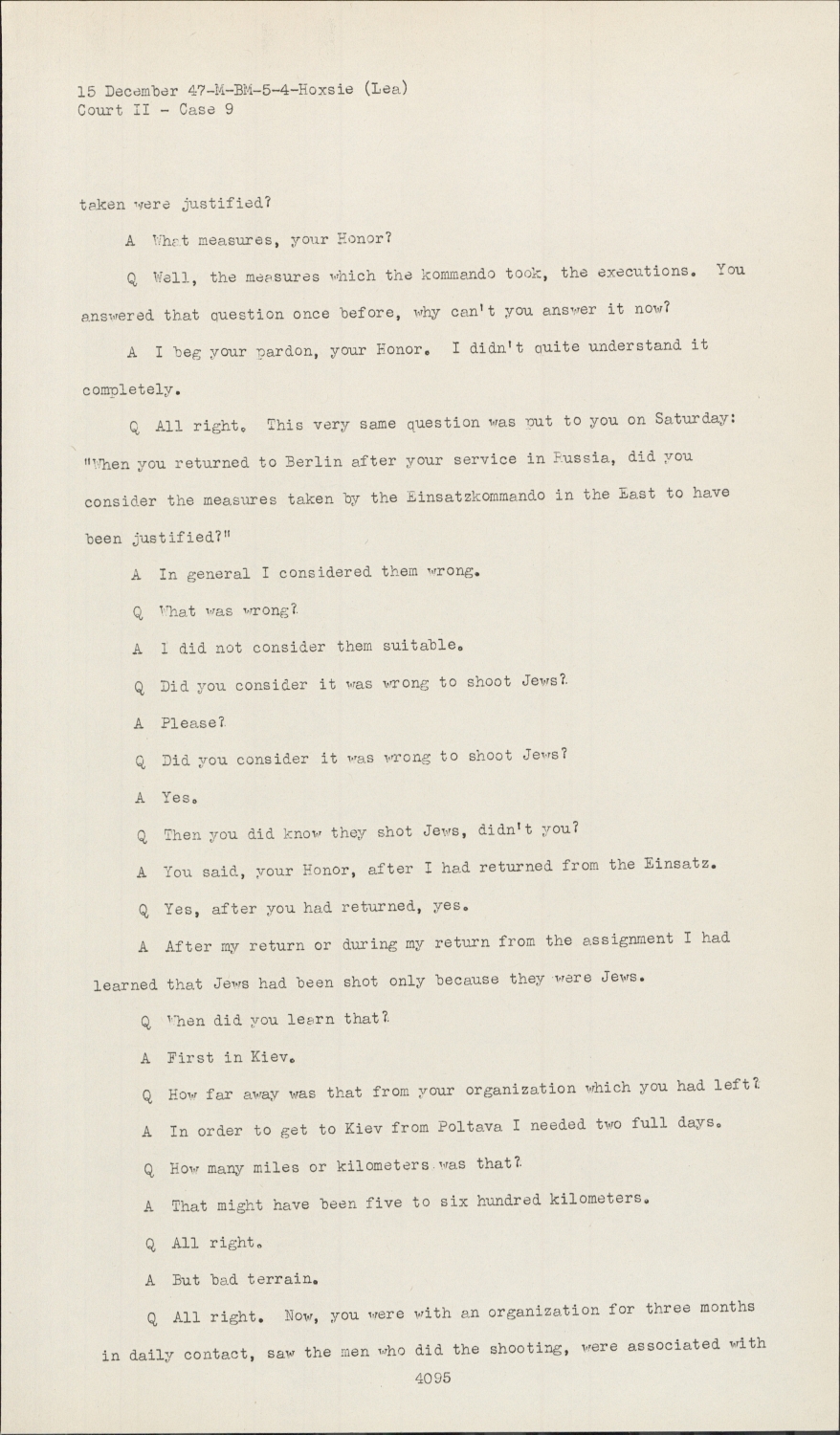
AWhat measures, your Honor?
QWell, the measures which the kommando took, the executions. You answered that question once before, why can't you answer it now?
AI beg your pardon, your Honor. I didn't quite understand it completely.
QAll right. This very same question was put to you on Saturday: "when you returned to Berlin after your service in Russia, did you consider the measures taken by the Einsatzkommando in the East to have been justified?"
AIn general I considered them wrong.
QWhat was wrong?
AI did not consider them suitable,
QDid you consider it was wrong to shoot Jews?
APlease?
QDid you consider it was wrong to shoot Jews?
AYes.
QThen you did know they shot Jews, didn't you?
AYou said, your Honor, after I had returned from the Einsatz.
QYes, after you had returned, yes.
AAfter my return or during my return from the assignment I had learned that Jews had been shot only because they were Jews.
QWhen did you learn that?.
AFirst in Kiev.
QHow far away was that from your organization which you had left?
AIn order to get to Kiev from Poltava I needed two full days.
QHow many miles or kilometers was that?
AThat might have been five to six hundred kilometers.
QAll right.
ABut bad terrain.
QAll right. Nov, you were with an organization for three months in daily contact, saw the men who did the shooting, were associated with the commander, and you didn't know--You were with Kommando 4b for three months in constant daily association with the men who were doing the shooting, in daily contact with the commander, and you did not know that Jews were being shot because they were Jews, but then when you were five hundred kilometers away, then you knew they were shooting Jews because they were Jews, is that correct?
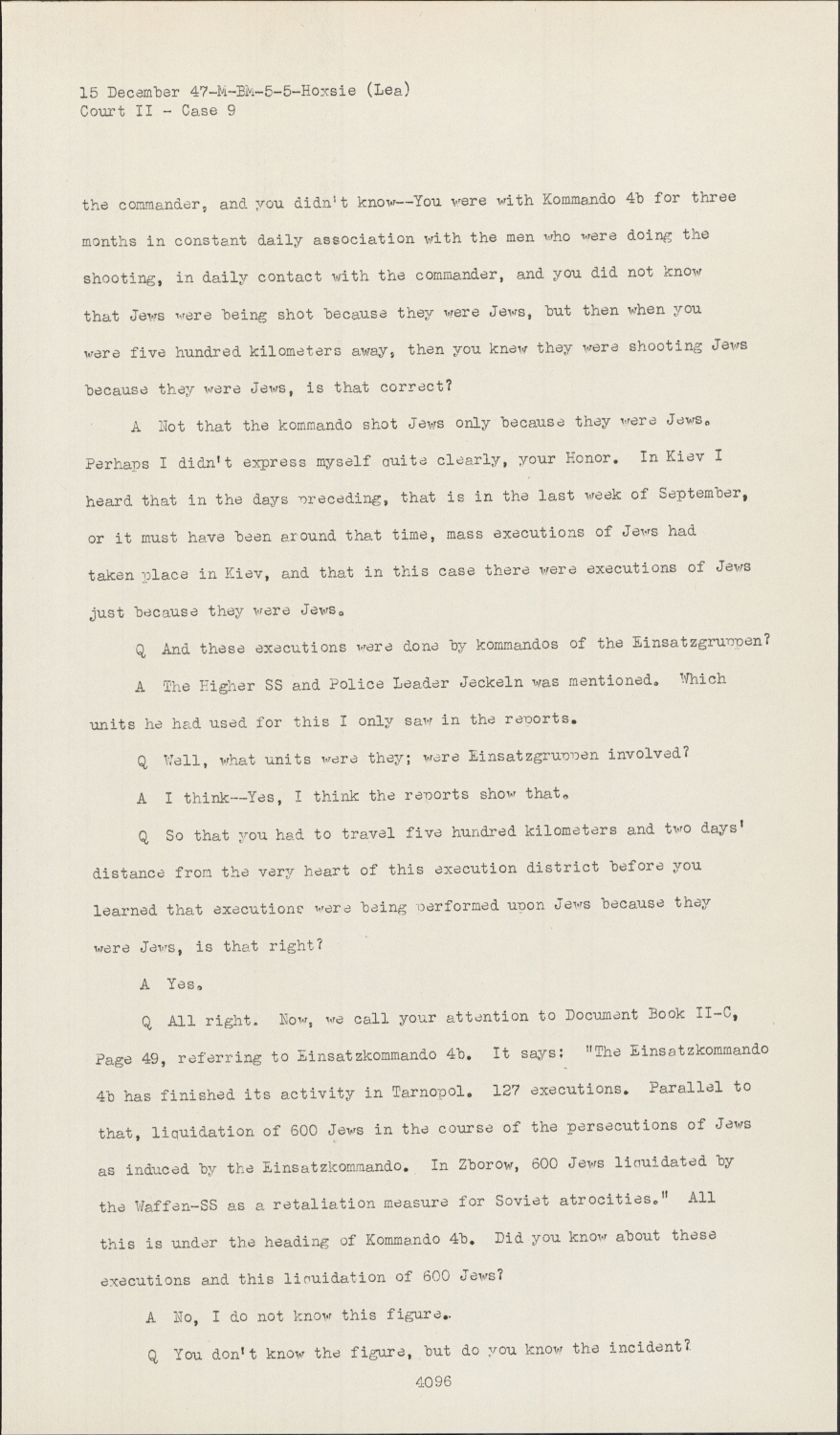
ANot that the kommando shot Jews only because they were Jews. Perhaps I didn't express myself quite clearly, your Honor. In Kiev I heard that in the days preceding, that is in the last week of September, or it must have been around that time, mass executions of Jews had taken place in Kiev, and that in this case there were executions of Jews just because they were Jews.
QAnd these executions were done by kommandos of the Einsatzgruppen?
AThe Higher SS and Police Leader Jeckeln was mentioned. Which units he had used for this I only saw in the reports.
QWell, what units were they; were Einsatzgruppen involved?
AI think--Yes, I think the reports show that.
QSo that you had to travel five hundred kilometers and two days' distance from the very heart of this execution district before you learned that executions were being performed upon Jews because they were Jews, is that right?
AYes.
QAll right. Now, we call your attention to Document Book II-C, Page 49, referring to Einsatzkommando 4b. It says: "The Einsatzkommando 4b has finished its activity in Tarnopol. 127 executions. Parallel to that, liquidation of 600 Jews in the course of the persecutions of Jews as induced by the Einsatzkommando. In Zborow, 600 Jews liquidated by the Waffen-SS as a retaliation measure for Soviet atrocities." All this is under the heading of Kommando 4b. Did you know about these executions and this liquidation of 600 Jews?
ANo, I do not know this figure.
QYou don't know the figure, but do you know the incident?
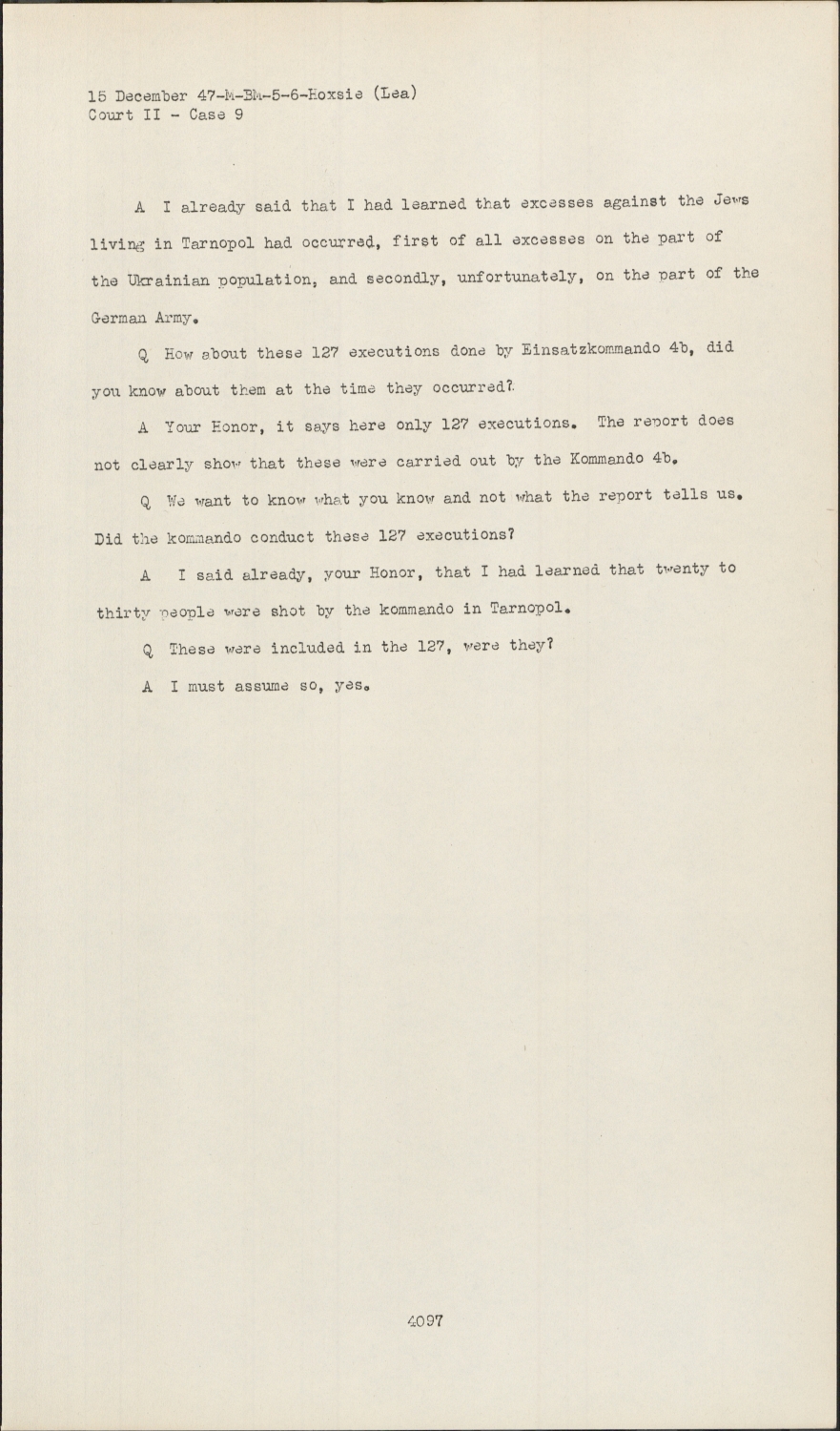
AI already said that I had learned that excesses against the Jews living in Tarnopol had occurred, first of all excesses on the part of the Ukrainian population, and secondly, unfortunately, on the part of the German Army.
QHow about these 127 executions done by Einsatzkommando 4b, did you know about them at the time they occurred?
AYour Honor, it says here only 127 executions. The report does not clearly show that these were carried out by the Kommando 4b,
QWe want to know what you know and not what the report tells us. Did the kommando conduct these 127 executions?
AI said already, your Honor, that I had learned that twenty to thirty people were shot by the kommando in Tarnopol.
QThese were included in the 127, were they?
AI must assume so, yes.
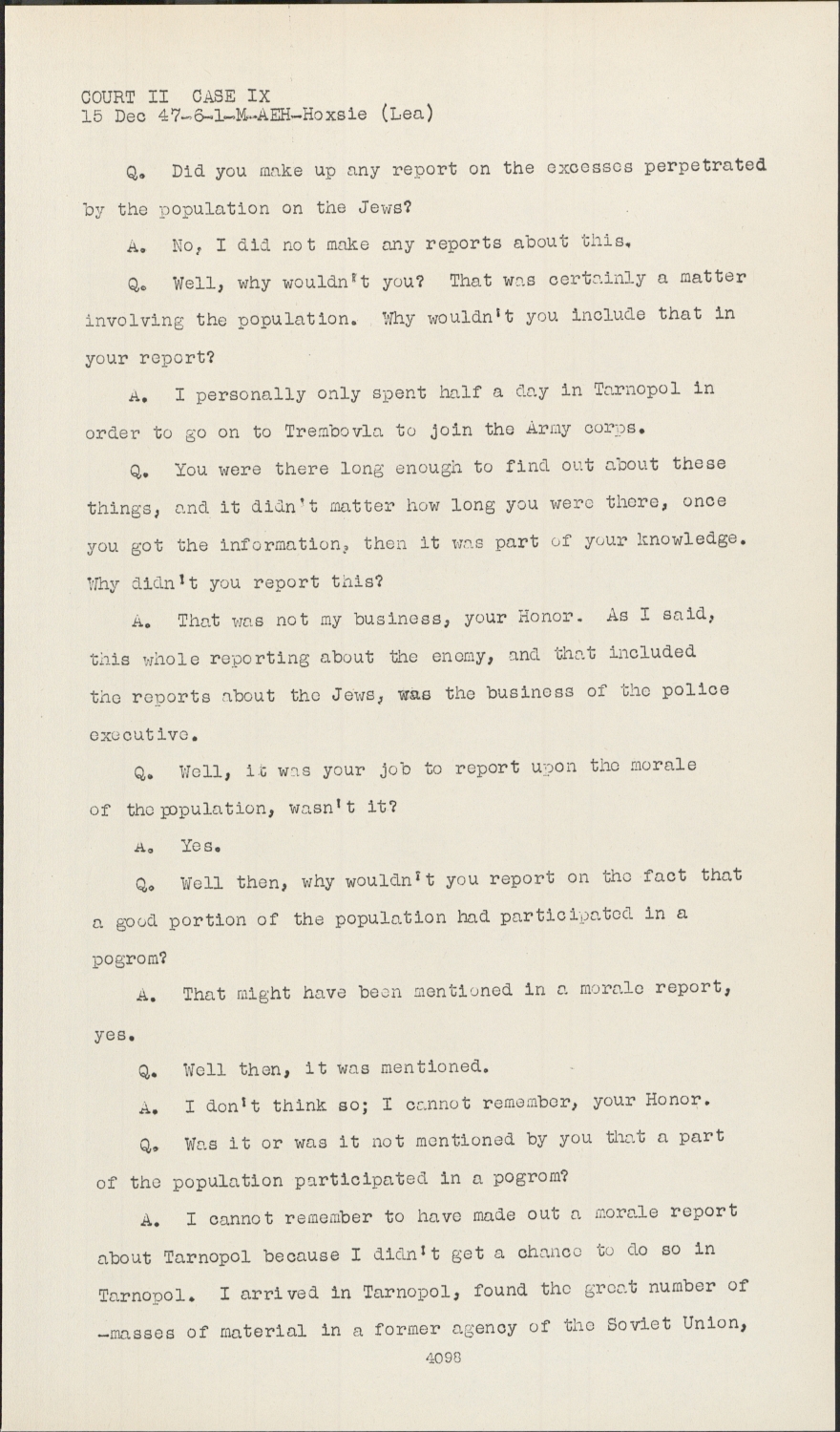
Q.Did you make up any report on the excesses perpetrated by the population on the Jews?
A.No, I did not make any reports about this.
Q.Well, why wouldn't you? That was certainly a matter involving the population. Why wouldn't you include that in your report?
A.I personally only spent half a day in Tarnopol in order to go on to Trembovla to join the Army corps.
Q.You were there long enough to find out about these things, and it didn't matter how long you were there, once you got the information, then it was part of your knowledge. Why didn't you report this?
A.That was not my business, your Honor. As I said, this whole reporting about the enemy, and that included the reports about the Jews, was the business of the police executive.
Q.Well, it was your job to report upon the morale of the population, wasn't it?
A.Yes.
Q.Well then, why wouldn't you report on the fact that a good portion of the population had participated in a pogrom?
A.That might have been mentioned in a morale report, yes.
Q.Well then, it was mentioned.
A.I don't think so; I cannot remember, your Honor.
Q.Was it or was it not mentioned by you that a part of the population participated in a pogrom?
A.I cannot remember to have made out a morale report about Tarnopol because I didn't get a chance to do so in Tarnopol. I arrived in Tarnopol, found the great number of -masses of material in a former agency of the Soviet Union, COURT II CASE IX and I looked at that material when I was there.
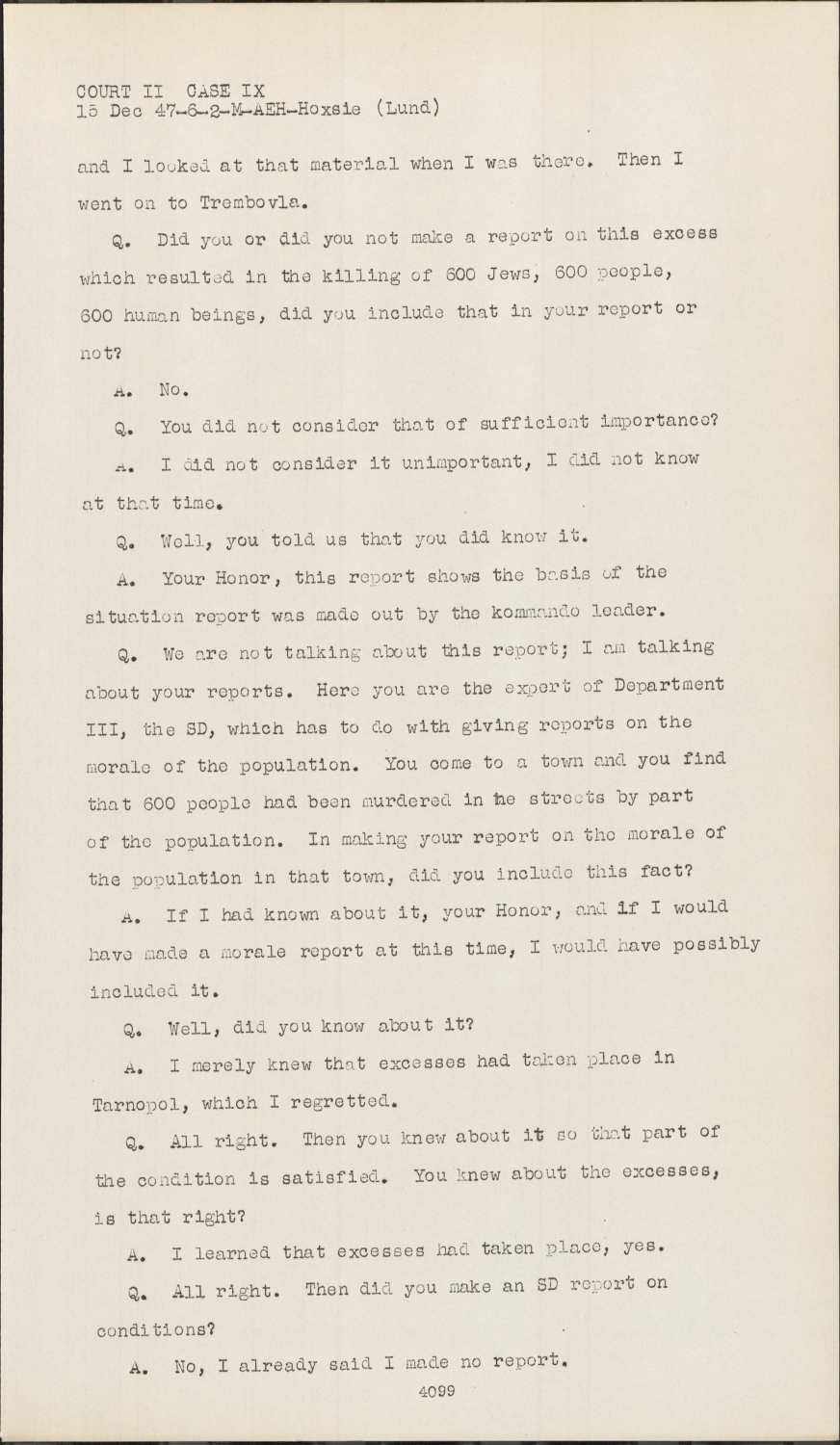
Then I went on to Trembovla.
Q.Did you or did you not make a report on this excess which resulted in the killing of 600 Jews, 600 people, 600 human beings, did you include that in your report or not?
A.No.
Q.You did not consider that of sufficient importance?
A.I did not consider it unimportant, I did not knew at that time.
Q.Well, you told us that you did know it.
A.Your Honor, this report shows the basis of the situation report was made out by the kommando leader.
Q.We are not talking about this report; I am talking about your reports. Here you are the export of Department III, the SD, which has to do with giving reports on the morale of the population. You come to a town and you find that 600 people had been murdered in he streets by part of the population. In making your report on the morale of the population in that town, did you include this fact?
A.If I had known about it, your Honor, and if I would have made a morale report at this time, I would have possibly included it.
Q.Well, did you know about it?
A.I merely knew that excesses had taken place in Tarnopol, which I regretted.
Q.All right. Then you knew about it so that part of the condition is satisfied. You knew about the excesses, is that right?
A.I learned that excesses had taken place, yes.
Q.All right. Then did you make an SD report on conditions?
A.No, I already said I made no report.
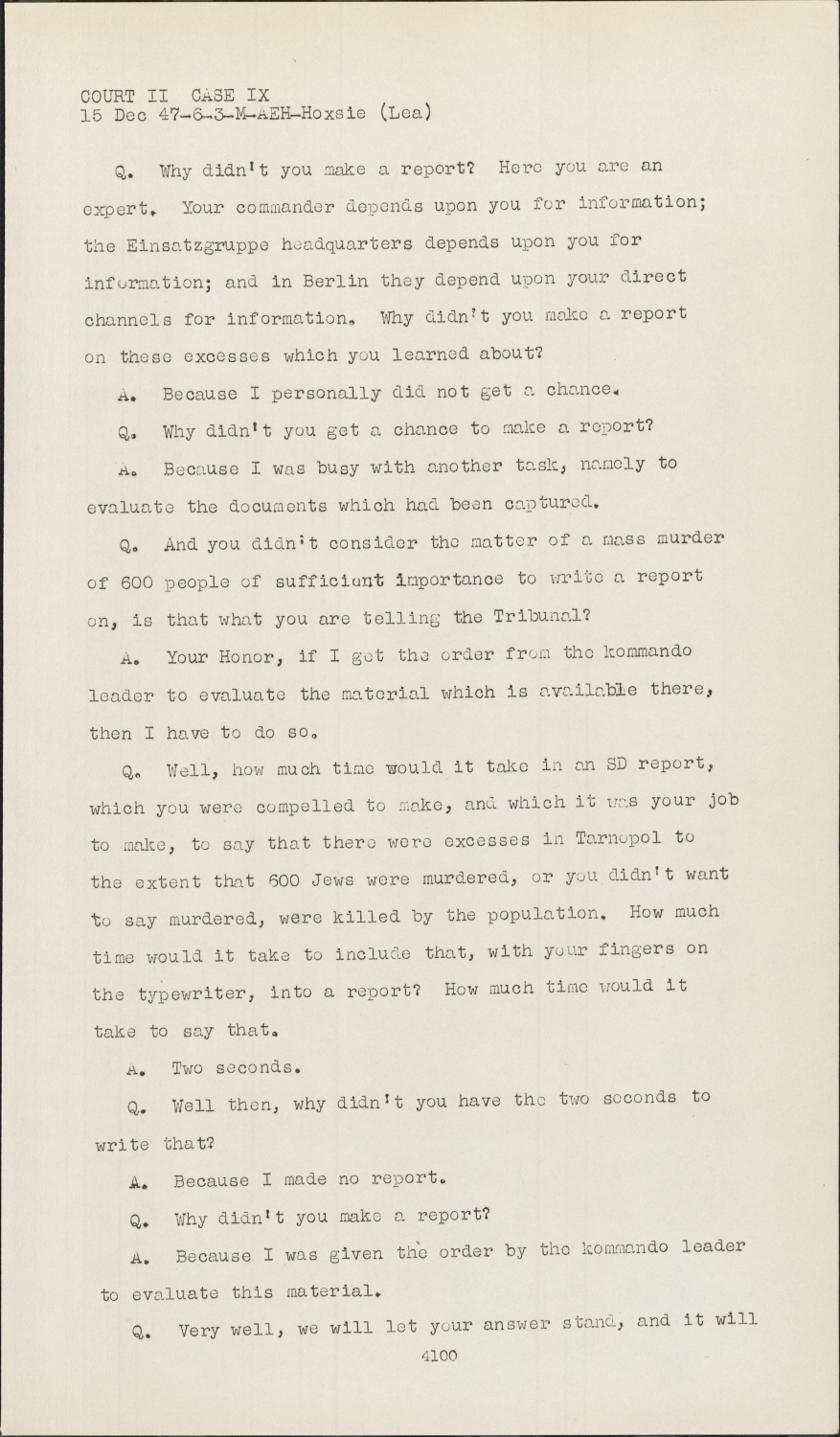
Q.Why didn't you make a report? Here you are an expert. Your commander depends upon you for information; the Einsatzgruppe headquarters depends upon you for information; and in Berlin they depend upon your direct channels for information. Why didn't you make a report on these excesses which you learned about?
A.Because I personally did not get a chance.
Q.Why didn't you get a chance to make a report?
A.Because I was busy with another task, namely to evaluate the documents which had been captured.
Q.And you didn't consider the matter of a mass murder of 600 people of sufficient importance to write a report on, is that what you are telling the Tribunal?
A.Your Honor, if I got the order from the kommando leader to evaluate the material which is available there, then I have to do so.
Q.Well, how much time would it take in an SD report, which you were compelled to make, and which it was your job to make, to say that there were excesses in Tarnopol to the extent that 600 Jews were murdered, or you didn't want to say murdered, were killed by the population. How much time would it take to include that, with your fingers on the typewriter, into a report? How much time would it take to say that.
A.Two seconds.
Q.Well then, why didn't you have the two seconds to write that?
A.Because I made no report.
Q.Why didn't you make a report?
A.Because I was given the order by the kommando leader to evaluate this material.
Q.Very well, we will let your answer stand, and it will COURT II CASE IX be evaluated later.
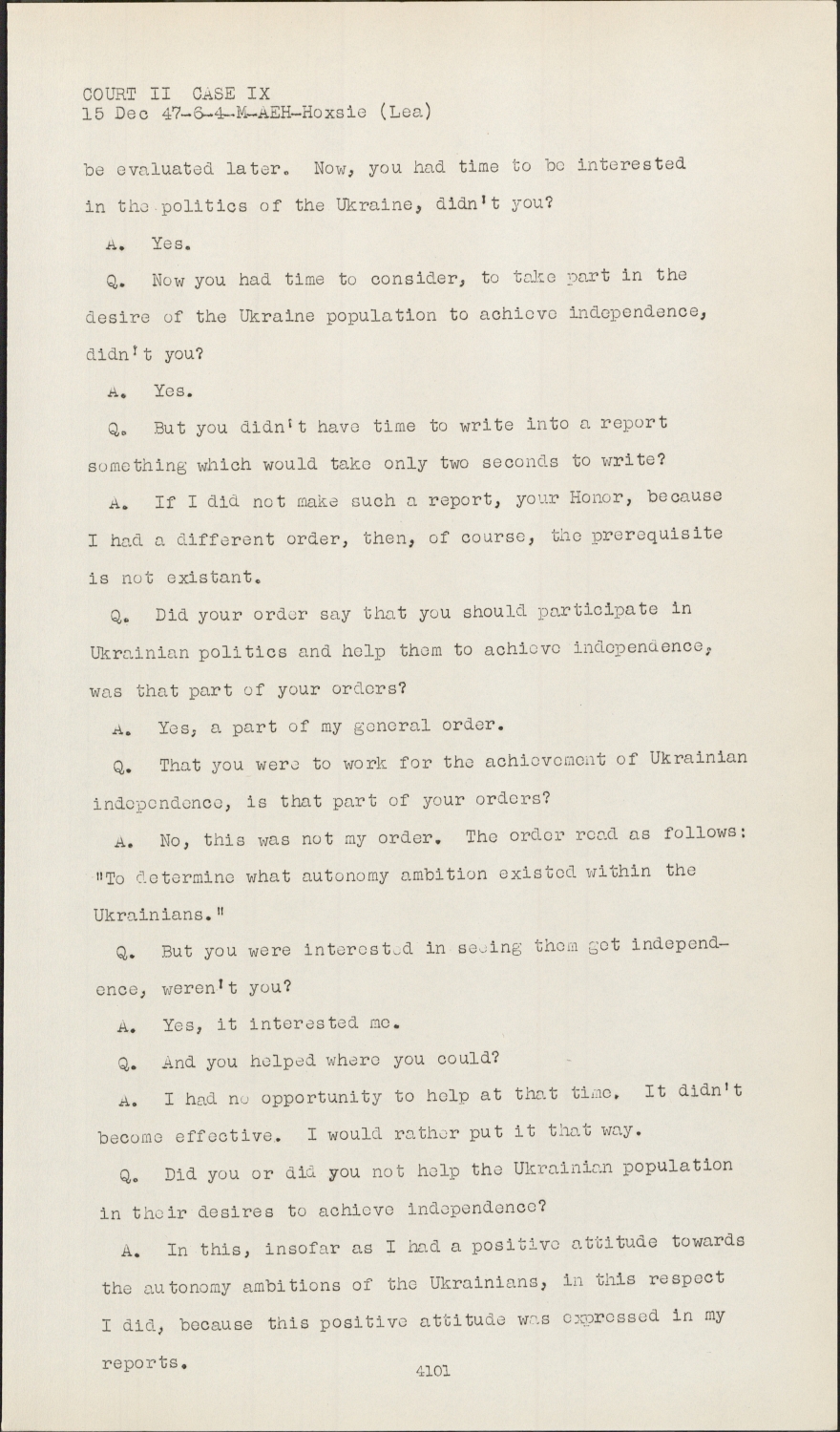
Now, you had time to be interested in the politics of the Ukraine, didn't you?
A.Yes.
Q.Now you had time to consider, to take part in the desire of the Ukraine population to achieve independence, didn't you?
A.Yes.
Q.But you didn't have time to write into a report something which would take only two seconds to write?
A.If I did not make such a report, your Honor, because I had a different order, then, of course, the prerequisite is not existant.
Q.Did your order say that you should participate in Ukrainian politics and help them to achieve independence, was that part of your orders?
A.Yes, a part of my general order.
Q.That you were to work for the achievement of Ukrainian independence, is that part of your orders?
A.No, this was not my order. The order read as follows: "To determine what autonomy ambition existed within the Ukrainians."
Q.But you were interested in seeing them get independence, weren't you?
A.Yes, it interested me.
Q.And you helped where you could?
A.I had no opportunity to help at that time, It didn't become effective. I would rather put it that way.
Q.Did you or did you not help the Ukrainian population in their desires to achieve independence?
A.In this, insofar as I had a positive attitude towards the autonomy ambitions of the Ukrainians, in this respect I did, because this positive attitude was expressed in my reports.