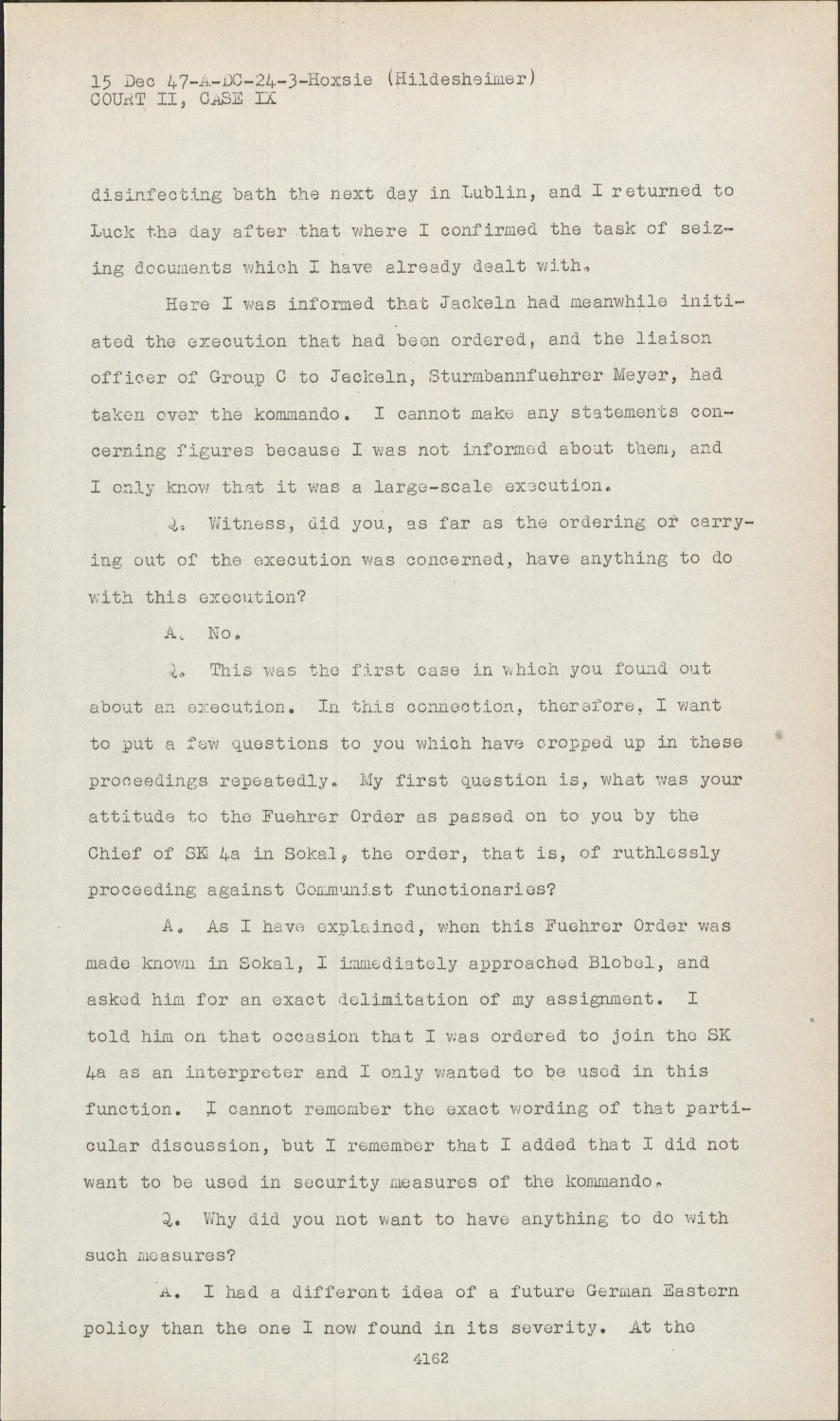
Here I was informed that Jackeln had meanwhile initiated the execution that had been ordered, and the liaison officer of Group C to Jeckeln, Sturmbannfuehrer Meyer, had taken over the kommando. I cannot make any statements concerning figures because I was not informed about them, and I only know that it was a large-scale execution.
Q.Witness, did you, as far as the ordering or carrying out of the execution was concerned, have anything to do with this execution?
A.No.
Q.This was the first case in which you found out about an execution. In this connection, therefore, I want to put a few questions to you which have cropped up in these proceedings repeatedly. My first question is, what was your attitude to the Fuehrer Order as passed on to you by the Chief of SK 4a in Sokal, the order, that is, of ruthlessly proceeding against Communist functionaries?
A.As I have explained, when this Fuehrer Order was made known in Sokal, I immediately approached Blobel, and asked him for an exact delimitation of my assignment. I told him on that occasion that I was ordered to join the SK 4a as an interpreter and I only wanted to be used in this function. I cannot remember the exact wording of that particular discussion, but I remember that I added that I did not want to be used in security measures of the kommando.
Q.Why did you not want to have anything to do with such measures?
A.I had a different idea of a future German Eastern policy than the one I now found in its severity. At the beginning of the war I was put into these conditions, and I had no clear picture of the aims of the German Eastern policy at that time.
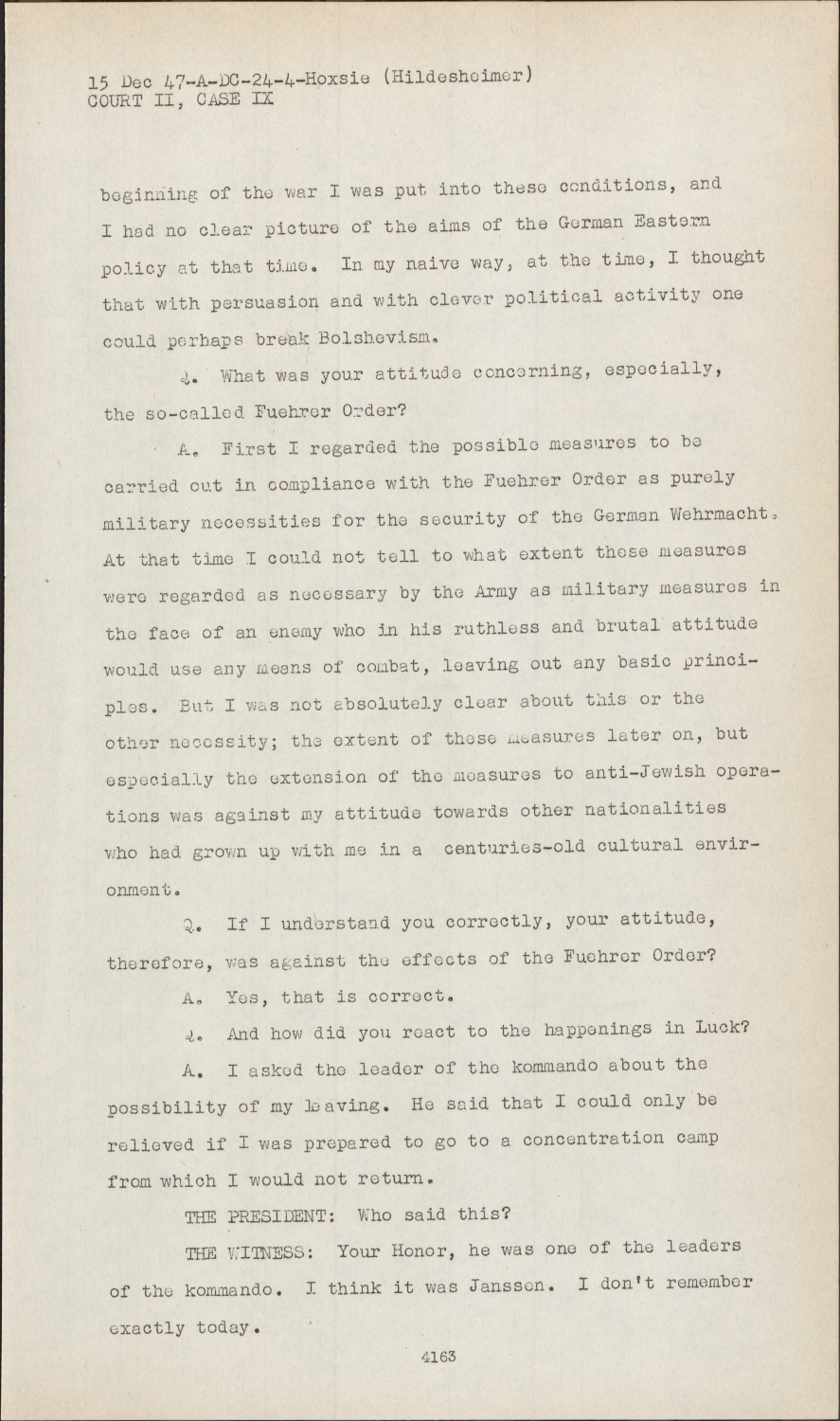
In my naive way, at the time, I thought that with persuasion and with clever political activity one could perhaps break Bolshevism.
Q.What was your attitude concerning, especially, the so-called Fuehrer Order?
A.First I regarded the possible measures to be carried out in compliance with the Fuehrer Order as purely military necessities for the security of the German Wehrmacht. At that time I could not tell to what extent these measures were regarded as necessary by the Army as military measures in the face of an enemy who in his ruthless and brutal attitude would use any means of combat, leaving out any basic principles. But I was not absolutely clear about this or the other necessity; the extent of these measures later on, but especially the extension of the measures to anti-Jewish operations was against my attitude towards other nationalities who had grown up with me in a centuries-old cultural environment.
Q.If I understand you correctly, your attitude, therefore, was against the effects of the Fuehrer Order?
A.Yes, that is correct.
Q.And how did you react to the happenings in Luck?
A.I asked the leader of the kommando about the possibility of my leaving. He said that I could only be relieved if I was prepared to go to a concentration camp from which I would not return.
THE PRESIDENT:Who said this?
THE WITNESS:Your Honor, he was one of the leaders of the kommando. I think it was Janssen. I don't remember exactly today.
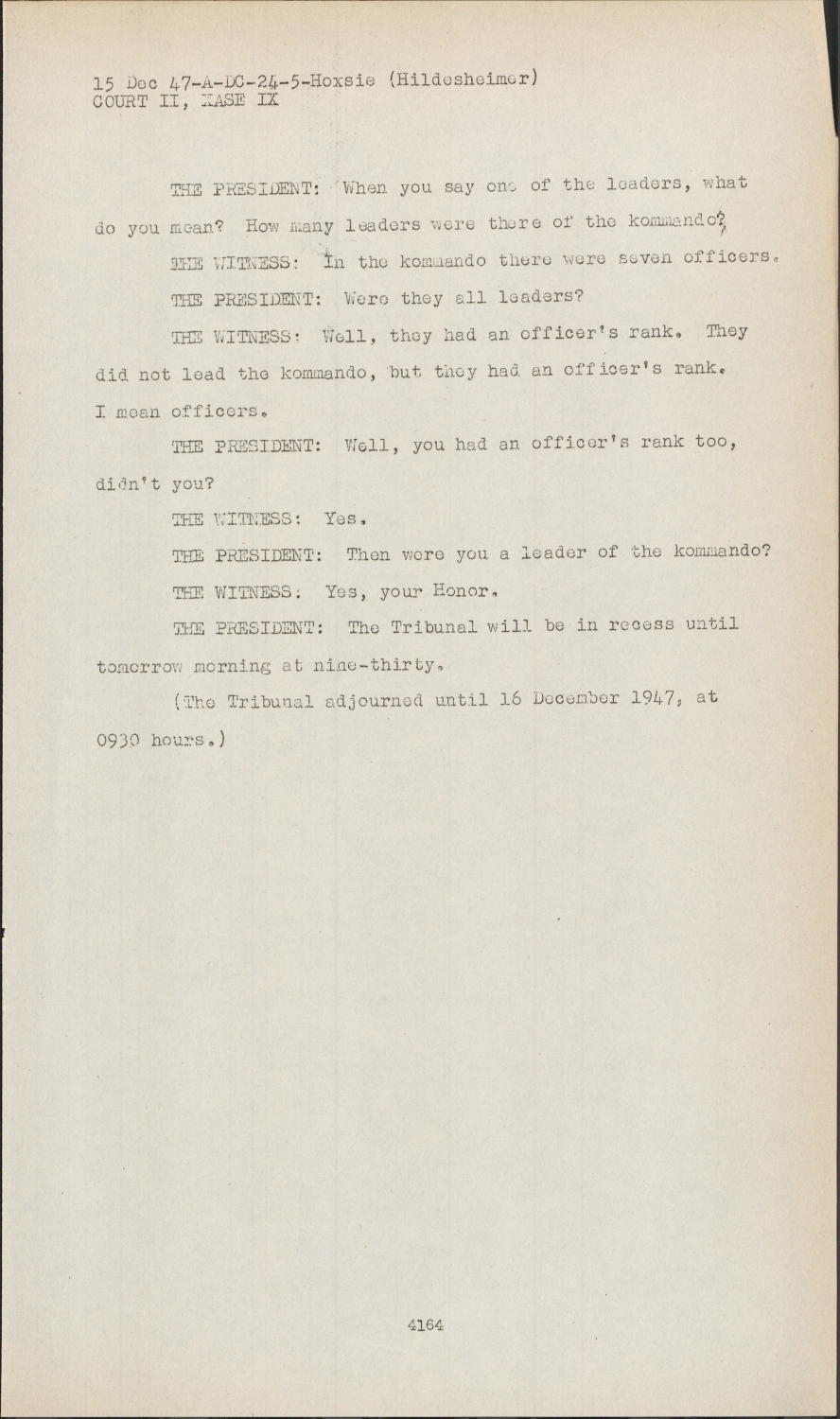
THE PRESIDENT:When you say one of the leaders, what do you mean? How many leaders were there of the kommando?
THE WITNESS:In the kommando there were seven officers.
THE PRESIDENT:Were they all leaders?
THEWITNESS; Well, they had an officer's rank. They did not lead the kommando, but they had an officer's rank. I mean officers.
THE PRESIDENT:Well, you had an officer's rank too, didn't you?
THE WITNESS:Yes.
THE PRESIDENT:Then were you a leader of the kommando?
THE WITNESS:Yes, your Honor.
THE PRESIDENT:The Tribunal will be in recess until tomorrow morning at nine-thirty. (The Tribunal adjourned until 16 December 1947, at 0930 hours.)
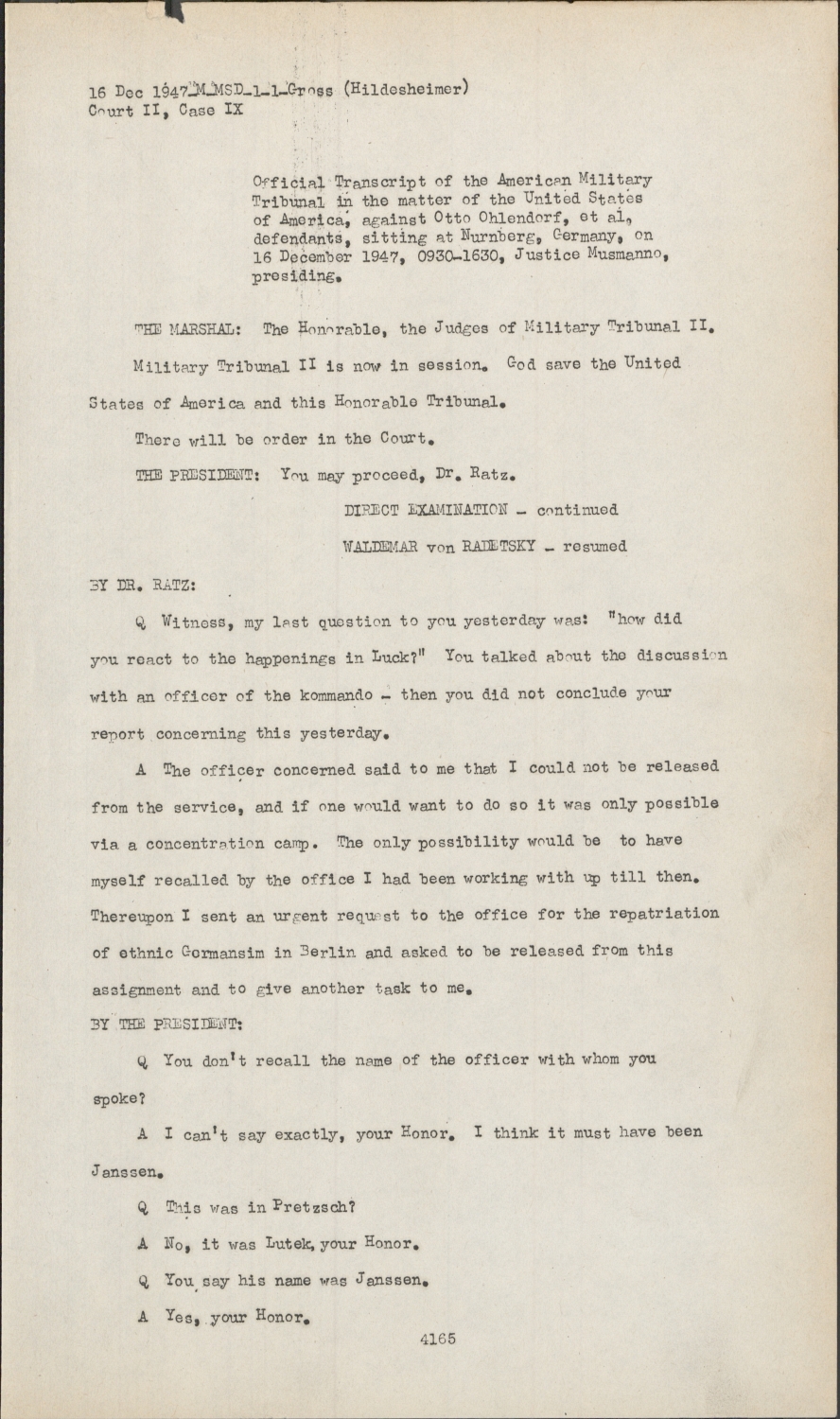
Official Transcript of the American Military Tribunal in the matter of the United States of America, against Otto Ohlendorf, et al, defendants, sitting at Nurnberg, Germany, on 16 December 1947, 0930-1630, Justice Musmanno, presiding.
THE MARSHAL:The Honorable, the Judges of Military Tribunal II. Military Tribunal II is now in session. God save the United States of America and this Honorable Tribunal.
There will be order in the Court.
THE PRESIDENT:You may proceed, Dr. Ratz.
DIRECT EXAMINATION - continued WALDEMAR von RADETSKY - resumed BY DR. RATZ:
QWitness, my last question to you yesterday was: "how did you react to the happenings in Luck?" You talked about the discussion with an officer of the kommando - then you did not conclude your report concerning this yesterday.
AThe officer concerned said to me that I could not be released from the service, and if one would want to do so it was only possible via a concentration camp. The only possibility would be to have myself recalled by the office I had been working with up till then. Thereupon I sent an urgent request to the office for the repatriation of ethnic Germansim in Berlin and asked to be released from this assignment and to give another task to me. BY THE PRESIDENT:
QYou don't recall the name of the officer with whom you spoke?
AI can't say exactly, your Honor. I think it must have been Janssen.
QThis was in Pretzsch?
ANo, it was Lutek, your Honor.
QYou say his name was Janssen.
AYes, your Honor.
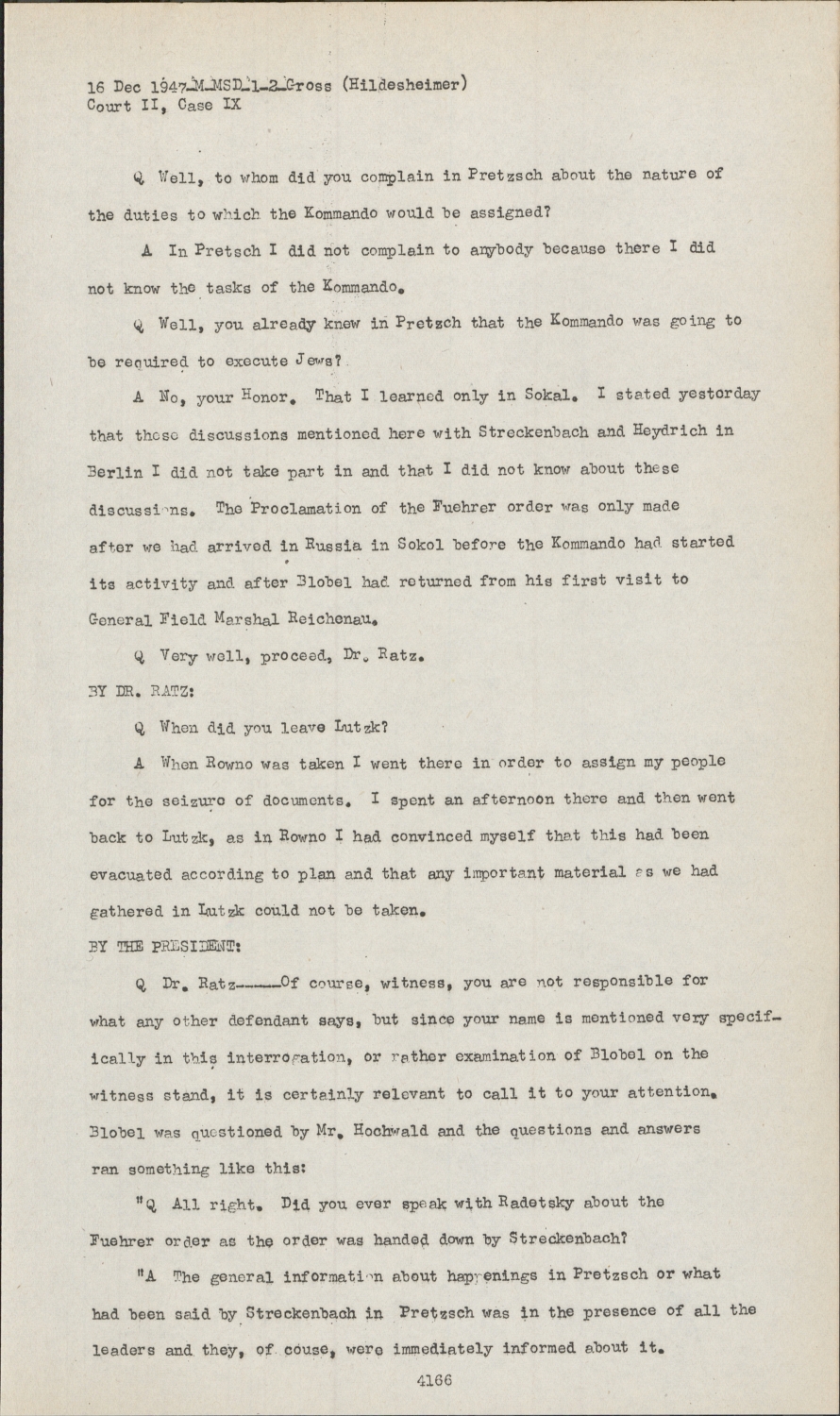
QWell, to whom did you complain in Pretzsch about the nature of the duties to which the Kommando would be assigned?
AIn Pretsch I did not complain to anybody because there I did not know the tasks of the Kommando.
QWell, you already knew in Pretzch that the Kommando was going to be required to execute Jews?
ANo, your Honor. That I learned only in Sokal. I stated yesterday that these discussions mentioned here with Streckenbach and Heydrich in Berlin I did not take part in and that I did not know about these discussions. The Proclamation of the Fuehrer order was only made after we had arrived in Russia in Sokol before the Kommando had started its activity and after Blobel had returned from his first visit to General Field Marshal Reichenau.
QVery well, proceed, Dr. Ratz. BY DR. RATZ:
QWhen did you leave Lutzk?
AWhen Rowno was taken I went there in order to assign my people for the seizure of documents. I spent an afternoon there and then went back to Lutzk, as in Rowno I had convinced myself that this had been evacuated according to plan and that any important material as we had gathered in Lutzk could not be taken. BY THE PRESIDENT:
QDr. Ratz-----Of course, witness, you are not responsible for what any other defendant says, but since your name is mentioned very specifically in this interrogation, or rather examination of Blobel on the witness stand, it is certainly relevant to call it to your attention. Blobel was questioned by Mr. Hochwald and the questions and answers ran something like this:
"Q All right, Did you ever speak with Radetsky about the Fuehrer order as the order was handed down by Streckehbach?
"A The general information about happenings in Pretzsch or what had been said by Streckenbach in Pretzsch was in the presence of all the leaders and they, of couse, were immediately informed about it.
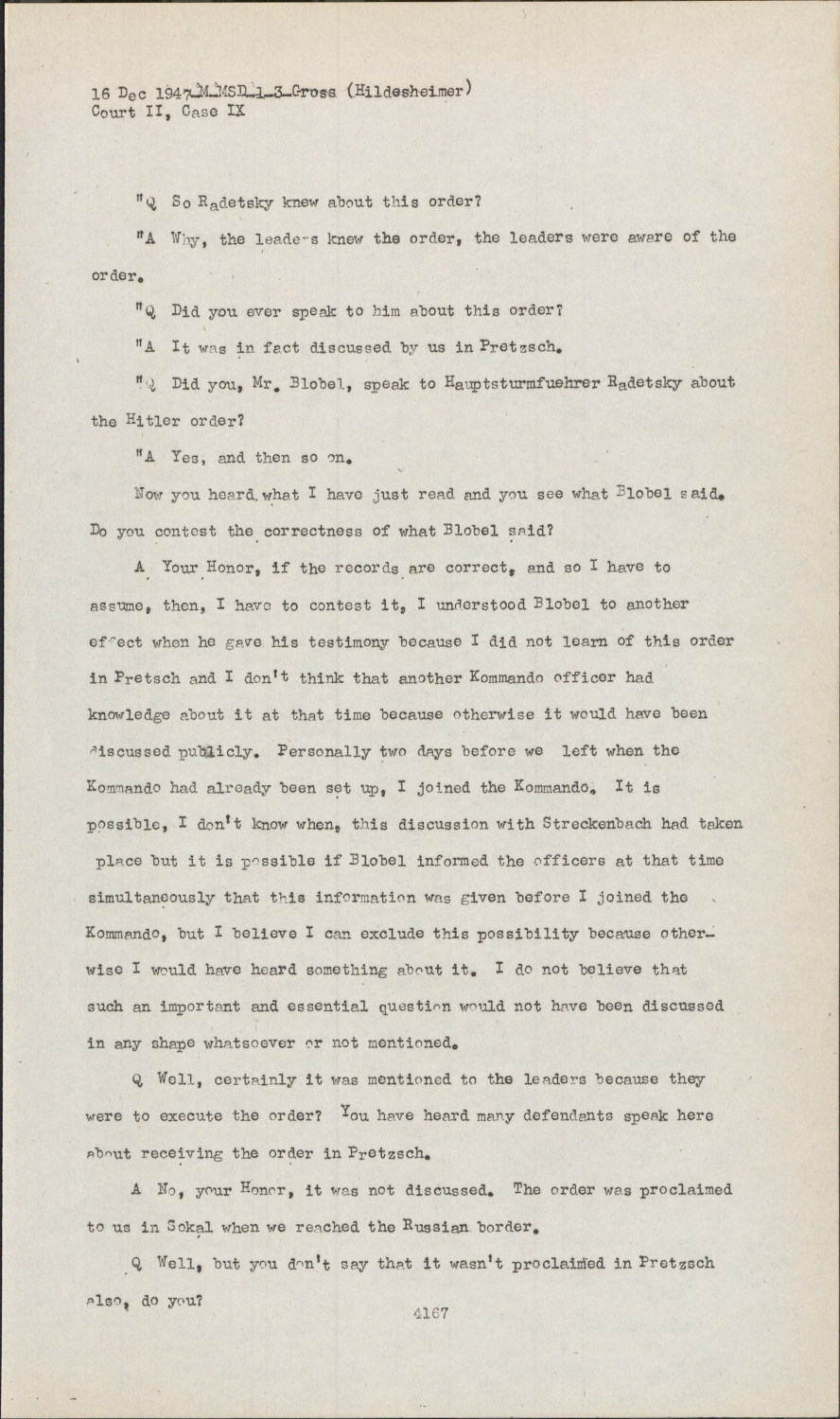
"Q So Radetsky knew about this order?
"A Why, the leaders knew the order, the leaders were aware of the order.
"Q Did you ever speak to him about this order?
"A It was in fact discussed by us in Pretzsch.
"Q Did you, Mr. Blobel, speak to Hautsturmfuehrer Radetsky about the Hitler order?
"A Yes, and then so on. Now you heard, what I have just read and you see what Blobel said. Do you contest the correctness of what Blobel said?
AYour Honor, if the records are correct, and so I have to assume, then, I have to contest it, I understood Blobel to another effect when he gave his testimony because I did not learn of this order in Pretsch and I don't think that another Kommando officer had knowledge about it at that time because otherwise it would have been discussed publicly. Personally two days before we left when the Kommando had already been set up, I joined the Kommando. It is possible, I don't know when, this discussion with Streckenbach had taken place but it is possible if Blobel informed the officers at that time simultaneously that this Information was given before I joined the Kommando, but I believe I can exclude this possibility because other wise I would have heard something about it. I do not believe that such an important and essential question would not have been discussed in any shape whatsoever or not mentioned.
QWell, certainly it was mentioned to the leaders because they were to execute the order? You have heard many defendants speak here about receiving the order in Pretzsch.
ANo, your Honor, it was not discussed. The order was proclaimed to us in Sokal when we reached the Russian border.
QWell, but you don't say that it wasn't proclaimed in Pretzsch also, do you?
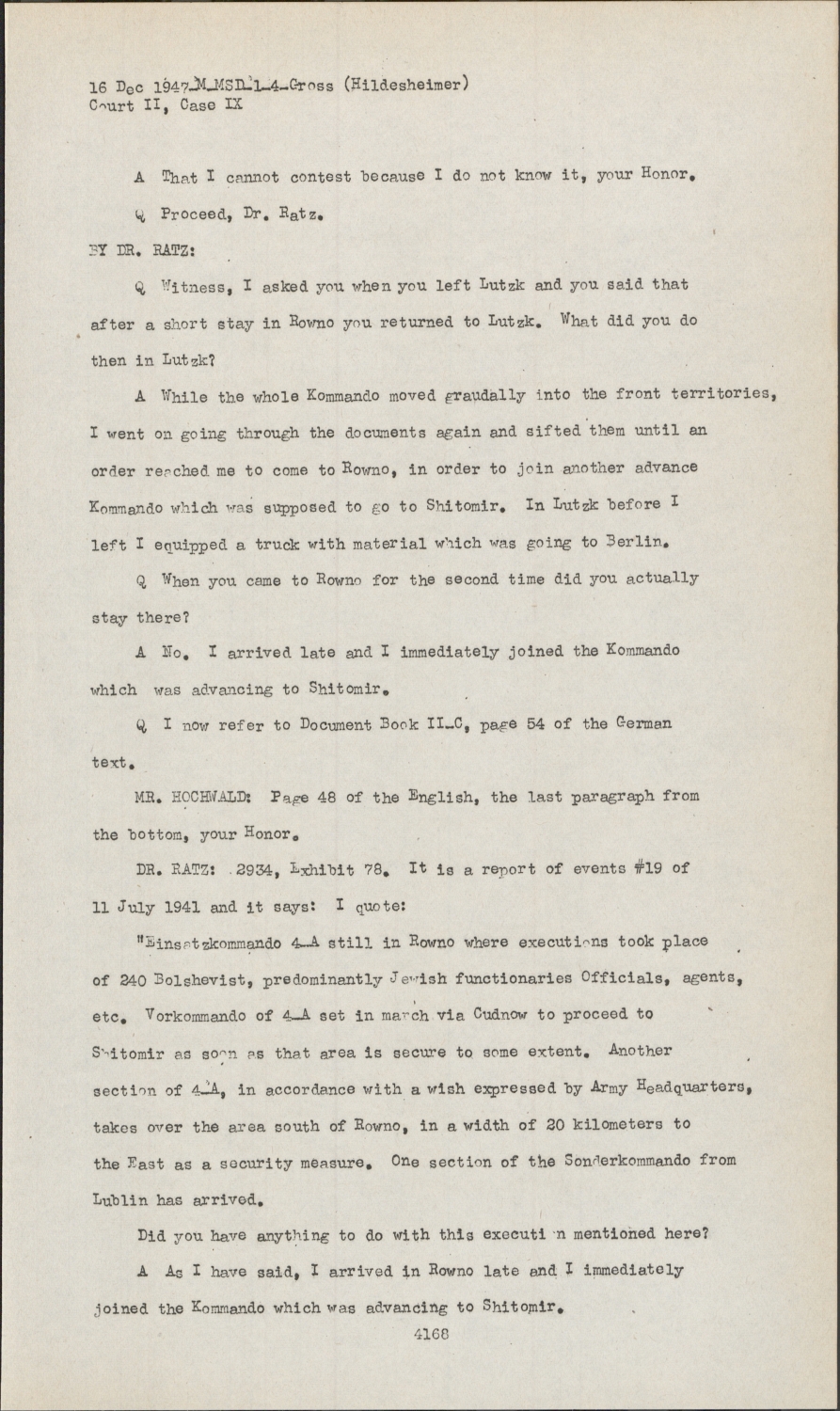
AThat I cannot contest because I do not know it, your Honor.
QProceed, Dr. Ratz. BY DR. RATZ:
QWitness, I asked you when you left Lutzk and you said that after a short stay in Rowno you returned to Lutzk. What did you do then in Lutzk?
AWhile the whole Kommando moved graudally into the front territories, I went on going through the documents again and sifted them until an order reached me to come to Rowno, in order to join another advance Kommando which was supposed to go to Shitomir. In Lutzk before I left I equipped a truck with material which was going to Berlin.
QWhen you came to Rowno for the second time did you actually stay there?
ANo. I arrived late and I immediately joined the Kommando which was advancing to Shitomir.
QI now refer to Document Book II-C, page 54 of the German text.
MR. HOCHWALD:Page 48 of the English, the last paragraph from the bottom, your Honor.
DR.RATZ: 2934, Exhibit 78. It is a report of events #19 of 11 July 1941 and it says: I quote:
"Einsatzkommando 4-A still in Rowno where executions took place of 240 Bolshevist, predominantly Jewish functionaries Officials, agents, etc. Vorkommando of 4-A set in march via Cudnow to proceed to Shitomir as soon as that area is secure to some extent. Another section of 4-A, in accordance with a wish expressed by Army Headquarters, takes over the area south of Rowno, in a width of 20 kilometers to the Fast as a security measure, One section of the Sonderkommando from Lublin has arrived.
Did you have anything to do with this execution mentioned here?
AAs I have said, I arrived in Rowno late and I immediately joined the Kommando which was advancing to Shitomir.
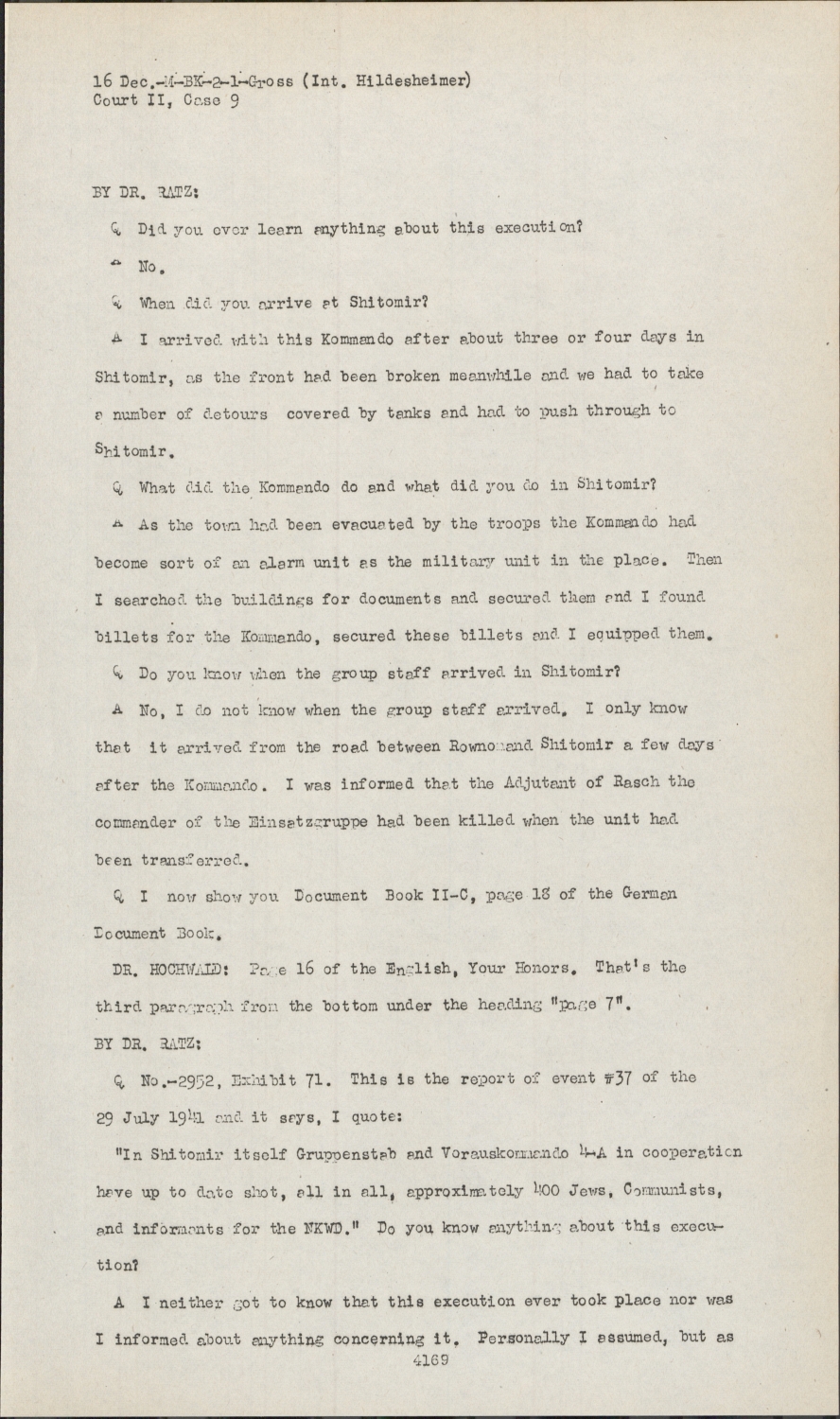
BY DR. RATZ:
QDid you over learn anything about this execution?
ANo.
QWhen did you arrive at Shitomir?
AI arrived with this Kommando after about three or four days in Shitomir, as the front had been broken meanwhile and we had to take a number of detours covered by tanks and had to push through to Shitomir.
QWhat did the Kommando do and what did you do in Shitomir?
AAs the town had been evacuated by the troops the Kommando had become sort of an alarm unit as the military unit in the place. Then I searched the buildings for documents and secured them and I found billets for the Kommando, secured these billets and I equipped them.
QDo you know when the group staff arrived in Shitomir?
ANo, I do not know when the group staff arrived. I only know that it arrived from the road between Rowno and Shitomir a few days after the Kommando. I was informed that the Adjutant of Rasch the commander of the Einsatzgruppe had been killed when the unit had been transferred.
QI now show you Document Book II-C, page 18 of the German Document Book.
DR. HOCHWALD:Page 16 of the English, Your Honors. That's the third paragraph from the bottom under the heading "page 7".
BY DR. RATZ:
QNo.-2952, Exhibit 71. This is the report of event #37 of the 29 July 1941 and it says, I quote:
"In Shitomir itself Gruppenstab and Vorauskommando 4-A in cooperation have up to date shot, all in all, approximately 400 Jews, Communists, and informants for the NKWD." Do you know anything about this execution?
AI neither got to know that this execution ever took place nor was I informed about anything concerning it. Personally I assumed, but as I say it is only an assumption, that if the Einsatzgruppe ordered such an execution, it must have been responsible for the carrying out of the execution itself.
QWhat did you do then in Shitomir?
AAs I did not receive a positive answer to my letter which I addressed to the office for the repatriation of ethnic Germans to be released from the Einsatzgruppe and since it could not he expected very soon I dedicated myself intensively to my actual task of reporting. I had to do this the more as the additional assignment - the Ukrainian questions - after a discussion with the representative of the Einsatzgruppe, Dr. Beyer, had been turned over to the interpreter Mueller. Mueller had spent all his life in the Ukraine and knew the Ukrainian language which I did not know.
QWhy did you resign from your field of activities with the Ukrainian questions?
AThe situation was the following. In 1917 after the Russian Revolution -BY THE PRESIDENT:
QWitness, just before you go into that, please. Do you say that you did not understand the Ukrainian language?
ANo, Your Honor.
QI thought that you were taken into this Kommando because of your linguistic talents.
AYour Honor, I spoke Russian.
Q, Well, when they took you into this Kommando certainly they knew where the Kommando was going to operate, and if they took you as in interpreter certainly they would assume that you would speak the language of the territory in which the unit was to operate.
AYour Honor, No consideration was taken to this apparently because I know Latvian and I know a little Estonian and it would have been the most natural thing to do to send me to my old home country, but this was not done but I was assigned to the Kommando which went to the Ukraine.
QDid you lead them to believe that you could speak the Ukrainian language?
ATo the Kommando officer?
QYes. When you were being considered for this post did you have them believe, because of what you said, or because of your attitude, did you lead them to believe that you were familiar with the Ukrainian language?
AHo, Your Honor.
QThey could have found out very easily that you did not speak the Ukrainian language, couldn't they?
AYes.
QDid they then know that you could not speak the Ukrainian language?
AYes, certainly.
QSo, therefore, your services as an interpreter were absolutely nil in this Kommando?
ANo, Your Honor. There is a great distinction between the Ukrainian language and the Russian. The difference is one of dialect. One can make one self understood in emergency cases.
QWell, did you then know the Ukrainian language?
AI knew it, but I did not speak it, if I may put it that way.
QWhy did you say just a little while ago you did not know the Ukrainian language?
AYour Honor, what I really wanted to say was that I could not speak the Ukrainian language, and I understood your question to the effect whether I know, whether I was aware of the Ukrainian language, whether I knew its consistance, whether there is a distinction between the Russian and the Ukrainian, I knew the distinction.
QIf I ask a person if he knows French, what do you suppose I am asking him?
AWhether he Masters the language.
Q whether he can understand it and speak it. That is what is understood by knowing a language, isn't it?
AYes.
QYou wouldn't ask a person if he knows a language end expect him to give you an etymological discussion on the language, would you?
AI am sorry I didn't understand your question, Your Honor.
QWhen I asked you if you knew the Ukrainian language it was very obvious that I was not asking you to give us the history of the Ukrainian language and all the theory of its creation and development. That was obvious, wasn't it?
AYes, Your Honor, I think I did express myself to the effect that I did not master the Ukrainian language.
QWell, then why did you say that you did not know the language and now you tell us you do know it.
AYour Honor, perhaps I misunderstood this or I expressed myself badly. I could not speak Ukrainian but I understood your last question to be whether I knew whether the Ukrainian was different from. Russian, whether I had knowledge at all of the Ukrainian language. In its distinction and in its spoken form and that I know, later on I learned Ukrainian and I could converse in the Ukrainian language.
QWell, now you tell us that you knew the language both to understand it and to speck it.
AYes.
QSo that in the course of three minutes you go from an absolute ignorance of the language to a complete possession of the language,
AYour Honor, it took two years that I picked up Ukrainian enough to speak it.
QYes, but when I asked you three minutes ago whether you knew the Ukrainian language you said no.
Then a minute or two later you said, Well, you understood it, now you tell us that you could speck it.
AYour Honor, may I clarify this which I had misunderstood? When I arrived in Russia I only spoke Russian. I knew that the Ukrainian language was different from the Russian and only later, during my stay in Ukrainia I gradually learned to speak the language.
QWhen I asked you if you knew the Ukrainian language why didn't you say yes, I didn't know it when I went to Russia but I learned it. That would be a forthright simple answer, wouldn't it?
AYes, I understood the question to be, whether at the time I knew the Ukrainian language.
QWell then, let's sum this up, when you reached the Ukraine you could understand the Ukrainian language, but could not speak it, is that correct?
AYes.
QThen later on you developed a proficiency in the language and then could speak it?
AYes.
QHow long after you arrived in the Ukraine did you acquire that familiarity with the language which permitted you to converse in it?
AAbout a year and a half to two years.
QWell, how long were you in the Ukraine?
AI was in the Ukraine for two years.
QThen it was only during the last six months of it that you could speak it?
AYes.
THE PRESIDENT:Proceed.
DIRECT EXAMINATION (Continued) BY DR. RATZ:
QWhy did you have yourself released from dealing with Ukrainian questions, Witness?
AThe situation was the following: In 1917. after the Russian revolution, the Ukraine proclaimed their independence, and defended this independence against the Soviets for four years until it was overpowered.
MR.HORLICK-HOCHWALD: If your Honor please, I do think that the witness goes again into a lecture on Eastern politics starting in 1917 at a time when he was seven years of age.
THE PRESIDENT:Well, if it isn't too long, Mr. Hochwald, we will hear it. Very well, the Ukraine declared its independence and defended if for four years. Then what?
A (Continuing) When the Eastern compaign began the Ukraine Government proclaimed their independence again in Lemberg, after all authorities in question, like the OKW, Eastern Ministry, and so on, had declared themselves prepared to agree to it.
In spite of this an order was issued that the Ukraine administration would be taken in so-called honorary custody, and all attempts for independence would have to be stopped. I had a discussion concerning this with Dr. Beyer who was the departmental expert for Ukrainian questions in the Einstazgruppe, in the course of which it was decided that he would immediately go to Berlin to the Reich Security Main Office in order to achieve a revocation or pacilitation of the proclamation. I personally saw myself not in the position to participate in a matter which had been negatively decided from its very beginning. In addition to this there was the fact I did not master the Ukrainian language because I had been employed as an interpreter for the Russian language. The Interpreter Mueller, however, believed, supported by the moderate party in the Ukraine, to achieve a success in time. He became interested in this question, especially as he was hoping that Beyer would he successful in his attempts in Berlin. My assumption, however, did not cheat me as Beyer came back not having achieved a thing.
THE PRESIDENT:Did Mueller speak the Ukrainian language?
THE WITNESS:Yes, your Honor.
THE PRESIDENT:Very well.
THE WITNESS:Therefore I never dealt with Ukrainian nor did I ever deal with the Jewish question as far as reporting goes.
Q (By Dr. Ratz) why did you not deal with the Jewish question?
AAgain on the same occasion I had a discussion with Dr. Beyer. In this Question, as well as in the Ukrainian question, he wanted to report to Heydrich in order to try that another attitude toward Jews in the Ukraine would he effected. This again he did not achieve. I, on my part, had to fear that if any reporting whatsoever on these two questions should be done by me I would automatically drift into executive activities as the whole dealing with the Jewish question went via Chief IV of Einsatzgruppen C, and the whole dealing of the Ukrainian problem went via the Ukraine expert, Dr. Beyer with this, my reports, as It actually happened in the future, would not only go to the Chief III of the Einsatzgruppe and then, as I have already said, I would have to come into contact with those who ordered executions, which I wanted to prevent and which I managed to avoid.
EXAMINATION BY THE PRESIDENT:
QI didn't quite catch that, you managed to prevent executions?
ANo, your Honor, I said, I managed to avoid getting into contact with the authorities who were responsible for executive activity, that is the whole Security Police activity. If I had reported to them about a question which, on the other hand, would have been dealt with by the Security Police authorities, I might have been employed in some further Security Police activity. Perhaps I may give an example to clarify this.
QWell now, wait there, now what did you do? You were not an interpreter, and you had nothing to do with executions. Why did they carry you along in this outfit?
AYour Honor, I was interpreter for Russian.
QWell, but a Russian interpreter was of no account in the Ukraine. Now, we have that settled. What did you do with this Einsatzkommando? You didn't interpret; you had nothing to do with executions. Why did they carry you along?
AYour Honor, first I was e-employed in seizing and safeguarding the documents. If I had the time, I mad out reports, and then I was employed as the liaison officer with the Wehrmacht, first of all because that was my express wish.
QWhat did you report on? You say, if you had the time. When you had the time, what did you report on?
AFirst I made out reports, on agriculture, industry and trade, and then I reported about cultural questions. My main attention went to questions of economy because that was something I knew something about.
Q well, in reporting on economy, you would have to know about the Jews, wouldn't you?
AYour Honor, I did do so.
QAnd when you reported on economy you had to report on the Jews who were being executed, didn't you?
AHe, your Honor.
QIf the Jews in any given territory were executed it would seriously affect the economy of that territory, wouldn't it?
AYour Honor, the whole economy of the Ukraine was in a very bad state, at that time.
QPlease answer that question. If the Jews were executed in-any given territory, that mere fact would have a very grave effect on the economy, wouldn't it?
ACertainly, your Honor.
QThen in making a report on the economy you would have to say, because of the depletion of the labor supply due to the execution of Jews, a certain situation has resulted, You would have to say that, wouldn't you?
AYour Honor, all these questions concerning Jews were merely the sphere of activities of Departments 3 and 4, and I did not report about these activities.
QYou did not answer my question. Making a report on the economy you would naturally have to talk about labor, and if a great number of those constituting the labor element were executed, that would affect seriously the economy of the country on which you were reporting, and you would need to include that in your reports, would you not?
AThe situation which was found, your Honor, was that the entire economy had been ruined and had to be built up. There was no shop in which you could buy anything.
QThe economy wasn't helped by shooting off further labor supply, was it?
ANo.
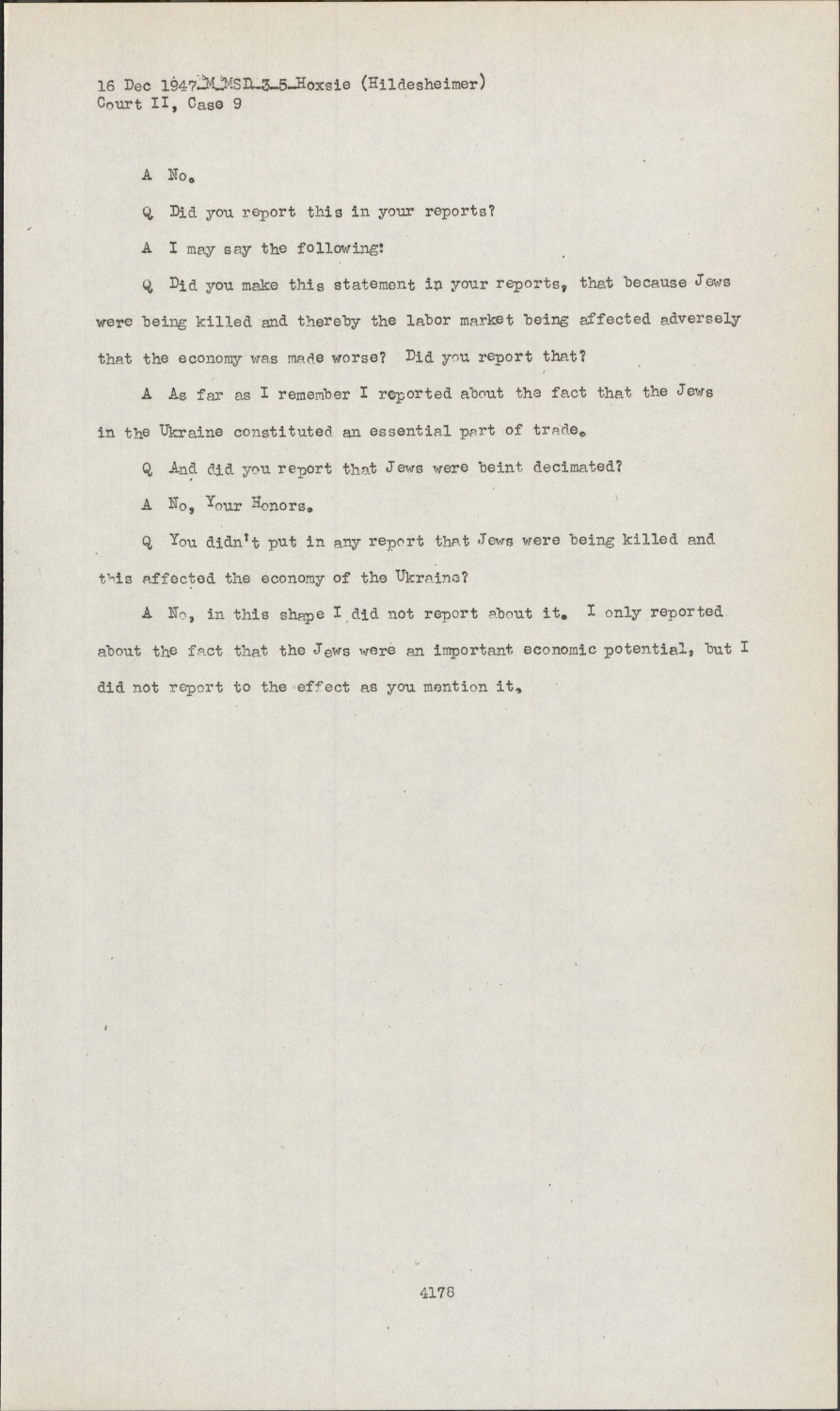
ANo.
QDid you report this in your reports?
AI may say the following:
QDid you make this statement in your reports, that because Jews were being killed and thereby the labor market being affected adversely that the economy was made worse? Did you report that?
AAs far as I remember I reported about the fact that the Jews in the Ukraine constituted an essential part of trade.
QAnd did you report that Jews were beint decimated?
ANo, Your Honors.
QYou didn't put in any report that Jews were being killed and this affected the economy of the Ukraine?
ANo, in this shape I did not report about it. I only reported about the fact that the Jews were an important economic potential, but I did not report to the effect as you mention it.
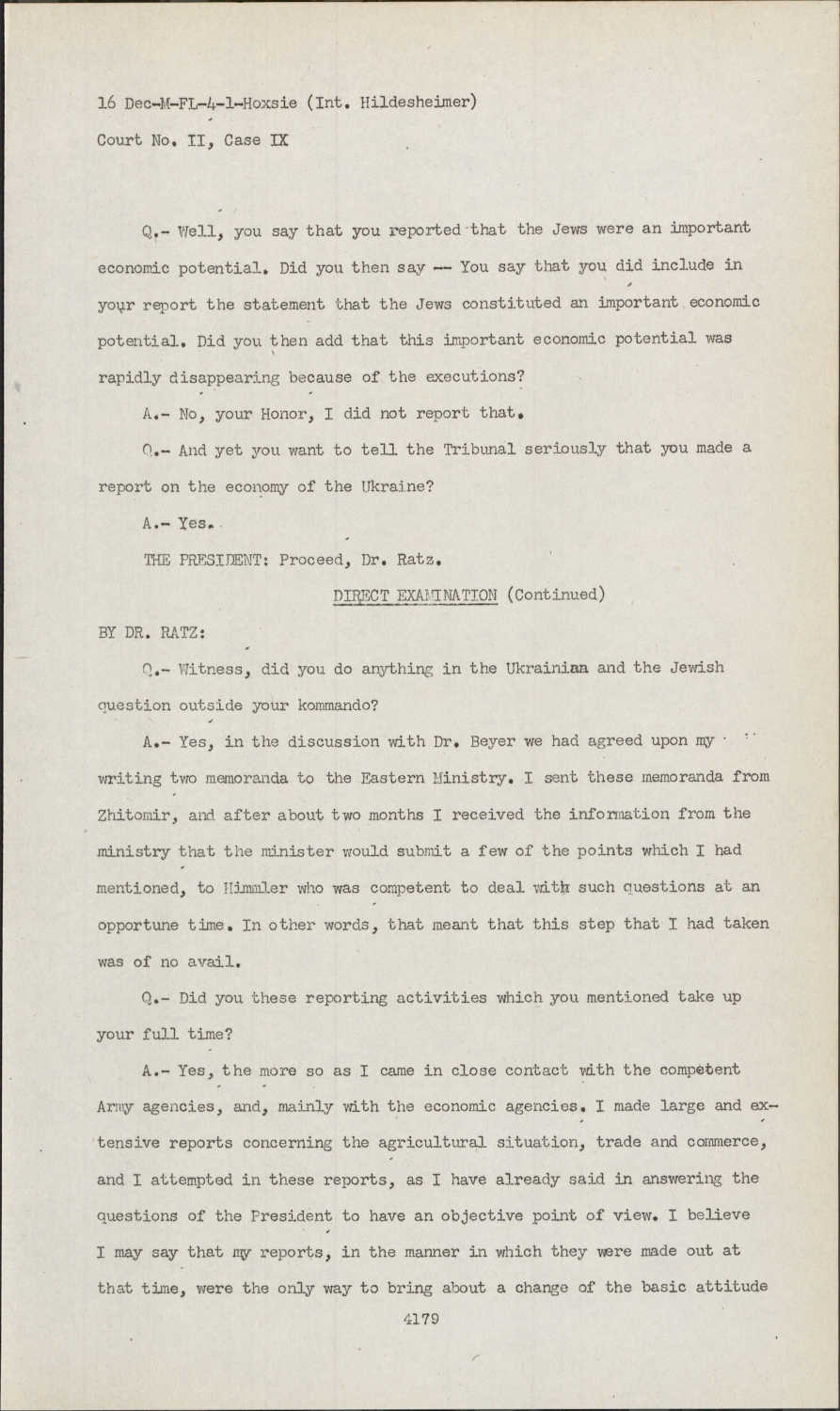
Q.- Well, you say that you reported that the Jews were an important economic potential. Did you then say -- You say that you did include in your report the statement that the Jews constituted an important economic potential. Did you then add that this important economic potential was rapidly disappearing because of the executions?
A.- No, your Honor, I did not report that.
Q.- And yet you want to tell the Tribunal seriously that you made a report on the economy of the Ukraine?
A.- Yes.
THE PRESIDENT:Proceed, Dr. Ratz.
DIRECT EXAMINATION (Continued) BY DR. RATZ:
Q.- Witness, did you do anything in the Ukrainian and the Jewish question outside your kommando?
A.- Yes, in the discussion with Dr. Beyer we had agreed upon my writing two memoranda to the Eastern Ministry. I sent these memoranda from Zhitomir, and after about two months I received the information from the ministry that the minister would submit a few of the points which I had mentioned, to Himmler who was competent to deal with such questions at an opportune time. In other words, that meant that this step that I had taken was of no avail.
Q.- Did you these reporting activities which you mentioned take up your full time?
A.- Yes, the more so as I came in close contact with the competent Army agencies, and, mainly with the economic agencies. I made large and extensive reports concerning the agricultural situation, trade and commerce, and I attempted in these reports, as I have already said in answering the questions of the President to have an objective point of view. I believe I may say that my reports, in the manner in which they were made out at that time, were the only way to bring about a change of the basic attitude of the German Reich towards the Eastern problems, and I found this confirmed on repeated occasions.
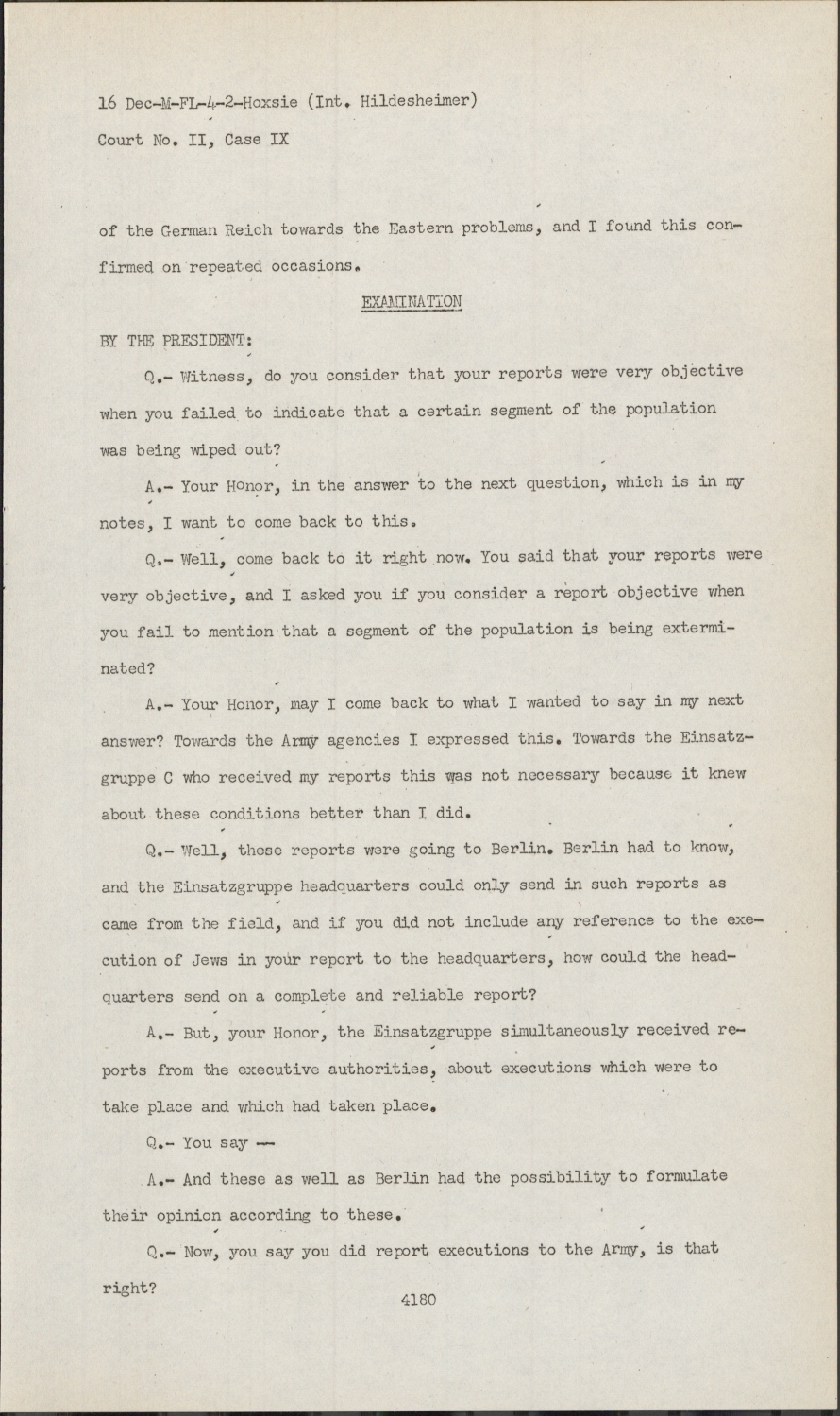
EXAMINATION BY THE PRESIDENT:
Q.- Witness, do you consider that your reports were very objective when you failed to indicate that a certain segment of the population was being wiped out?
A.- Your Honor, in the answer to the next question, which is in my notes, I want to come back to this.
Q.- Well, come back to it right now. You said that your reports were very objective, and I asked you if you consider a report objective when you fail to mention that a segment of the population is being exterminated?
A.- Your Honor, may I come back to what I wanted to say in my next answer? Towards the Army agencies I expressed this. Towards the Einsatzgruppe C who received my reports this was not necessary because it knew about these conditions better than I did.
Q.- Well, these reports were going to Berlin. Berlin had to know, and the Einsatzgruppe headquarters could only send in such reports as came from the field, and if you did not include any reference to the execution of Jews in your report to the headquarters, how could the headquarters send on a complete and reliable report?
A.- But, your Honor, the Einsatzgruppe simultaneously received reports from the executive authorities, about executions which were to take place and which had taken place.
Q.- You say -
A.- And these as well as Berlin had the possibility to formulate their opinion according to these.
Q.- Now, you say you did report executions to the Army, is that right?
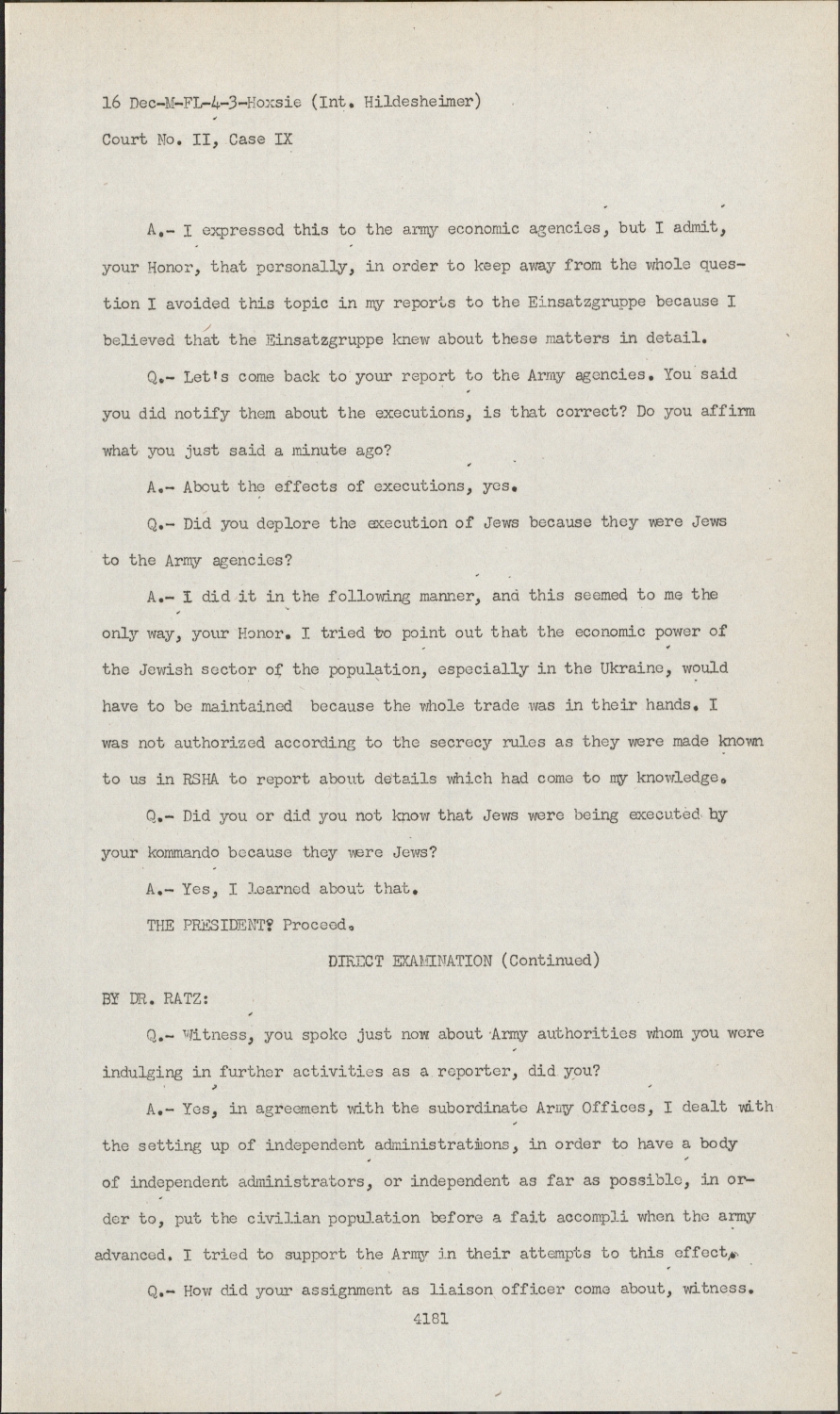
A.- I expressed this to the army economic agencies, but I admit, your Honor, that personally, in order to keep away from the whole question I avoided this topic in my reports to the Einsatzgruppe because I believed that the Einsatzgruppe knew about these matters in detail.
Q.- Let's come back to your report to the Army agencies. You said you did notify them about the executions, is that correct? Do you affirm what you just said a minute ago?
A.- About the effects of executions, yes.
Q.- Did you deplore the execution of Jews because they were Jews to the Army agencies?
A.- I did it in the following manner, and this seemed to me the only way, your Honor. I tried to point out that the economic power of the Jewish sector of the population, especially in the Ukraine, would have to be maintained because the whole trade was in their hands. I was not authorized according to the secrecy rules as they were made known to us in RSHA to report about details which had come to my knowledge.
Q.- Did you or did you not know that Jews were being executed by your kommando because they were Jews?
A.- Yes, I learned about that.
THEPRESIDENT? Proceed.
DIRECT EXAMINATION (Continued) BY DR. RATZ:
Q.- witness, you spoke just now about Army authorities whom you were indulging in further activities as a reporter, did you?
A.- Yes, in agreement with the subordinate Army Offices, I dealt with the setting up of independent administrations, in order to have a body of independent administrators, or independent as far as possible, in order to, put the civilian population before a fait accompli when the army advanced. I tried to support the Army in their attempts to this effect.
Q.- How did your assignment as liaison officer come about, witness.