QIf I ask a person if he knows French, what do you suppose I am asking him?
AWhether he Masters the language.
Q whether he can understand it and speak it. That is what is understood by knowing a language, isn't it?
AYes.
QYou wouldn't ask a person if he knows a language end expect him to give you an etymological discussion on the language, would you?
AI am sorry I didn't understand your question, Your Honor.
QWhen I asked you if you knew the Ukrainian language it was very obvious that I was not asking you to give us the history of the Ukrainian language and all the theory of its creation and development. That was obvious, wasn't it?
AYes, Your Honor, I think I did express myself to the effect that I did not master the Ukrainian language.
QWell, then why did you say that you did not know the language and now you tell us you do know it.
AYour Honor, perhaps I misunderstood this or I expressed myself badly. I could not speak Ukrainian but I understood your last question to be whether I knew whether the Ukrainian was different from. Russian, whether I had knowledge at all of the Ukrainian language. In its distinction and in its spoken form and that I know, later on I learned Ukrainian and I could converse in the Ukrainian language.
QWell, now you tell us that you knew the language both to understand it and to speck it.
AYes.
QSo that in the course of three minutes you go from an absolute ignorance of the language to a complete possession of the language,
AYour Honor, it took two years that I picked up Ukrainian enough to speak it.
QYes, but when I asked you three minutes ago whether you knew the Ukrainian language you said no.
Then a minute or two later you said, Well, you understood it, now you tell us that you could speck it.
AYour Honor, may I clarify this which I had misunderstood? When I arrived in Russia I only spoke Russian. I knew that the Ukrainian language was different from the Russian and only later, during my stay in Ukrainia I gradually learned to speak the language.
QWhen I asked you if you knew the Ukrainian language why didn't you say yes, I didn't know it when I went to Russia but I learned it. That would be a forthright simple answer, wouldn't it?
AYes, I understood the question to be, whether at the time I knew the Ukrainian language.
QWell then, let's sum this up, when you reached the Ukraine you could understand the Ukrainian language, but could not speak it, is that correct?
AYes.
QThen later on you developed a proficiency in the language and then could speak it?
AYes.
QHow long after you arrived in the Ukraine did you acquire that familiarity with the language which permitted you to converse in it?
AAbout a year and a half to two years.
QWell, how long were you in the Ukraine?
AI was in the Ukraine for two years.
QThen it was only during the last six months of it that you could speak it?
AYes.
THE PRESIDENT:Proceed.
DIRECT EXAMINATION (Continued) BY DR. RATZ:
QWhy did you have yourself released from dealing with Ukrainian questions, Witness?
AThe situation was the following: In 1917. after the Russian revolution, the Ukraine proclaimed their independence, and defended this independence against the Soviets for four years until it was overpowered.
MR.HORLICK-HOCHWALD: If your Honor please, I do think that the witness goes again into a lecture on Eastern politics starting in 1917 at a time when he was seven years of age.
THE PRESIDENT:Well, if it isn't too long, Mr. Hochwald, we will hear it. Very well, the Ukraine declared its independence and defended if for four years. Then what?
A (Continuing) When the Eastern compaign began the Ukraine Government proclaimed their independence again in Lemberg, after all authorities in question, like the OKW, Eastern Ministry, and so on, had declared themselves prepared to agree to it.
In spite of this an order was issued that the Ukraine administration would be taken in so-called honorary custody, and all attempts for independence would have to be stopped. I had a discussion concerning this with Dr. Beyer who was the departmental expert for Ukrainian questions in the Einstazgruppe, in the course of which it was decided that he would immediately go to Berlin to the Reich Security Main Office in order to achieve a revocation or pacilitation of the proclamation. I personally saw myself not in the position to participate in a matter which had been negatively decided from its very beginning. In addition to this there was the fact I did not master the Ukrainian language because I had been employed as an interpreter for the Russian language. The Interpreter Mueller, however, believed, supported by the moderate party in the Ukraine, to achieve a success in time. He became interested in this question, especially as he was hoping that Beyer would he successful in his attempts in Berlin. My assumption, however, did not cheat me as Beyer came back not having achieved a thing.
THE PRESIDENT:Did Mueller speak the Ukrainian language?
THE WITNESS:Yes, your Honor.
THE PRESIDENT:Very well.
THE WITNESS:Therefore I never dealt with Ukrainian nor did I ever deal with the Jewish question as far as reporting goes.
Q (By Dr. Ratz) why did you not deal with the Jewish question?
AAgain on the same occasion I had a discussion with Dr. Beyer. In this Question, as well as in the Ukrainian question, he wanted to report to Heydrich in order to try that another attitude toward Jews in the Ukraine would he effected. This again he did not achieve. I, on my part, had to fear that if any reporting whatsoever on these two questions should be done by me I would automatically drift into executive activities as the whole dealing with the Jewish question went via Chief IV of Einsatzgruppen C, and the whole dealing of the Ukrainian problem went via the Ukraine expert, Dr. Beyer with this, my reports, as It actually happened in the future, would not only go to the Chief III of the Einsatzgruppe and then, as I have already said, I would have to come into contact with those who ordered executions, which I wanted to prevent and which I managed to avoid.
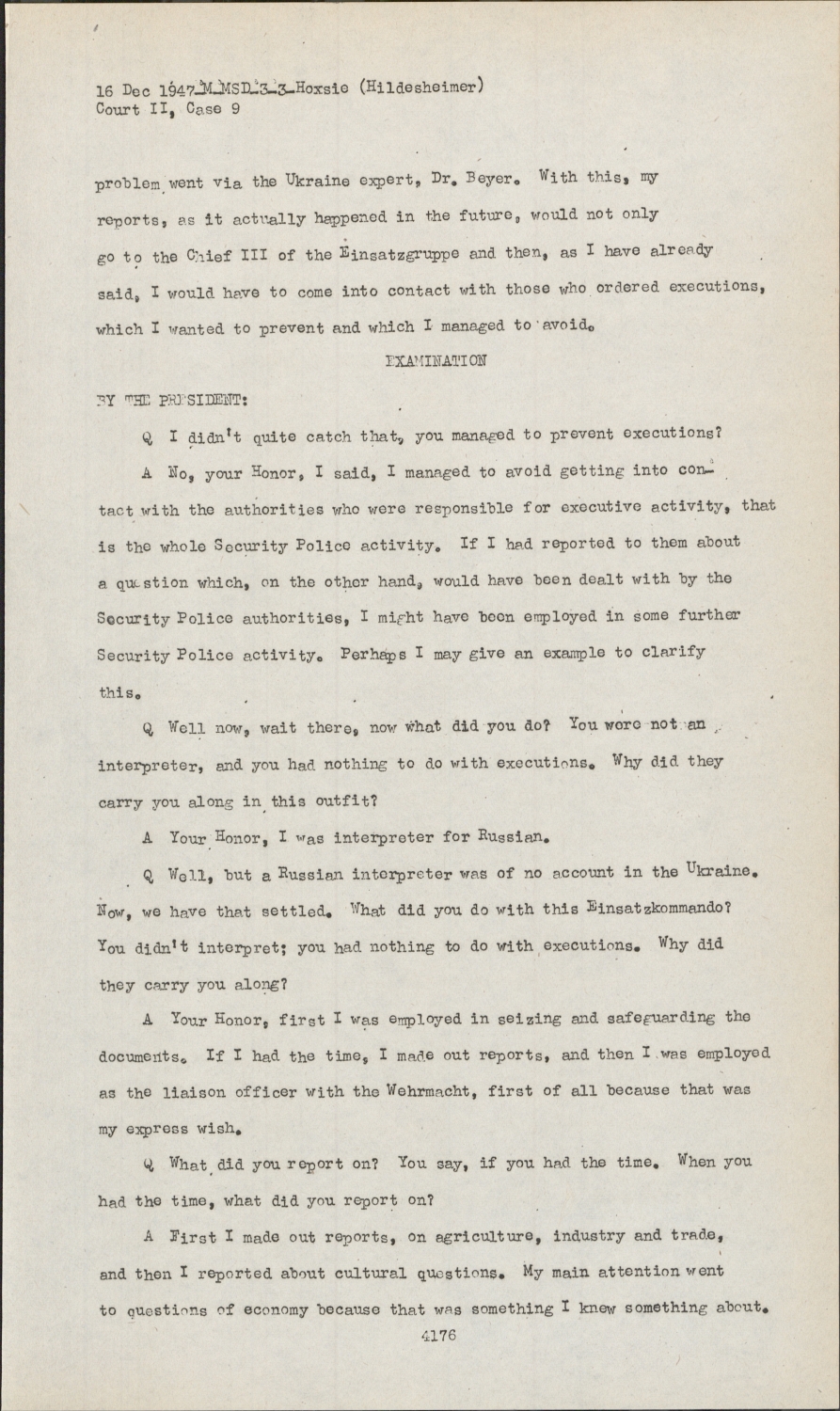
EXAMINATION BY THE PRESIDENT:
QI didn't quite catch that, you managed to prevent executions?
ANo, your Honor, I said, I managed to avoid getting into contact with the authorities who were responsible for executive activity, that is the whole Security Police activity. If I had reported to them about a question which, on the other hand, would have been dealt with by the Security Police authorities, I might have been employed in some further Security Police activity. Perhaps I may give an example to clarify this.
QWell now, wait there, now what did you do? You were not an interpreter, and you had nothing to do with executions. Why did they carry you along in this outfit?
AYour Honor, I was interpreter for Russian.
QWell, but a Russian interpreter was of no account in the Ukraine. Now, we have that settled. What did you do with this Einsatzkommando? You didn't interpret; you had nothing to do with executions. Why did they carry you along?
AYour Honor, first I was e-employed in seizing and safeguarding the documents. If I had the time, I mad out reports, and then I was employed as the liaison officer with the Wehrmacht, first of all because that was my express wish.
QWhat did you report on? You say, if you had the time. When you had the time, what did you report on?
AFirst I made out reports, on agriculture, industry and trade, and then I reported about cultural questions. My main attention went to questions of economy because that was something I knew something about.
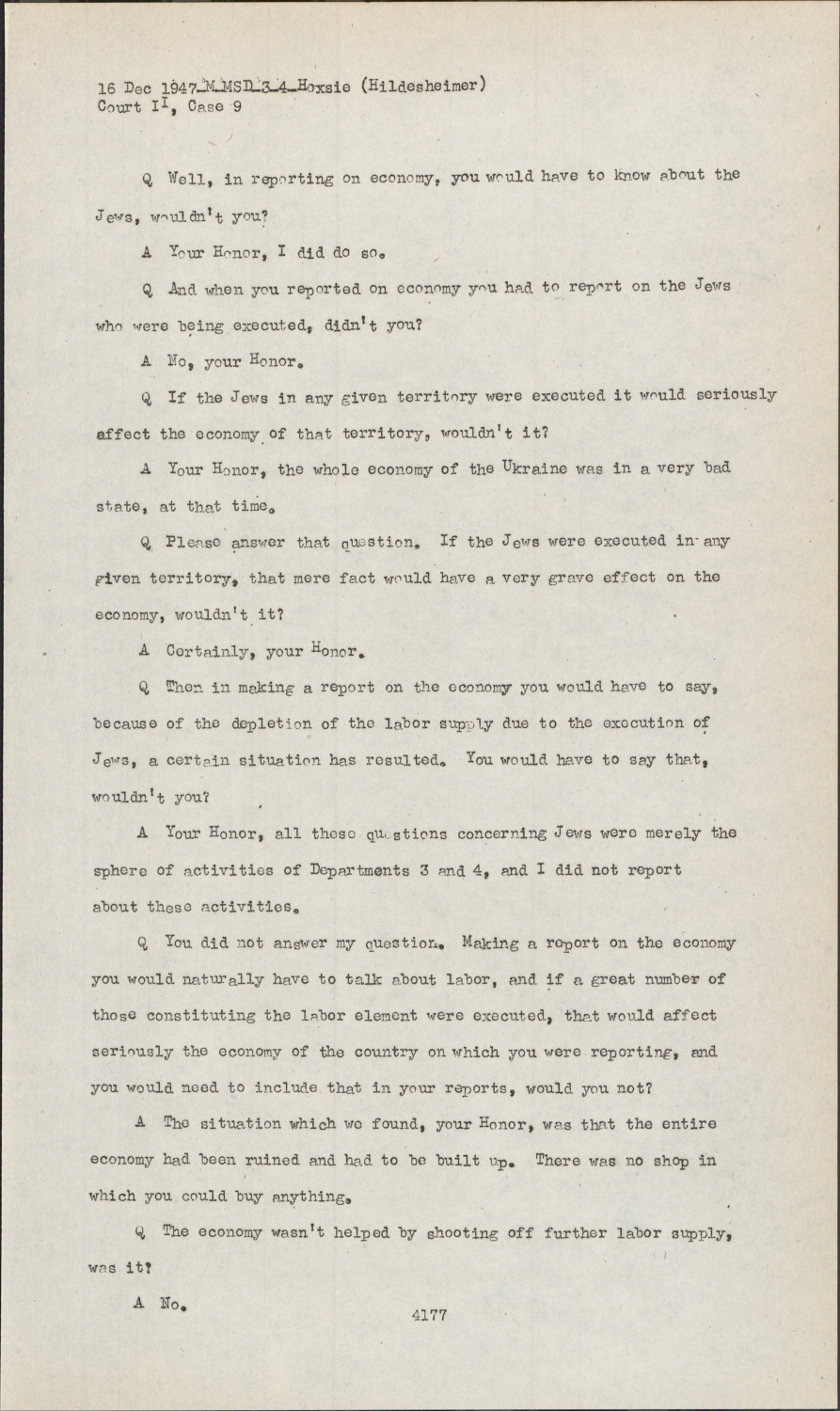
Q well, in reporting on economy, you would have to know about the Jews, wouldn't you?
AYour Honor, I did do so.
QAnd when you reported on economy you had to report on the Jews who were being executed, didn't you?
AHe, your Honor.
QIf the Jews in any given territory were executed it would seriously affect the economy of that territory, wouldn't it?
AYour Honor, the whole economy of the Ukraine was in a very bad state, at that time.
QPlease answer that question. If the Jews were executed in-any given territory, that mere fact would have a very grave effect on the economy, wouldn't it?
ACertainly, your Honor.
QThen in making a report on the economy you would have to say, because of the depletion of the labor supply due to the execution of Jews, a certain situation has resulted, You would have to say that, wouldn't you?
AYour Honor, all these questions concerning Jews were merely the sphere of activities of Departments 3 and 4, and I did not report about these activities.
QYou did not answer my question. Making a report on the economy you would naturally have to talk about labor, and if a great number of those constituting the labor element were executed, that would affect seriously the economy of the country on which you were reporting, and you would need to include that in your reports, would you not?
AThe situation which was found, your Honor, was that the entire economy had been ruined and had to be built up. There was no shop in which you could buy anything.
QThe economy wasn't helped by shooting off further labor supply, was it?
ANo.
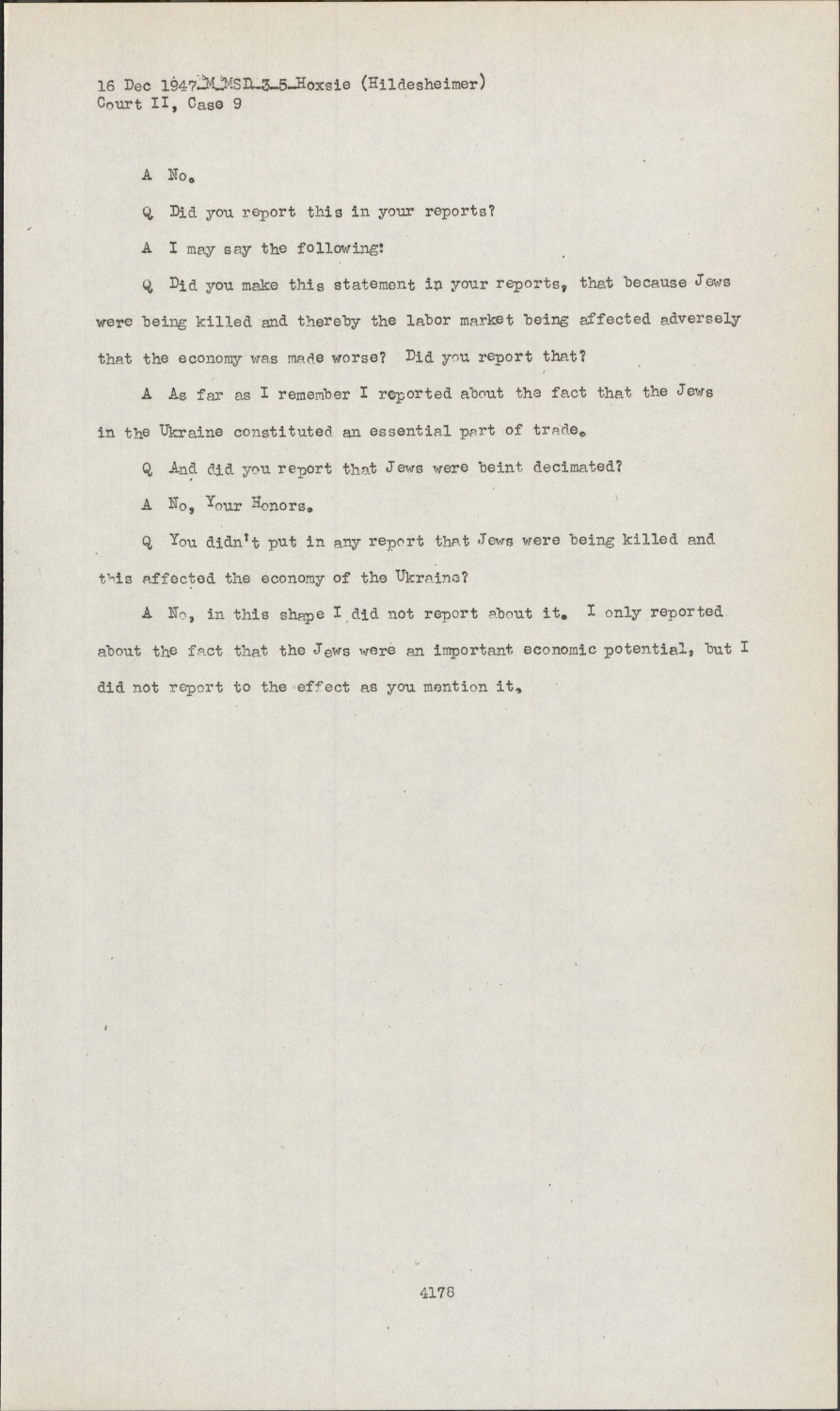
ANo.
QDid you report this in your reports?
AI may say the following:
QDid you make this statement in your reports, that because Jews were being killed and thereby the labor market being affected adversely that the economy was made worse? Did you report that?
AAs far as I remember I reported about the fact that the Jews in the Ukraine constituted an essential part of trade.
QAnd did you report that Jews were beint decimated?
ANo, Your Honors.
QYou didn't put in any report that Jews were being killed and this affected the economy of the Ukraine?
ANo, in this shape I did not report about it. I only reported about the fact that the Jews were an important economic potential, but I did not report to the effect as you mention it.
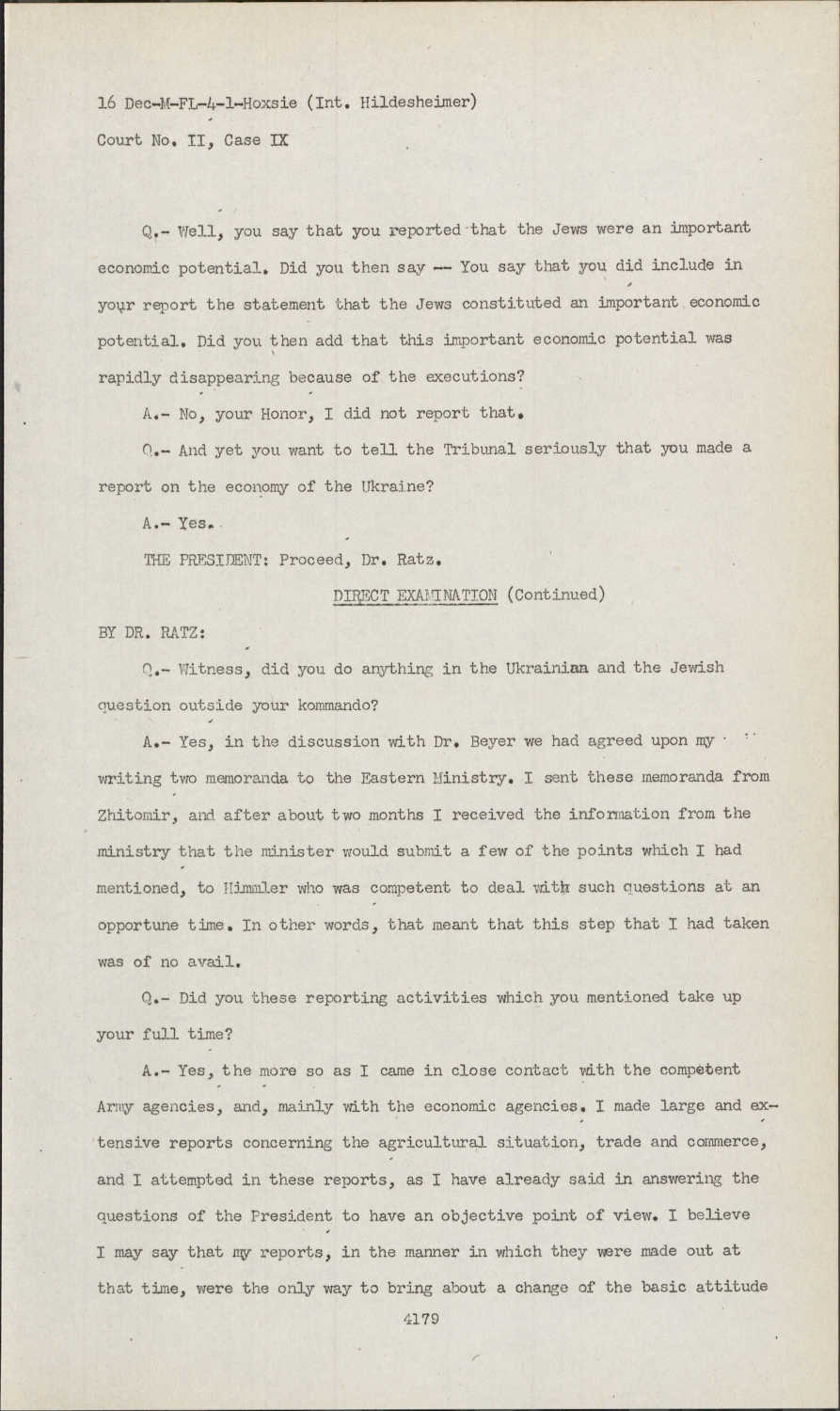
Q.- Well, you say that you reported that the Jews were an important economic potential. Did you then say -- You say that you did include in your report the statement that the Jews constituted an important economic potential. Did you then add that this important economic potential was rapidly disappearing because of the executions?
A.- No, your Honor, I did not report that.
Q.- And yet you want to tell the Tribunal seriously that you made a report on the economy of the Ukraine?
A.- Yes.
THE PRESIDENT:Proceed, Dr. Ratz.
DIRECT EXAMINATION (Continued) BY DR. RATZ:
Q.- Witness, did you do anything in the Ukrainian and the Jewish question outside your kommando?
A.- Yes, in the discussion with Dr. Beyer we had agreed upon my writing two memoranda to the Eastern Ministry. I sent these memoranda from Zhitomir, and after about two months I received the information from the ministry that the minister would submit a few of the points which I had mentioned, to Himmler who was competent to deal with such questions at an opportune time. In other words, that meant that this step that I had taken was of no avail.
Q.- Did you these reporting activities which you mentioned take up your full time?
A.- Yes, the more so as I came in close contact with the competent Army agencies, and, mainly with the economic agencies. I made large and extensive reports concerning the agricultural situation, trade and commerce, and I attempted in these reports, as I have already said in answering the questions of the President to have an objective point of view. I believe I may say that my reports, in the manner in which they were made out at that time, were the only way to bring about a change of the basic attitude of the German Reich towards the Eastern problems, and I found this confirmed on repeated occasions.
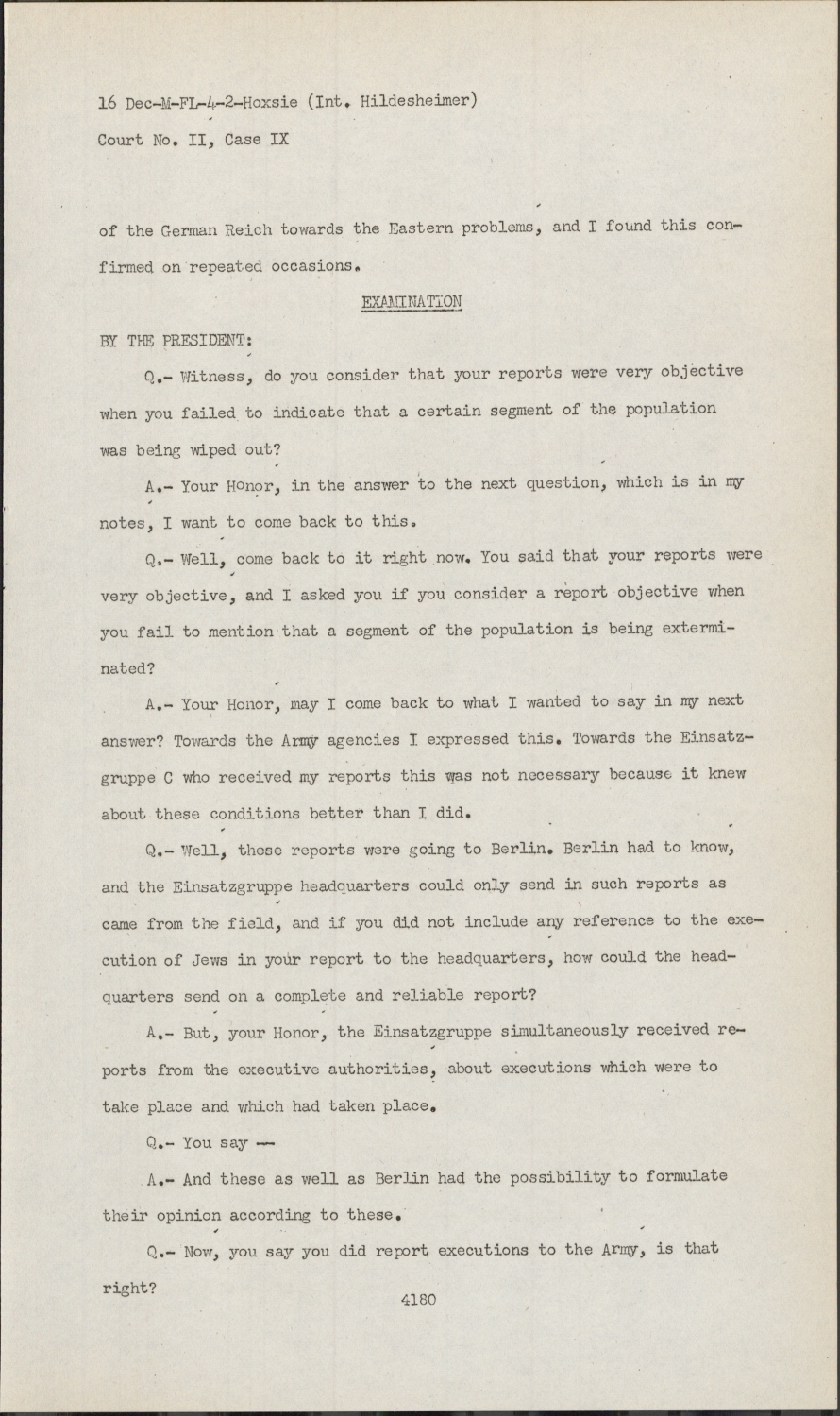
EXAMINATION BY THE PRESIDENT:
Q.- Witness, do you consider that your reports were very objective when you failed to indicate that a certain segment of the population was being wiped out?
A.- Your Honor, in the answer to the next question, which is in my notes, I want to come back to this.
Q.- Well, come back to it right now. You said that your reports were very objective, and I asked you if you consider a report objective when you fail to mention that a segment of the population is being exterminated?
A.- Your Honor, may I come back to what I wanted to say in my next answer? Towards the Army agencies I expressed this. Towards the Einsatzgruppe C who received my reports this was not necessary because it knew about these conditions better than I did.
Q.- Well, these reports were going to Berlin. Berlin had to know, and the Einsatzgruppe headquarters could only send in such reports as came from the field, and if you did not include any reference to the execution of Jews in your report to the headquarters, how could the headquarters send on a complete and reliable report?
A.- But, your Honor, the Einsatzgruppe simultaneously received reports from the executive authorities, about executions which were to take place and which had taken place.
Q.- You say -
A.- And these as well as Berlin had the possibility to formulate their opinion according to these.
Q.- Now, you say you did report executions to the Army, is that right?
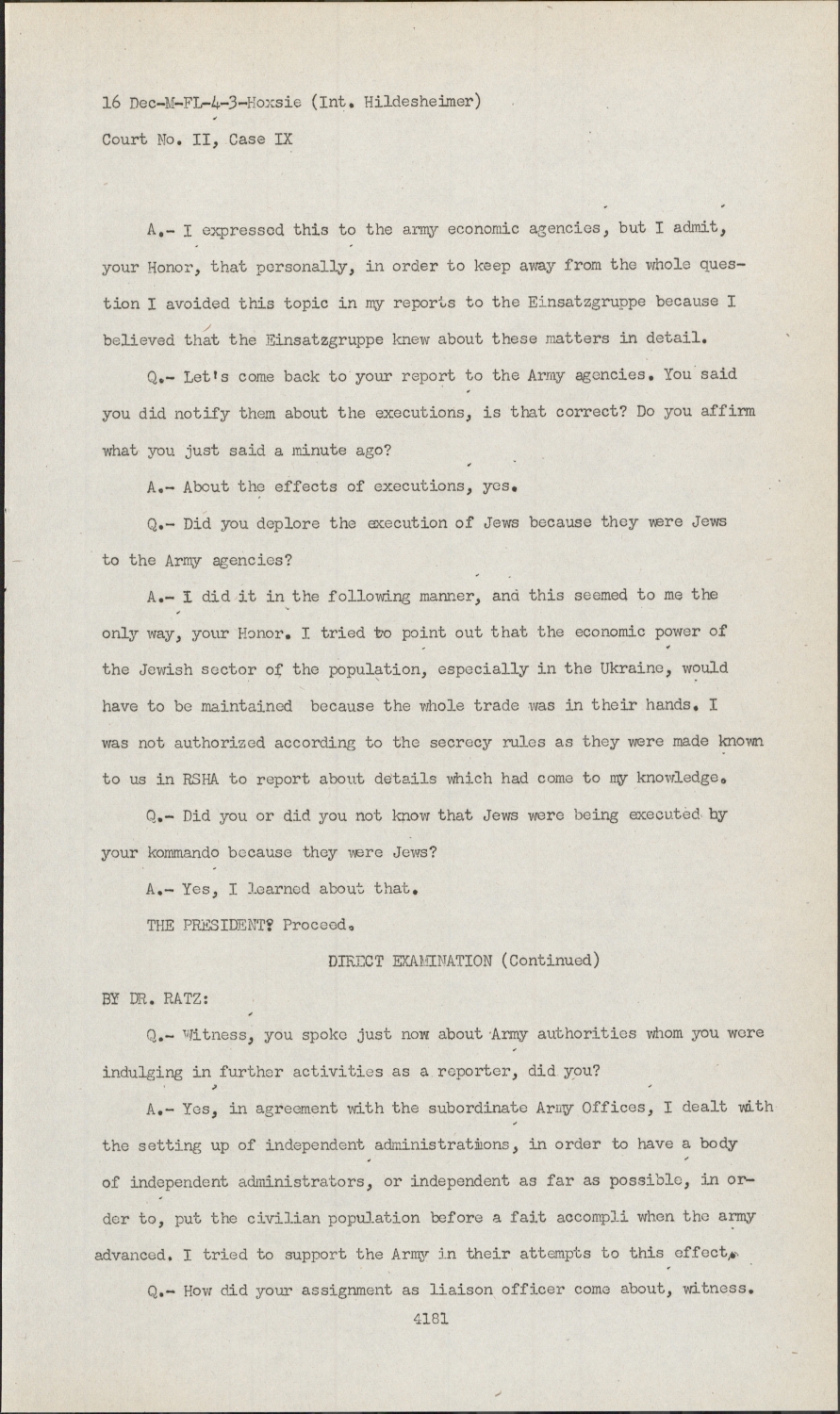
A.- I expressed this to the army economic agencies, but I admit, your Honor, that personally, in order to keep away from the whole question I avoided this topic in my reports to the Einsatzgruppe because I believed that the Einsatzgruppe knew about these matters in detail.
Q.- Let's come back to your report to the Army agencies. You said you did notify them about the executions, is that correct? Do you affirm what you just said a minute ago?
A.- About the effects of executions, yes.
Q.- Did you deplore the execution of Jews because they were Jews to the Army agencies?
A.- I did it in the following manner, and this seemed to me the only way, your Honor. I tried to point out that the economic power of the Jewish sector of the population, especially in the Ukraine, would have to be maintained because the whole trade was in their hands. I was not authorized according to the secrecy rules as they were made known to us in RSHA to report about details which had come to my knowledge.
Q.- Did you or did you not know that Jews were being executed by your kommando because they were Jews?
A.- Yes, I learned about that.
THEPRESIDENT? Proceed.
DIRECT EXAMINATION (Continued) BY DR. RATZ:
Q.- witness, you spoke just now about Army authorities whom you were indulging in further activities as a reporter, did you?
A.- Yes, in agreement with the subordinate Army Offices, I dealt with the setting up of independent administrations, in order to have a body of independent administrators, or independent as far as possible, in order to, put the civilian population before a fait accompli when the army advanced. I tried to support the Army in their attempts to this effect.
Q.- How did your assignment as liaison officer come about, witness.
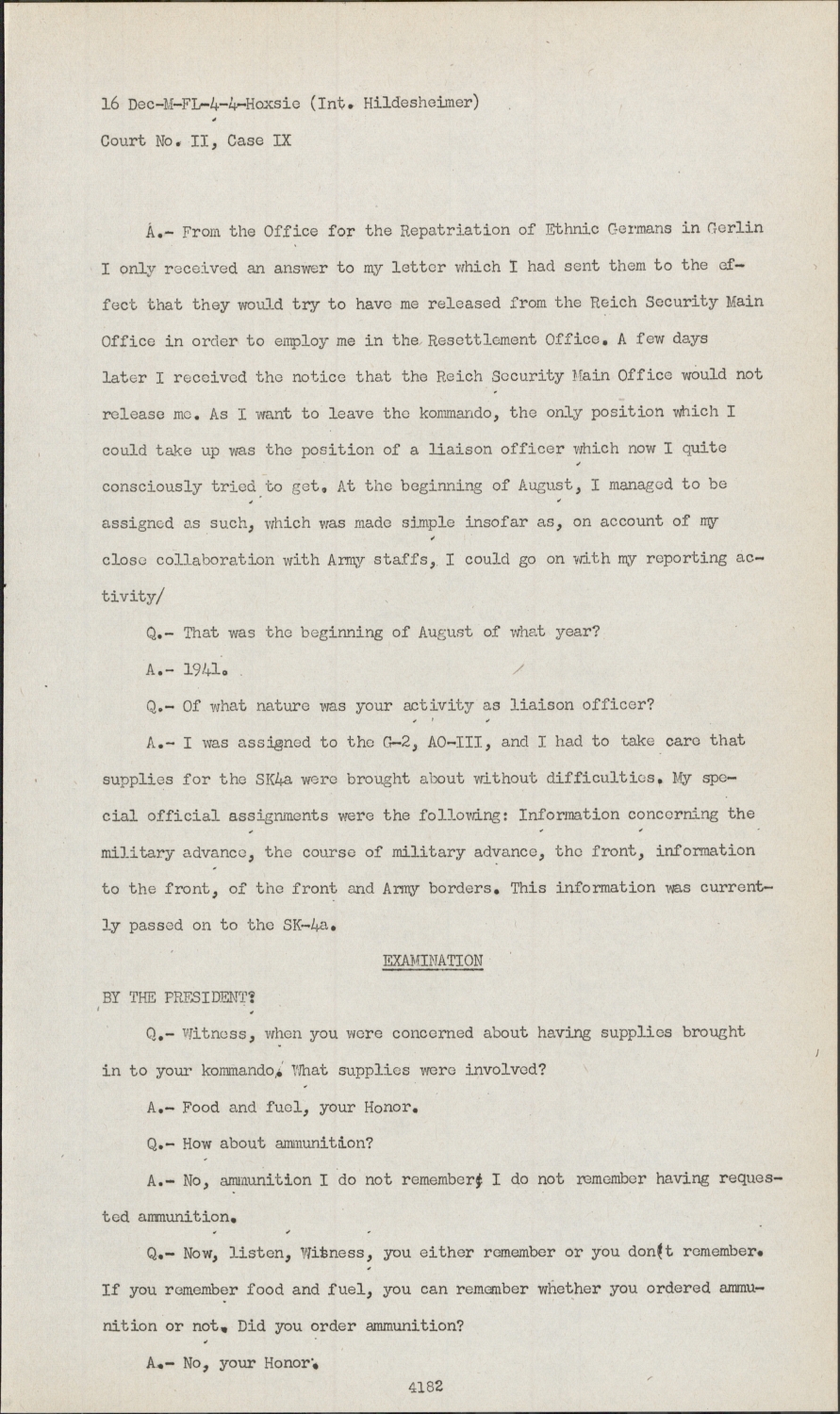
A.- From the Office for the Repatriation of Ethnic Germans in Gerlin I only received an answer to my letter which I had sent them to the effect that they would try to have me released from the Reich Security Main Office in order to employ me in the Resettlement Office. A few days later I received the notice that the Reich Security Main Office would not release me. As I want to leave the kommando, the only position which I could take up was the position of a liaison officer which now I quite consciously tried to get. At the beginning of August, I managed to be assigned as such, which was made simple insofar as, on account of my close collaboration with Army staffs, I could go on with my reporting activity/
Q.- That was the beginning of August of what year?
A.- 1941.
Q.- Of what nature was your activity as liaison officer?
A.- I was assigned to the G-2, AO-III, and I had to take care that supplies for the SK4a were brought about without difficulties. My special official assignments were the following: Information concerning the military advance, the course of military advance, the front, information to the front, of the front and Army borders. This information was currently passed on to the SK-4a.
EXAMINATION BY THE PRESIDENT?
Q.- Witness, when you were concerned about having supplies brought in to your kommando. What supplies were involved?
A.- Food and fuel, your Honor.
Q.- How about ammunition?
A.- No, ammunition I do not remembers I do not remember having requested ammunition.
Q.- Now, listen, Witness, you either remember or you don't remember. If you remember food and fuel, you can remember whether you ordered ammunition or not. Did you order ammunition?
A.- No, your Honor.
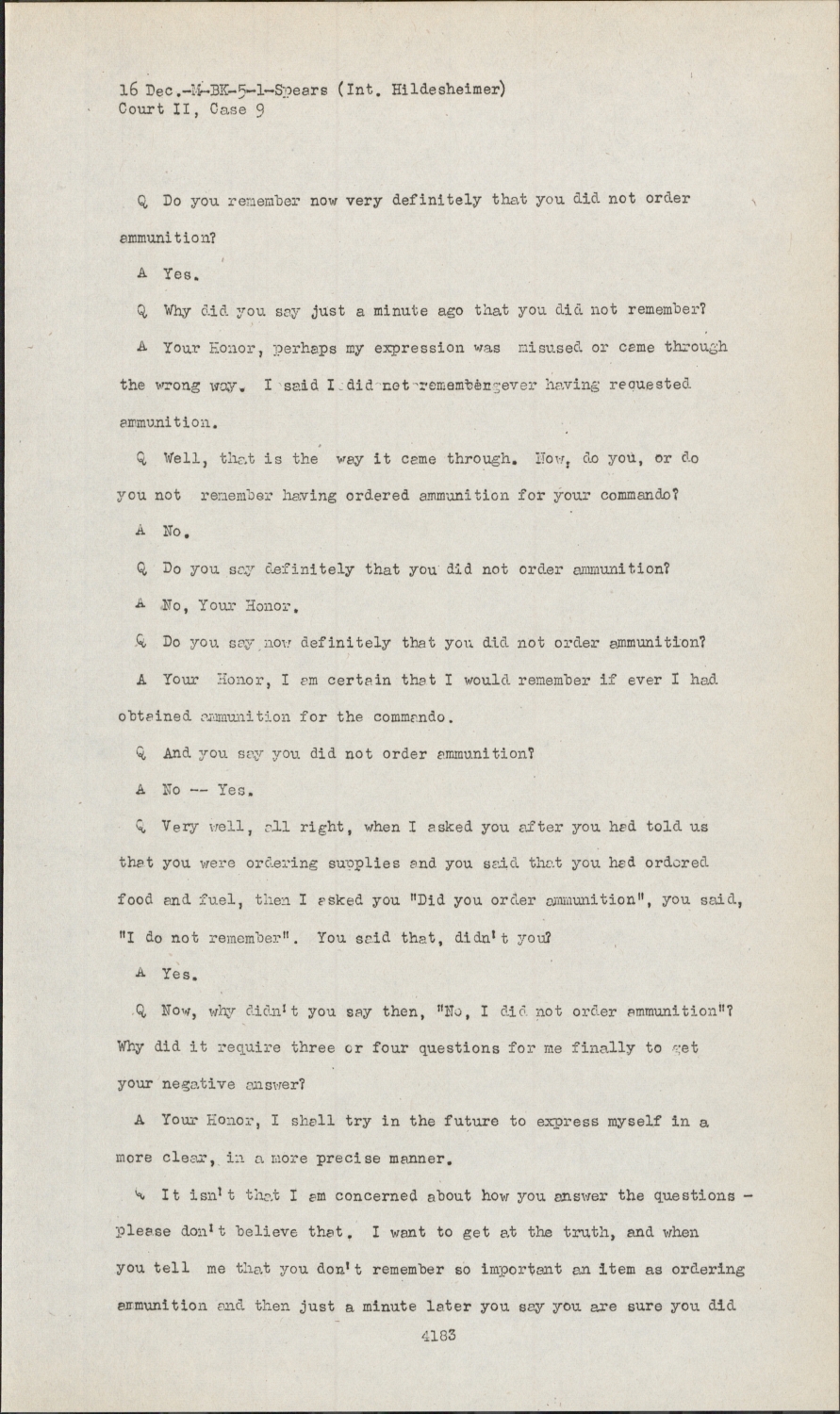
QDo you remember now very definitely that you did not order ammunition?
AYes.
QWhy did you say just a minute ago that you did not remember?
AYour Honor, perhaps my expression was misused or came through the wrong way. I said I did not remember ever having requested ammunition.
QWell, that is the way it came through. How, do you, or do you not remember having ordered ammunition for your commando?
ANo.
QDo you say definitely that you did not order ammunition?
ANo, Your Honor.
QDo you say now definitely that you did not order ammunition?
AYour Honor, I am certain that I would remember if ever I had obtained ammunition for the commando.
QAnd you say you did not order ammunition?
ANo -- Yes.
QVery well, all right, when I asked you after you had told us that you were ordering supplies and you said that you had ordered food and fuel, then I asked you "Did you order ammunition", you said, "I do not remember". You said that, didn't you?
AYes.
QNow, why didn't you say then, "No, I did not order ammunition"? Why did it require three or four questions for me finally to get your negative answer?
AYour Honor, I shall try in the future to express myself in a more clear, in a more precise manner.
QIt isn't that I am concerned about how you answer the questions please don't believe that. I want to get at the truth, and when you tell me that you don't remember so important an item as ordering ammunition and then just a minute later you say you are sure you did not order ammunition, the question arises as to whether you are attempting to conceal something or not.
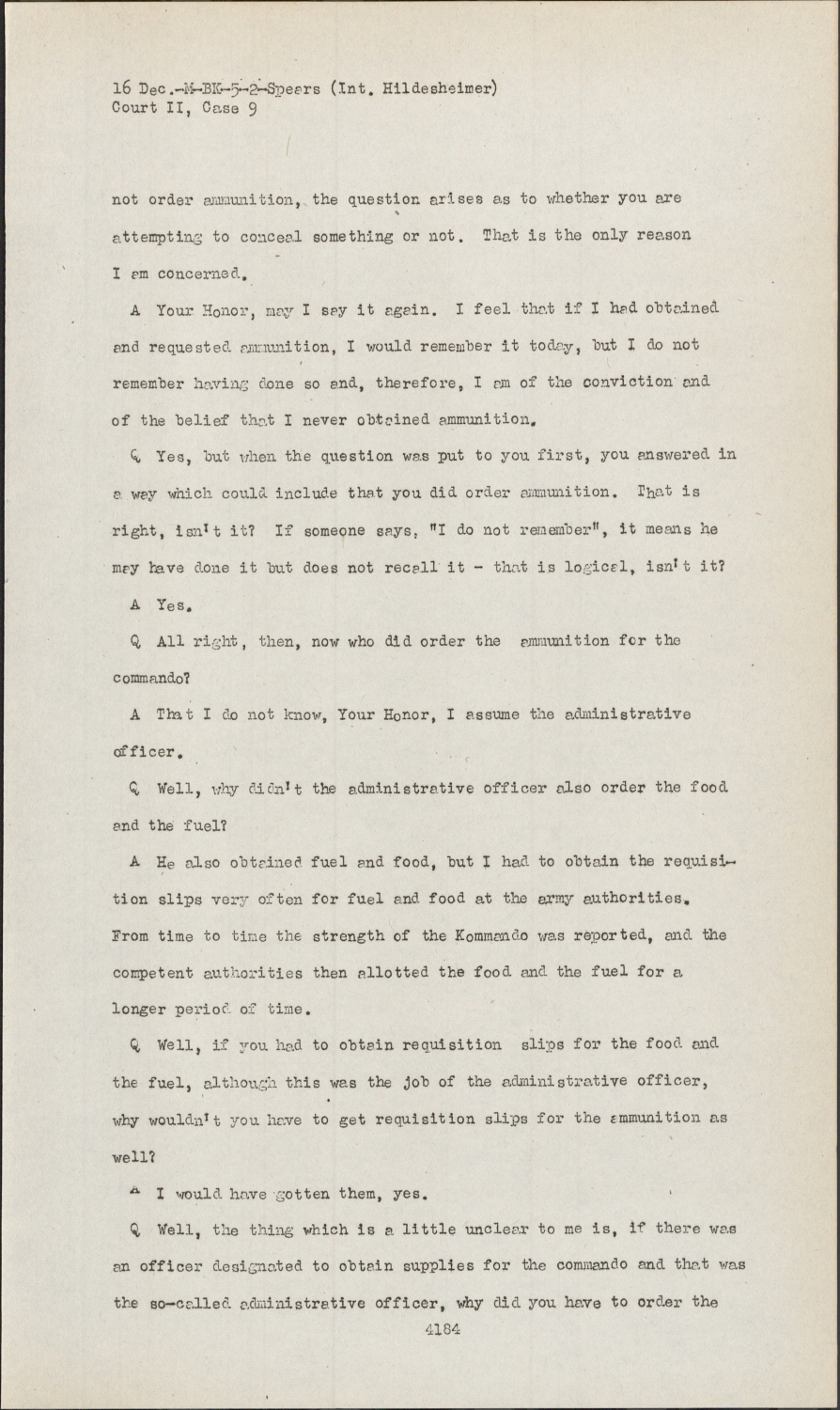
That is the only reason I am concerned.
AYour Honor, nay I spy it again. I feel-that if I had obtained end requested ammunition, I would remember it today, but I do not remember having done so and, therefore, I am of the conviction and of the belief that I never obtained ammunition.
QYes, but when the question was put to you first, you answered in a way which could include that you did order ammunition. That is right, isn't it? If someone says. "I do not remember", it means he may have done it but does not recall it - that is logical, isn't it?
AYes.
QAll right, then, now who did order the ammunition for the commando?
AThat I do not know, Your Honor, I assume the administrative officer.
QWell, why didn't the administrative officer also order the food and the fuel?
AHe also obtained fuel and food, but I had to obtain the requisition slips very often for fuel and food at the army authorities. From time to time the strength of the Kommando was reported, and the competent authorities then allotted the food and the fuel for a longer period of time.
QWell, if you had to obtain requisition slips for the food and the fuel, although this was the job of the administrative officer, why wouldn't you have to get requisition slips for the ammunition as well?
AI would have gotten them, yes.
QWell, the thing which is a little unclear to me is, if there was an officer designated to obtain supplies for the commando and that was the so-called administrative officer, why did you have to order the fuel and the food?
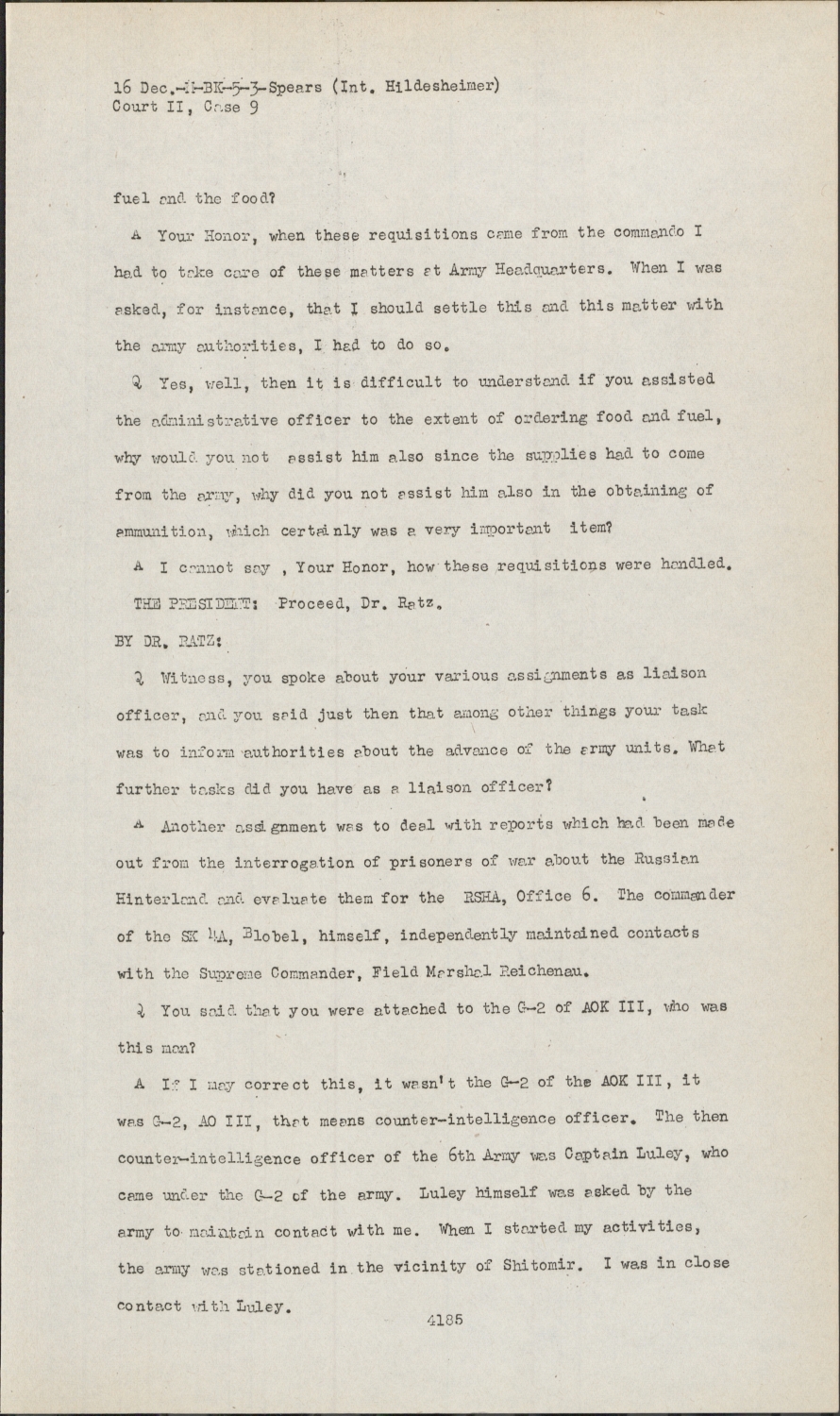
AYour Honor, when these requisitions came from the commando I had to take Care of these matters at Army Headquarters. When I was asked, for instance, that I should settle this and this matter with the army authorities, I had to do so.
QYes, well, then it is difficult to understand if you assisted the administrative officer to the extent of ordering food and fuel, why would you not assist him also since the supplies had to come from the army, why did you not assist him also in the obtaining of ammunition, which certainly was a very important item?
AI cannot say, Your Honor, how these requisitions were handled.
THE PRESIDENT:Proceed, Dr. Ratz. BY DR. RATZ:
QWitness, you spoke about your various assignments as liaison officer, and you said just then that among other things your task was to inform authorities about the advance of the army units. What further tasks did you have as a liaison officer?
AAnother assignment was to deal with reports which had been made out from the interrogation of prisoners of war about the Russian Hinterland and evaluate them for the RSHA, Office 6. The commander of the SK 4A, Blobel, himself, independently maintained contacts with the Supreme Commander, Field Marshal Reichenau.
QYou said that you were attached to the G-2 of AOK III, who was this man?
AIf I may correct this, it wasn't the G-2 of the AOK III, it was G-2, AO III, that means counter-intelligence officer. The then counter-intelligence officer of the 6th Army was Captain Luley, who came under the G-2 of the army. Luley himself was asked by the army to maintain contact with me. When I started my activities, the army was stationed in the vicinity of Shitomir. I was in close contact with Luley.
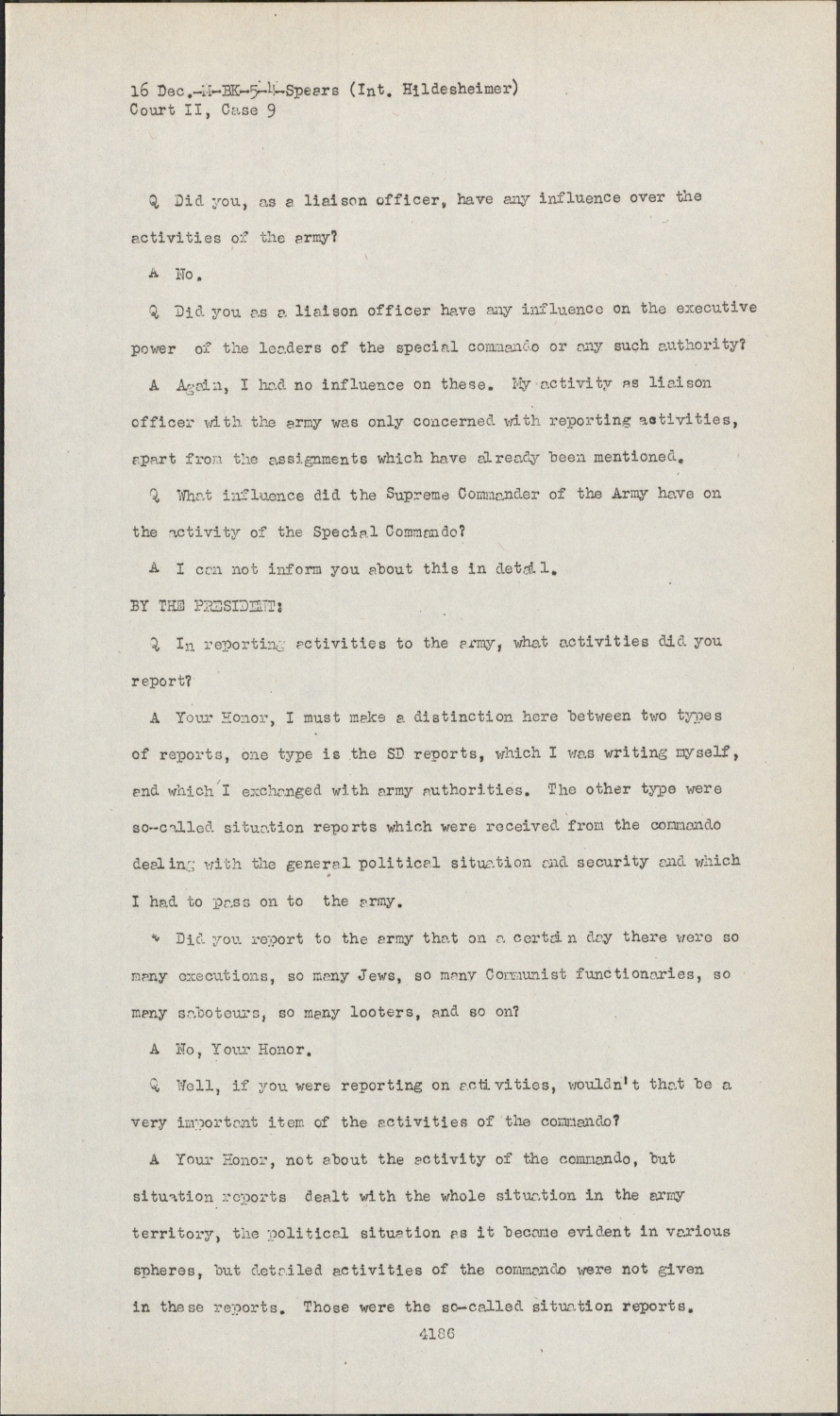
QDid you, as a liaison officer, have any influence over the activities of the army? a No.
QDid you as a liaison officer have any influence on the executive power of the leaders of the special commando or any such authority?
AAgain, I had no influence on these. My activity as liaison officer with the army was only concerned with reporting activities, apart from the assignments which have already been mentioned.
QWhat influence did the Supreme Commander of the Army have on the activity of the Special Commando?
AI can not inform you about this in detail. BY THE PRESIDENT:
QIn reporting activities to the army, what activities did you report?
AYour Honor, I must make a distinction here between two types of reports, one type is the SD reports, which I was writing myself, and which I exchanged with army authorities. The other type were so-called situation reports which were received from the commando dealing with the general political situation and security and which I had to pass on to the army.
QDid you report to the army that on a certain day there were so many executions, so many Jews, so many Communist functionaries, so many saboteurs, so many looters, and so on?
ANo, Your Honor.
QWell, if you were reporting on activities, wouldn't that be a very important item of the activities of the commando?
AYour Honor, not about the activity of the commando, but situation reports dealt with the whole situation in the army territory, the political situation as it became evident in various spheres, but detailed activities of the commando were not given in these reports. Those were the so-called situation reports.
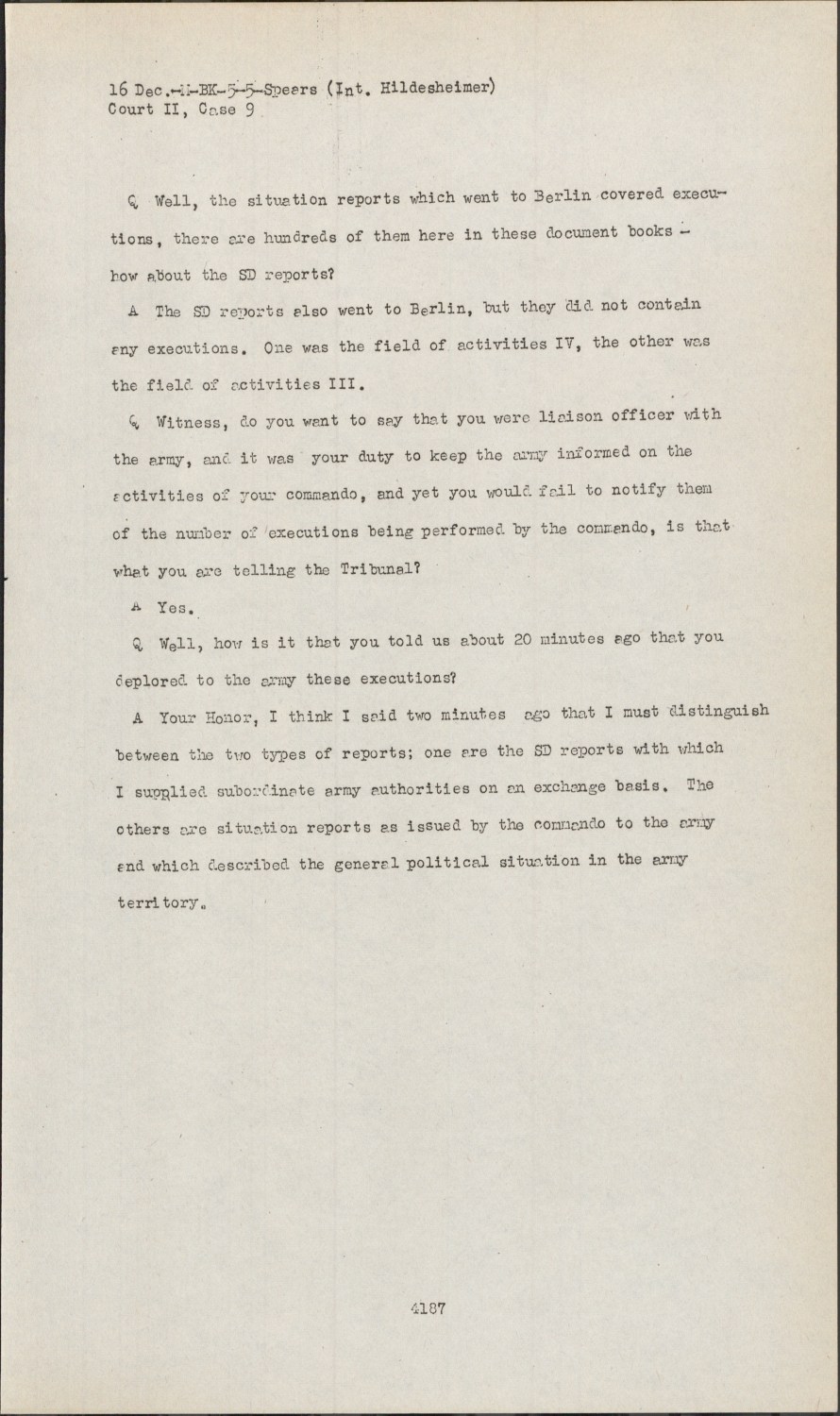
QWell, the situation reports which went to Berlin covered executions, there are hundreds of them here in these document books how about the SD reports?
AThe SD reports also went to Berlin, but they did not contain any executions. One was the field of activities IV, the other was the field of activities III.
QWitness, do you want to say that you were liaison officer with the army, and it was your duty to keep the army informed on the activities of your commando, and yet you would fail to notify them of the number of executions being performed by the commando, is that what you are telling the Tribunal?
AYes.
QWell, how is it that you told us about 20 minutes ago that you deplored to the army these executions?
AYour Honor, I think I said two minutes ago that I must distinguish between the two types of reports; one are the SD reports with which I supplied, subordinate army authorities on an exchange basis. The others are situation reports as issued by the commando to the army and which described the general political situation in the army territory.
QDid you, or did you not report to the army on executions performed by your commando?
ANo, that was not my assignment, Your Honor,
QI asked you if you did or did not - I am not asking you about your assignment.
ANo, Your Honor.
QDid you not say stout 15 or 20 minutes ago that you deplored to the army agencies these executions?
AYour Honor, I only now realize my mistake I made in the way I expressed myself. If I Bay "army", I mean the staff, the operational department of :the VI Army. In the future I shall make a clear distinction here - the army staff -
Q well, we will take a broader term, say military authorities. Did you report to the military authorities the executions being performed by your commando?
AYes.
THE PRESIDENT:Proceed. BY DR. RATZ:
QWhat influence did the Army Supreme Commander have on the activity of the Special Commando?
AI can not give details about this. I know that the Army decided on the transfer of the Sonderkommando, or at least of parts of it.
QDo you know whether the army gave execution orders to the special commando?
ANo, I do not know. The special commando or parts of it operated in the territories to which they had been assigned, and were under the command of the competent divisional commander. As far as I could see the so-called sub-commandos received their directives from these agencies under which they operated.
QDid you, as a liaison officer, pass on any such directives?
ANo. I was with the G-a, AO III, that is, counter-intelligence officer, and as I said, no such orders for executions went to this office.
QWas this office informed of an execution after it had taken place - actually, of course, you have already given testimony concerning this?
AI have already answered this question to the President.
QDid any further activity result out of this for you?
ANo, except that through such close collaboration with the group agriculture, a sub-department of the army staff, and through my reporting activity, we took an important part in the bringing in of the harvest and, of course, members of the commando were employed in the harvest.
QI show you Document Book II-C, page 66 of the English Document Book, page 74 of the German, Document Number 2947, Exhibit 82. It is Report of Events 47 of the 9th of August 1941. There it says, I quote:
MR.HORLICK-HOCHWALD: I do think that Dr. Dr. Ratz will quote from page 69 of the English under the - or it will be 68 - sorry, 67 -- under the heading "page 8 of the original".
DR. RATZ:I quote, "Particular attention, especially in the villages, is given to the gathering of the coming harvest. The population is in a helpless situation, since the Russians have carried away or have destroyed, respectively, the most needed agricultural machines. The individual labor-squads are therefore working systematically on the preparation of the harvest. Since no Buergermeisters have so far been installed by the Wehrmacht, especially in the remote villages, this has been taken in hand everywhere, subject to later regulations, by the Kommandos and with great success." BY DR. RATZ:
QPlease comment on this.
AThe situation as it is partly described here was as follows: It was my task to negotiate with the group agriculture and the commando and to arranger that the commando put a number of people at the disposal of the agricultural group in order to repair the agricultural machinery.
I mention here that, for instance, in the vicinity of Shitomir, of 3,000 tractors, 2,700 were partly or wholly destroyed "by the Russians when they left and that one machine was constructed from many which were out of use in order to use it for the harvest.
QWhen the ethnic German resettlement office gave you a negative answer, did you undertake any further steps in your personal matter?
AYes. When the entire kommando moved into Shitomir, a company of the Waffen SS consisting of two platoons had been assigned to it for the military security in the northern territory of Shitomir in the band-infested area. One day in the beginning of August, the CO of this company came to my office and asked for a confidential discussion. He said that the Einsatzgruppe to which he was subordinated had ordered him to disperse his company and to put the men at the disposal of other Einsatzkommandos. He feared that these could then be used for executions and that they would no longer be under his control and supervision as from then. I supported the company commander in his attempts to keep his unit from the activity of the other Einsatzkommandos and the success we achieved was that the Waffen SS company was released. In the course of this procedure, I, together with this above-mentioned company commander, went to the officer of the Einsatzkommando 6, as we wanted to ask him to intervene at the Einsatzgruppe and it was at that time in the vicinity of the Einsatzkommando 6. On this occasion I described to him my personal situation. He warned me very urgently not to take any direct steps concerning my release.
QOne last question concerning the activity in the vicinity of Shitomir. How long did you remain in the Shitomir sector?

AI remained with the army until the middle of September 1941. Then I received the assignment, not to proceed with the stiff of the army, that is, the operational department which was to by-pass Kiev with the advancing troops -- but to go to Kiev immediately in order to seize documents and secure them and then to rejoin the army staff which intended to take up quarters in Kiev.
THE PRESIDENT:The Tribunal will he in recess 15 minutes.
(A recess was taken.)