you had it physically in your possession - why didn't you do that?
A your Honor, of course physically I could have done something.
Theoretically, one can see that after the event has taken place but at the time the situation was such that physically I was not in a position to do what I wanted to do.
I said I wanted to change that but Mr. Wartenberg said "Any corrections you want to make you have to discuss with me before and I will tell you whether it is to be changed or not."
And this permission - - -
THE PRESIDENT:Well, did you tell him, "Mr.Wartenberg, I would like to change the word 'supervise'"?
AYes, your Honor. The word supervise as well as other wordings which I tried to change.
THE PRESIDENT:Did you say "Mr. Wartenberg, I want to change this word 'supervise'?" Did you call that specifically to his attention?
AI am almost certain, your Honor, that I said such because I remember specifically that just because of this wordings I discussed this particular bit with him for quite some time and my mind was put to the fact that this particular word should be changed.
THE PRESIDENT:You can dwell on possibilities. We must know definitely whether it did or did not happen.
Did you specifically call to Mr. Wartenberg's attention the word "supervise"?
AYes, your Honor.
THE PRESIDENT:And did you call to his attention the word Seibert,the name Seibert?
AYes, your Honor. And I would like to say here the answer that I got from Mr. Wartenberg concerning this particular wording of the answer.
THE PRESIDENT:What was the answer?
AI don't know literally but I thin, I can give its drift. when I told Mr. Wartenberg that the date had been changed and the passage "or Seibert" is also contained again Mr. Wartenberg told me words to this effect - "Yes, but in January or February Seibert was there again". I told Mr. Wertenberg that that of course was correct, but...
THE PRESIDENT:Listen, witness. We are going over ground which you have tilled a number of times. Now we have cultivated that ground and we have got the harvest - mainly the correction. Don't go back to the date. Let's go back to the other things. We understand the conversation you had about the date - that is settled. you called it to his attention, you convinced him that the correction should be made, and you made the correction as evidenced by the fact that it does appear corrected and your handwritten corrections are here. Well, now why didn't you go through the same procedure on the matter of the word "supervise". That's the question.
A your Honor, I should like to be very brief on this point. I asked for this change to be made on various occasions and was not permitted to make it.
THE PRESIDENT:Not on various occasions but on this one occasion when you corrected this date, why didn't you correct "supervise"?
AYour Honor, perhaps I was not insistent enough in my resistance to this word. If I have changed the wording of the dage, if I succeeded in doing so, it may be so because I was particularly obstinate on this point because I didn't want a co-defendent of mine to be indicted by a negligent remark in this document. All other wordings referred to my own person and after Mr. Wartenberg told me that at the proper time I would be able to explain everything as I meant it, I thought, in the state I was in at the time, that I could no longer resist, that I thought I would have to sign this statement being able to explain later because I did not want to appear in dubious light in case I would resist too long and trusting that I would be able to make use of this promise that I would be able to explain the text, I did not insist any more and now I think the moment has come in which I am able to explain it.
THE PRESIDENT:Well, it you feared that you would be put in dubious light by signing something that said something different from what you intended.
Wasn't that the occasion to correct the dubiosity of the situation?
Wasn't that the time to make the correc tion?
AIf I had had the possibility, Your Honor, I would have loved to do it -
THE PRESIDENT:Well, now just a moment, did Mr. Wartenberg threaten you in any way?
AYour Honor, I must go a little farther....
THE PRESIDENT:Well, please answer that, did he threaten you?
AOn this occasion I was not threatened but I certainly did not feel myself free, in any case not so free that I could say today that without any misgivings whatsoever I just signed this affidavit but I think I must make this explanation, this correction, why I did sign it although I was of the conviction that it was not quite correct.
THE PRESIDENT:Did you read this? "I had the opportunity to make changes and corrections in the above statement.
I made this statement of my own free will without any promise of reward and I was not sub jected to any threat or duress whatsoever". Did you read that?
A yes, but I may say the following, Your Honor. This way of putting it is both correct and incorrect at the same time, objectively speaking.
I was in the position to make some corrections, 8 corrections in fact, and I was in the position to make only 8 corrections, but not in the position to make all corrections.
When it says "I read this statement and" that "I had the opportunity to make corrections" then it is in a way not false, not wrong, but it doesn't explain everything.
THE PRESIDENT:You were allowed to make 8 corrections but not 9 corrections?
Is that what you are telling the Tribunal?
AI had to ask for the permission of Mr. Wartenberg for everyone of these 8 corrections but I did not receive permission for this owrding "supervise". I do not know at the moment whether those are the only corrections which I wished to make on that occasion .
The PRESIDENT: Suppose you do this witness. You indicate to the Tribunal the corrections which you actually made end then indicate the corrections which you want to make now and then we will have it on the record just what this statement should be. Tell us what corrections you did make and what corrections you want to make now. Dr. Koessl, will you please take him over that field? BY DR. KOESSL:
QI will. witness, please state on what passages of your affidavit of 24 February you wanted to make any corrections on your own behalf?
AI may first draw the attention of the Tribunal to the fact that I do not want to make out a new affidavit now, but that I only want to carry out what Mr. Wartenberg had promised me that is to explain what I mean and what unfortunately he worded incorrectly.
QTell us, therefore, very briefly, what words you want to correct?
AWherever it says "supervise" it would say "inspect" or "to look at".
QI may draw the attention of the Tribunal to the fact that it is contained under #3 of the German, the fourth line, paragraph 3-A at the beginning of 3-B, the first expression. Furthermore again at #3 C. Then under paragraph 4, line 3, in the German and then in the next line -
THE PRESIDENT:Well, just a moment, are you making these corrections?
DR. KOESSL:The witness has already stated that all these points where it says "supervise" instead of "look at" or "inspect" - that all these points should be changed. Personally I have marked these points in my affidavit. I therefore wanted to tell you briefly. The witness is in position to do so himself - it would be the same.
THE PRESIDENT:Yes. Now, you said that 3-A was wrong but you didn't indicate how it was wrong.
Suppose you let the witness do it Dr. Koessl. Let him point out in the affidavit where it is wrong. Now, what is wrong with 3-A?
DR. KOESSL:Tell us, witness, under #3 any passages, what passages you want to be changed?
AThe wording in 3-A is completely unclear and it makes no sense. I would like to say -BY THE PRESIDENT:
QWell, tell us why it doesn't make sense. It seems to read very clearly to us. It makes sense. "To see that the location of the shooting be remote enough so that there could be no witnesses to the shootings". I don't know how it reads in German but it is clear in English. why is it so obscure in German?
AI don't know, your Honor, whether you are quoting now from the English, and whether it says there "to see". It says in the German "beaufsichtigen". That would be "supervise" in the English. If it says there "to see" I am in agreement, as I approve of the wording this way, although to "confirm" would be quite correct. I only had to convince myself of the actual order.
QWe will tell you what our impression is from reading this sentence: that you would go to the location to make an observation and make certain that the location of the shooting was far enough away that people who might be in the vicinity would not see the shooting. That, in other words, is what we gather from this 3-A. is the thought you intended to convey?
AI am on principle in agreement with this way of putting it, but according to the wording in the affidavit it means that I had to supervise this particular place where executions took place. I cannot have a supervision of a place. therefore I object to the way of putting it here.
QThis says that you went out and looked over the scene and made certain that the shooting scene would be far enough away that witnesses might not see the actual shooting.
AYes, I was to confirm, myself, to establish the fact that it was in a proper state and that is what I think I have said in my statement. The wording of the affidavit means something else, in my opinion.
QDo you want to emphasize that you did not actually select the shooting place, is that what you want to emphasize?
AYes, Your Honor.
QAll right. This does not say that you selected it. It says that you went there to make certain that the place selected for the shooting was so located that it would fall within the regulations, namely that there would not be any unnecessary witnesses to the shooting.
A yes, your Honor.
THE PRISIDENT:Yes. Let's proceed to the next one. We understand that.
DIRECT EXAMINATION (Continued) BY DR. KOESSL:
QNow, tell us about the other expressions and passages which you did not like.
AThen the next figure,Paragraph 3-B, there again it says "to supervise" so that.....
THE PRESIDENT:So that -- proceed, proceed. BY DR. KOESSL:
QWhat was the wording that you approve?
AIt should read, and I think I said that in my interrogation, that I convinced myself that the collection of money and valuables of people to be shot was not done by force, etc. The next passages, 3-0, here it says again "to supervise that executions were carried out as far as possible in a humane and military fashion."
QAnd what should it be?
AIt should say "to convinced myself" or "to look" or "see" that matters would be carried out like that.
QAny further corrections?
AYes, under figure 4 it says in the second sentence "I went into the Gypsy quarter of Simferopol and I supervised the loading into the trucks of people to be executed". Again it should say "I convinced myself" that this was to be done and not what it says here in the affidavit.
QWhat next?
AThe same sentence in the next paragraph "I took care that people were loaded as fast as possible and that no unrest and no disturbances should take place on the part of the native population. Furthermore, I took care that people who were to be executed should not be beaten while they were loaded into the vehicles.
QWhat should it say?
AThere again it should say "I convinced myself" of the fact of that, etc., there it could not even be formulated "I saw to it." I could only have meant "I convinced myself", because there is nothing else that could have been meant, and I could not have said anything to a different effect during my interrogation. In the last paragraph of No. 4 it says "as it was my task to supervise the whole execution I could only remain a short time at each of the different phases". There again "supervise" is wrong. Again it should say "to inspect" here or "to see", in order to get the true meaning, in order to be able to cope with my task.
THE PRESIDENT:Are those the corrections you want to make in the affidavit?
THE WITNESS:No, unfortunately, they are not all,
THE PRESIDENT:All right, let's have them all.
THE WITNESS:In No. 5 of the affidavit again there is the word, "I supervised". On page 3 of the original, the second sentence begins, "I supervised the SS and regular police that these people should not keep any of the valuables that were collected. Again there was nothing to supervise but only to convince myself, and I had to supervise how these things were carried out and whether they were in agreement with the orders which were given. Again it should not say "supervise". Under No. 5 again, the next hit one sentence, there it says. "This stage was supervised by me in detail so that all valuables should be turned over to the Einsatzgruppe for the purpose of passing them on to Berlin at a later date". This wording might permit the conclusion that it was my assignment to supervise and to take care that everything that was to be taken, actually was taken, so that everything would actually be transferred to Berlin. I think that Mr. Wartenberg thought of this way of constructing it when he formulated the sentence, but again I can only say that it was not my task to supervise these people taking the valuables, that it was not my assignment, but only, and that is what I said this morning, the stage of events, while I was there, to look at it and see to it that it was complied with, according to orders given.
I did not have to actually supervise this procedure. but I only had to see to it that it was done. BY DR. KOESSL:
QAny further corrections?
AUnder paragraph 6 it says "a short while when these executees were already in position in the ditches I supervised the shooting". This supervision again is wrong because I have already stated this morning that the task of supervision was the task of an officer who held the rank of a major. Therefore, there was nothing for me to supervise because there was already somebody who was supervising it who had a much higher rank than I had, and I did not have the executive power that these things were carried out.
QYou have already mentioned this morning one correction referring to Seibert. In the compiling of your corrections I think it would be a good thing if you now mentioned this particular point again.
AIt is No. 3 where it is said that "in December, 1941 - I do not remember the exact date - I was detailed by Ohlendorf or Seibert to supervise the execution of seven hundred to eight hundred people". This wording "or Seibert" is completely wrong for the mere reason that Seibert at that time was not present in Simferopol at all. I think I have already clarified this point by saying that I told Mr. Wartenberg that this was wrong, but he did not permit me to make any corrections concerning Seibert because, allegedly, I had said in the interrogation "Ohlendorf or Seibert". This possibility I could not contest at the time, but I do not want to contest it today, that in the first moment when this question was put to me whether I ever or "what would you say, Herr Schubert, if we had proofs that you had actually to inspect executions?"
that was the question that was put to me at the time.
It was put by Mr. Wartenberg. I think that it is possible that first of all I said when the question was put to me, "Ohlendorf or Seibert". I cannot and do not want to contest that, but before signing the affidavit on the 21st, as well as on the 24th of February, I drew the attention of Mr. Wartenberg to the fact that if that had been what I had said, I would have to correct it now, because Seibert actually was not there at the time but he was on leave in Berlin.
Therefore, it would have to be crossed out, but unfortuna tely, it remained.
THE PRESIDENT:Does that cover all the corrections now?
DR. KOESSL:I just wanted to put that same question to the witness.
BY DR. KOESSL:
QHave you now made all the corrections which you wanted to make?
AI see here under Paragraph 1 of the affidavit another passage which is inessential but which should be corrected.
It is the last but one sentence of paragraph 1. "On the 9th of May, 1934, I was transferred from the Hitler Youth to the Party". It should say "on the 1st of May". I do not know whether I made this statement at the time or whether it is just a printing mistake.
QAnd now let's just discuss again Paragraph 2. Is Paragraph 2 correct as it is put here, or do you have any other remarks to make?
AUnder Figure 2 it says in this second sentence, "Otto Ohlendorf was chief of the Einsatzgruppe his deputy was Willy Seibert". I should like to state in order to explain this and to enlighten the Tribunal on this matter what was meant by his deputy, and I believe that in the interrogation which followed I clarified these matters or at least tried to explain them a little more clearly then they were actually understood and put down by Mr. Wartenberg in this very general form, what can be meant here is only that Herr Seibert in the staff of Einsatz gruppe D and only for the staff of the Einsatztruppe D was the deputy of Ohlendorf, only in this one function, but never, and that is what I said, the case could have happened in which Seibert would have been the deputy of Ohlendorf for the entire Einsatzgruppe D. Therefore I would like to explain this particular wording "Seibert was his deputy", and that is what I said, I think, in my interrogation very clearly, and I certainly did not put it into this very general form.
QThese then, are all the corrections and explanations that you have to make concerning this affidavit?
AThere is another mistake in writing which I think might have been corrected by now. In the last but one sentence in paragraph 2 it says "I was appointed Ohlendorf's adjutant for the Einsatzgruppe and I kept this post from my joining the group until I left in 1944". I think that must have been a mistake. I think that has been corrected by the prosecutor. It should have said '42.
QI think that is only in the German copy. It should read June, 142.
AYes.
QAny more corrections?
AI might add on explanation concerning Figure 6 of the affidavit where it says in the last sentence "it is known to me that it was of special importance for Ohlendorf that people who were shot were killed in a humane and military manner as in case other methods of killing were used the psychological burden of the members of the kommando would have been too heavy." I was very sorry that this is the last sentence of this particular passage, but I could not very well tell Mr. Wartenberg what he should put in and what he should leave out, but in my interrogation I tried to explain that this psychological burden was not only the particular burden of the kommando itself but that each victim, of course, would have a much heavier burden, and that is what I would like to say here; and I think that with this all matters are now cleared up which I wanted to be cleared up.
EXAMINATION BY THE PRESIDENT:
QNow, witness, you consider yourself an educated man, don't you?
AYour Honor, one should not say that of one's self. But I think that I have an average education.
QWell, you had your schooling; you worked in a lawyer's office; you were a civil servant; you worked for the Reich; and you belonged to the Hitler Youth. I don't know that that would be any evidence of great education but at any rate -- how old are you?
AI am now thirty-three years old.
QThirty-three years old? How old were you when you signed this affidavit?
AThirty-two, Your Honor.
QYes. Now you signed three times on this document, didn't you? you signed your name three times?
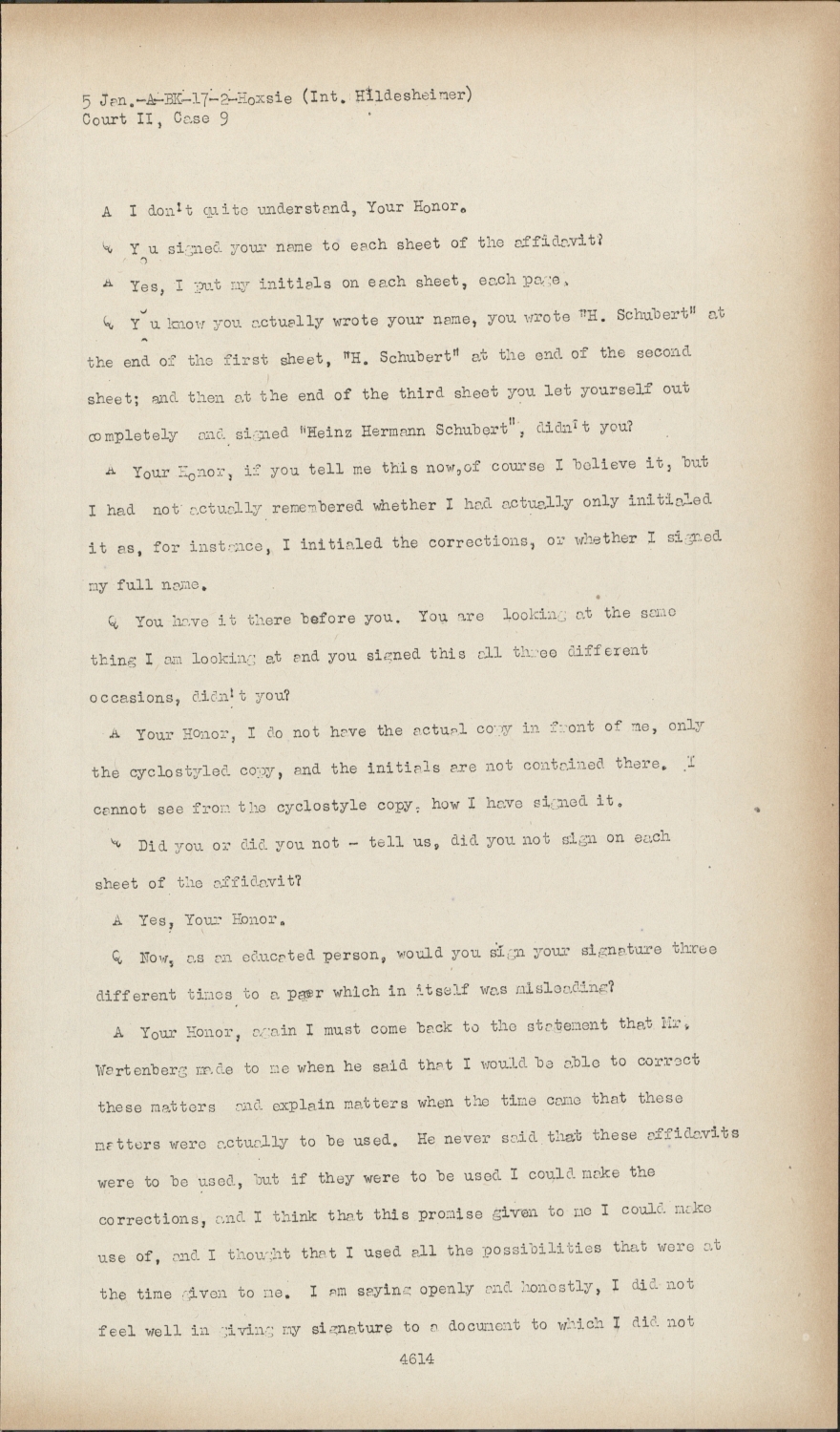
AI don't quite understand, Your Honor.
QYou signed your name to each sheet of the affidavit?
AYes, I put my initials on each sheet, each page,
QYou know you actually wrote your name, you wrote "H. Schubert" at the end of the first sheet, "H. Schubert" at the end of the second sheet; and then at the end of the third sheet you let yourself out completely and signed "Heinz Hermann Schubert", didn't you?
AYour Honor, if you tell me this now, of course I believe it, but I had not actually remembered whether I had actually only initialed it as, for instance, I initialed the corrections, or whether I signed my full name.
QYou have it there before you. You are looking at the same thing I am looking at and you signed this all three different occasions, didn't you?
AYour Honor, I do not have the actual copy in front of me, only the cyclostyled copy, and the initials are not contained there.
I cannot see from the cyclostyle copy, how I have signed it.
QDid you or did you not - tell us, did you not sign on each sheet of the affidavit?
AYes, Your Honor.
QNow, as an educated person, would you sign your signature three different times to a paper which in itself was misleading?
AYour Honor, again I must come back to the statement that Mr. Wartenberg made to me when he said that ii would be able to correct these matters and explain matters when the time came that these matters were actually to be used.
He never said that these affidavits were to be used, but if they were to be used I could make the corrections, and I think that this promise given to me I could make use of, and I thought that I used all the possibilities that were at the time given to me.
I am saying openly and honestly, I did not feel well in giving my signature to a document to which I did not fully agree, but I thought -
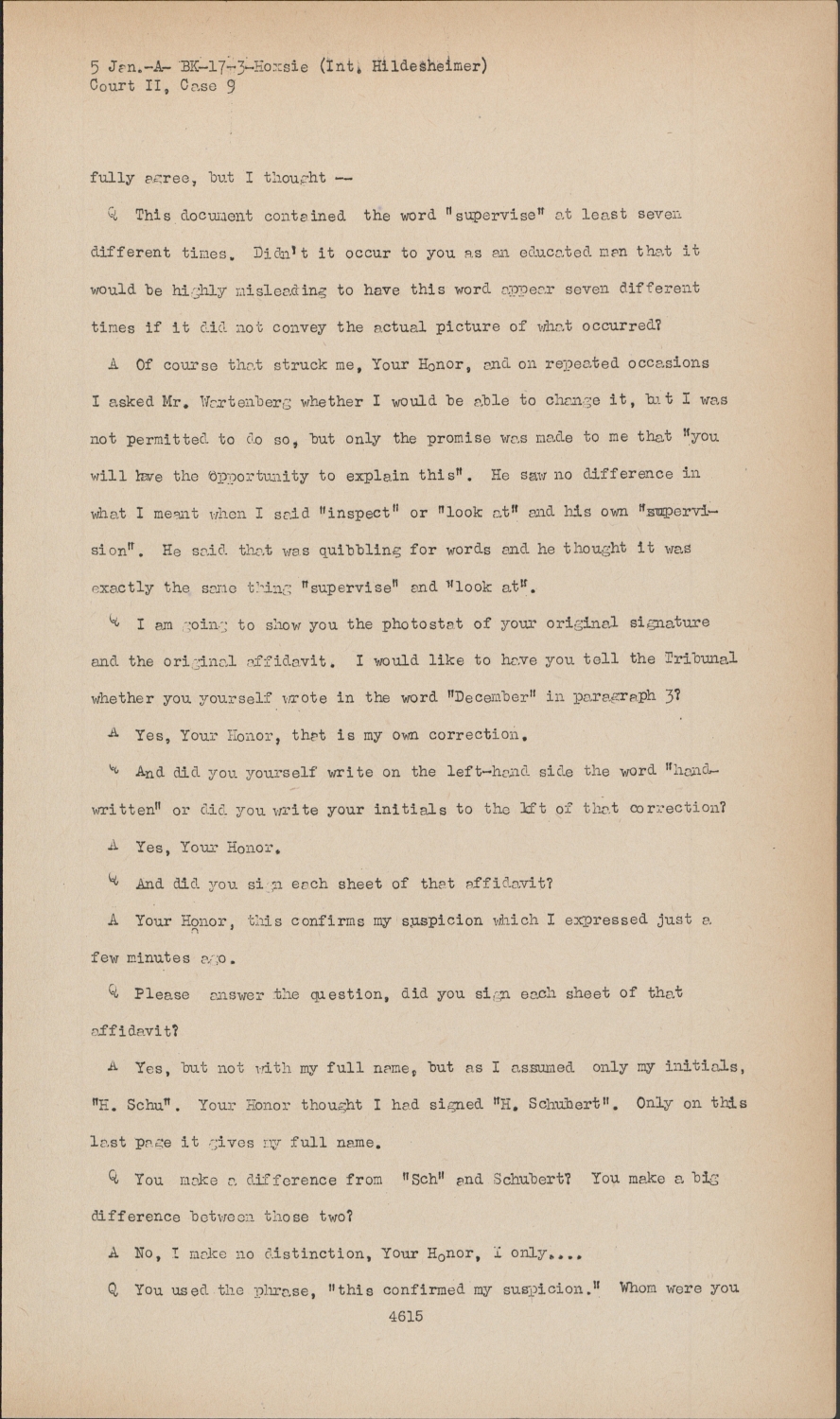
QThis document contained the word "supervise" at least seven different times. Didn't it occur to you as an educated man that it would be highly misleading to have this word appear seven different times if it did not convey the actual picture of what occurred?
AOf course that struck me, Your Honor, and on repeated occasions I asked Mr. Wertenberg whether I would be able to change it, but I was not permitted to do so, but only the promise was made to me that "you will have the opportunity to explain this". He saw no difference in what I meant when I said "inspect" or "look at" and his own "supervision". He said that was quibbling for words and he thought it was exactly the same thing "supervise" and "look at".
QI am going to show you the photostat of your original signature and the original affidavit. I would like to have you tell the Tribunal whether you yourself wrote in the word "December" in paragraph 3?
AYes, Your Honor, that is my own correction.
QAnd did you yourself write on the left-hand side the word "handwritten" or did you write your initials to the left of that correction?
AYes, Your Honor.
QAnd did you sign each sheet of that affidavit?
A your Honor, this confirms my suspicion which I expressed just able few minutes ago.
QPlease answer the question, did you sign each sheet of that affidavit?
AYes, but not with my full name, but as I assumed only my initials, "H. Schu". Your Honor thought I had signed "H. Schubert". Only on this last page it gives my full name.
QYou make a difference from "Sch" and Schubert? You make a big difference between those two?
ANo, I make no distinction, Your Honor, I only....
Q you used the phrase, "this confirmed my suspicion." Whom were you suspecting:
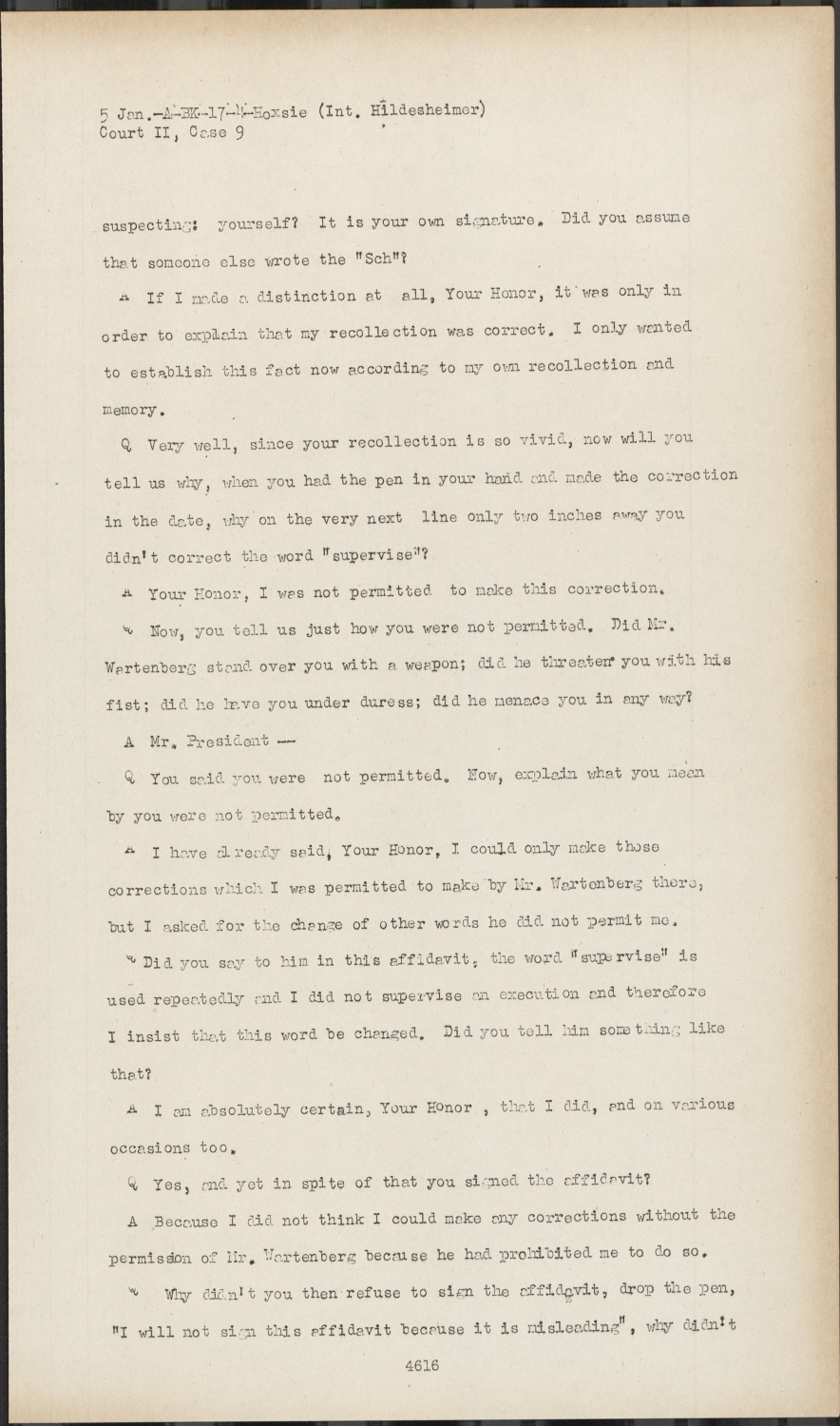
yourself? It is your own signature. Did you assume that someone else wrote the "Sch"?
AIf I made a distinction at all, Your Honor, it was only in order to explain that my recollection was correct.
I only wanted to establish this fact now according to my own recollection and memory.
QVery well, since your recollection is so vivid, now will you tell us why, when you had the pen in your hand and made the correction in the date.
why on the very next line only two inches away you didn't correct the word "supervise"?
AYour Honor, I was not permitted to make this correction.
QNow, you tell us just how you were not permitted. Did Mr. Wartenberg stand over you with a weapon; did he threaten you with his first; did he have you under duress; did he menace you in any way?
AMr. President
QYou said you were not permitted. Now, explain what you mean by you were not permitted.
AI have already said, your Honor, I could only make those corrections which I was permitted to make by Mr. Wartenberg there, but I asked for the change of other words he did not permit me.
QDid you say to him in this affidavit, the word "supervise" is used repeatedly and I did not supervise an execution and therefore I insist that this word be changed.
Did you tell him some think like that?
AI am absolutely certain, your Honor , that I did, and on various occasions too.
QYes, and yet in spit of that you signed the affidavit?
ABecause I did not think I could make any corrections without the permission of Mr. Wartenberg because he had prohibited me to do so.
QWhy didn't you then refuse to sign the affidavit, drop the pen, "I will not sign this affidavit because it is misleading", why didn't you do that?
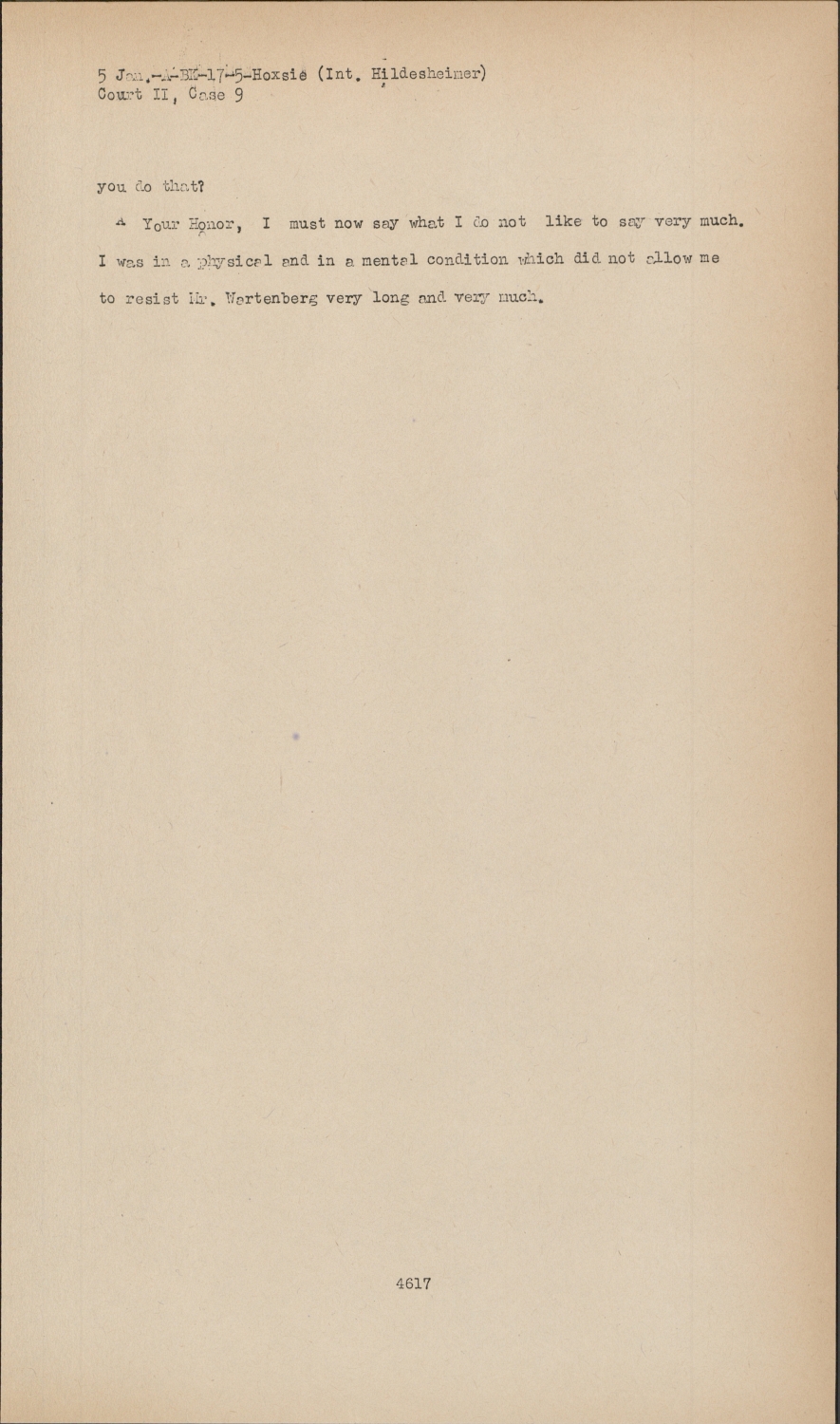
AYour Honor, I must now say what I do not like to say very much. I was in a physical and in a mental condition which did not allow me to resist Mr. Wertenberg very long and very much.
QWell, if your physical condition was Such that it impeded your actions, it was less of an effort not to Sign than to sign?
AYour Honor, I do not know whether it would have been the right thing to refuse to sign it. It seems now that it would have been better to do see but I thought after I had resisted for so long and refused to be content, now with the promises of Mr. Wartenberg and apart from that-
QDid you ever once say to him, "Mr. Wartenberg, I refuse to sign this paper", once, did you ever say that to him?
AYes,Your Honor referring to the change of the date; when I had to confirm that the wording of the affidavit of the 24th had been changed, I told Mr. Wartenberg that I would not be willing to sign that, and this is how I explain the actual change that was then made and which I was permitted to make.
QNow you are going back to that date which I have indicated, you have told us, which we understands, and which is a closed book--You insist on the change of date made; you initialed it, Now, I ask you, leaving aside the date, did you say to Mr. Wartenberg, "I refuse to sign this statement again; but I would like to add now, Your Honor, that immediately after the interrogation of the 18th of February I was taken into a severe custody, and on the 31st of February as well as on the 24th I did not feel myself free in my own will and physically as well as psychologically I was not in the position to resist any further, I was not in the position to go any further than I had already gone, and I thought that I had achieved all that could be done in this situation. I was put into solitary confinement. I was not allowed to go for walks I was put into an unheated cell and that in February. I could not leave the cell even to get my food, The food was brought into my cell. My cell was lit up from outside as at that time it was only usual in the case of defendants, although I at that time was not a defendants, There was, therefore, a difference between my custody as it had been until then. A difference like day and night; my state of health physically was very bad.
I was 26 percent underweight, and I was not in the position-
QDid Mr. Wartenberg have to do anything with what you have just now related?
AYour Honor, Mr. Wartenberg was asked by my defense counsel here when he was in the witness box under cross examination concerning these matters and, if I remember correctly, he has stated that he had then been under the impression that I was thinking of committing suicide, based on the statements which I had made previously and that it was possible that owing to the statement that he had made to the prison office that therefore I was taken into more severe custody. This statement of Mr. Wartenberg's I cannot bring into agreement with the usual habits in such cases in the prison office.
QWell, Witness, are you trying to indicate that you were subjected to what you regard as hardships in order to make you sign an affidavit which contained statements not in accordance with the facts, is that the point which you are trying to make?
AThat I should sign an affidavit which did not correspond to the facts?
QWell, you have enumerated the various hardships which you underwent, and I presume it is only with regard to the affidavit that you tell us about these hardships. Now, do you want to argue or state that you were subjected to this confinement and the other hardships which you have enumerated in order to make you sign an affidavit which did not conform to facts?
AYour Honor, I do not know the reason and the purpose of this particular measure, but I could only regard it as pressure because this more severe custody was immediately relieved after I had signed the affidavit, therefore, this is the only conclusion that I am in a position to draw.
QDid you say to Mr. Wartenberg, "If I sign this paper, will I be released from solitary confinement or did be indicate to you that if you signed it you would be released from confinement?
AYour Honor, and if I had been threatened with death, such question I would never put to my victors. I think I would be too proud to do that.
QWell, were you too proud to sign this statement, "I had the opportunity to make changes and corrections in the above statement. I Made this statement of my own free will without any promise of reward, and I was not subjected to any threat or dress what so ever." Was it because of magnanimity of soul which caused you to sign your name to a statement of that kind when, according to what you tell us now, it does not represent the fact--was that just magnanimity on your part toward your victor, as you call it?
AYour Honor, I may perhaps express it to the following effect. This formulation I signed because it was not exactly incorrect to a certain degree, but as I had no possibilities to make any modifying remarks or make any supplementary notes which would not have been received.....
QBut let us just see just how much what you have told in court today differs from what you said in the affidavit. You said that you did not supervise, you only had to see that it was done.
AYour Honor, I cannot agree to this kind of interpretation. It is again--it is said that I had to see to it that it was done. That is again not quite correct.
QDid you, or did you not say that? That is what I have in my notes. Did you say that this afternoon?
AWhat Your Honor just said and what has been translated, certainly not.
QYou were sent there by Ohlendorf, is that right?
AYes, Your Honor.
QWell, let us suppose that when you arrived you found that the execution was not being conducted in the manner ordered by Ohlendorf; you would have spoken to the officer in charge, wouldn't you?
AYes, Immediately. I may say that General Ohlendorf himself and Dr. Braune inspected the execution on that very day. I would have had enough opportunity to express my misgivings even if the superior officer had not been of my opinion or had not shared my misgivings.
QLet us suppose that the scene of the execution was laid in the middle of the city in a square--in the public square--you would have immediately informed the officer in charge that this was not in accordance with Ohlendorf's orders, wouldn't you?
AIn this case, I would have had to do so, Your Honor, because it was well-known that the exeuction place should not have been inside the town but 20 kilometers outside the town.