
QLet us suppose that some of the SS men had taken some of the valuables and pocketed them instead of turning them over to Einsatzgruppe D. You would have informed the officer there that this was contrary to Herr Ohlendorf's orders?
AI should have tried that first, Yes, and if it had come to my notice that this officer was not using his authority to prevent such matters, then I would have had to report this incident to Herr Ohlendorf.
QLet us suppose instead of using submachine guns and rifles you came upon an officer who was about to use hand grandes to execute the victims. You would have immediately called it to the attention of Ohlendorf that this was contrary to orders?
AIf that had happened, certainly, Your Honor.
QSo that in fact you were there to see to it that the executions were carried out in accordance with the orders issued by the chief of the Einsatzgruppe D?
AWhether it was carried out like that according to orders, but that they were actually carried out, I don't know, and I had no influence on that for this the presponsible person was an officer holding the rank of a major who was responsible for everything and who had all the authority. I was not responsible for the action, execution, I was only to find out about the manner in which it was to be carried out, but I had no influence on whether it was actually carried out, but only to see how it was carried out.
QAnd to indicate to the officer in charge of the execution squad that he was going astray in the event he was not following the orders of Ohlendorf?
AThat I would have had to do in any case, and I think everybody else would have done that without a corresponding order if he had found out about incidents of that kind. That, of course, was his duty without any special order.
THE PRESIDENT:The court will recess for 15 minutes.
DR. KOESSL:Your Honor, just one little question before the recess.
THE PRESIDENT:Certainly, even a big question.
BY DR. KOESSL:
QWitness, were you ever threatened by Mr. Wartenberg?
AYes, and I am perfectly aware of the fact that Mr. Wartenberg the question to this effect by my defense counsel which was "whether he had threatened me with a broomstick in Oberursel on one occasion", in the negative.
I can say, under oath, that I can give an affirmative answer to this question because such a threat actually took place.
BY THE PRESIDENT:
QWhen was that?
AThat was during the time when I was in the interrogation center in Oberursel.
QWhen as that--the date?
AYour Honor, I can only give the approximate period between October and December '45.
I don't know what month--which of the three months.
QWas it at least a year and a half prior to the time you signed the affidavit--wasn't it?
AYes, Your Honor.
QDo you want to tell us now that for a year and a half you were in fear of a broomstick and signed it just because of that recollection of a year and a half previously?
AYour Honor, it wasn't the broomstick, but the fact that suddenly when I was taken into the interrogation room I was confronted with the very same person.
QWith the very same broomstick?
ANo, it wasn't the broomstick, Your Honor, but the incidents or the events of October or December 1945 were clearly in front of me at that very moment when I was led in and in the meantime until I had arrived here I had found out about incidents and happenings which made me afraid of the worst--of the methods of interrogation, and I was certainly realizing again all these methods; I cannot say that it was not exactly fear, but I had a psychological reaction, and I thought I might be exposed to such extreme measures of interrogation again.
I had not by any means forgotten the incident of Oberursel, and I am prepared to give details about this event, if the president wants me to do so,then he is a stronger character than I am, at least, stronger in his resistance. I was no longer in the possession of my full strength, otherwise, I would have resisted again, and if I may emphasize this again, it was my express intention to change all those passages--wrong statements which indicted other people. As far as my own person was concerned, I trusted that I would be able to explain myself if these things would be used against me. Perhaps that was wrong of me to do so, but I cannot find any other explanation for it.
THE PRESIDENT:The Tribunal will be in recess 15 minutes.
(A recess was taken.)

THE MARSHAL:The Tribunal is again in session.
THE KOESSL:I would like to continue?
THE PRESIDENT:All right, Dr. Koessl.
BY DR. KOESSL:
QWitness, did you receive any distinction during your assignment in Russia?
ADuring my assignment in Russia I received the Iron Cross second class; the corresponding Rumanian distinction, which is about the same as the Iron Cross, and also rememberance distinctions.
I received the German Winter Medallion for the Eastern campaign.
I received the Rumanian Medallion for this winter campaign as well the so-called distinction Cruisade (Kreuzzug) against Russia.
I also received the Crimea distinction.
And those other distinctions and commemorative medals which I received during my assignment in Russia.
Insofar as the Iron Cross is concerned, and the Rumanian distinction, they were rewards for bravery, they were awarded for bravery on the front with the enemy.
All the others are merely commemorative medals which everybody received who was in Russia during that period.
It was merely required to have been there at certain periods.
QDid all the members of the Wehrmacht, or the Navy, or the Airforce receive the same medals on the same occasions?
AYes, they were medallions of the German Wehrmacht; they were not SS or Einsatzgruppe medals or distinctions but were awarded throughout the entire German Wehrmacht.
QWhen did you finish with your assignment of the East?
AI concluded my assignment in the East when I was recalled, if I remember correctly, on 6th or 8th of July 1942.
I flew at the time together with Herr Ohlendorf and returned to Berlin.
QWhat did you do during the following time in the SD?
AFirst of all I remained adjutant of Herr Ohlendorf at this time in my capacity as Office Chief III in the Reich Security Main office.
This position I retained until about the beginning of October 1943.
At that time office I to which I had belonged until then transferred me to office III, and I was put into the auxiliary position as an assistant, and in Group III-B of the Reich Security Main Office I Worked in the manner I have already explained this morning.
QWhy were you transferred to Office III?
AThere were several reasons for this: private reasons as well as official reasons, but they occurred at the same time.
About this time, about the end of September 1943, the Fuehrer Degree was issued, which said that the position of adjutant was only to be held by persons who were commanding generals and the highest officers.
I, therefore, had to get a new job because of this Fuehrer Order.
Also in the mean time I had remarried and Herr Ohlendorf on his own initiative was prepared to spare me from working every evening until late night.
QWhat did you do in Group III-B?
AIn the Group III-B I was an Auxiliary Referent III-BS. That is what this Auxiliary Department was called, In this work, according to instructions by my group chief, I had to deal with the internal personnel matters of the group.
That was because of my knowledge which I had obtained in Office-I, and as personnel expert I dealt with orders, transfers, or T/O Office Ratings, according to the instruc tions of my chief.
I had to supervise the filing and registration departments of this group.
QHow long did you stay in this office?
AI remained in this office until 30 November 1944. With affect from 1 September 1944 the Reich Security Main Office transferred me to Augsburg.
QWhat were your tasks in the SD Sector of Augsburg?
AIn the SD Sector of Augsburg I was put in charge of Department III-B. That is a department where the domestic sphere problems concerning Ethnic Germans and National Health were dealt with.
This work in the SD-Sector Augsburg had to be reorganized right from the start, because the office of the SD Sector of Augsburg in August 1945 had been suspended. Therefore, at first I had to deal with organizing mostly in the internal construction. And when the machinery had finally started working I made reports to the Reich Security Main Office, and the local offices of the Gau District of Schwaben. I did this work until the collapse, exactly until 26 April 1945, when the office owing to the arrival of American troops was dissolved.
QWhile belonging to the SD, did you ever receive any police training?
ANeither during my membership in the SD nor at any other time did I receive any police training.
QWere you ever active in the executive? I don't want you to think of the Russian assignment now?
AAt no front was I ever active in any executive.
QDuring your work in the SD, in office I and Office III, did you ever have to deal with Jewish questions?
ANo, never.
QDid you know about the event of 9 and 10 November 1938?
AOf course, I knew as much as any other German on the average, at the time, and could have had according to publications and announcements in the newspapers and the radio. At no time as a SD member did I hear anything about this officially. May I add here that at the time of these events, when they occurred, I myself was not in the service, but that afterwards I heard nothing further about this in my official capacity. I had nothing to do with such matters.
QBut you heard about the work of the Einsatzgruppen?
AYes, of course I had.
QWhy did you not leave the SD then?
AOn principle I would like to say that according to my definite convictions, according to what I had heard during the many years of my membership, it was impossible to resign from the SD, but every SD member came under military law, and, therefore, could not get out.
May I point here again that even for very important personal reasons when presented in such applications were refused; as it happened to me when stating that I had lost my wife and child I asked that I no longer be deferred, that even such an application was refused.
May I just add something about this.
I believe that I am fully convinced that from the knowledge of the work of the Einsatzgruppe, which I heard during my time I could not draw the conclusion that these tasks of the Einsatzgruppe in Russia could in any way have had anything to do with the tasks of the organization of the State Police, or the Criminal Police, or the SD, even.
Never did I hear of any orders which the Offices III, IV, V, VI, or VII of the RSHA issued concerning the treatment of Jews.
I do not know of any such orders. I merely know that the Fuehrer Order as exclusively applied at the time.
I heard nothing else in the Territory Barbarossa, that is, the operation al territory in Russia.
Reasonably, therefore, from this work I could not tell my superiors that I intended to leave this organization for that reason, because the tasks had nothing to do with such matters;and, if one should formulate this theoretically now, a member of the SD or the State Police, or the Criminal Police should have been satis fied, if he could resume his former work within the SD, but in particular in the SD he could never expect that as part of the tasks of this organization that he would ever have to carry out any such tasks.

QDo you know that members of the SD took part in the occurrences on the border shortly before the Police campaign?
ANo, I don't know that. I merely heard about this later as part of the announcements and the publications in the IMT Trial.
THE PRESIDENT:Are you referring, Dr. Koessl, to the radio station incidents?
DR. KOESSL: Yes, I was thinking of the attack on the Gleiwitz transmitter which was considered in the IMT judgment, and for which a number of SD people were made responsible.
I now want to ask the witness about this, of what he heard about such things.
BY DR. KOESSL:
QApart from your Russian assignment were you ever active in any occupied territories, or did you take part in any such work?
ANo, at no time.
QDid you know that the SD arrested civilians of occupied territories and kept them prisoners under inhumane conditions?
ANo, during my time of service I heard never anything of the kind.
QDid you, during that time of your work, ever hear that the SD, or the SD members carried out interrogations of the third degree, as they were called?
ANo. This expression "interrogations of the third degree" I only heard of after having had contact with offices of the American Army.
I had never heard of that before. I did not know what it was.
QDo you know that Office III or members of the SD took part in the shootings of hostages?
ANo, I never heard about that.
QDid you know whether Office III or any members of SD took part in measures of this so-called Summary Special Treatment?
AI would like to say here that I know the expression "summary special treatment" means nothing to me, and I can not imagine what it means, that I never heard about anything of that kind.
THE PRESIDENT:You don't say you don't know now what it means, do you?
THE WITNESS:Your Honor, this was part of the IMT verdict against the SD, and that is where I heard this expression "Summary Special Treatment", and that is the only knowledge I have of this.
THE PRESIDENT:I understood you to say that you don't know even today what it means?
THE WITNESS:I surely don't know now what it means. I only know it was contained in the IMT verdict, but I don't know what it means today.
THE PRESIDENT:You don't know what is meant by the phrase "Special Treatment"?
THE WITNESS:The expression "Special Treatment"? I think that during the trial I have understood what this means.
THE PRESIDENT:You know "Special Treatment" means liquidation. You know that, don't you?
DR. KOESSL:Your Honor, I didn't ask about "Special Treatment". But about "Summary Special Procedure". Special Summary Procedure.
THE PRESIDENT:Oh, well, that is different. Then you are asking about Summary Procedure?
DR. KOESSL:Yes, procedure.
THE PRESIDENT:Very well.
BY DR. KOESSL:
QWhat do you know about the so-called "Night and Fog Decree" and the "Kugel Decree"?
AAt the time when I think I was in the camp Darmstadt, I heard these expressions for the first time.
I actually had never heard of it until then.
In the Camp Darmstadt it was part of the radio broadcast of the trial here in Nurnberg.
QAnd do you know, or did you whether the SD took part in the confiscation of property in the occupied territories?
AI have already said that I was in no other occupied territories, and I did not work there, and I don't know anything about matters or orders which contained such kind of work done by the SD in occupied territories.
QDid you know whether the SD took part in Forced Labor Programs?
ANo, I knew nothing about that.
QDo you know about the so-called "Commando Order"?
ANeither.
QDid you know the so-called "Lynch Order" against Allied Airmen?
ASuch an order was never made known to me. I never heard about it, in fact.
QAfter the end of the war, did you undertake anything in order to avoid punishment?
AI believe I have done the contrary, if I may explain this briefly. originally I was in French captivity, and I then asked the French Captain to transfer me to the Americans if the territory occupied by the French would be handed over to the Americans. This was the territory of Oberallgau in the Alps. I also pointed out that I had heard the announcement of the American Army according to which every officer NCO and enlisted man who had served in any part of the NSDAP was to remain where he was until further decisions had been made concerning such people. I, therefore, had to expect that the Americans in Augsburg would look for me, and, I, therefore, asked to have me handed over to the American authorities, so that I could assume the responsibility for my work there. I think that I considered that I owed it to those persons in Augsburg who worked under me, and who might be interrogated by the Americans. I want to assume responsibility for my work and did not want to keep anything a secret.
DR. KOESSL:I have no further questions, thank you.
THE PRESIDENT:Any defense counsel desire to cross examine the witness? If not, Mr. Walton will proceed with the Prosecution's cross examination CROSS EXAMINATION BY MR. WALTON:
QMr. Schubert, you have stated in one of you affidavits that you reported for service in Einsatzgruppe D in October 1941, is this correct?
AYes, I had reported at the beginning of October 1941 for service with Einsatzgruppe D.
QAt this time, where was the headquarters of Einsatzgruppe D? What city or what town in Russia?
AThe headquarters of Einsatzgruppe D was at the time in Nikolajew.
QHow soon after your arrival was your conference with General Ohlendorf?
AMy first discussion?
QYes?
ATwo or three days after my arrival. Perhaps I may explain this in more detail why two days intervened.
QPlease do so?
AThis was just at the time when the Reichsfuehrer SS Himmler had been staying in the territory, and as I heard later had talked to members of Einsatzgruppe D. During this visit of Himmler in Nikolajew we suddenly appeared unexpectedly.
At the moment they could not use us, and I would like to say, they kept us on ice, so to say, until Himmler had gone, and then Herr Ohlendorf had the time to deal with us.
QHow did you occupy yourself during those two or three days before You could see General Ohlendorf?
AI had a look at the city of Nikolajew. Apart from that I had no other definite work.
I had no special occupation during that time.
Q.Did you hold conversation with other members of the Einsatzgruppe?
A.No, during those days I was together with those comrades who had come together with me as re-enforcements.
We had no contact with the Einsatzgruppe as yet.
Q.Now when you finally had this conference with General Ohlendorf how long did it last?
A.This discussion with Herr Ohlendorf took a very long time because, as I have already explained this morning, Herr Ohlendorf scrutinized everyone of these officers per sonally, very thoroughly, and I think some of them didn't like it.
This took a very long time. I think it was se veral hours.
Q.Did General Ohlendorf have his conference with all ten of you together or did he confer with you one at all time in private?
A.No, we were all 10 together in the casino of the Gruppenstab together with Herr Ohlendorf.
Q.Did General Ohlendorf explain to you at the con ference what the over-all or primary mission of Einsatz gruppen D was?
A.I did not quite get that. What the primary task was?
Q.Did he tell you in what work generally the Einsatz gruppen was engaged at that particular time?
A.I can only repeat here what I have already said this morning.
Herr Ohlendorf described the work of the Einsatzgruppen in general to us as it resulted from the Barbarossa decree as a security task in the territory of the rear Army, - duties concerning the carrying out of the security task as far as I can recall here were not mentioned at the time.
Q.Was anything said in that conference or by General Ohlendorf about the executions of Jews, Gypsies, Communist functionaries, Krimjaks, Asiatics, or others?
A.May I repeat here what I said this morning. About such matters it was never talked on that occasion.
Q.Now, I believe you testifies this morning that you first learned of the Fuehrer order from the files in the Headquarters of Einsatzgruppen D, is that correct?
A.No, Mr. Prosecutor, not through the files did I hear about the Fuehrer order but from the files I saw thing which made me assume or suspect that resettlement as it was written in the reports was a camoflage expression for executions, possibly.
And, in order to be clear about such matters I asked Herr Ohlendorf about this.
On that occasion Herr Ohlendorf told me about the contents of the Fuehrer Order.
Q.About how soon did this discussion concerning the Fuehrer order take place with General Ohlendorf after you arrived in Nikolajew?
A.I cannot say that any more now for certain but I think I used the very first opportunity in order to asked Herr Ohlendorf about this, but of course I could not mention this when he returned from his official trip to his office.
I think I let some time pass, perhaps it was the next day, but I don't know for certain.
Q.At your first opportunity then you asked him about why these terms of resettlement, etc.
, were used in reports to mean liquidation of Russian nationals?
At you first op portunity you discussed this with General Ohlendorf?
A.The occasion of that discussion after his return from Berlin in the last third of the month of October.
Q.Now when did you first learn that reports of ex ecutions of Jews, Gypsies, and Communist functionaries were being sent to Berlin?
A.For certain after that discussion because before I was not certain that my suspicion that this resettlement was camouflaged expression and was justified I wanted to have this confirmed.
Q.Did you ever discuss this topic with any other member of the Gruppenstab?
A.I cannot remember any discussion, Mr. Prosecutor, with any other member of the Gruppenstab in particular concerning this Fuehrer order.
There was no particular reason officially for me to do so.
Q.How soon after you reported for duty with Ein satzgruppe D did you meet Seibert?
A.I met Mr. Seibert when I came to Gruppenstab of Einsatzgruppen D, that is the beginning of October 1941.
Q.Did you ever hold any discussions with him con cerning your duties?
A.About my duties, my official duties? As far as I can recall I did not talk with him particularly because my duties I knew according to the orders given my by Herr Ohlendorf.
I had no reason to discuss my duties with Herr Seibert.
Of course, I talked to Herr Seibert every now and then.
Q.Now, after you reported to Einsatzgruppen D in Nikolajew and after you had this conference with General Ohlendorf you received your assignment from the General himself, did you not?
A.Yes, from Herr Ohlendorf personally.
Q.How soon after your assignment was given and you entered on your official duties did General Ohlendorf leave his headquarters for an official trip to Berlin?
A.That might have been about 2 weeks but I cannot say for certain.
*---*t is possible that Herr Ohlendorf re turned already before two weeks had elapsed.
I remember very clearly that at the time Herr Ohlendorf in as far as the return from Berlin to Nikolajew was concerned only took three days to return to Nikolajew.
Q.I think you misunderstood the question. How soon after you entered upon your duties as the adjutant of General Ohlendorf did he leave the Gruppenstab Headquarters for his trip to Berlin?
A.I beg you pardon. I now understand the question It might have been the second or the day after the next after my arrival after I went to report to Herr Ohlendorf.
Q.Now, at that time some of your tasks and duties and your surroundings were strange to you, weren't they?
You were a new man on a new job, so at least you didn't understand thoroughly everything you were to do on this job, did you?
A.I believe that it would have been the same for anyone.
Q.That's right.
A.I was about to do a task which was partly new to me.
I had to get used to it. Therefore, on the first day I could not see all the jobs I would have to do.
Q.And when prospects or problems came up which puzzled you and General Ohlendorf left for Berlin so soon after you had arrived there to whom did you turn for advice and counsel in these problems with General Ohlendorf gone?
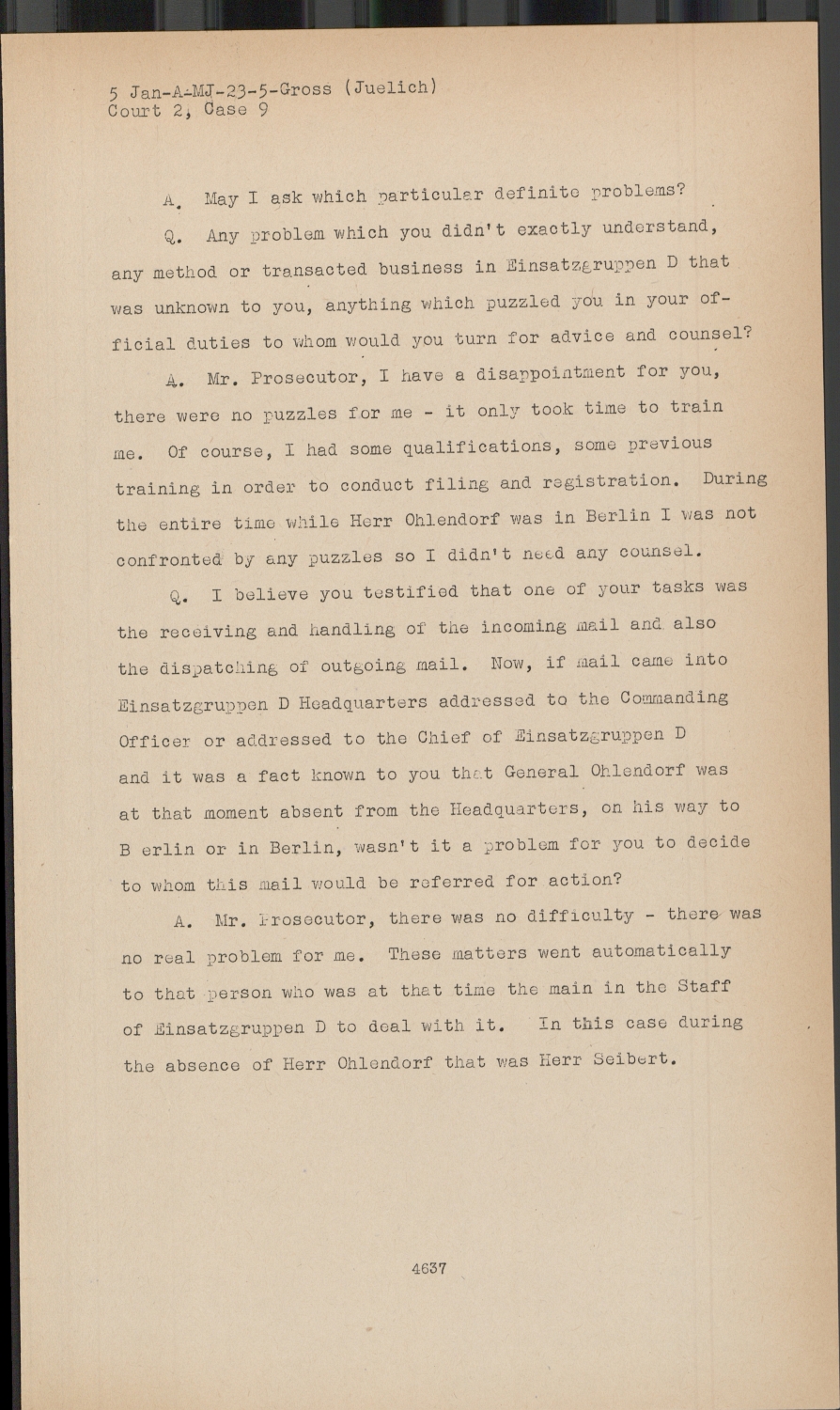
A.May I ask which particular definite problems?
Q.Any problem which you didn't exactly understand, any method or transacted business in Einsatzgruppen D that was unknown to you, anything which puzzled you in your of ficial duties to whom would you turn for advice and counsel?
A.Mr. Prosecutor, I have a disappointment for you, there were no puzzles for me - it only took time to train me.
Of course, I had some qualifications, some previous training in order to conduct filing and registration.
During the entire time while Herr Ohlendorf was in Berlin I was not confronted by any puzzles so I didn't need any counsel.
Q.I believe you testified that one of your tasks was the receiving and handling of the incoming mail and also the dispatching of outgoing mail.
Now, if mail came into Einsatzgruppen D Headquarters addressed to the Commanding Officer or addressed to the Chief of Einsatzgruppen D and it was a fact know to you that General Ohlendorf was at that moment absent from the Headquarters, on his way to Berlin or in Berlin, wasn't it a problem for you to decide to whom this mail would be referred for action?
A.Mr. Prosecutor, there was no difficulty - there was no real problem for me.
These matters went automatically to that person who was at that time the main in the Staff of Einsatzgruppen D to deal with it.
In this case during the absence of Herr Ohlendorf that was Herr Seibert.
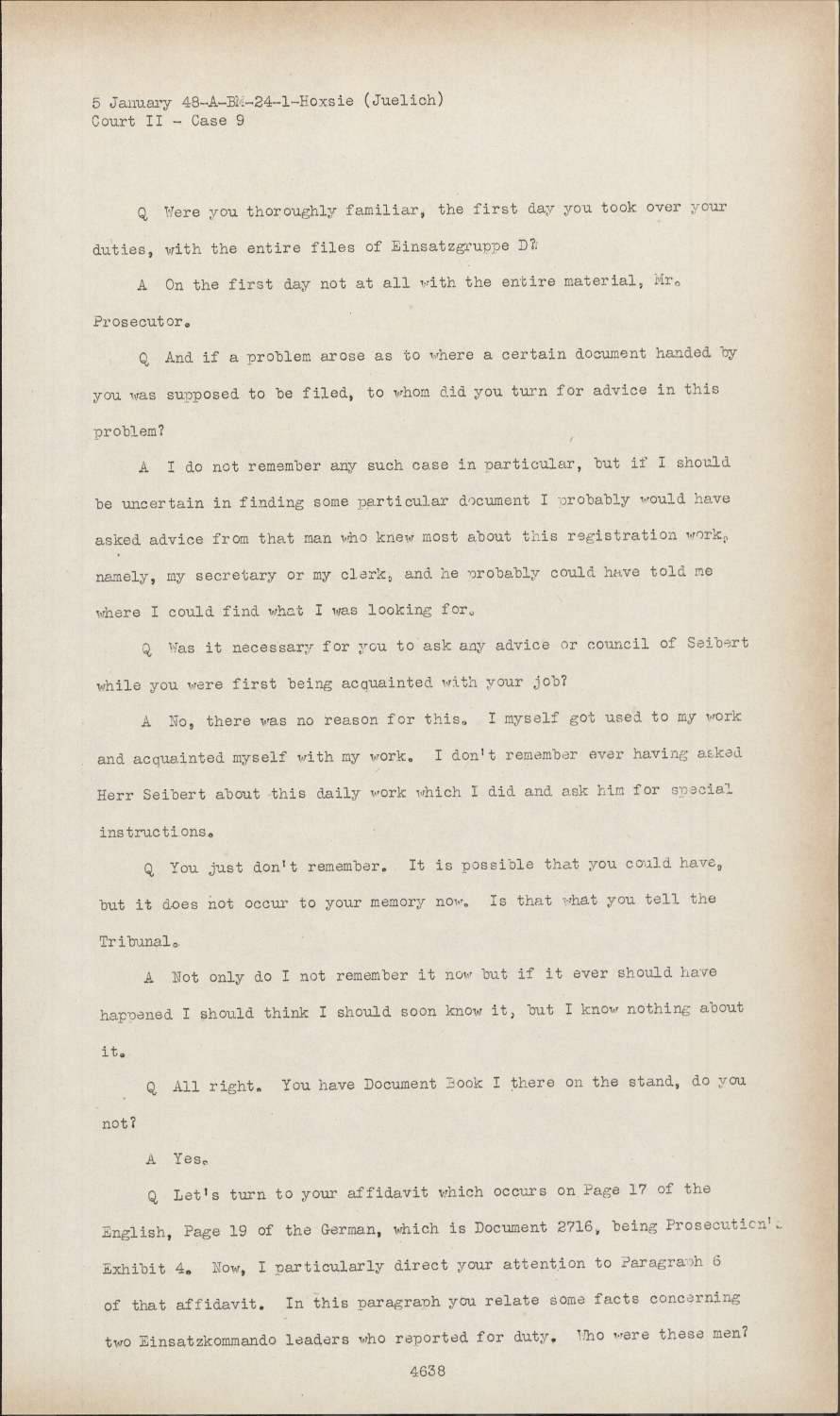
QWere you thoroughly familiar, the first day you took over your duties, with the entire files of Einsatzgruppe D?A on the first day not at all with the entire material, Mr. Prosecutor.
QAnd if a problem arose as to where a certain document handed by you was supposed to be filed, to whom did you turn for advice in this problem?
AI do not remember any such case in particular, but if I should be uncertain in finding some particular document I probably would have asked advice from that man who knew most about this registration work, namely, my secretary or my clerk, and he probably could have told me where I could find what I was looking for.
Q was it necessary for you to ask any advice or council of Seibert while you were first being acquainted with your job?
ANo, there was no reason for this. I myself got used to my work and acquainted myself with my work.
I don't remember ever having asked Herr Seibert about this daily work which I did and ask him for special instructions.
QYou just don't remember. It is possible that you could have, but it does not occur to your memory now.
Is that what you tell the Tribunal.
ANot only do I not remember it now but if it ever should have happened I should think I should soon know it, but I know nothing about it.
QAll right. You have Document Book I there on the stand, do you not?
AYes.
QLet's turn to your affidavit which occurs on Page 17 of the English, Page 19 of the German, which is Document 2716.
being Prosecution's Exhibit 4. Now, I particularly direct your attention to Paragraph 6 of that affidavit.
In this paragraph you relate some facts concerning two Einsatzkommando leaders who reported for duty.
Who were these men?

ADuring the time of my work in Einsatzgruppe D new kommando leaders were brought in as relief for two others, to replace two others, the kommando chief 11b, the co-defendant, Dr. Braune,and the successor for the kommando chief 12, the co-defendant Nosske, who had been relieved in March, 1942, and an SS-Standartenfuehrer replaced him whose name was Mueller.
I believe that when making my affidavit I thought of those two names.
QNow, when you spoke of during this period, you mean during the period of your service, or do you refer specifically to during the period of your arrival in Nikolaev in October, 1941, which is referred to in the immediately preceding paragraph of that affidavit?
Note, please, that you start Paragraph 6 with the words, "During this period".A "During this activity" it says here.
QThat means that your activity in - the period of your activity in Einsatzgruppe D.
AI believe this refers to the last sentence under Figure 5 where it says I came to Ohlendorf as an adjutant, and then figure 6 starts, "During this activity". It refers, therefore, as far as II understand, to my work as adjutant in Einsatzgruppe D.
QAll right. Now, you say these men were Dr. Braune and Nosske?
ANot Nosske, but Dr. Braune and Mueller.
QI beg your pardon, Dr. Nosske's sucessor?
AYes.
QDid these men receive any instructions, to your knowledge, about their duties from anyone except General Ohlendorf?
AMr. Prosecutor, I cannot say anything about these discussions:
that is definite because I was not present, but it was my opinion at the time too when this was written that these kommando chiefs surely received instructions about their tasks.
What kind of instructions these were, of course I don't know.
I could only give a general opinion.
QI asked you whether according to your knowledge they received any instructions from anyone else in the staff except General Ohlendorf?
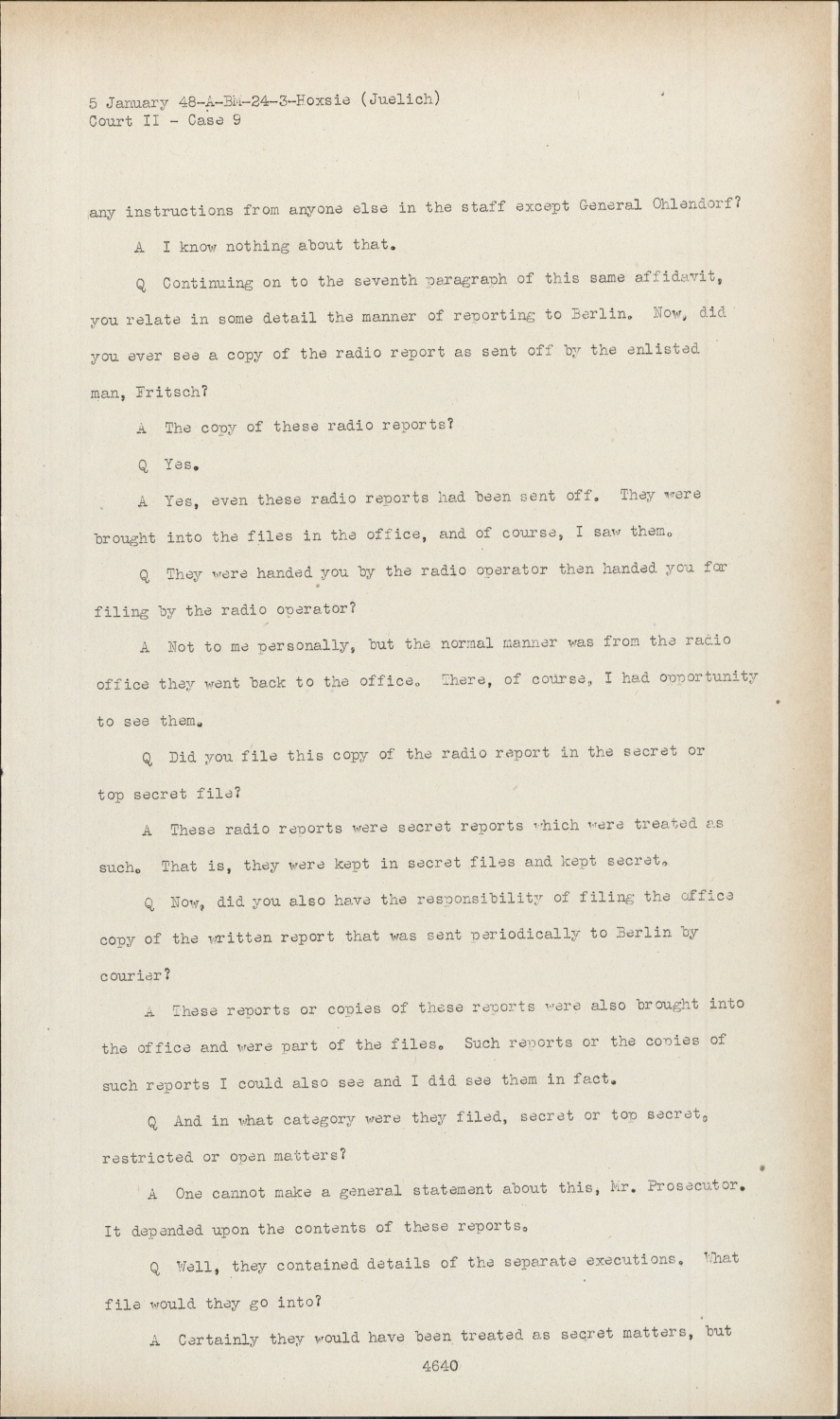
AI know nothing about that.
QContinuing on to the seventh paragraph of this same affidavit, you relate in some detail the manner of reporting to Berlin.
Now, did You ever see a copy of the radio report as sent off by the enlisted man, Fritsch?
AThe copy of these radio reports?
QYes.
AYes, even these radio reports had been sent off. They were brought into the files in the office, and of course, I saw them.
QThey were handed you by the radio operator then handed you for filling by the radio operator?
ANot to me personally, but the normal manner was from the radio office they went back to the office.
There, of course, I had opportunity to see them.
QDid you file this copy of the radio report in the secret or top secret file?
AThese radio reports were secret reports which were treated as such.
That is, they were kept in secret files and kept secret.
QNow, did you also have the responsibility of filling the office copy of the written report that was sent periodically to Berlin by courier?
AThese reports or copies of these reports were also brought into the office and were part of the files.
Such reports or the copies of such reports I could also see and I did see them in foot.
QAnd in what category were they filed, secret or top secret.
restricted or open matters?
AOne cannot make a general statement about this, Mr. Prosecutor.
It depended upon the contents of these reports.
QWell, they contained details of the separate executions. What file would they go into?
ACertainly they would have been treated as secret matters, but may I point out here, Mr. Prosecutor, that in our file system concerning those two persons, that is myself and my clerk, there was no difference made on the outside, and I don't see much difference.
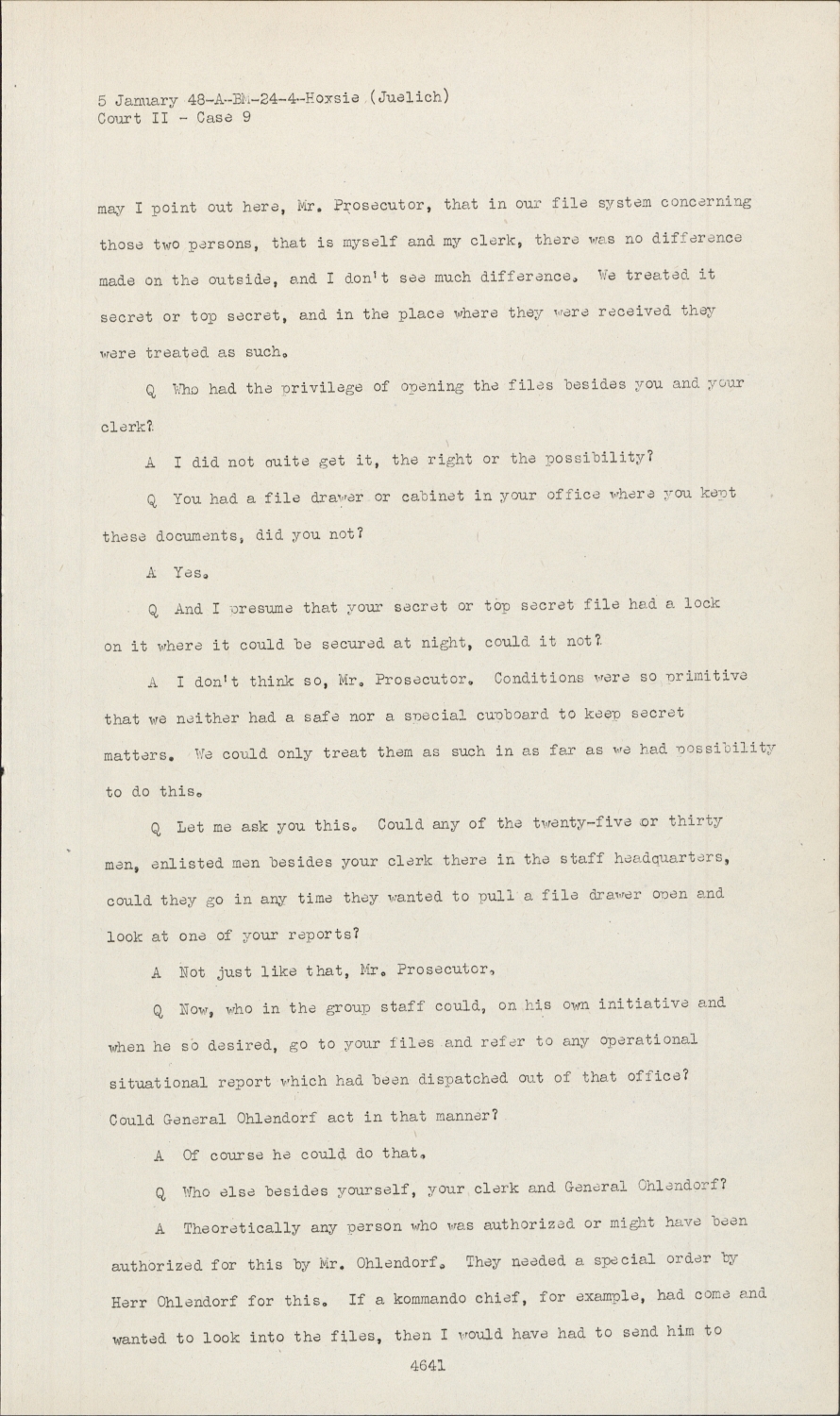
We treated it secret or top secret, and in the place where they were received they were treated as such.
QWho had the privilege of opening the files besides you and your clerk?
AI did not quite get it, the right or the possibility?
QYou had a file drawer or cabinet in your office where you kept these documents, did you not?
AYes.
QAnd I presume that your secret or top secret file had a look on it where it could be secured at night, could it not?
AI don't think so, Mr. Prosecutor. Conditions were so primitive that we neither had a safe nor a special cupboard to keep secret matters.
We could only treat them as such in as far as we had possibility to do this.
QLet me ask you this. Could any of the twenty-five or thirty men, enlisted men besides your clerk there in the staff headquarters, could they go in any time they wanted to pull a file drawer open and look at one of your reports?
ANot just like that, Mr. Prosecutor.
QNow, who in the group staff could, on his own initiative and when he so desired, go to your files and refer to any operational situational report which had been dispatched out of that office?
Could General Ohlendorf act in that manner?
A of course he could do that.
QWho else besides yourself, your clerk and General Ohlendorf?
ATheoretically any person who was authorized or might have been authorized for this by Mr. Ohlendorf.
They needed a special order by Herr Ohlendorf for this.
If a kommando chief, for example, and come and wanted to look into the files, then I would have had to send him to Herr Ohlendorf because I was not allowed to let him look into the files without special permission.