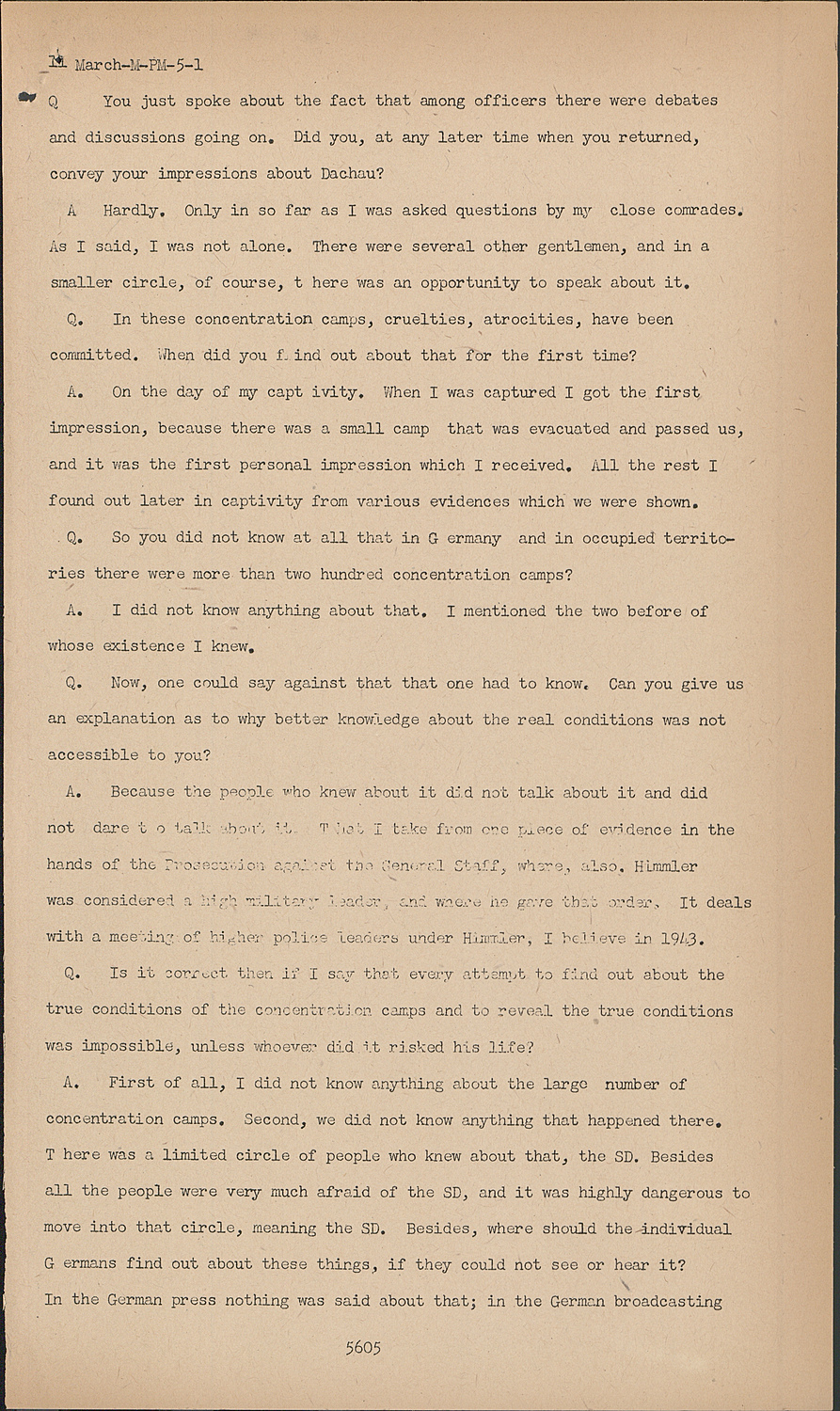
Q You just spoke about the fact that among officers there were debates and discussions going on.
Did you, at any later time when you returned, convey your impressions about Dachau?
AHardly. Only in so far as I was asked questions by my close comrades. As I said, I was not alone. There were several other gentlemen, and in a smaller circle, of course, t here was an opportunity to speak about it.
Q.In these concentration camps, cruelties, atrocities, have been committed. When did you f ind out about that for the first time?
A.On the day of my capt ivity. When I was captured I got the first impression, because there was a small camp that was evacuated and passed us, and it was the first personal impression which I received. All the rest I found out later in captivity from various evidences which we were shown.
Q.So you did not know at all that in G ermany and in occupied territories there were more than two hundred concentration camps?
A.I did not know anything about that. I mentioned the two before of whose existence I knew.
Q.Now, one could say against that that one had to know. Can you give us an explanation as to why better knowledge about the real conditions was not accessible to you?
A.Because the people who knew about it did not talk about it and did not dare t o talk about it. T hat I take from one piece of evidence in the hands of the Prosecution against the General staff, where, also. Himmler was considered a high military leader, and where he gave that order. It deals with a meeting of higher police leaders under Himmler, I believe in 1943.
Q.Is it correct then if I say that every attempt to find out about the true conditions of the concentration camps and to reveal the true conditions was impossible, unless whoever did it risked his life?
A.First of all, I did not know anything about the large number of concentration camps. Second, we did not know anything that happened there. T here was a limited circle of people who knew about that, the SD. Besides all the people were very much afraid of the SD, and it was highly dangerous to move into that circle, meaning the SD. Besides, where should the individual G ermans find out about these things, if they could not see or hear it? In the German press nothing was said about that; in the German broadcasting or radio, nothing was said about that; to listen to enemy broadcasts was forbidden by the death penalty in most cases.
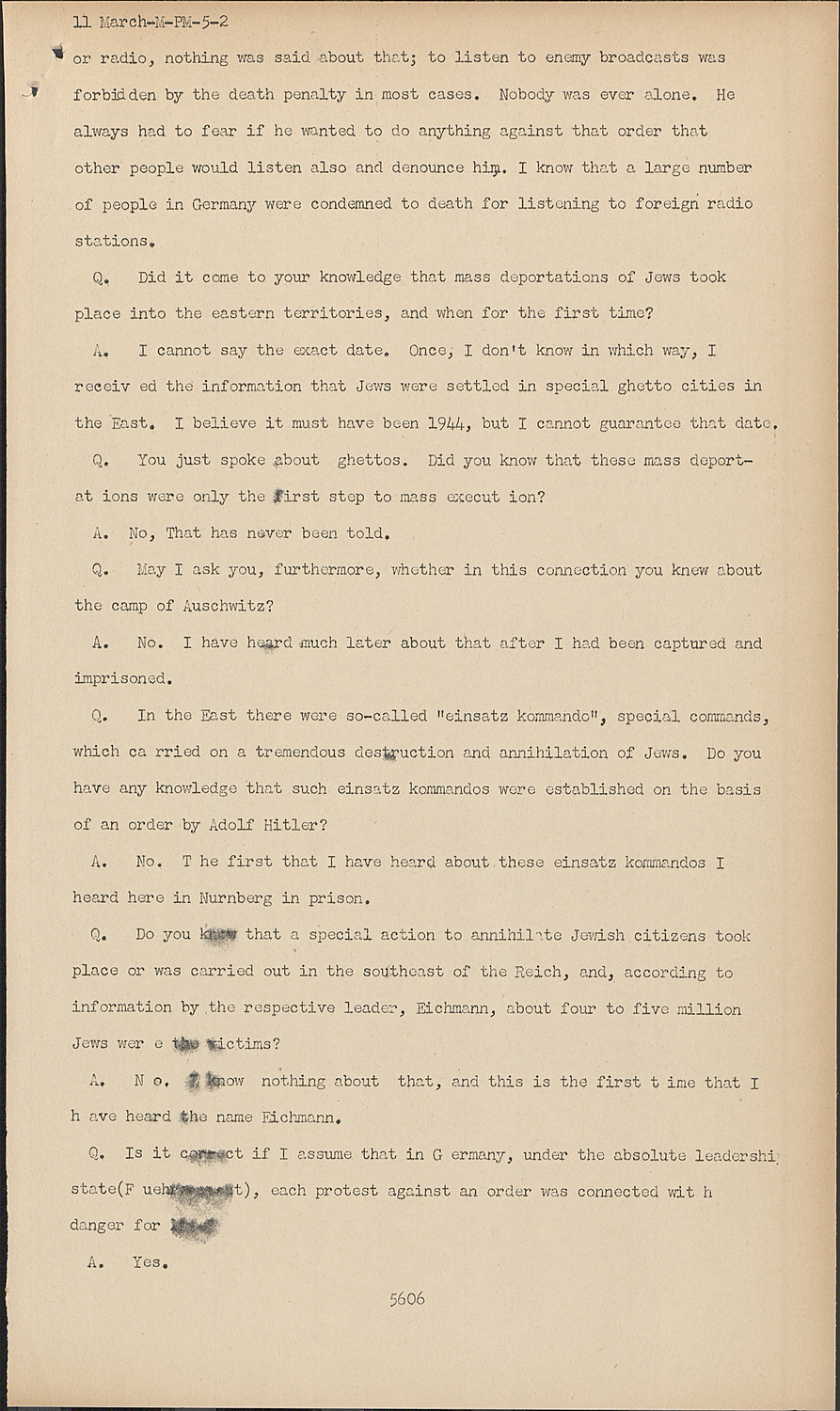
Nobody was ever alone. He always had to fear if he wanted to do anything against that order that other people would listen also and denounce hip. I know that a large number of people in Germany were condemned to death for listening to foreign radio stations.
Q.Did it come to your knowledge that mass deportations of Jews took place into the eastern territories, and when for the first time?
A.I cannot say the exact date. Once, I don't know in which way, I receiv ed the information that Jews were settled in special ghetto cities in the East. I believe it must have been 1944, but I cannot guarantee that date.
Q.You just spoke about ghettos. Did you know that these mass deportat ions were only the first stop to mass execut ion?
A.No, That has never been told.
Q.May I ask you, furthermore, whether in this connection you knew about the camp of Auschwitz?
A.No. I have heard much later about that after I had been captured and imprisoned.
Q.In the East there were so-called "einsatz kommando", special commands, which ca rried on a tremendous destruction and annihilation of Jews. Do you have any knowledge that such einsatz kommandos were established on the basis of an order by Adolf Hitler?
A.No. T he first that I have heard about these einsatz kommandos I heard here in Nurnberg in prison.
Q.Do you know that a special action to annihilate Jewish citizens took place or was carried out in the southeast of the Reich, and, according to information by the respective leader, Eichmann, about four to five million Jews wer e the victims?
AN o. I know nothing about that, and this is the first t ime that I h ave heard the name Eichmann.
Q.Is it correct if I assume that in G ermany, under the absolute leadership state(F uehr *---*t), each protest against an order was connected wit h danger for *---*
A.Yes.
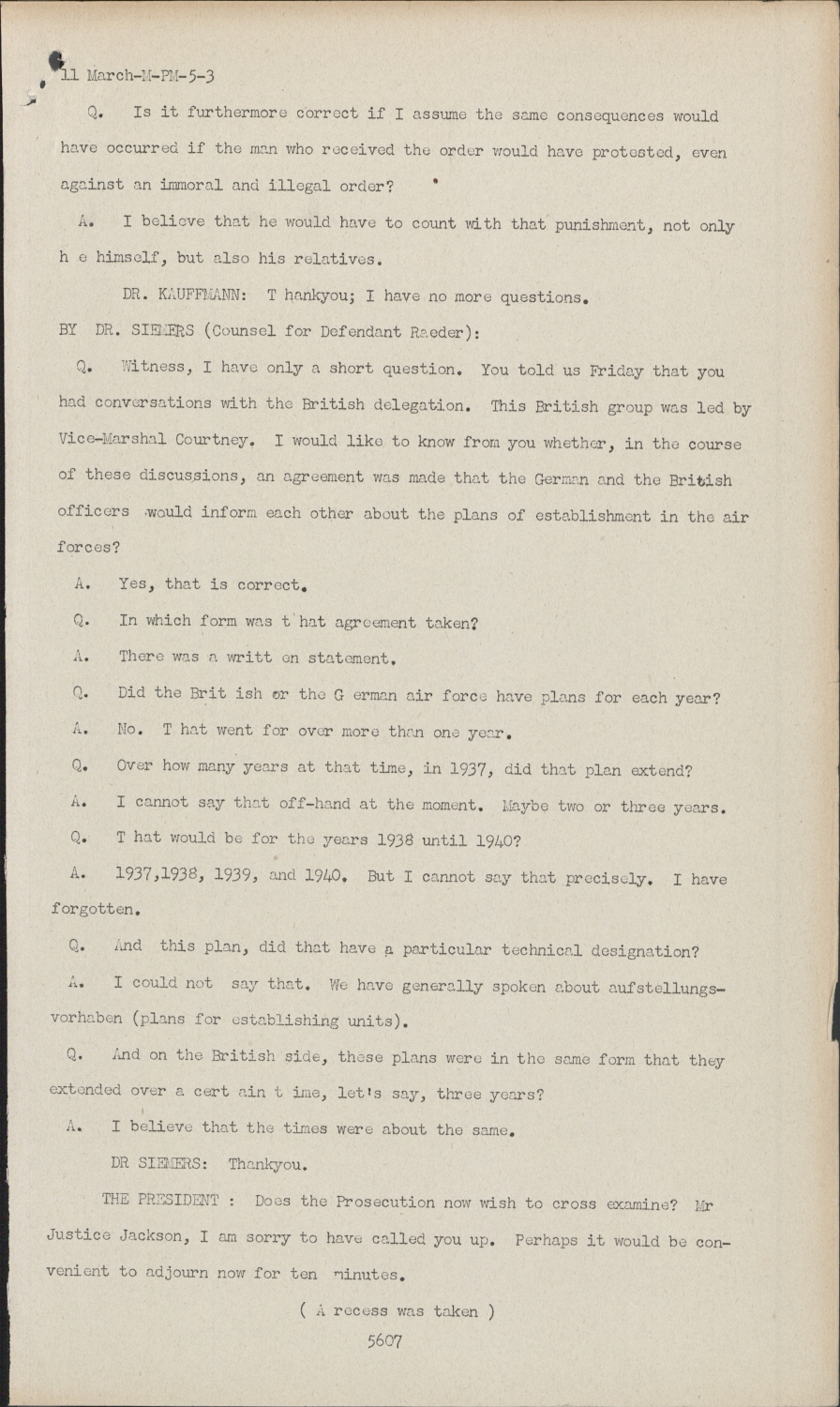
Q. Is it furthermore correct if I assume the same consequences would have occurred if the man who received the order would have protected, even against an immoral and illegal order?
A.I believe that he would have to count with that punishment, not only h e himself, but also his relatives.
DR. KAUFFMANN:T hankyou; I have no more questions. BY DR. SIEMERS (Counsel for Defendant Raeder):
Q.Witness, I have only a short question. You told us Friday that you had conversations with the British delegation. This British group was led by Vice-Marshal Courtney. I would like to know from you whether, in the course of these discussions, an agreement was made that the German and the British officers would inform each other about the plans of establishment in the air forces?
A.Yes, that is correct.
Q.In which form was t hat agreement taken?
A.There was a writt en statement.
Q.Did the Brit ish or the G erman air force have plans for each year?
A.No. T hat went for over more than one year.
Q.Over how many years at that time, in 1937, did that plan extend?
A.I cannot say that off-hand at the moment. Maybe two or three years.
Q.T hat would be for the years 1933 until 1940?
A. 1937,1938, 1939, and 1940. But I cannot say that precisely. I have forgotten.
Q.And this plan, did that have a particular technical designation?
A.I could not say that. We have generally spoken about aufstellungsvorhaben (plans for establishing units).
Q.And on the British side, these plans were in the same form that they extended over a cert ain t ime, let's say, three years?
A.I believe that the times were about the same.
DR SIEMERS:Thankyou.
THE PRESIDENT :Does the Prosecution now wish to cross examine? Mr Justice Jackson, I am sorry to have called you up. Perhaps it would be convenient to adjourn now for ten minutes.
( A recess was taken )
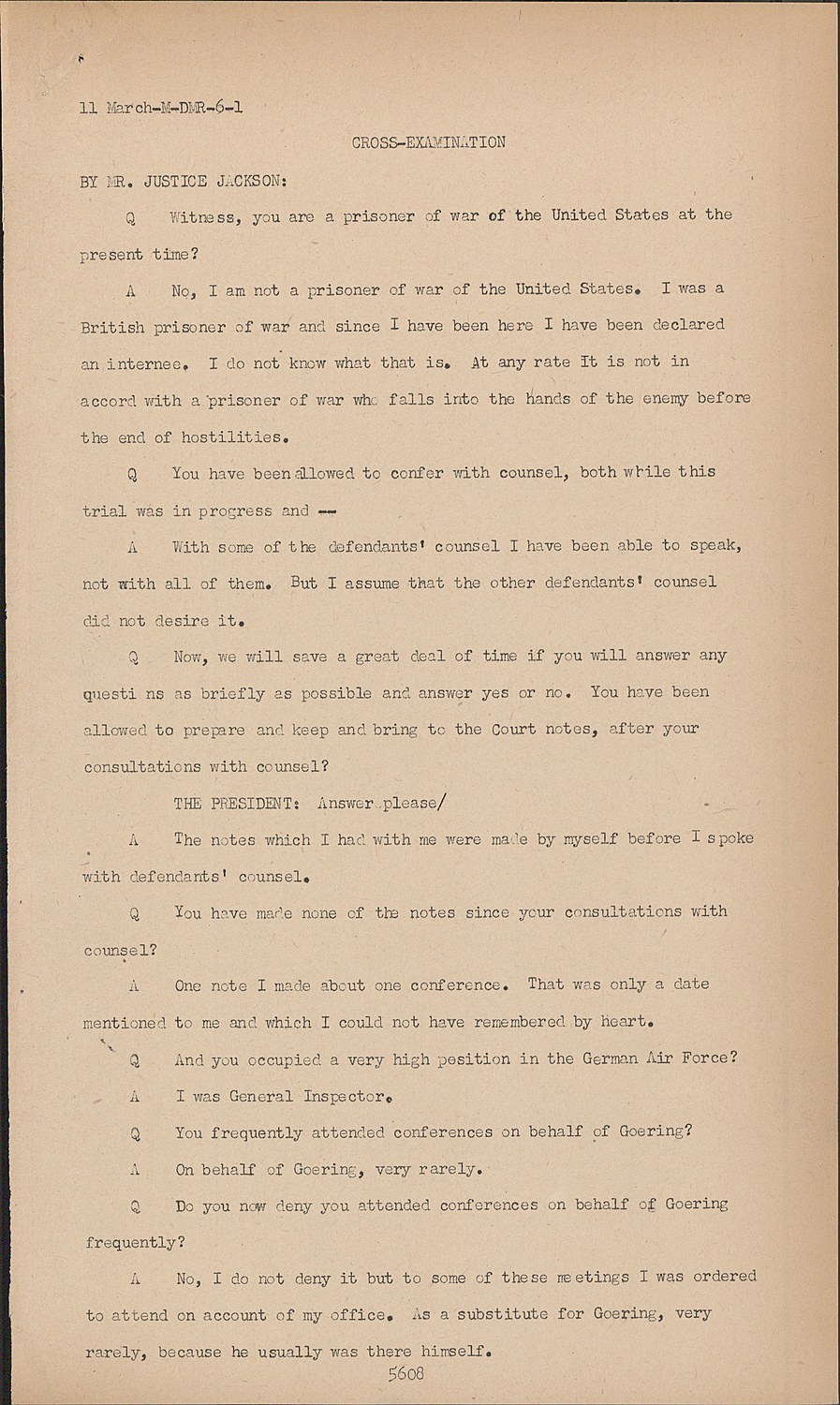
CROSS-EXAMINATION BY MR. JUSTICE JACKSON:
QWitness, you are a prisoner of war of the United States at the present time?
ANo, I am not a prisoner of war of the United States. I was a British prisoner of war and since I have been here I have been declared an internee. I do not know what that is. At any rate It is not in accord with a prisoner of war who falls into the hands of the enemy before the end of hostilities.
QYou have beenallowed to confer with counsel, both while this trial was in progress and -
AWith some of the defendants' counsel I have been able to speak, not with all of them. But I assume that the other defendants' counsel did not desire it.
QNow, we will save a great deal of time if you will answer any questi ns as briefly as possible and answer yes or no. You have been allowed to prepare and keep and bring to the Court notes, after your consultations with counsel?
THE PRESIDENT:Answer please/
AThe notes which I had with me were made by myself before I spoke with defendants' counsel.
QYou have made none of the notes since your consultations with counsel?
AOne note I made about one conference. That was only a date mentioned to me and which I could not have remembered by heart.
QAnd you occupied a very high position in the German Air Force?
AI was General Inspector.
QYou frequently attended conferences on behalf of Goering?
AOn behalf of Goering, very rarely.
QDo you now deny you attended conferences on behalf of Goering frequently?
ANo, I do not deny it but to some of these meetings I was ordered to attend on account of my office. As a substitute for Goering, very rarely, because he usually was there himself.
Q You had a very large part in building up the Luftwaffe, did you not?
AYes.
QAnd you were honored for that, were you not, in 1941, by the Hitler regime?
A 41--no, I believe you mean, Mr. Justice, in 1940.
Q 1940--well, perhaps I'm wrong.
AYou mean the promotion to Field Marshal?
QWhen was your promotion to Field Marshal?
AOn the 19 of July 1940.
QAnd did you not receive a gift from the Hitler regime in recognition of your services?
AIn 1942 at the event of my fiftieth birthday I received a recognition.
QAnd the recognition was in the form of cash, wasn't it?
AYes, it was a cash recognition out of which I could buy an estate.
QAnd What did it consist of?
AThe money amounted to 250,000 marks.
QAnd now you come here to testify, as I understand your testimony, that the regime, of which you were a part, put Germany into a war for which it was in no way prepared. Do I understand you correctly?
AIt is correct insofar as that Germany came into a war in 1939 for which it was not prepared as far as the Air Force was concerned.
QDid the Head of the Air Force give any warning of that fact to the German people?
AI could not say that. I do not believe he could do that.
QYou do not know that he ever did do it, do you?
AI cannot remember that he ever gave such a warning to the people publicly. I should like to assume that the warning was given to the military officer above him.
QWhat officer would be above him?
AThat was the leader, the Fuehrer, Adolf Hitler. As a soldier the Reichsmarshal could not appeal to the public.
Q Now, can you point to any time, at any meeting of the High Command or at any other meeting that the Fuehrer called, that Reichsmarshal Goering raised the question that Germany was not prepared for war, in the presence of any of these people?
AI cannot remember such a conference because such conferences were held only between the two people concerned. The Reichsmarshal has never reported to the Fuehrer before the public or before a large number of his offices and he has never protested to him publicly because Hitler would not have tolerated such opposition.
QDo you know of any occasion when any one of the defendants in the box ever took a public position against going to war?
APublicly no, I cannot remember. But I should like to believe also for the personalities who are now accused the war came as a surprise.
QYou would like to believe that?
AI believe it, yes.
QHow long did it take the German forces to conquer Poland?
APardon -- to conquer Poland I believe eighteen days.
QEighteen days. How long did it take to drive England off the continent, including the disaster of Dunkirk?
AI believe six weeks.
QHow long did it take to overrun Holland and Belgium?
AA few days.
QHow long did it take to overrun France and take Paris?
AEntirely--about two months.
QAnd how long did it take to overrun Denmark and to take possession of Norway?
AAlso a short time. Denmark very short because Denmark gave in immediately and for Norway a few weeks.
QAnd you testify that you want this Tribunal to understand you, as an officer, as saying that there was no preparation known to the officers in advance of those movements? Is that your testimony as an officer?
APardon, I have not understood.
Q You testified that those were all surprise movements to the officers of the Luftwaffe.
You were surprised at every one of them, you said.
ASurprised--I said of the beginning of the war because at first only Poland was spoken about. The other things came later and were covered by the preparations for this war.
QWell now, relative to Poland, you do not deny that Germany was well prepared for a war with Poland, do you?
AThe supplies of Germany compared to Poland were large enough. What I considered by saying preparedness for war when I testified, means for the extent of a world war. For that Germany was not prepared in 1939.
QBut she was prepared for the campaign that she initiated, was she not?
AI would not like to say it that way. Of course there was armament as every other nation that has an army has it and with regard to Poland it was alerted and was sufficiently large even though it surprised us to crush Poland.
QWould you question or deny that relative to the other powers on thecontinent of Europe, Germany was the best prepared for war on the first day of September, 1939?
AI believe that as such the British Air Force at that time was stronger than the German.
QI asked you in reference to the continental powers. Do you question that Germany was far better prepared for war than any of her immediate neighbors?
AI am convinced that France and Poland with respect to their forces were just as well prepared as Germany. They had the advantage of linger work in that field, which in Germany could only start five years before the outbreak of the war.
QWhen did you first meet Hermann Goering?
AI believe in the year 1928.
QWhat was he then,what position did he hold?
AHe was then a member of the Reichstag.
QWhat were you doing?
A I was then the chief of the German Lufthansa, a civil transport agency.
QDid you have some discussions with Hermann Goering at about that time as to what would be done with air forces if the Nazi Party came to power?
AAt that early time, no.
QWhen did you first discuss that with Goering?
AAbout this question I believe Goering spoke to me in 1932. There existed a plan to take over the government in 1932. One believed that at that time already the other parties would form a coalition with the National Socialists and at that occasion I believe Goering had talked about the possibility that if a government would be in power, of which the National Socialists would be a part, there would be a chance that Germany would become "Wehrfaehig", that is, able to fight.
QFollowing that you became a member of the Nazi Party, did you not?
AAfter 1933 I joined the Party, and later on I became an officer, and then this fact did not count any longer.
Q And you wai ted until after they won to join?
A.Yes.
QDo you recall a conversation that you had with Hermann Goering on the 28th of January 1933?
AYes.
QAnd where did that take place?
AIn my own apartment.
QDid he call upon you?
ANo, that eventing I had guests in my house and he came suddenly because he wanted to talk to me very urgently.
QAnd will you relate to the Tribunal the conversation that you had with Goering at that time.
AHe told me that now, with all the other parties in question, an agreement had been made which foresaw a common government with National Socialists; Reichspresident von Hindenberg now agreed to appoint Adolph Hitler as Chancellor in this government.
He, Goering, asked me whether I would be ready to take over an air force ministry which should be founded. Only for the reason that I did not want to leave the Lufthansa, I named two other persons in my place. Goering refused and insisted that I should place my cooperation at his disposal.
QDid you agree to do so?
AI told him I would think it over, and I made it dependent on the circumstances of Hitler's insisting on it.
QWell, what did Hitler do?
AI accepted on the 30th, after Hitler told me again that on account of my technical knowledge and ability in the field of aviation he considered it necessary.
QSo, on the day that the Nazi Party came to power, you took over the task of building a Nazi air force, did you not?
ANo, not the air force. First, there was only the question of organizing various fields of aviation. There was the civil aviation transport, and the transport schools, fliers' schools, the weather service, and the various research institutes. I believe that that covers the entire field of aviation, not air force, at that time.
Q Perhaps, I will say, you took over the task of making Germany preeminent in the air.
ANo, one cannot -
QTell us what you did, what your object was in taking over this new task.
ATo develop air transport, aviation and everything that belongs to it. That was the task in general.
QYou made visits then to France and England and returned and reported to Hitler personally, did you not?
AYes.
QWhen you returned from England, did you warn Hitler against the activities of Ribbentrop?
AYes.
QWhat did you tell Hitler about the activities of Ribbentrop in England?
AThat in England I had gained the impression that von Ribbentrop was not persona grata, was not a liked person.
QNow, when you were interrogated before, didn't you state after your capture that you told Hitler that if he didn't get rid of Ribbentrop soon he was going to have trouble with England? Isn't that what youtold Hitler in substance?
AI cannot remember the exact words.
QBut the sense of it?
AIt was my opinion that another man should be sent to England in order to further the desire which Hitler often expressed about England in his policies, to realize that.
QBefore you talked with Hitler about that, you had discussed it with Goering, had you not?
AWith whom?
QGoering.
AAbout what?
QAbout Ribbentrop.
ANo, I did not discuss that question with the Reichsmarshal.
QThere came a time when some engineers were sent to Russia, were they not, to inspect the air construction there, factories, facilities, and that sort of thing?
A Yes, that is correct.
QThis was a group of engineers, and you had something to do with sending them there, did you not?
ANo, I had nothing to do with that group. At that time I had nothing to do with technical research.
QUnder whose command were they?
AUnder Colonel General Udet, and he was under the Reichsmarshal.
QWhen they came back, you learned that they had reported that Russia had greater capacity for building airplane engines than all six of the German factories, did you not?
AYes, that is correct.
QWhat order did Goering give about that information being made available, even to the Fuehrer?
AGoering did not believe that information at that time. I know that from the words of Colonel General Udet.
QIs it not a fact that you stated to the interrogators before that Goering called them defeatists and forbade them to repeat that information to any person, and threatened them with concentration camps if they repeated that information? Did you say that or didn't you.
ANo, I cannot say that it was so far reaching.
QYou put it in your form now and tell us just what was said by Goering on that subject.
AAt a considerably later date, when it was the question of American armament figures, the Reichsmarshal told me once, "Now, you also are going to be a defeatist and believe these large figures." I told him then that I did indeed believe these figures, but at that time that had nothing to do with the Russian affair.
QWere those Russian figures ever reported to Hitler, or to the Reichstag or in any way made public to the German people?
AThe Russian figures? That I could not say. I had nothing to do with that question. The American figures were presented to Hitler, I am sure, but Hitler did not believe them.
QYou testified on Friday, I believe, that you knew that the commencement of the war with Russia would end with the annihilation of Germany. I remind you of that, and that is correct, is it not?
A Not with the destruction, the annihilation, but with defeat.
QWell, you went to Reichsmarshal Goering to protest against the entrance into the Russian war, is that right?
AYes.
QAnd did Goering agree with you that it would end with the defeat of Germany?
ANo, he did not agree. With respect to his relation to Hitler, he had to be very cautious in his statements. I told him about the reasons, the difficulties for Germany, and he nodded, and I had the impression from his words that he had tried the same objections with Hitler, that he had presented the same arguments to Hitler without success.
QIn other words, he agreed with you that it would end in the defeat of Germany, but he didn't want it said to Hitler, is that right?
ANo, I cannot say that that is so. That was my conclusion, that it would end in defeat for Germany. He just agreed that this war had to be avoided at any rate, and that it would be a misfortune for Germany. In that connection, the word "defeat" was not mentioned by him.
QWas it mentioned by you?
AI mentioned that that would be the defeat of Germany, to start a two front war with an adversary as strong as Russia.
QAnd didhe disagree with you about that? Did he take issue with you about that?
ANo, we did not argue about it. He only declared himself opposed to undertaking any further step because he considered it impossible, and it would only *---* to the impression with Hitler that the Air Force were defeatists.
QAnd you didn't attempt any further to convey the information on which you thought Germany would be defeated if she entered war with Russia to Hitler or to any other officer of the High Command?
AThat was impossible for me. I could not do anything against the order of my superior.
QThe Reichsmarshal?
AThe Reichsmarshal, yes.
QAnd so far as you know, he never conveyed that information, after his talk with you, to Hitler, that it was your opinion that the war would end in disaster?
A I had the impression that he had discussed that previously with Hitler, but that in so doing he had no chance to succeed because that was impossible with Hitler.
QBut you had been abroad for Hitler and reported to him and he apparently had confidence in you, and I am asking you if Hermann Goering ever reported to Hitler that you, out of your information, felt that it was a disaster to go into that war.
AMy trips were not made on order of Hitler, but upon invitation of the foreign Government to the German Air Force, ordered by the Reichsmarshal. With regard to the importance of these trips, and the political words which have been mentioned, although I was told that I had nothing to do with that as a soldier, I thought that I had to transmit to Hitler my impressions
QDid Goering direct you to do that?
ATo go to Hitler? Yes. I believe that Goering had told Hitler and Hitler ordered me to come. I did not say myself, "I am going to Hitler now." I received an order from him.
QAnd did he send you to Hitler until he knew what you were going to report?
ANo, he -
QThen he did know?
AHe himself had no knowledge. He had no time to receive me.
QGoering had no time to receive you?
ANo, Goering had many other things to do at that time and he did not like to have anything to do with these things.
QSo he left that to Hitler who wasn't busy, I take it. Is that true?
AHitler had an interest in it.
QI think you told us in the interrogations that Goering was not very industrious, is that correct?
AI would not like to answer that question.
QI withdraw it. I t wasn't a kindly question to begin with.
When you found that Germany was going into a war which you, as an informed officer, considered a disaster, did you resign?
AResign what?
QResign your commission as an officer or take any other steps to step out?
A No, that was absolutely impossible, and it was ordered by special order that that could not be done.
QAnd who gave that order?
A Hitler himself.
QNow,you said you had experienced this yourself.
ANot for my case personally, but generally he gave that order.
QYou said Friday that you experienced it yourself, that you could not resign.
AOne could not withdraw, one could not resign, no.
QDid you try it at any time?
AI asked to resign several times, in peace-time, but it was not granted for the reason that I did not have the right to ask for it, but I would be told from above when I had to go.
QDid you not-
A (Interposing): During the war I never asked, because during the war, a s a soldier, I could not ask for it.
QDid you not have some talk with Goering at one time about retiring from your position, in which he not only forbad you to leave, but also told you there would be no use in feigning ill-health?
AYes. That is to say, there was no possibility of excusing oneself in this way when one was not really sick. The use had been that if one retired, one gave as a reason ill health; that was no longer possible.
QAnd he did suggest to you, in that discussion, one way out, did he not
ANo, he did not suggest any, but I suggested a way.
QWhat did you suggest? What talk did you have about suicide? Did Goering tell you that the only way you could get out was to commit suicide?
AThat would have been the only possibility of getting out.
QDid Goering tell you that?
ANo, I said that, he did not.
QAnd he didn't disagree with you, I take it.
ANo, he did not particularly want me to do that.
QNo, you have the regulations with you which you say were printed for the information of every soldier about international law and regulations? Do you have them with you this morning?
AI have them with me; that is, in my pay-book, like every soldier's pay-book.
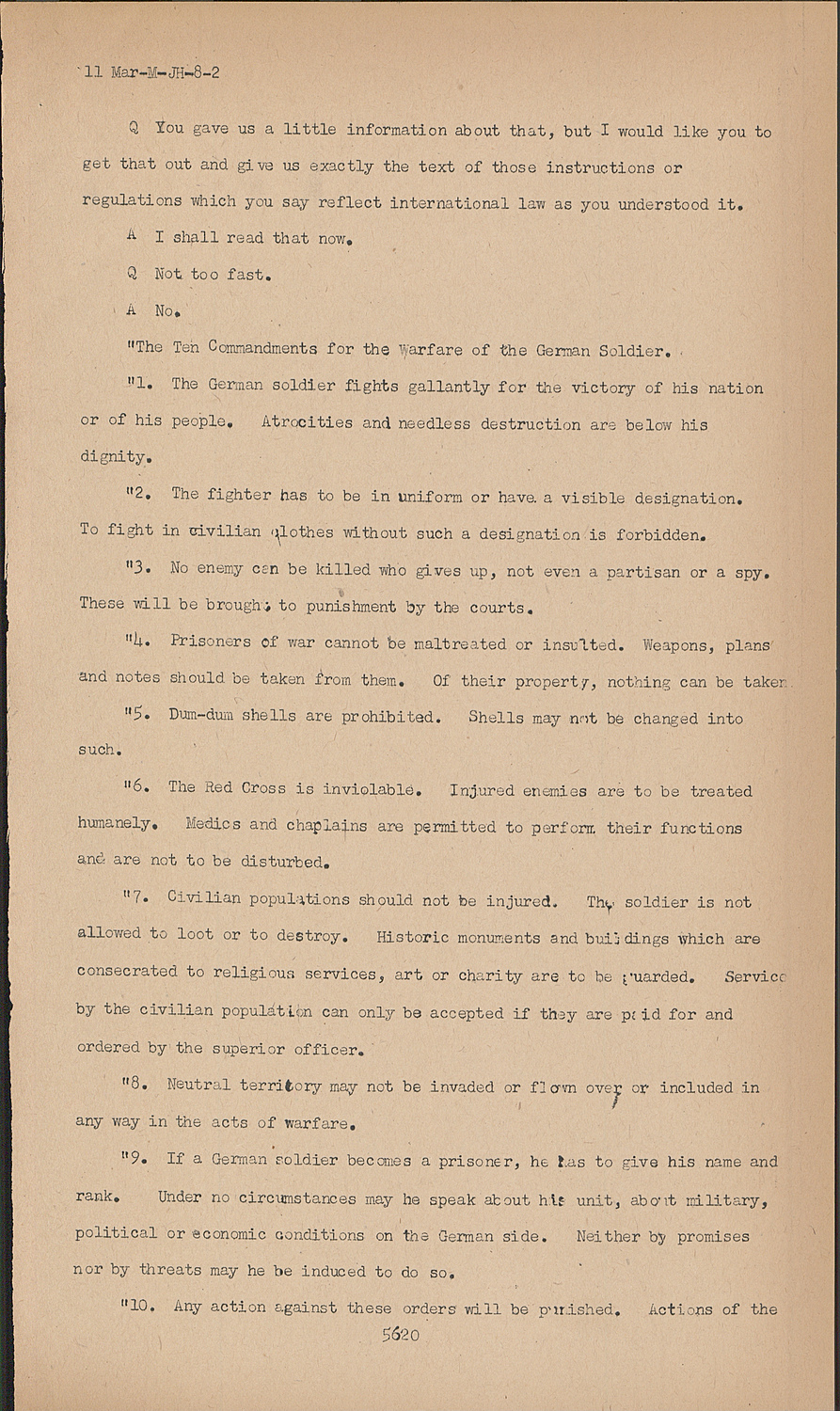
Q You gave us a little information about that, but I would like you to get that out and give us exactly the text of those instructions or regulations which you say reflect international law as you understood it.
AI shall read that now.
QNot too fast.
ANo.
"The Ten Commandments for the Warfare of the German Soldier.
"1. The German soldier fights gallantly for the victory of his nation or of his people. Atrocities and needless destruction are below his dignity.
"2. The fighter has to be in uniform or have a visible designation. To fight in civilian clothes without such a designation is forbidden.
"3. No enemy can be killed who gives up, not even a partisan or a spy. These will be brought to punishment by the courts.
"4. Prisoners of war cannot be maltreated or insulted. Weapons, plans and notes should be taken from them. Of their property, nothing can be taken "5. Dum-dum shells are prohibited.
Shells may not be changed into such.
"6. The Red Cross is inviolable. Injured enemies are to be treated humanely. Medics and chaplains are permitted to perform their functions and are not to be disturbed.
"7. Civilian populations should not be injured. The soldier is not allowed to loot or to destroy. Historic monuments and buildings which are consecrated to religious services, art or charity are to be guarded. Service by the civilian population can only be accepted if they are paid for and ordered by the superior officer.
"8. Neutral territory may not be invaded or flown over or included in any way in the acts of warfare.
"9. If a German soldier becomes a prisoner, he has to give his name and rank. Under no circumstances may he speak about his unit, about military, political or economic conditions on the German side. Neither by promises nor by threats may he be induced to do so.
"10. Any action against these orders will be punished. Actions of the enemy against points from one to eight are to be reported.
Reprisals can only be taken upon orders by the higher commanders."
QNow that, as you understand it, is the military law conforming with international law which was promulgated for the government of the troops in the field?
AYes.
QAnd you understood, and it was generally understood in the German Army, that that was international law, was it not?
AThat is to say, each soldier had to know that these were the German rules, because they were on the first sheet in his pay-book, which each soldier had to have and carry with him. They were pasted in. The soldier, of course, did not know that that meant international law.
QThe higher commanders like yourself did, didn't you?
AYes.
QThat represented your understanding and interpretation of your duties and obligations as honorable men in combat?
AYes.
QNow, did you participate in the activities of Hermann Goering in collecting the art of France and other occupied territories?
ANo.
QDid you participate in the removal of civilian populations for forced labour?
ANo.
QYou know that it was done, do you not?
AI did not know that the workers who came from foreigncountries were deported, but we were told that they came on the basis of voluntary recruitment. As to France, I knew that the Frenchmen themselves, from a certain time, did not want to come any more, but that the French Government had given directives itself.
QAside from that, then, you didn't know anything about involuntary or forced labor in Germany? Is that your testimony?
ANo.
QTell us what you did knew about and what you did about it.
A I knew that these people had been cruited at that time, that they came voluntarily.
I knew that many were satisfied, but as the German military situation became worse, among these foreign workers -- and, as much as I heard, it was only to a small extent -- there were bad feelings.
QYou have not yet-
A (Interposing) May I say also that in general we saw the reason in the fact that the food for these people was not such as they wanted. Therefore, many officers tried, first of all the Ministry of Speer, to improve the living conditions of these people and to facilitate their condition.
QYou have not yet answered my question. Did you know that forced labor was being brought from occupied territories and compelled to work in Germany? Did you know that? Answer that "yes" or "no."
AI knew only that the Frenchmen were forced, at the end, by their own French Government, to come.
QDid you know that prisoners of war were forced to work in the airplane industry, and were actually forced to man guns? Did you know that?
AI have heard about it.
QAnd you heard about it from your fellow officers, did you not?
AI do not know at the moment from whom I heard it. There was an institution which was called "Hilfswillige." It was a recruitment, as much as I know, of volunteers among the prisoners of war.
QAnd did you learn about -- even if you didn't participate in it -the plan for the collection of art from the occupied countries?
ANo, I did not know anything of this plan. Here in Nurnberg I was told about it by some witnesses.
QNow I want to ask you some questions about certain exhibits. I refer to number 343-PS, United States Exhibit 463. I would like to have that exhibit shown to you.
(A document was submitted to the witness)
AThese letters are signed by myself and they are on my stationery. They must have been drafted by the Sanitaetsinspektion, Medical Inspection. I do not remember the contents any more, as I said a few days ago.
I only want to say that by the answers I meant that there should be no difficulty between ourselves and Himmler.
For instance, I never read the statement by Dr. Rascher and Dr. Romberg.
They were read by the Medical Inspection.
QI will get to that.
ASo far as that is concerned, I was a sort of letter carrier for the correspondence from the SS to our Medical Inspection.
QWhen you testified on interrogation you had no recollection of these letters, but on Friday you testified that you made some alteration in one of them before it went out. Do you want to tell us what that alteration was?
AYes. These letters were submitted to me in part while I was interrogated, and that is how I remember it. The changes which I made were only as to a question of politeness, with respect to the great sensitivity of Mr. Himmler. I do not believe it is in one of these letters where the change was made; I believe it was another letter.
QIt was the other letter in which there was a change, number 167.
AI believe so, yes.
QNow, on your examination in your interrogation, you gave a reason why these were brought to you for signature instead of being signed by the bureau chiefs. Do you remember what that reason was?
A. Yes, I had the impression that the medical inspector did not want to write his refusal himself to Himmler, because he was afraid, when Himmler was to leave, because generally he wrote either to the Reichsmarshal or to myself, for one, because he did not know the organization of the air force, his field, because the medical inspector was not under me,
Q.I understand from your interrogation that you gave as the reason why these letters were brought to you for signature, that your office was in fear of Himmler and didn't want to take the responsibility of writing a letter to him, is that right ?
A.Not my office, but I believe the medical inspection did not want to get into a bad position with Himmler.
Q.I think you also said that the officials of that department were afraid of the SS.
A.Yes, that is what I wanted to say.
Q.Were they engaged in any illegal conduct or any activity against the Government ?
A.I did not quite get that.
Q.These people who were afraid.
A.They the Sanitactsinspektion ? No
Q.They were responsible officials doing their duty, as far as you know, is that right ?
A.Yes, Mr Justice. There one has to think about the conditions as they developed durning the war.
Q.That is exactly what I want you to think about, and tell me about; Why were these; people performing their duty in a Goverment office, afraid of Himmler on the SS? Explain that to us.
A.Not of the SS as such, but of the Secret Police. For none of us was the position an easy one. We were all convinced that we were under surveillance and regardless of what rank we had. I believe there was no body about whom there were not files kept, and hence many people, for that reason, were brought to trial. And the difficulties which arose from this fact did not touch only these people, or myself, but went all the way up to the Reichsmarshal, who was also affected by it.
Q.So that in you men, from the Reichsmarshal right down to the humblest citizen, there was fear of Heinrich Himmler and his organization ?