A Yes, that is correct.
QThis was a group of engineers, and you had something to do with sending them there, did you not?
ANo, I had nothing to do with that group. At that time I had nothing to do with technical research.
QUnder whose command were they?
AUnder Colonel General Udet, and he was under the Reichsmarshal.
QWhen they came back, you learned that they had reported that Russia had greater capacity for building airplane engines than all six of the German factories, did you not?
AYes, that is correct.
QWhat order did Goering give about that information being made available, even to the Fuehrer?
AGoering did not believe that information at that time. I know that from the words of Colonel General Udet.
QIs it not a fact that you stated to the interrogators before that Goering called them defeatists and forbade them to repeat that information to any person, and threatened them with concentration camps if they repeated that information? Did you say that or didn't you.
ANo, I cannot say that it was so far reaching.
QYou put it in your form now and tell us just what was said by Goering on that subject.
AAt a considerably later date, when it was the question of American armament figures, the Reichsmarshal told me once, "Now, you also are going to be a defeatist and believe these large figures." I told him then that I did indeed believe these figures, but at that time that had nothing to do with the Russian affair.
QWere those Russian figures ever reported to Hitler, or to the Reichstag or in any way made public to the German people?
AThe Russian figures? That I could not say. I had nothing to do with that question. The American figures were presented to Hitler, I am sure, but Hitler did not believe them.
QYou testified on Friday, I believe, that you knew that the commencement of the war with Russia would end with the annihilation of Germany. I remind you of that, and that is correct, is it not?
A Not with the destruction, the annihilation, but with defeat.
QWell, you went to Reichsmarshal Goering to protest against the entrance into the Russian war, is that right?
AYes.
QAnd did Goering agree with you that it would end with the defeat of Germany?
ANo, he did not agree. With respect to his relation to Hitler, he had to be very cautious in his statements. I told him about the reasons, the difficulties for Germany, and he nodded, and I had the impression from his words that he had tried the same objections with Hitler, that he had presented the same arguments to Hitler without success.
QIn other words, he agreed with you that it would end in the defeat of Germany, but he didn't want it said to Hitler, is that right?
ANo, I cannot say that that is so. That was my conclusion, that it would end in defeat for Germany. He just agreed that this war had to be avoided at any rate, and that it would be a misfortune for Germany. In that connection, the word "defeat" was not mentioned by him.
QWas it mentioned by you?
AI mentioned that that would be the defeat of Germany, to start a two front war with an adversary as strong as Russia.
QAnd didhe disagree with you about that? Did he take issue with you about that?
ANo, we did not argue about it. He only declared himself opposed to undertaking any further step because he considered it impossible, and it would only *---* to the impression with Hitler that the Air Force were defeatists.
QAnd you didn't attempt any further to convey the information on which you thought Germany would be defeated if she entered war with Russia to Hitler or to any other officer of the High Command?
AThat was impossible for me. I could not do anything against the order of my superior.
QThe Reichsmarshal?
AThe Reichsmarshal, yes.
QAnd so far as you know, he never conveyed that information, after his talk with you, to Hitler, that it was your opinion that the war would end in disaster?
A I had the impression that he had discussed that previously with Hitler, but that in so doing he had no chance to succeed because that was impossible with Hitler.
QBut you had been abroad for Hitler and reported to him and he apparently had confidence in you, and I am asking you if Hermann Goering ever reported to Hitler that you, out of your information, felt that it was a disaster to go into that war.
AMy trips were not made on order of Hitler, but upon invitation of the foreign Government to the German Air Force, ordered by the Reichsmarshal. With regard to the importance of these trips, and the political words which have been mentioned, although I was told that I had nothing to do with that as a soldier, I thought that I had to transmit to Hitler my impressions
QDid Goering direct you to do that?
ATo go to Hitler? Yes. I believe that Goering had told Hitler and Hitler ordered me to come. I did not say myself, "I am going to Hitler now." I received an order from him.
QAnd did he send you to Hitler until he knew what you were going to report?
ANo, he -
QThen he did know?
AHe himself had no knowledge. He had no time to receive me.
QGoering had no time to receive you?
ANo, Goering had many other things to do at that time and he did not like to have anything to do with these things.
QSo he left that to Hitler who wasn't busy, I take it. Is that true?
AHitler had an interest in it.
QI think you told us in the interrogations that Goering was not very industrious, is that correct?
AI would not like to answer that question.
QI withdraw it. I t wasn't a kindly question to begin with.
When you found that Germany was going into a war which you, as an informed officer, considered a disaster, did you resign?
AResign what?
QResign your commission as an officer or take any other steps to step out?
A No, that was absolutely impossible, and it was ordered by special order that that could not be done.
QAnd who gave that order?
A Hitler himself.
QNow,you said you had experienced this yourself.
ANot for my case personally, but generally he gave that order.
QYou said Friday that you experienced it yourself, that you could not resign.
AOne could not withdraw, one could not resign, no.
QDid you try it at any time?
AI asked to resign several times, in peace-time, but it was not granted for the reason that I did not have the right to ask for it, but I would be told from above when I had to go.
QDid you not-
A (Interposing): During the war I never asked, because during the war, a s a soldier, I could not ask for it.
QDid you not have some talk with Goering at one time about retiring from your position, in which he not only forbad you to leave, but also told you there would be no use in feigning ill-health?
AYes. That is to say, there was no possibility of excusing oneself in this way when one was not really sick. The use had been that if one retired, one gave as a reason ill health; that was no longer possible.
QAnd he did suggest to you, in that discussion, one way out, did he not
ANo, he did not suggest any, but I suggested a way.
QWhat did you suggest? What talk did you have about suicide? Did Goering tell you that the only way you could get out was to commit suicide?
AThat would have been the only possibility of getting out.
QDid Goering tell you that?
ANo, I said that, he did not.
QAnd he didn't disagree with you, I take it.
ANo, he did not particularly want me to do that.
QNo, you have the regulations with you which you say were printed for the information of every soldier about international law and regulations? Do you have them with you this morning?
AI have them with me; that is, in my pay-book, like every soldier's pay-book.
Q You gave us a little information about that, but I would like you to get that out and give us exactly the text of those instructions or regulations which you say reflect international law as you understood it.
AI shall read that now.
QNot too fast.
ANo.
"The Ten Commandments for the Warfare of the German Soldier.
"1. The German soldier fights gallantly for the victory of his nation or of his people. Atrocities and needless destruction are below his dignity.
"2. The fighter has to be in uniform or have a visible designation. To fight in civilian clothes without such a designation is forbidden.
"3. No enemy can be killed who gives up, not even a partisan or a spy. These will be brought to punishment by the courts.
"4. Prisoners of war cannot be maltreated or insulted. Weapons, plans and notes should be taken from them. Of their property, nothing can be taken "5. Dum-dum shells are prohibited.
Shells may not be changed into such.
"6. The Red Cross is inviolable. Injured enemies are to be treated humanely. Medics and chaplains are permitted to perform their functions and are not to be disturbed.
"7. Civilian populations should not be injured. The soldier is not allowed to loot or to destroy. Historic monuments and buildings which are consecrated to religious services, art or charity are to be guarded. Service by the civilian population can only be accepted if they are paid for and ordered by the superior officer.
"8. Neutral territory may not be invaded or flown over or included in any way in the acts of warfare.
"9. If a German soldier becomes a prisoner, he has to give his name and rank. Under no circumstances may he speak about his unit, about military, political or economic conditions on the German side. Neither by promises nor by threats may he be induced to do so.
"10. Any action against these orders will be punished. Actions of the enemy against points from one to eight are to be reported.
Reprisals can only be taken upon orders by the higher commanders."
QNow that, as you understand it, is the military law conforming with international law which was promulgated for the government of the troops in the field?
AYes.
QAnd you understood, and it was generally understood in the German Army, that that was international law, was it not?
AThat is to say, each soldier had to know that these were the German rules, because they were on the first sheet in his pay-book, which each soldier had to have and carry with him. They were pasted in. The soldier, of course, did not know that that meant international law.
QThe higher commanders like yourself did, didn't you?
AYes.
QThat represented your understanding and interpretation of your duties and obligations as honorable men in combat?
AYes.
QNow, did you participate in the activities of Hermann Goering in collecting the art of France and other occupied territories?
ANo.
QDid you participate in the removal of civilian populations for forced labour?
ANo.
QYou know that it was done, do you not?
AI did not know that the workers who came from foreigncountries were deported, but we were told that they came on the basis of voluntary recruitment. As to France, I knew that the Frenchmen themselves, from a certain time, did not want to come any more, but that the French Government had given directives itself.
QAside from that, then, you didn't know anything about involuntary or forced labor in Germany? Is that your testimony?
ANo.
QTell us what you did knew about and what you did about it.
A I knew that these people had been cruited at that time, that they came voluntarily.
I knew that many were satisfied, but as the German military situation became worse, among these foreign workers -- and, as much as I heard, it was only to a small extent -- there were bad feelings.
QYou have not yet-
A (Interposing) May I say also that in general we saw the reason in the fact that the food for these people was not such as they wanted. Therefore, many officers tried, first of all the Ministry of Speer, to improve the living conditions of these people and to facilitate their condition.
QYou have not yet answered my question. Did you know that forced labor was being brought from occupied territories and compelled to work in Germany? Did you know that? Answer that "yes" or "no."
AI knew only that the Frenchmen were forced, at the end, by their own French Government, to come.
QDid you know that prisoners of war were forced to work in the airplane industry, and were actually forced to man guns? Did you know that?
AI have heard about it.
QAnd you heard about it from your fellow officers, did you not?
AI do not know at the moment from whom I heard it. There was an institution which was called "Hilfswillige." It was a recruitment, as much as I know, of volunteers among the prisoners of war.
QAnd did you learn about -- even if you didn't participate in it -the plan for the collection of art from the occupied countries?
ANo, I did not know anything of this plan. Here in Nurnberg I was told about it by some witnesses.
QNow I want to ask you some questions about certain exhibits. I refer to number 343-PS, United States Exhibit 463. I would like to have that exhibit shown to you.
(A document was submitted to the witness)
AThese letters are signed by myself and they are on my stationery. They must have been drafted by the Sanitaetsinspektion, Medical Inspection. I do not remember the contents any more, as I said a few days ago.
I only want to say that by the answers I meant that there should be no difficulty between ourselves and Himmler.
For instance, I never read the statement by Dr. Rascher and Dr. Romberg.
They were read by the Medical Inspection.
QI will get to that.
ASo far as that is concerned, I was a sort of letter carrier for the correspondence from the SS to our Medical Inspection.
QWhen you testified on interrogation you had no recollection of these letters, but on Friday you testified that you made some alteration in one of them before it went out. Do you want to tell us what that alteration was?
AYes. These letters were submitted to me in part while I was interrogated, and that is how I remember it. The changes which I made were only as to a question of politeness, with respect to the great sensitivity of Mr. Himmler. I do not believe it is in one of these letters where the change was made; I believe it was another letter.
QIt was the other letter in which there was a change, number 167.
AI believe so, yes.
QNow, on your examination in your interrogation, you gave a reason why these were brought to you for signature instead of being signed by the bureau chiefs. Do you remember what that reason was?
A. Yes, I had the impression that the medical inspector did not want to write his refusal himself to Himmler, because he was afraid, when Himmler was to leave, because generally he wrote either to the Reichsmarshal or to myself, for one, because he did not know the organization of the air force, his field, because the medical inspector was not under me,
Q.I understand from your interrogation that you gave as the reason why these letters were brought to you for signature, that your office was in fear of Himmler and didn't want to take the responsibility of writing a letter to him, is that right ?
A.Not my office, but I believe the medical inspection did not want to get into a bad position with Himmler.
Q.I think you also said that the officials of that department were afraid of the SS.
A.Yes, that is what I wanted to say.
Q.Were they engaged in any illegal conduct or any activity against the Government ?
A.I did not quite get that.
Q.These people who were afraid.
A.They the Sanitactsinspektion ? No
Q.They were responsible officials doing their duty, as far as you know, is that right ?
A.Yes, Mr Justice. There one has to think about the conditions as they developed durning the war.
Q.That is exactly what I want you to think about, and tell me about; Why were these; people performing their duty in a Goverment office, afraid of Himmler on the SS? Explain that to us.
A.Not of the SS as such, but of the Secret Police. For none of us was the position an easy one. We were all convinced that we were under surveillance and regardless of what rank we had. I believe there was no body about whom there were not files kept, and hence many people, for that reason, were brought to trial. And the difficulties which arose from this fact did not touch only these people, or myself, but went all the way up to the Reichsmarshal, who was also affected by it.
Q.So that in you men, from the Reichsmarshal right down to the humblest citizen, there was fear of Heinrich Himmler and his organization ?
A Well, the amount of fear may have been different in the highest and lowest positions.
Of course, it was in the least, but in the middle bracket it was much more difficult. But it was quite clear that the middle position criticised everything that happened and these criticisms were not tolerated from above.
QI take it from your testimony that the reputation of the Gestapo was pretty well understood in Germany.
AThe last years of the war particularly so, yes. I could not say how far this was based on facts, but there was that feeling.
QNow, I think you also testified that some high military authorities did resign. I call your attention to your testimony in your interrogation by us, about von Fritsch and Beck. They resigned, didn't they?
ANo, they did not resign. They were already out.
QThey were thrown out, is that it?
AYes, they were told they were not needed any more.
QI understood you to say that even the generals did not dare utter an opinion after those two left.
ANo, I never said that. I cannot remember that. I will be grateful if I could see the minutes.
QWell, I have them. I will ask you if you were not asked these questions and gave these answers:
"Question: From your knowledge of instructions in army circles, among the air force , and among the general staff people whom you knew would have any opinion as to their attitude for beginning a war, would they share your view?"
The minutes show that you answered "All of them unanimously,all officers agreed with me.
All higher officers agreed with me. A long time ago I had talked to Field Marshal von Blomberg, in 1937, about the danger of war on account of the careless policy of cur politicians and we feared at that time that England or France wouldn't tolerate that policy in the long run. The first of November, 1937, I had a long discussion with von Blomberg about this matter, and he was of the same opinion."
AYes, I remember.
Q That is true, isn't it? You were then asked this "Is it true that after General Fritsch and General Beck left their offices that the position of the army was subordinated to the position of the political personality?"
ANo, not subordinate. The army was always directly subordinate to the Fuehrer or the Reichspresident. Nothing was changed. In that, the Chief of State was at the same time the Supreme Commander.
QAt the time you were interrogated your answer, which I will now read, was this:
"Yes, because Hitler took over the high command personally of the army and the navy and the air force. That was the position that was held by von Blomberg before, and Blomberg was in a position to resist Hitler, which he had done very often, and Hitler respected and feared and listened to his advice. Blomberg was the only elder soldier who was clever enough to reconcile military and political questions. This resistance"-
AYes, it was my conviction.
Q (Continuing) -- "This resistance could not be kept up by the men near Hitler later on. They were too weak for that. For that reason he probably chose them."
Is that true?
AMy opinion.
Q "Question: Did the generals with whom you associated even before 1939 not feel thatthe course of action which was being taken by Hitler would be likely to result in a war?
"Answer: Those who were able to think in foreign political terms, yes, but they had to be very cautious about it, because they could not utter any opinion, that he dared not utter -- any opinion or writing."
Is that right?
ARight.
QAnd what were the high generals in command afraid of that they didn't utter an opinion?
AThat general wouldn't have had a chance to report it to Hitler.
QWho would have done anything about? There were many generals and only one Hitler. Who was going to carry out any orders against them?
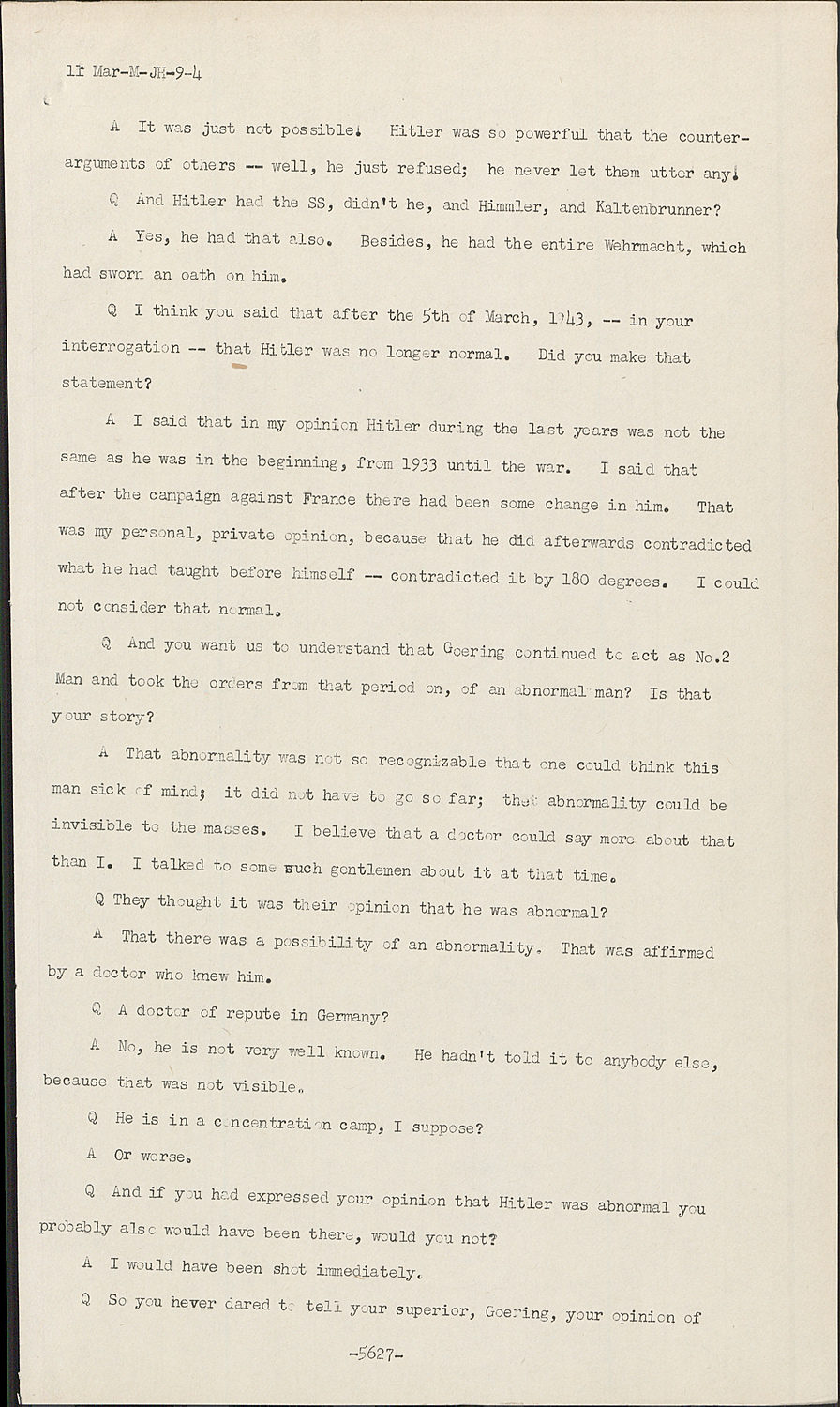
A It was just not possible. Hitler was so powerful that the counter-
arguments of others -- well, he just refused; he never let them utter any.
QAnd Hitler had the SS, didn't he, and Himmler, and Kaltenbrunner?
AYes, he had that also. Besides, he had the entire Wehrmacht, which had sworn an oath on him.
QI think you said that after the 5th of March, 1943, -- in your interrogation -- that Hitler was no longer normal. Did you make that statement?
AI said that in my opinion Hitler during the last years was not the same as he was in the beginning, from 1933 until the war. I said that after the campaign against France there had been some change in him. That was my personal, private opinion, because that he did afterwards contradicted what he had taught before himself -- contradicted it by 180 degrees. I could not consider that normal.
AAnd you want us to understand that Goering continued to act as No.2 Man and took the orders from that period on, of an abnormal man? Is that your story?
AThat abnormality was not so recognizable that one could think this man sick of mind; it did not have to go so far; that abnormality could be invisible to the masses. I believe that a doctor could say more about that than I. I talked to some such gentlemen about it at that time.
QThey thought it was their opinion that he was abnormal?
AThat there was a possibility of an abnormality. That was affirmed by a doctor who knew him.
QA doctor of repute in Germany?
ANo, he is not very well known. He hadn't told it to anybody else, because that was not visible.
QHe is in a concentration camp, I suppose?
AOr worse.
QAnd if you had expressed your opinion that Hitler was abnormal you probably also would have been there, would you not?
AI would have been shot immediately.
QSo you never dared to tell your superior, Goering, your opinion of Hitler.
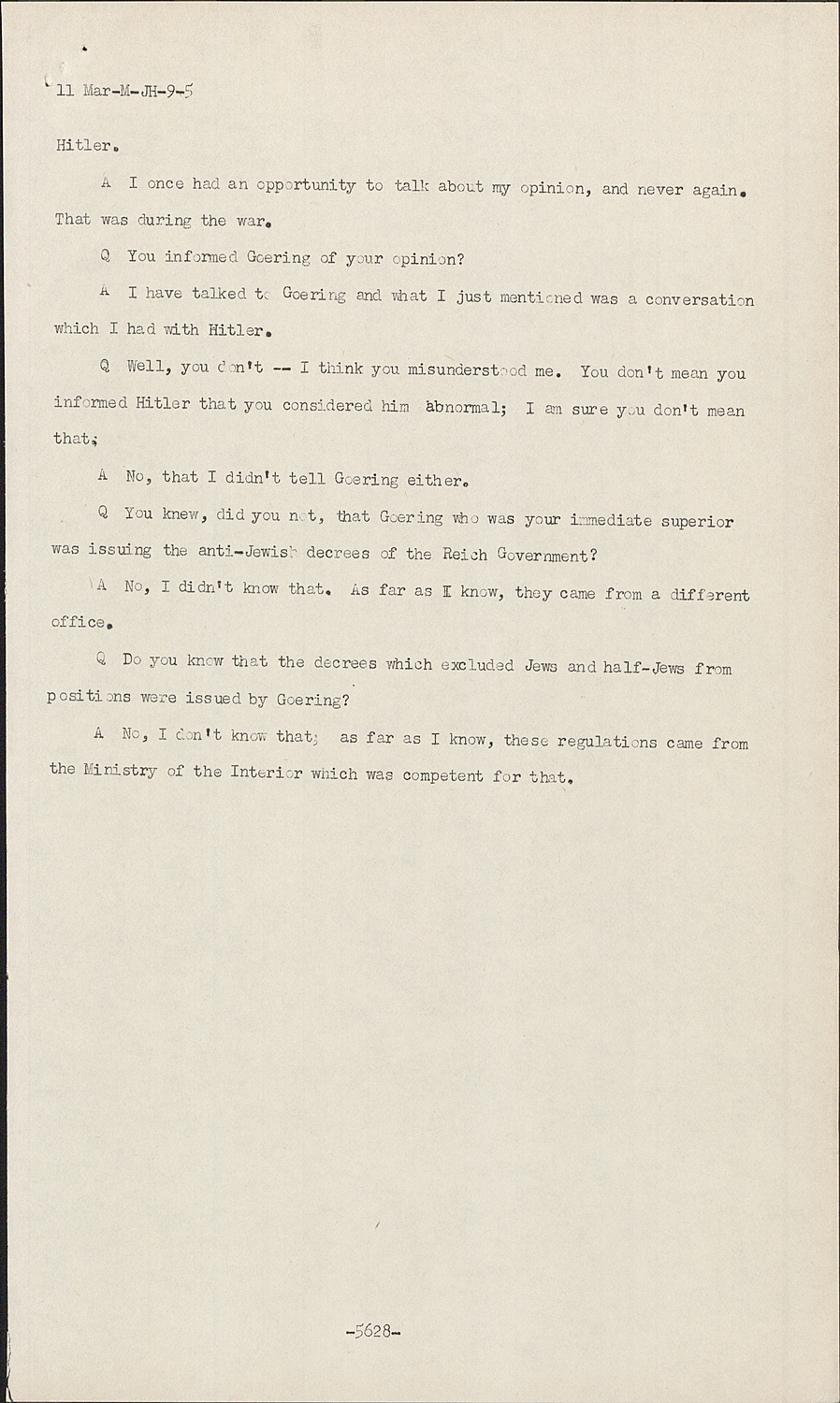
AI once had an opportunity to talk about my opinion, and never again. That was during the war.
QYou informed Goering of your opinion?
AI have talked to Goering and what I just mentioned was a conversation which I had with Hitler.
QWell, you don't -- I think you misunderstood me. You don't mean you informed Hitler that you considered him abnormal; I am sure you don't mean that.
ANo, that I didn't tell Goering either.
QYou knew, did you not, that Goering who was your immediate superior was issuing the anti-Jewish decrees of the Reich Government?
ANo, I didn't know that. As far as I know, they came from a different office.
QDo you knew that the decrees which excluded Jews and half-Jews from positions were issued by Goering?
ANo, I don't know that; as far as I know, these regulations came from the Ministry of the Interior which was competent for that.
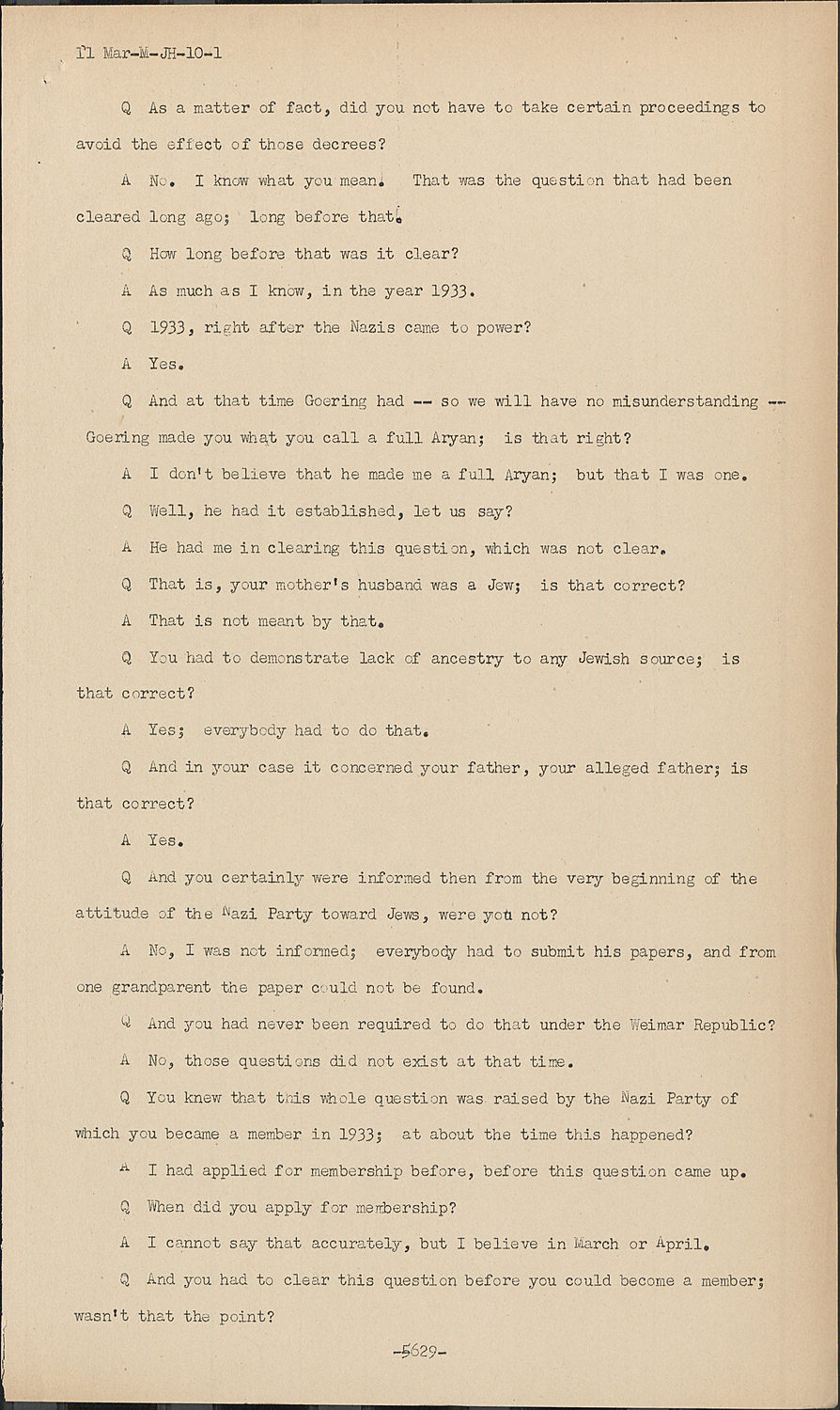
Q As a matter of fact, did you not have to take certain proceedings to avoid the effect of those decrees?
ANo. I know what you mean. That was the question that had been cleared long ago; long before that.
QHow long before that was it clear?
AAs much as I know, in the year 1933.
Q 1933, right after the Nazis came to power?
AYes.
QAnd at that time Goering had -- so we will have no misunderstanding -Goering made you what you call a full Aryan; is that right?
AI don't believe that he made me a full Aryan; but that I was one.
QWell, he had it established, let us say?
AHe had me in clearing this question, which was not clear.
QThat is, your mother's husband was a Jew; is that correct?
AThat is not meant by that.
QYou had to demonstrate lack of ancestry to any Jewish source; is that correct?
AYes; everybody had to do that.
QAnd in your case it concerned your father, your alleged father; is that correct?
AYes.
QAnd you certainly were informed then from the very beginning of the attitude of the Nazi Party toward Jews, were you not?
ANo, I was not informed; everybody had to submit his papers, and from one grandparent the paper could not be found.
QAnd you had never been required to do that under the Weimar Republic?
ANo, those questions did not exist at that time.
QYou knew that this whole question was raised by the Nazi Party of which you became a member in 1933; at about the time this happened?
AI had applied for membership before, before this question came up.
QWhen did you apply for membership?
AI cannot say that accurately, but I believe in March or April.
QAnd you had to clear this question before you could become a member; wasn't that the point?
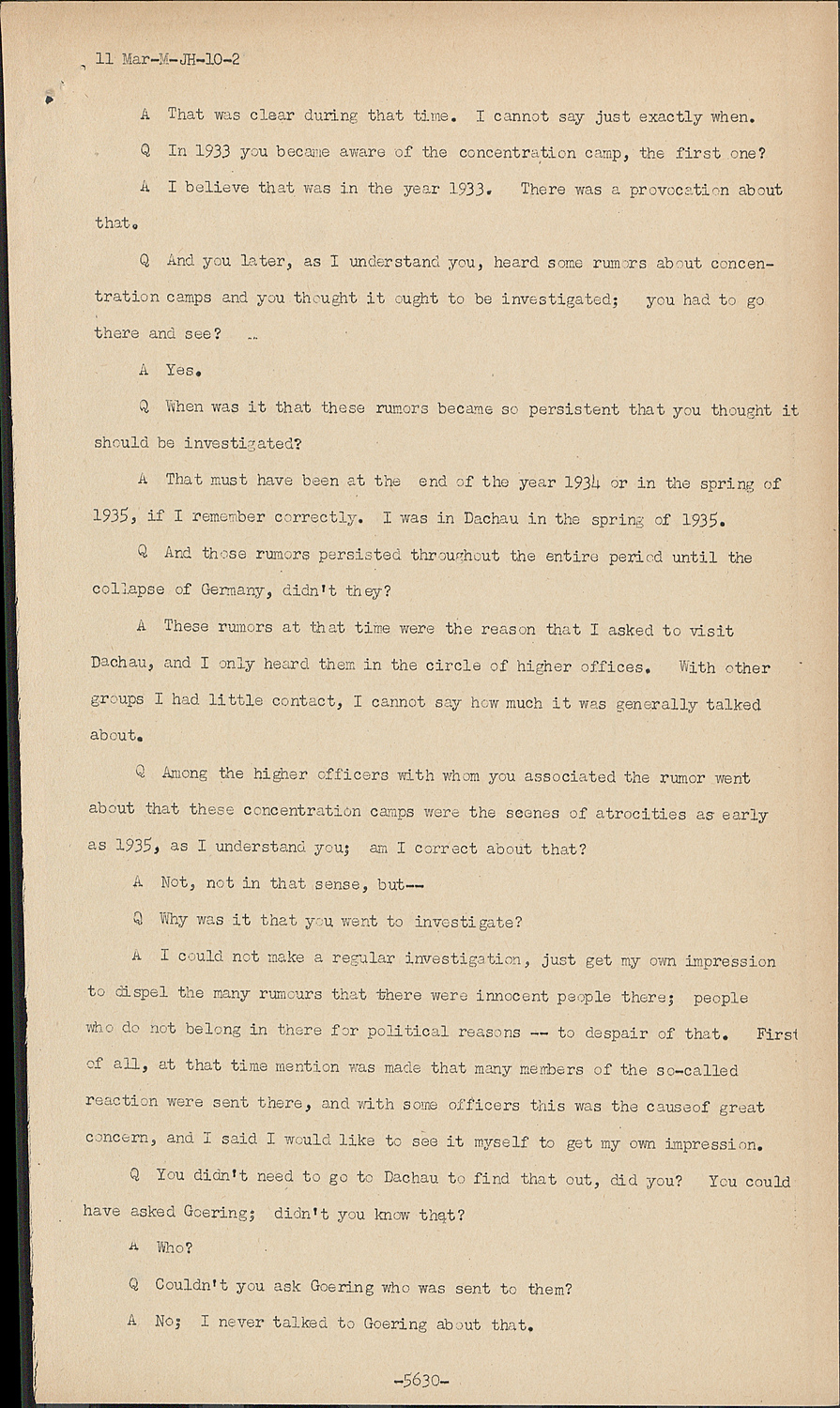
A That was clear during that time. I cannot say just exactly when.
QIn 1933 you became aware of the concentration camp, the first one?
AI believe that was in the year 1933. There was a provocation about that.
QAnd you later, as I understand you, heard some rumors about concentration camps and you thought it ought to be investigated; you had to go there and see?
AYes.
QWhen was it that these rumors became so persistent that you thought it should be investigated?
AThat must have been at the end of the year 1934 or in the spring of 1935, if I remember correctly. I was in Dachau in the spring of 1935.
QAnd these rumors persisted throughout the entire period until the collapse of Germany, didn't they?
AThese rumors at that time were the reason that I asked to visit Dachau, and I only heard them in the circle of higher offices. With other groups I had little contact, I cannot say how much it was generally talked about.
QAmong the higher officers with whom you associated the rumor went about that these concentration camps were the scenes of atrocities as early as 1935, as I understand you; am I correct about that?
ANot, not in that sense, but-
QWhy was it that you went to investigate?
AI could not make a regular investigation, just get my own impression to dispel the many rumours that there were innocent people there; people who do not belong in there for political reasons -- to despair of that. First of all, at that time mention was made that many members of the so-called reaction were sent there, and with some officers this was the causeof great concern, and I said I would like to see it myself to get my own impression.
QYou didn't need to go to Dachau to find that out, did you? You could have asked Goering; didn't you know that?
AWho?
QCouldn't you ask Goering who was sent to them?
ANo; I never talked to Goering about that.
Q Did you know that Goering publicly said that political enemies of the regime were going to be sent there; that was what they were founded for; did you know that?
AI cannot say that I never heard it myself, but I had thought about that, and that is why I wanted to go and see.
QAnd you found nobody there except criminals?
AWhat I was shown were all people who had committed either crimes or dealt in larger things. Of political prisoners I only saw two people; whether there were others I could not say because I cannot be sure that I saw the entire camp. But all we wanted to see -- we used to say we wanted to see this and that, and then we went there and were guided.
QWhose authority did you get to get into the concentration camp for an examination?
AHimmler's.
QWho asked Himmler if you could go?
AI don't understand.
QDid Goering know you were making the trip?
AI don't think so.
QWhy were you so-
A It was no special trip. I was living in southern Germany, doing military things, and I set aside one morning, forenoon, for an inspection.
QThere were people in the concentration camp that had to do with the Roehm Putsch, as you call it?
AYes.
QHow many were there that had to do with that?
AI can not say that any more exactly. All together, from what I have seen, I would estimate four to five hundred people.
QFour to five hundred people. And how many were killed?
AYes, but this figure I can not guarantee; it could be just as well seven hundred. My estimate is around that.
QHow many people were killed in the Roehm Putsch?
AI can only give the figure which Hitler publicly stated in the Reichstag; I can not say that I exactly remember.
QWhy were you so concerned about concentration camps? Did you have any official responsibility for them?
ANo, I had no responsibility; but since there was so much talk about it I tried to get an impression, a personal impression, because I told myself many people asked me about that and I could not answer them, and I would like to see for myself if it is possible to get a personal impression.
QGermany had ordinary prisons for criminal prisoners didn't it?
AOf course; naturally.
QAnd those prisons had sufficed for a good many years to take care of the criminal population; had they not?
AFor that reason they might have been; I could not say.
QAnd the concentration camp was something new that came in after 1933?
AYes. At any rate, I had not heard before that time of any concentration camp in Germany.
QDid you see any Jews in the camp?
AI don't understand.
QDid you see any Jews in the concentration camp when you inspected it?
AYes; there was one barrack which contained Jews, and they all had heavy signs for economic crimes; for fraud and such things. None of them whom we asked--and everybody answered about his punishment--the reason for it --and there was not a single one of these who said that he was there for political reasons.
The political owes were only the SA men.
QYou couldn't find a single prisoner there who claimed he was innocent?
ANo; everyone reported his crime as his punishment.
QWho accompanied you on that trip?
AAs much as I remember, General Weber, who was chief of the General Staff, and I think also Colonel General Udet, and several other gentlemen, but I do not remember at the moment who they were.
QWho showed you through the concentration camp? Who guided you?
AI don't know what his name was; it was one of the officials of the SD. I assume it was the commander of the camp himself, but I don't know his name.
QWho was running the concentration camp? What organization was in charge of it?
AI could not say that, but I assume some offices of Himmler's.
QYou have said that the march into the Rhineland was a great surprise to you; is that right?
AYes.
QWhere were you on your leave when this occurred?
AI was in Bergen for a winter leave; in a foreign country.
QNorway?
ANo; no.
QWhat country were you in?
AI wasin the Alps; I believe it was southern Tyrol, that is, at that time, Italy.
QDid you not hear of a meeting, the minutes of which are in evidence here as Great Britain's Exhibit No.160, concerning the Reich Defense Council meeting held on the 26th of June 1935, some nine months before the occupation of the Rhineland?
AWhether I was present I could not say; I can not remember.
QThere were, according to the evidence, twenty-four members of the Wehrmacht and five members of the Luftwaffe present as well as twenty-four at State and Party officials.
Were you one of those persons/that conference at which this discussion took place?
A May I ask again for the date?
QThe 26th of June 1935.
AI can not remember. I don't know.
QDid you never learn of that meeting?
AAt the moment I really can not remember what is supposed to have been said at that meeting.
QAt which the preparations for the occupation of the Rhineland were to be kept secret and the plan was made to invade the Rhineland? Did you ever learn of that meeting?
AI can not remember. I don't believe that I was present.
MR. JUSTICE JACKSON:If Your Honors please, the usual time for adjournment is here. I intend to take up a different subject which involves some documents. It might be a convenient time to adjourn.
THE PRESIDENT:We will adjourn now.
(A recess was taken until 1400 hours.)