A Well, the amount of fear may have been different in the highest and lowest positions.
Of course, it was in the least, but in the middle bracket it was much more difficult. But it was quite clear that the middle position criticised everything that happened and these criticisms were not tolerated from above.
QI take it from your testimony that the reputation of the Gestapo was pretty well understood in Germany.
AThe last years of the war particularly so, yes. I could not say how far this was based on facts, but there was that feeling.
QNow, I think you also testified that some high military authorities did resign. I call your attention to your testimony in your interrogation by us, about von Fritsch and Beck. They resigned, didn't they?
ANo, they did not resign. They were already out.
QThey were thrown out, is that it?
AYes, they were told they were not needed any more.
QI understood you to say that even the generals did not dare utter an opinion after those two left.
ANo, I never said that. I cannot remember that. I will be grateful if I could see the minutes.
QWell, I have them. I will ask you if you were not asked these questions and gave these answers:
"Question: From your knowledge of instructions in army circles, among the air force , and among the general staff people whom you knew would have any opinion as to their attitude for beginning a war, would they share your view?"
The minutes show that you answered "All of them unanimously,all officers agreed with me.
All higher officers agreed with me. A long time ago I had talked to Field Marshal von Blomberg, in 1937, about the danger of war on account of the careless policy of cur politicians and we feared at that time that England or France wouldn't tolerate that policy in the long run. The first of November, 1937, I had a long discussion with von Blomberg about this matter, and he was of the same opinion."
AYes, I remember.
Q That is true, isn't it? You were then asked this "Is it true that after General Fritsch and General Beck left their offices that the position of the army was subordinated to the position of the political personality?"
ANo, not subordinate. The army was always directly subordinate to the Fuehrer or the Reichspresident. Nothing was changed. In that, the Chief of State was at the same time the Supreme Commander.
QAt the time you were interrogated your answer, which I will now read, was this:
"Yes, because Hitler took over the high command personally of the army and the navy and the air force. That was the position that was held by von Blomberg before, and Blomberg was in a position to resist Hitler, which he had done very often, and Hitler respected and feared and listened to his advice. Blomberg was the only elder soldier who was clever enough to reconcile military and political questions. This resistance"-
AYes, it was my conviction.
Q (Continuing) -- "This resistance could not be kept up by the men near Hitler later on. They were too weak for that. For that reason he probably chose them."
Is that true?
AMy opinion.
Q "Question: Did the generals with whom you associated even before 1939 not feel thatthe course of action which was being taken by Hitler would be likely to result in a war?
"Answer: Those who were able to think in foreign political terms, yes, but they had to be very cautious about it, because they could not utter any opinion, that he dared not utter -- any opinion or writing."
Is that right?
ARight.
QAnd what were the high generals in command afraid of that they didn't utter an opinion?
AThat general wouldn't have had a chance to report it to Hitler.
QWho would have done anything about? There were many generals and only one Hitler. Who was going to carry out any orders against them?
A It was just not possible. Hitler was so powerful that the counter-
arguments of others -- well, he just refused; he never let them utter any.
QAnd Hitler had the SS, didn't he, and Himmler, and Kaltenbrunner?
AYes, he had that also. Besides, he had the entire Wehrmacht, which had sworn an oath on him.
QI think you said that after the 5th of March, 1943, -- in your interrogation -- that Hitler was no longer normal. Did you make that statement?
AI said that in my opinion Hitler during the last years was not the same as he was in the beginning, from 1933 until the war. I said that after the campaign against France there had been some change in him. That was my personal, private opinion, because that he did afterwards contradicted what he had taught before himself -- contradicted it by 180 degrees. I could not consider that normal.
AAnd you want us to understand that Goering continued to act as No.2 Man and took the orders from that period on, of an abnormal man? Is that your story?
AThat abnormality was not so recognizable that one could think this man sick of mind; it did not have to go so far; that abnormality could be invisible to the masses. I believe that a doctor could say more about that than I. I talked to some such gentlemen about it at that time.
QThey thought it was their opinion that he was abnormal?
AThat there was a possibility of an abnormality. That was affirmed by a doctor who knew him.
QA doctor of repute in Germany?
ANo, he is not very well known. He hadn't told it to anybody else, because that was not visible.
QHe is in a concentration camp, I suppose?
AOr worse.
QAnd if you had expressed your opinion that Hitler was abnormal you probably also would have been there, would you not?
AI would have been shot immediately.
QSo you never dared to tell your superior, Goering, your opinion of Hitler.
AI once had an opportunity to talk about my opinion, and never again. That was during the war.
QYou informed Goering of your opinion?
AI have talked to Goering and what I just mentioned was a conversation which I had with Hitler.
QWell, you don't -- I think you misunderstood me. You don't mean you informed Hitler that you considered him abnormal; I am sure you don't mean that.
ANo, that I didn't tell Goering either.
QYou knew, did you not, that Goering who was your immediate superior was issuing the anti-Jewish decrees of the Reich Government?
ANo, I didn't know that. As far as I know, they came from a different office.
QDo you knew that the decrees which excluded Jews and half-Jews from positions were issued by Goering?
ANo, I don't know that; as far as I know, these regulations came from the Ministry of the Interior which was competent for that.
Q As a matter of fact, did you not have to take certain proceedings to avoid the effect of those decrees?
ANo. I know what you mean. That was the question that had been cleared long ago; long before that.
QHow long before that was it clear?
AAs much as I know, in the year 1933.
Q 1933, right after the Nazis came to power?
AYes.
QAnd at that time Goering had -- so we will have no misunderstanding -Goering made you what you call a full Aryan; is that right?
AI don't believe that he made me a full Aryan; but that I was one.
QWell, he had it established, let us say?
AHe had me in clearing this question, which was not clear.
QThat is, your mother's husband was a Jew; is that correct?
AThat is not meant by that.
QYou had to demonstrate lack of ancestry to any Jewish source; is that correct?
AYes; everybody had to do that.
QAnd in your case it concerned your father, your alleged father; is that correct?
AYes.
QAnd you certainly were informed then from the very beginning of the attitude of the Nazi Party toward Jews, were you not?
ANo, I was not informed; everybody had to submit his papers, and from one grandparent the paper could not be found.
QAnd you had never been required to do that under the Weimar Republic?
ANo, those questions did not exist at that time.
QYou knew that this whole question was raised by the Nazi Party of which you became a member in 1933; at about the time this happened?
AI had applied for membership before, before this question came up.
QWhen did you apply for membership?
AI cannot say that accurately, but I believe in March or April.
QAnd you had to clear this question before you could become a member; wasn't that the point?
A That was clear during that time. I cannot say just exactly when.
QIn 1933 you became aware of the concentration camp, the first one?
AI believe that was in the year 1933. There was a provocation about that.
QAnd you later, as I understand you, heard some rumors about concentration camps and you thought it ought to be investigated; you had to go there and see?
AYes.
QWhen was it that these rumors became so persistent that you thought it should be investigated?
AThat must have been at the end of the year 1934 or in the spring of 1935, if I remember correctly. I was in Dachau in the spring of 1935.
QAnd these rumors persisted throughout the entire period until the collapse of Germany, didn't they?
AThese rumors at that time were the reason that I asked to visit Dachau, and I only heard them in the circle of higher offices. With other groups I had little contact, I cannot say how much it was generally talked about.
QAmong the higher officers with whom you associated the rumor went about that these concentration camps were the scenes of atrocities as early as 1935, as I understand you; am I correct about that?
ANot, not in that sense, but-
QWhy was it that you went to investigate?
AI could not make a regular investigation, just get my own impression to dispel the many rumours that there were innocent people there; people who do not belong in there for political reasons -- to despair of that. First of all, at that time mention was made that many members of the so-called reaction were sent there, and with some officers this was the causeof great concern, and I said I would like to see it myself to get my own impression.
QYou didn't need to go to Dachau to find that out, did you? You could have asked Goering; didn't you know that?
AWho?
QCouldn't you ask Goering who was sent to them?
ANo; I never talked to Goering about that.
Q Did you know that Goering publicly said that political enemies of the regime were going to be sent there; that was what they were founded for; did you know that?
AI cannot say that I never heard it myself, but I had thought about that, and that is why I wanted to go and see.
QAnd you found nobody there except criminals?
AWhat I was shown were all people who had committed either crimes or dealt in larger things. Of political prisoners I only saw two people; whether there were others I could not say because I cannot be sure that I saw the entire camp. But all we wanted to see -- we used to say we wanted to see this and that, and then we went there and were guided.
QWhose authority did you get to get into the concentration camp for an examination?
AHimmler's.
QWho asked Himmler if you could go?
AI don't understand.
QDid Goering know you were making the trip?
AI don't think so.
QWhy were you so-
A It was no special trip. I was living in southern Germany, doing military things, and I set aside one morning, forenoon, for an inspection.
QThere were people in the concentration camp that had to do with the Roehm Putsch, as you call it?
AYes.
QHow many were there that had to do with that?
AI can not say that any more exactly. All together, from what I have seen, I would estimate four to five hundred people.
QFour to five hundred people. And how many were killed?
AYes, but this figure I can not guarantee; it could be just as well seven hundred. My estimate is around that.
QHow many people were killed in the Roehm Putsch?
AI can only give the figure which Hitler publicly stated in the Reichstag; I can not say that I exactly remember.
QWhy were you so concerned about concentration camps? Did you have any official responsibility for them?
ANo, I had no responsibility; but since there was so much talk about it I tried to get an impression, a personal impression, because I told myself many people asked me about that and I could not answer them, and I would like to see for myself if it is possible to get a personal impression.
QGermany had ordinary prisons for criminal prisoners didn't it?
AOf course; naturally.
QAnd those prisons had sufficed for a good many years to take care of the criminal population; had they not?
AFor that reason they might have been; I could not say.
QAnd the concentration camp was something new that came in after 1933?
AYes. At any rate, I had not heard before that time of any concentration camp in Germany.
QDid you see any Jews in the camp?
AI don't understand.
QDid you see any Jews in the concentration camp when you inspected it?
AYes; there was one barrack which contained Jews, and they all had heavy signs for economic crimes; for fraud and such things. None of them whom we asked--and everybody answered about his punishment--the reason for it --and there was not a single one of these who said that he was there for political reasons.
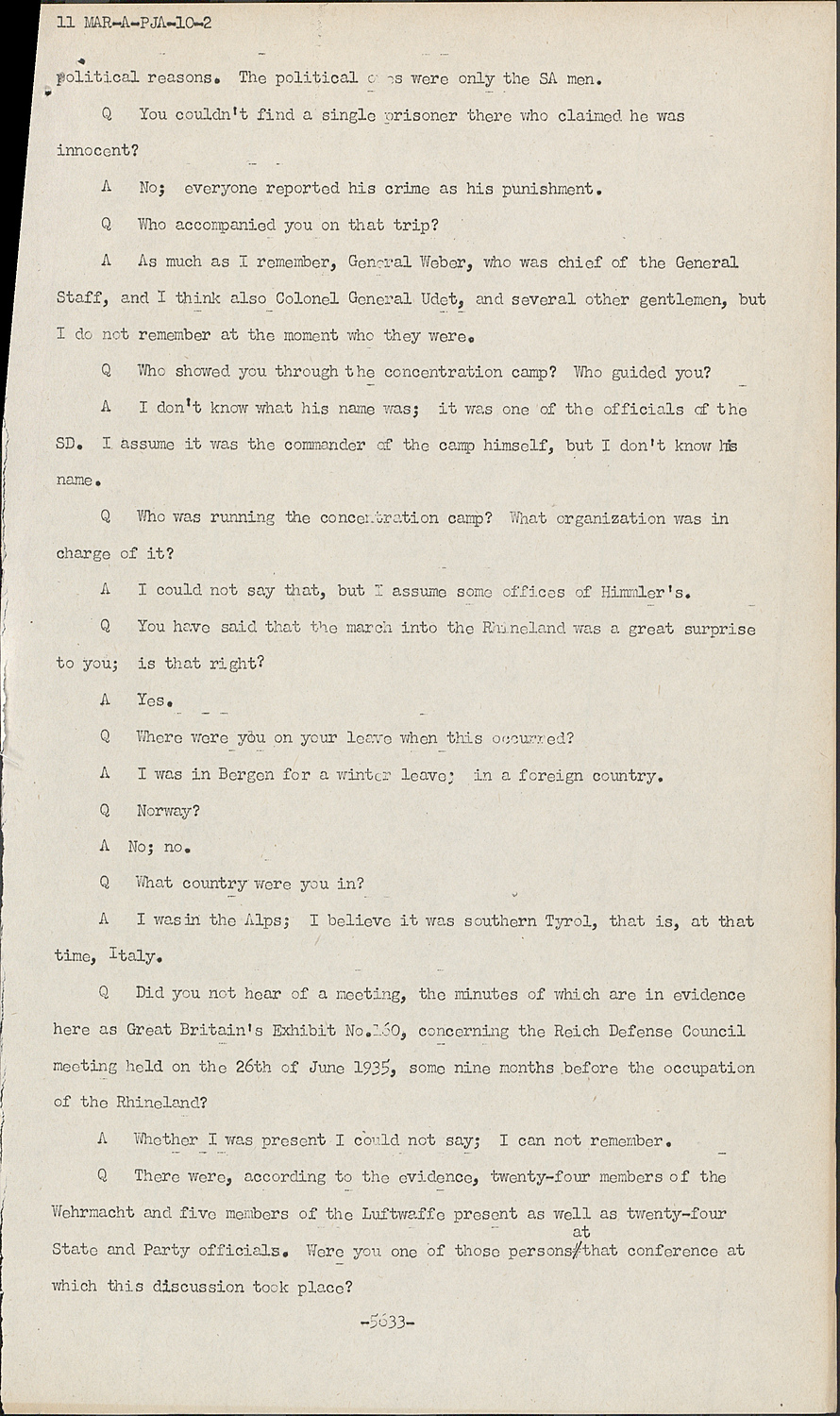
The political owes were only the SA men.
QYou couldn't find a single prisoner there who claimed he was innocent?
ANo; everyone reported his crime as his punishment.
QWho accompanied you on that trip?
AAs much as I remember, General Weber, who was chief of the General Staff, and I think also Colonel General Udet, and several other gentlemen, but I do not remember at the moment who they were.
QWho showed you through the concentration camp? Who guided you?
AI don't know what his name was; it was one of the officials of the SD. I assume it was the commander of the camp himself, but I don't know his name.
QWho was running the concentration camp? What organization was in charge of it?
AI could not say that, but I assume some offices of Himmler's.
QYou have said that the march into the Rhineland was a great surprise to you; is that right?
AYes.
QWhere were you on your leave when this occurred?
AI was in Bergen for a winter leave; in a foreign country.
QNorway?
ANo; no.
QWhat country were you in?
AI wasin the Alps; I believe it was southern Tyrol, that is, at that time, Italy.
QDid you not hear of a meeting, the minutes of which are in evidence here as Great Britain's Exhibit No.160, concerning the Reich Defense Council meeting held on the 26th of June 1935, some nine months before the occupation of the Rhineland?
AWhether I was present I could not say; I can not remember.
QThere were, according to the evidence, twenty-four members of the Wehrmacht and five members of the Luftwaffe present as well as twenty-four at State and Party officials.
Were you one of those persons/that conference at which this discussion took place?
A May I ask again for the date?
QThe 26th of June 1935.
AI can not remember. I don't know.
QDid you never learn of that meeting?
AAt the moment I really can not remember what is supposed to have been said at that meeting.
QAt which the preparations for the occupation of the Rhineland were to be kept secret and the plan was made to invade the Rhineland? Did you ever learn of that meeting?
AI can not remember. I don't believe that I was present.
MR. JUSTICE JACKSON:If Your Honors please, the usual time for adjournment is here. I intend to take up a different subject which involves some documents. It might be a convenient time to adjourn.
THE PRESIDENT:We will adjourn now.
(A recess was taken until 1400 hours.)
Official transcript of the International Military Tribunal in the Matter of The United States of America, the French Republic, the United Kingdom of Great Britain and Northern Ireland, and the Union of Soviet Socialist Republics against Hermann Wilhe,m Goering et al, Defendants, sitting at Nurnberg, Germany on 11 March, 1400-1700 hours, Lord Justice Lawrence presiding.
BY MR. JUSTICE JACKSON:
QI want to ask you some questions referring to your duties and activities on the Central Planning Board. You were a member of the Central Planning Board, were you not?
AYes.
QAnd what was the period of your membership?
AFrom the beginning--I believe that was in the year 1941 or 1942-until the end.
QMembers of that Board, in addition to yourself, were the defendant Speer?
AYes.
QFunk?
AYes, but only later.
QWhen did he come on?
AAt the moment when a large part of the civil production was turned over to the ministry of Speer.
QAnd Koerner? Koerner was a member of the Board?
AKoerner? Yes.
QWho was Dr. Sauer?
ASauer was an official in the ministry of Speer, but he did not belong to the Central Planning Board.
QBut he did keep some of the minutes, did he not?
ANo, in my opinion, he did not keep them.
QSauckel frequently attended the meetings, did he not?
ANot frequently, but at times.
QWhat were the functions of the Central Planning Board?
AThe distribution of raw materials to the various groups who had contingents; that is, Army, Navy, Air Force, civil requirements, for mining, various sectors, building industry, private concerns, and so on.
Q And labor, did it not?
ALabor, no. That was not to be distributed.
QIt had nothing to do with labor? Do I understand you correctly?
AWe could make suggestions, but not the distribution.
QYou mean by that not the distribution between different industries which were competing to obtain labor?
AThat was a point which concerned Armament Industry more than the Central Planning.
QDid you know that Speer turned over to the United States all of his personal papers and records, including the minutes of this Central Planning Board?
AI did not know that; I just hear it now.
QI will ask that the minutes, volumes of minutes which constitute U. S. Document R-124, offered in evidence as French Exhibit RF 30, be made available for examination by the witness in the original German, and I shall ask you some questions about it.
AYes.
(Documents were thereupon presented to the witness).
QIf you will point out to the witness page 1,059, Line 22, this, Mr. Witness, purports to be the minutes of Conference No. 21 of the Central Planning Board, held on 30 October 1942 at the Reich Ministry of Armament and Munitions, and the minutes show you to have been present. Do you recallbeing there at that meeting?
AFrom that one sentence, I can not see it, but I can well assume it.
QNow-
AYes, I see here that in the minutes my name is frequently mentioned.
QNow, I call your attention to Page 1059, Line 22, to the following entry and ask you if this refreshes your recollection about the functions of that Board:
"By Speer: We must also discuss the slackers. Ley has ascertained that the sick lists decreased to one-fourth or one-fifth in the factories where there are doctors on the staff who are examining the sick men. There is nothing to be said against the SS and Police taking drastic steps and putting these known as slackers into concentration camps. There is no alternative.

Let it happen several times, and the news will soon go around."
Were you not concerned with the discussion of the labor situation in that conference, and does that not refresh your recollection as to the dealing with the labor question?
A I can remember that there was talk about this question, but the slackers were workers who, in normal times, in peacetime, were not with us as workers, but by mobilizing the total labor power were put into the ranks and with regard to these people, I point out that they were not normal workers, and there were some slackers who disturbed the spirit of the work, and these are the people in question.
QThese were to be sent to concentration camps, asyou knew?
AYes, that was said, but that does not mean that was a resolution. Besides, this was not within our competence, to send anybody to the concentration camps.
QWell, was it not said that there was "nothing to be said against the SS" taking them over? You know that the SS was running the concentration camps, did you not?
AYes, of course.
QAnd, therefore, you know that turning them over to the SS and sending them to the concentration camps was a means of forcing them to produce more goods, was it not?
AYes, of course. Of course, these people should be forced. It was a question about the Germans who did not want to perform their duties to their county.
QDid this relate only to Germans?
AAs much as I know, it dealt only with Germans, who were called Bumulantew--fluctuating workers or vagrants. They were the only people who were charging their place of work frequently, and we were mostly told about them by the representatives of our own workers. Our own workers complained about the fact that these people had all the advantages, as far as foot, et cetera, was concerned, and they did not do anything and always in time left the factories, and each factory was glad when they got rid of these people.
QAnd got rid of them by sending them to the concentration camps under the SS?
AThey should be trained because it was raid that if these people would get a different kind of ration, not the basic rations which depended on the work, they would be quickly trained.

I do not see it here, but I can remember that the proposal was made to limit their treatment in time to about two or three months and to take them out again after that time if they were reasonable enough and to re instate them back into their old conditions.
Q Now, did you have anything to do on the Central Planning Board with the working of prisoners of war?
ANo, in my opinion not.
QWell, I ask that you be shown the twenty-second conference of the Central Planning Board minutes of the meeting held on the 2nd of November 1942, page 1042, at line 24, which quotes you. The English translation is on page 27.
I ask you to refresh your recollection by reading this paragraph "Milch, I believe that agriculture must get its labor quota.
Assuming we could have given agriculture 100,000 more men, we would now have 100,000 more men who would be more or less well fed. Well, actually, the human material which we received generally above all the PW's are not in good enough condition for work."
Did you make that statement?
AI cannot remember in detal, but I assume -- I don't think I have ever seen these minutes before, but I know that we dealt with the question that agriculture, if at all possible, should get their workers because the question of nutrition was so important and agriculture, of course, beuond the rations which the civilian population received would feed their workers. The question that one put these people into agriculture was quite in conformity with my intentions, but these are only suggestions which were made by the Central Planning Board. I don't know whether Sauckel was present at that meeting. We have uttered our opinion to these people who were there how several questions could be solved.
QAnd you made recommendations to the Reichsmarshal, didn't you?
AI could not say that from memory. No, I don't know. I can't say it from memory.
QThen you knew the Reichsmarshal's wishes in reference to the utilization of prisoners of war, did you not?
AThat prisoners of war were also working, well, I knew that. Especially in the country there were many prisoners of war put to work.
QDid you attend a meeting with the Fuehrer with Minister Speer?
AAt what date?
QThe 5th of March, 1944.
Q The 5th of March?
AThe 5th of March, 1944.
AOn the 5th of March, yes, I saw the Fuehrer. At that time it was the question to establish a fighter staff, that is, an effort of the entire industry to manufacture as many fighters as possible.
QWell, I'll ask that you be shown Speer's memorandum of that meeting with the Fuehrer at which General von Bodenschatz and Colonel von Belo were also present. Were they not?
The English translation is on page 35; the German on page 139.
I call your attention to this paragraph:
"I told the Fuehrer of the Reichsmarshal's wish for the further utilization of the productive power of prisoners of war by giving the direction of the Stalag to the SS. With the exception of the English and Americans, the Fuehrer considers the proposal good and has asked Colonel von Belo to arrange matters accordingly."
I ask you how the SS could increase the production of the prisoners of war; what steps you expected to be taken?
Now, just answer my question. What steps did you expect the SS to take to increase the production of the prisoners of war?
AI could not say that today any more. At any rate at that time we really did not know anything about the methods of the SS as we know it today.
QThis was in March of 1944?
AYes.
QWell, you have no knowledge of the methods by which the SS would be able to speed up production by prisoners of war. That's the way you want tha to stand?
ANo, no, that isn't the way I want it to stand. I was thinking about this point because I want to think about it a moment. I believe that it was dealing with the question whether prisoners of war were put to their disposal or not. It was not the question that these prisoners of war should do any work under the SS, only that they should be put at the disposal for that word That's what I have to assume.
QPut at the disposal by the SS, you mean?
Well, let's go on to the thirty-third conference by the Central Planning Board.
That is on the 16th of February, 1943, at which Speer and Sauckel among others appear to have been present. The English translation is on page 28; the German page 2276 to 2307. There was at this meeting, to summarize, considerable discussion of the labor situation, first a report from Schreiber and then Tim gave a general discussion of the labor situation. I call your attention to your contribution on page 2298 at the top.
AYes, I have just read it.
QIt is as follows:
"Milch, we have made a request for an order that a certain percentage of men in the artillery must be Russian. Fifty thousand will be taken together. Thirty thousand are already employed as gunners. This is an amusing thing that the Russians must work the guns."
What was amusing about making the Russian prisoners of war work the guns
AThe words "We have demanded", that doesn't mean the Central Planning Board, but that means Hitler had made that demand.
QYes, the German Government.
And I find it very peculiar that one should let the prisoners of war shoot against the planes of their allies. We did not like it because we he to release these men from this work. We were against it that they should be used in AA.
Q "This is an amusing thing that the Russians must work the guns."
what was amusing about it?
AI found it peculiar, not to be understood. I cannot say whether that word was used. I don't know these minutes. I have not seen them before Q Now, I call your attention to the rest of your statement.
"The last 20,000 are still outstanding. Yesterday I received a letter from the Army High Command, in which they say they could not release a single man. They themselves have not enough. Thus this measure will not be successful for us."
Who does "for us" refer to if not to your industry requirements?
AI think these minutes are wrong. It has never been said because it doesn't make sense. I cannot accept these minutes in that form.
QLet's turn to page 2298 for a -
ATo clarify this I can say that it deals with the problem of taking people out of armament and into anti-aircraft. We who were concerned with armament did not want to release these men and we were against it. That was the idea of the whole thing, and the OKH declared that they did not have enough people.
QI understand the sense of this to be that you applied for certain workmen for the armament industry and that the Army High Command refused to give you the men and said they already employed working guns and other work. Now, is that the souse of that or isn't it?
ANo, not quite.
QNow, just tell me what the sense of it is.
A As much as I can remember the whole affair, the armament should release for the Air Force 50,000 Russian prisoners for anti-aircraft, that the armament industry would not miss these people.
THE PRESIDENT:I am afraid we must adjourn due to some technical difficulty.
(A recess was taken)
THE PRESIDENT:Mr. Justice Jackson, it may be convenient to you to know that we are going to rise at 4:30 today.
MR. JUSTICE JACKSON:I hope to be finished by then.
CROSS EXAMINATION - continued BY MR. JUSTICE JACKSON:
QI will ask to have your attention called to page 2297, in the English translation about page 28, to your contribution, which reads as follows:
"Milch: Of course a front exists somewhere in the East. This front will be held for a certain time. The only thing which the Russians inherit if we evacuate an area is the population. The question is whether we had not better make it a rule to take the population back first as far as 100 kilometers to the rear of the front. All of the civil population will be taken back 100 kilometers behind the front."
Do you find that?
AYes, I have found it.
QAnd I understood you this morning to state that it was a rule promulgated in your book that the civilian population should not be interfered with.
AFrom the last sentence, that the people would not be used for earth work, we can see that these people at that time were used for earth work. What kind of people they were I could not say. They had been used for these kinds of work already.
QAnd you knew that. You knew that they were being used for that kind of work.
AThat is in there in these minutes. I do not know it today any more, but at that time, according to the minutes, it has been said, that is to say, if these minutes are correct.