ANo, and --
QThat is an answer and there is no need to explain that.
AKoch? had had the opposite opinion previously, that the future problems of the Russians would be the same as those of the German Youth.
QSo I take it you were surprised when this man turned out to be the kind of man that he did turn out to be. Is that a fair statement?
AWell, that came out later by and by, that impulsive temperament, that these results could not quite be anticipated and I think it would not have come that far if he wouldn't have been supported by the other side.
QYou don't think he was quite as good a man as appears by the record but rather encouraged by some others; is that what you are trying to tell us?
AYes,of course, that contributed.
QI am going to ask that you be shown document 1019-PS; it becomes USA Exhibit 823. By the way, before we look at that document, he is the man whom you blame to a very great extent for many of these terrible things that happened under your ministry in the Ukraine, isn't he? There isn't any doubt about that. You told us about that all day yesterday.
AYes.
THE PRESIDENT:Mr. Dodd, could you go just a little bit slower?
MR. DODD:Yes, your Honor, I will. BY MR. DODD:
QIf you look at this document, you will see that it is a memorandum about your recommendations as to the personnel for the Reich Commissariat in the East and for the Political Central Office in Berlin, and it was written on the 7th day of April 1941, and I take it that that was only a few days after Hitler talked to you about your new assignment in the East, four or five days at the most; isn't that so? Will you answer that question.
AYes.
Q Now, in this memorandum you set out that you recommended Gauleiter Lohse and we know from the documents and the testimony that he was appointed, isn't that a fact?
AYes.
QAll right. Now, turn to the next page of the English text, it is the paragraph beginning as follows:
"In addition it will eventually become necessary to occupy with troops not only Petersburg but also Moscow. This occupation will definitely differ considerably from that in the Baltic provinces, in the Ukraine and in the Caucasus. It will be accomplished by suppressing any Russian and Bolshevik resistance and will necessitate an absolutely ruthless person both as regards the military representation (and also the eventual political direction. The problems arising from this need not be detailed here. If it is not intended to maintain a permanent military administration the undersigned would recommend that the Gauleiter of East Prussia, Erich Koch, as Reich Commissar, Commissioner in Moscow".
Did you recommend Koch for that job as a particularly ruthless man in April of 1941? yes or no?
AYes.
QJust a minute. You have done a, lot of talking here for the last day and today if you will just give me a chance once in a while.
He is the same man you told us a minute ago you did not know to be particularly ruthless until after he did these terrible things in the Ukraine. Now, it is very clear you did know it in April of 1941, isn't it? What is your answer to that?
AThat is not correct. I have stated that I know from Koch from '43 and 44 he had a special interest for the Russian people. I knew Koch as a man of economic initiative in East Prussia and then, I had to expect that at the center at Moscow and around Moscow would be center of gravity for Bolshevism and there the harshest, that is the greatest resistance would surge and then I did not want to have Koch in the eastern territories and in the Ukraine because there I did not anticipate such resistance.

There was Koch's attitude to the Russian people and then I knew he had initiative and finally I knew he was well supported and that a job in the east was expected of him, any job in the east, either by the Juehrar or the Reich Marshal.
QWhen you were looking for a ruthless man you suggested Koch as early as April of 1941.
AThis expression concerns initiative and, of course, also I had the opinion that he would fight any Bolshevik resistance, yes, but not in the sense that he would suppress foreign culture or try to exterminate it.
QThe proof of the matter is that you had some peculiar and odd interest in the Ukraine and you had somebody else in mind for that job but you knew Koch was a bad actor and you wanted him in another part of Russia, is it not?
ANo, for the Ukraine I wanted Backe and my Stableiter Schickedanz, as can be seen from the document. I wanted Backe as State Secretary because he was a German from the Caucasus and speaks Russian, knows the entire southern area and could have worked very well there. I did not get him and I was forced to accept Koch and I would like to say, against my personal protest in the meeting of the 16th of July.
QWell, if that is your answer I do not care to go any further with it.
With respect to your attitude towards the Jewish people, in your Frankfort speech in 1933 you suggested that they all leave Europe and leave Germany, did you not?
AThis phrase -
QAll you need to say is yes or no. Did you do that or not in your speech in Frankfort in 1938 -
AYes, but I only can answer yes or no on a correct quotation.
QI do not think you need to explain anything at all. I merely asked you whether you said that in Frankfort in your Party Day speech.

A Yes, essentially that is correct.
QNow, in your Party Day speech to which you made reference yesterday, you said you used harsh language about the Jews. In those days you were objecting to the fact that they were in certain professions, I suppose, and things of that character. Is that a fair statement?
AI have said yesterday that in two speeches I demanded a chivalrous solution and I said one could not, one should not be able to accuse us of extermination of the Jewish people from abroad, that is foreign nations
QYes, very well, Did you ever talk extermination of the Jews?
A Not in a single speech have I spoken about the extermination of the Jews.
One has to consider the words -
QYou will get around to the words. You just tell me now whether you ever said it or not? You said that you did not?
ANot in a single speech in that sense.
QI understand the sense. Did you ever talk about it with anybody as a matter of state policy or party policy, about the extermination of the Jews?
AIn a conference with the Fuehrer there was mention made of an intended speech which was never held and that question was also mentioned in the sense that now that a war had started the that threat which had been mentioned should not be mentioned again. That whole speech was not held.
QWhen was it you were going to deliver that speech? Approximately what was the date?
AIn December 1941.
QThen you had written into your speech remarks about the extermination of the Jews, hadn't you? Answer that yes or no.
AI have said already that that word does not have the sense which you want to give to it.
QI will get around to the word and the meaning of it. I am asking you, did you not use the word or the term extermination of the Jews in the speech which you were prepared to make in the Sportpalast in December of 1941? Now, you can answer that pretty simply.
AThat may be, but I do not remember. I have not even read the drafts. In which fort that was expressed I cannot say therefore.
QWell then, perhaps we can help you on that. I will ask you be shown document 1517-PS. It becomes USA Exhibit 284.
(witness handed document)
Now, this is also a memorandum of yours written by you about a discussion you had with Hitler on the 14th of December, 1941, and it is quite clear from the first paragraph that you and Hitler were discussing a speech which you were to deliver in the Sportspalast in Berlin and if you will look at the second paragraph, you will find these words:

"I remarked on the Jewish question that the comments about the Now York Jews must perhaps be changed somewhat after the conclusion (of matters in the East). I took the standpoint, not to speak of the extermination (Ausrottung) of the Jews.
The Fuehrer affirmed this and said that they had burdened the war upon us and that they had brought the destruction; it is no wonder if the results would strike them first."
Now, you have indicated that you have some difficulty with the meaning of the word and I am going to ask you about the word "ausrottung." I am going to ask you be shown -- you are familiar with the Standard German-English dictionary, Cassell's, I suppose, are you? Do you know this work, ever heard of it?
ANo.
QThis is something you will be interested in. Will you look up and read out to the Tribunal wheat the definition of "ausrottung" is?
AI do not need a foreign dictionary in order to explain what in the German language the word "ausrottung" may mean in various meanings. One can exterminate an idea, a system, a social order and as a final consequence, also a group of human beings, certainly. Those are the same varieties which are contained in that word and for that I do not need an English -German dictionary. The translations from German into English are so often wrong and just as in that last document you have submitted to me I heard again the translation of "Herrenrasse" and in the document itself it is not even mentioned. There is the meaning of a false Herrenmenschentum -
QAll right, I am not interested in that. Let us stay on this term of "ausrottung." I take it then that you agree it does mean to wipe out or to kill off, as it is understood, and that you did use the term in speaking to Hitler.
AHere I have to read a different translation again, with a new German translation and so I cannot even find out what you have just wanted to say in English.
QAre you very serious in pressing this apparent inability of yours to agree with me about this word or are you trying to kill time?

Don't you know thatthere are plenty of people in this Court room who speak German and who agree that that word does mean to wipe out, to extirpate?
AIt means to overcome first and then as to its use not with respect to individuals but only as a juridical, historical and traditional word it has always been used with respect to the German people and we have not believed that the consequences could be taken to mean the shooting of sixty millions of Germans.
QI want to remind you that this speech of yours in which you use the term "ausrottung" was made about six months after Himmler told Hoess, whom you heard on this witness stand, to start exterminating the Jews. That is a fact, is it not?

A No, that is not correct, because Adolph Hitler said in his statement before the Reichstag that here a now world war by the immigrants would be star ted by their attacks; that the consequence would be an extermination.
That has been taken as a political fact and, apparently, a similat political threat was made by me before the war against America broke out. And now, when the war broke out, I have apparently said that, since it has come to it already, there is no use to speak of it any more.
QWell, actually, the Jews were being exterminated in the Eastern Occupied Territories at that time and thereafter, weren't they?
AThen, may I say something to the use of the words here? One speak of the Ausrottung of Jewry and between Jewry and individual Jews there is still a difference.
QI asked you if it wasn't asfact that at that time and later on Jews were being exterminated in the occupied Eastern Territories which were under your ministry? Will you answer that yes or no?
AYes, and after that you told the Tribunal or, as I understood you at least, you wanted the Tribunal to believe that that was being done by the police and without any of your people being involved in it; is that so?
AI have heard from a witness here that a District Commissar had participated in these things, and I have heard from another witness, Wilna, that in other cities reports came that the police was to carry it out. From Document 1184 I could see that a District Commissar within his capacity protested agains these "Schweinerei" as he called them.
QDr. Leibbrandt was your subordinate; he was in charge of the main Division 2 in your Ministry for the occupied Eastern Territories wasn't he?
AYes.
QAll right. Now, for the second time, I'll ask that you be shown Document 3663-PS, USA 825.
(Witness was handed the document.)
Q (Continuing.) Now, this document consists of three parts as you will notice. The first page is a letter written by Dr. Leibbrandt on the stationery of the Reich Minister for the occupied Eastern Territories and it's dated the 31st of October 1941; that's not too many days before you had your conversation with the Fuehrer about your speech and it's addressed to the Reichskommissioner for the East Ostland in Riga; that was Lohse, the man whom you recommended.
The letter says:
"The Reich and Security Rain Office has complained that the Reichskommissioner for the East has forbidden execution of Jews in Libau. I request a report in regard to this matter by return mail by order (signed) "Leibrandt".
Now, if you will turn to the next page, you'll see the answer. Turn that document over if you have the original, do you? You'll see the answer, dated Riga, the 15th of November 1941, to the Reich Minister for the occupied Eastern Territories, Berlin. "Re: Execution of Jews, District of Erlau." It refers to the letter of Leibrandt, apparently, of the 31st of October 1941, and it says:
"I have forbidden the wild execution of Jews in Liepeja because they were not justifiable in the manner in which they were carried out. I should like to be informed whether your inquiry of 31 October is to be regarded as a directive to liquidate all Jews in the East. Shall this take place without regard to age and sex and economic interest of the Wehrmacht, for instance, and specialists in the armament industry?" And there's a note in different handwritting: "Of course, the cleansing of the East of Jews is a necessary task. Its solution, however, must be harmonized with the necessities of war production.So far I have not been able to find such a directive, either in the regulations regarding the Jewish question in the Brown Portfolio nor in other decrees."
Now, that has the initial "L" for "Lohse", doesn't it, at the botton of it And then, if you'll look at the third page -- no, it's another document. There are only two parts to that document.
Now, I wish that you'll look at 366-PS, which becomes USA 826.
THE PRESIDENT:That has on it the initial "L" has it?
MR. DODD:The original has, Your Honor, yes.
THE PRESIDENT:And the defendant agrees that that is the initial of Lohse is that right?
THE WITNESS:On the botton, no; that could hardly be Lohse. I could not read Lohse' initial.

MR DODD. Well, it's very --
THE WITNESS:I can't distinguish it as such. It could have been Leibbrandt and it could be Lohse. BY MR.DODD:
QYou're not willing to say that that second letter was from Lohse and that that's his initial on the bottom of it?
AWell, that I cannot say.
QAll right.
ABecause usually these letters are sent typewritten. It had not -
QWell, we're -
AIt is not quite clear but, essentially, it means that there was a trial against police measures and that -
QWe will go into what it means in a minute. We're just talking about the initial "L". While we're talking about the initial, will you look at it and see if there are any "R's", capital "R".
AAn "L", yes. An "R"?
QYes, "R".
AYes, there are two "R's".
QDid you put those on there?
AYes.
QYou initialled them, did you?
AWell, no; I could not distinguish that as mine, as my "R".
QYou say that it's not your "R"? We'll have to be clear about this. You'd have to know your own initial when you saw it anywhere.
AI never made such a pointed "R" on the top. You can compare it with my handwriting.
QWe'll do that; don't worry. I just want to ask you now if that's your initial or not?
AThat I could not identify as my initial.
QDo you say that it is not your initial?
AYes.
QAll right. Now, I wish you'd look at Document 3666-PS, which is also related to these other documents, and that's also a letter written on the stationery of the Reich Minister of the occupied Eastern Territories, and it's dated December 18, 1941.
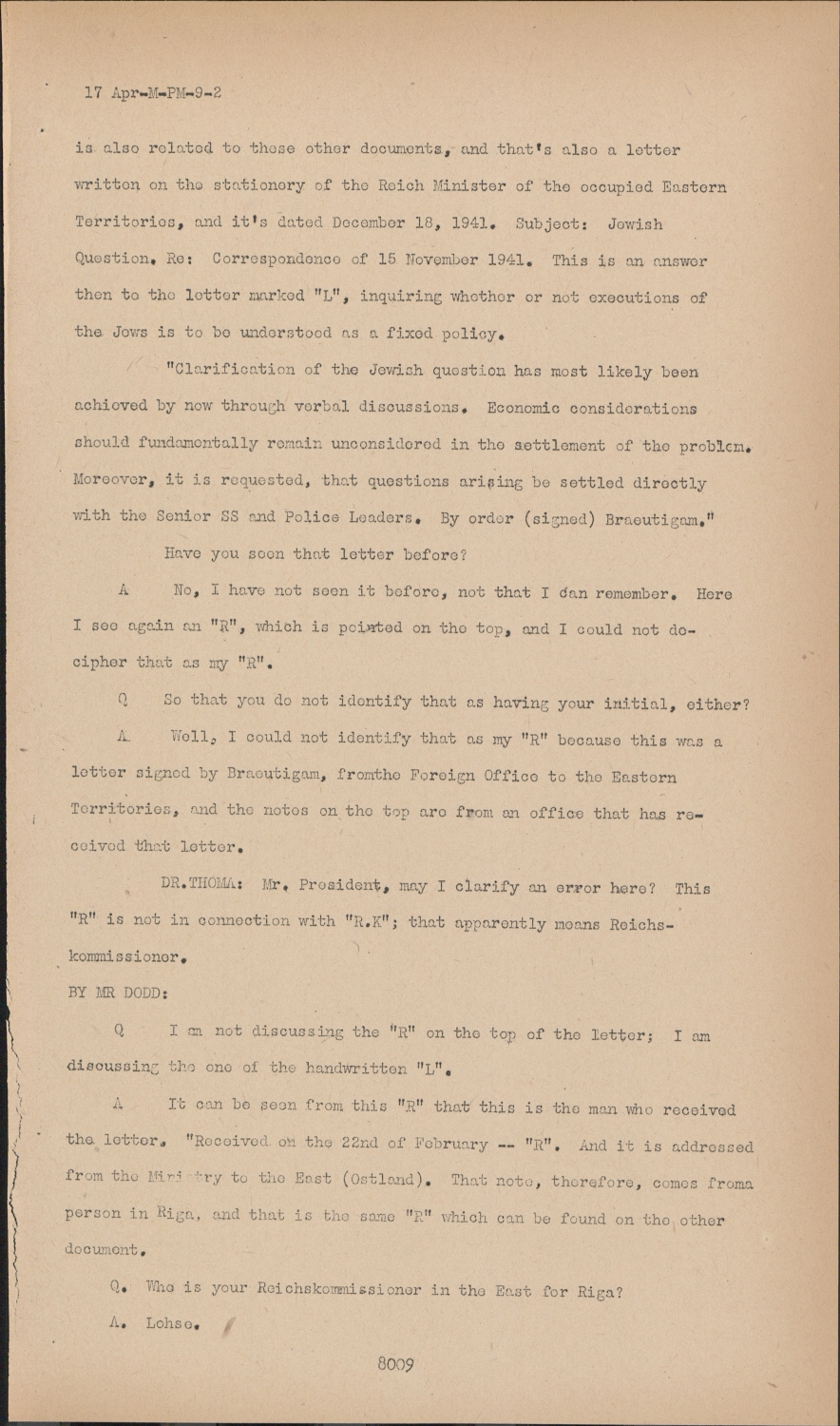
Subject: Jewish Question. Re: Correspondence of 15 November 1941. This is an answer then to the letter marked "L", inquiring whether or not executions of the Jews is to be understood as a fixed policy.
"Clarification of the Jewish question has most likely been achieved by now through verbal discussions. Economic considerations should fundamentally remain unconsidered in the settlement of the problem. Moreover, it is requested, that questions arising be settled directly with the Senior SS and Police Leaders. By order (signed) Braeutigam."
Have you seen that letter before?
ANo, I have not seen it before, not that I can remember. Here I see again an "R", which is pointed on the top, and I could not decipher that as my "R".
QSo that you do not identify that as having your initial, either?
AWell, I could not identify that as my "R" because this was a letter signed by Braeutigam, fromthe Foreign Office to the Eastern Territories, and the notes on the top are from an office that has received that letter.
DR.THOMA:Mr. President, may I clarify an error here? This "R" is not in connection with "R.K"; that apparently means Reichskommissioner. BY MR DODD:
QI am not discussing the "R" on the top of the letter; I am discussing the one of the handwritten "L".
AIt can be seen from this "R" that this is the man who received the letter. "Received, on the 22nd of February -- "R". And it is addressed from the Ministry to the East (Ostland). That note, therefore, comes froma person in Riga, and that is the same "R" which can be found on the other document.
Q.Who is your Reichskommissioner in the East for Riga?
A.Lohse.
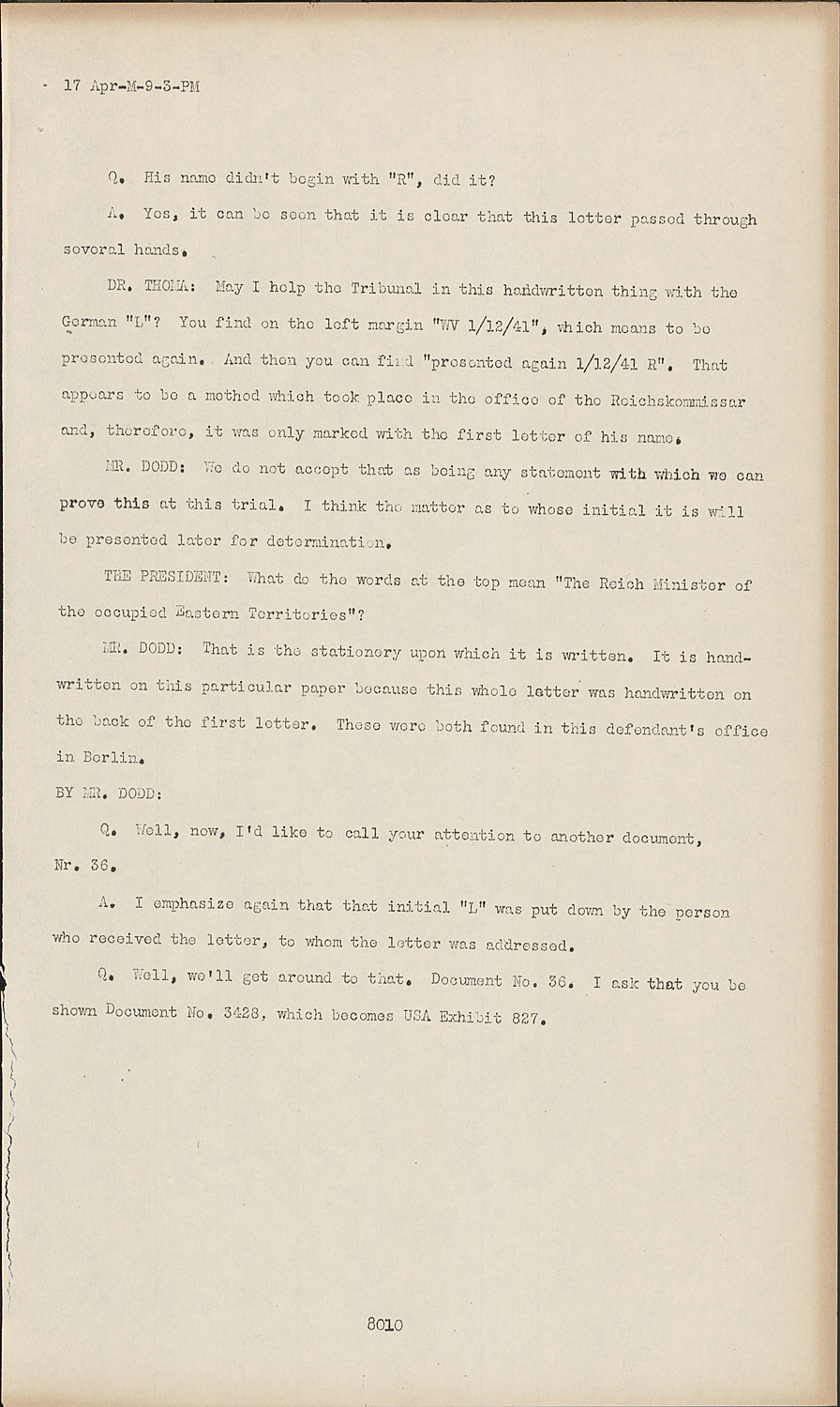
Q. His name didn't begin with "R", did it?
A.Yes, it can be seen that it is clear that this letter passed through several hands.
DR. THOMA:May I help the Tribunal in this handwritten thing with the German "L"? You find on the left margin "WV 1/12/41", which means to be presented again. And then you can find "presented again 1/12/41 R". That appears to be a method which took place in the office of the Reichskommissar and, therefore, it was only marked with the first letter of his name.
MR. DODD:We do not accept that as being any statement with which we can prove this at this trial. I think the matter as to whose initial it is will be presented later for determination.
THE PRESIDENT:What do the words at the top mean "The Reich Minister of the occupied Eastern Territories"?
MR. DODD:That is the stationery upon which it is written. It is handwritten on this particular paper because this whole letter was handwritten on the back of the first letter. Those were both found in this defendant's office in Berlin. BY MR. DODD:
Q.Well, now, I'd like to call your attention to another document, Nr. 36.
A.I emphasize again that that initial "L" was put down by the person who received the letter, to whom the letter was addressed.
Q.Well, we'll get around to that. Document No. 36. I ask that you be shown Document No. 3428, which becomes USA Exhibit 827.
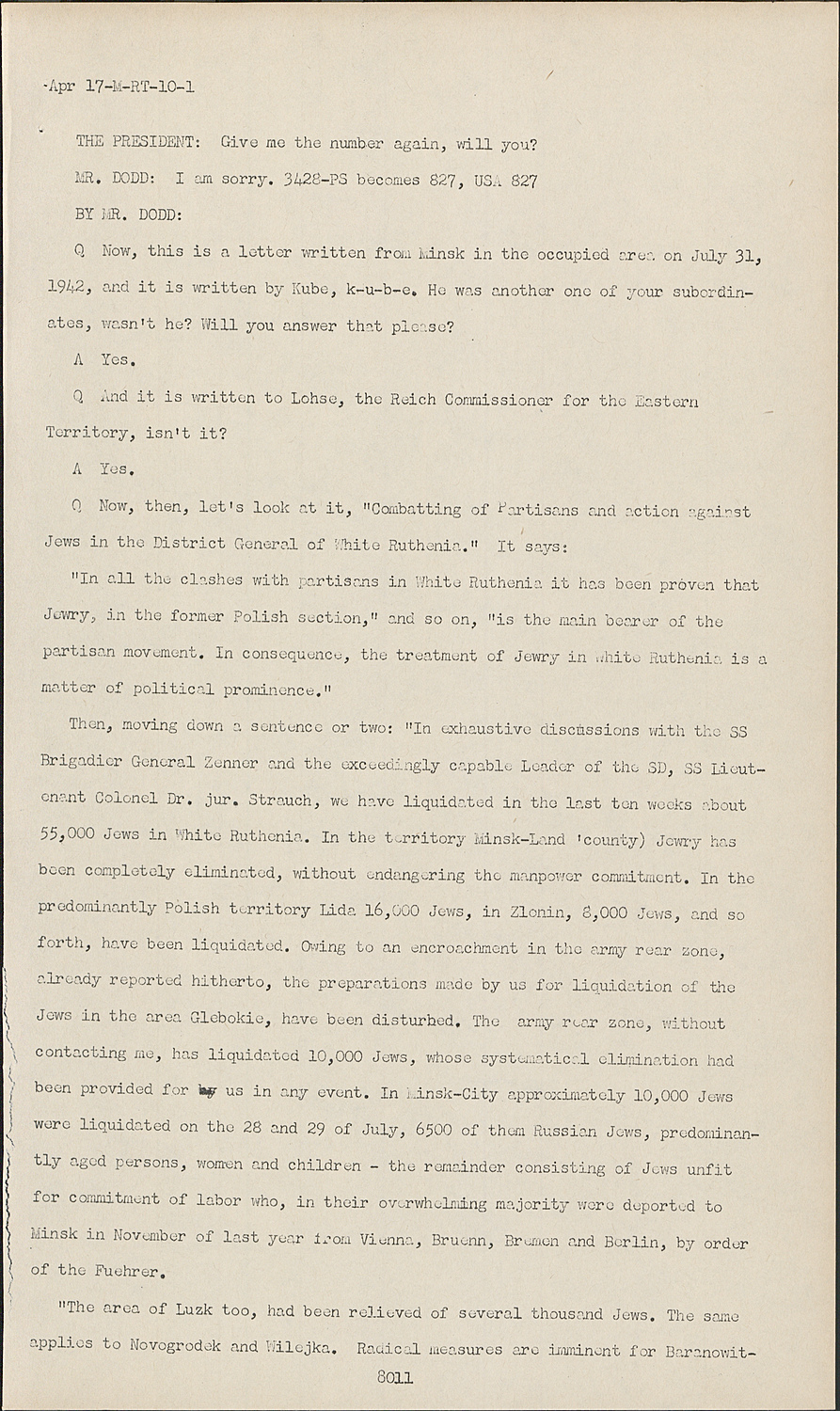
THE PRESIDENT: Give me the number again, will you?
MR. DODD:I am sorry. 3428-PS becomes 827, USA 827
BY MR. DODD:
QNow, this is a letter written from Minsk in the occupied area on July 31, 1942, and it is written by Kube, k-u-b-e. He was another one of your subordinates, wasn't he? Will you answer that please?
AYes.
QAnd it is written to Lohse, the Reich Commissioner for the Eastern Territory, isn't it?
AYes.
QNow, then, let's look at it, "Combatting of Partisans and action against Jews in the District General of White Ruthenia." It says:
"In all the clashes with partisans in White Ruthenia it has been proven that Jewry, in the former Polish section," and so on, "is the main bearer of the partisan movement. In consequence, the treatment of Jewry in white Ruthenia is a matter of political prominence."
Then, moving down a sentence or two: "In exhaustive discussions with the SS Brigadier General Zenner and the exceedingly capable Leader of the SD, SS Lieutenant Colonel Dr. jur. Strauch, we have liquidated in the last ten weeks about 55,000 Jews in White Ruthenia. In the territory Minsk-Land 'county) Jewry has been completely eliminated, without endangering the manpower commitment. In the predominantly Polish territory Lida 16,000 Jews, in Zlonin, 8,000 Jews, and so forth, have been liquidated. Owing to an encroachment in the army rear zone, already reported hitherto, the preparations made by us for liquidation of the Jews in the area Glebokie, have been disturbed. The army rear zone, without contacting me, has liquidated 10,000 Jews, whose systematical elimination had been provided for by us in any event. In Minsk-City approximately 10,000 Jews were liquidated on the 28 and 29 of July, 6500 of them Russian Jews, predominantly aged persons, women and children - the remainder consisting of Jews unfit for commitment of labor who, in their overwhelming majority were deported to Minsk in November of last year from Vienna, Bruenn, Bremen and Berlin, by order of the Fuehrer.
"The area of Luzk too, had been relieved of several thousand Jews. The same applies to Novogrodek and Wilejka. Radical measures are imminent for Baranowit schi and Hanzewitschi.
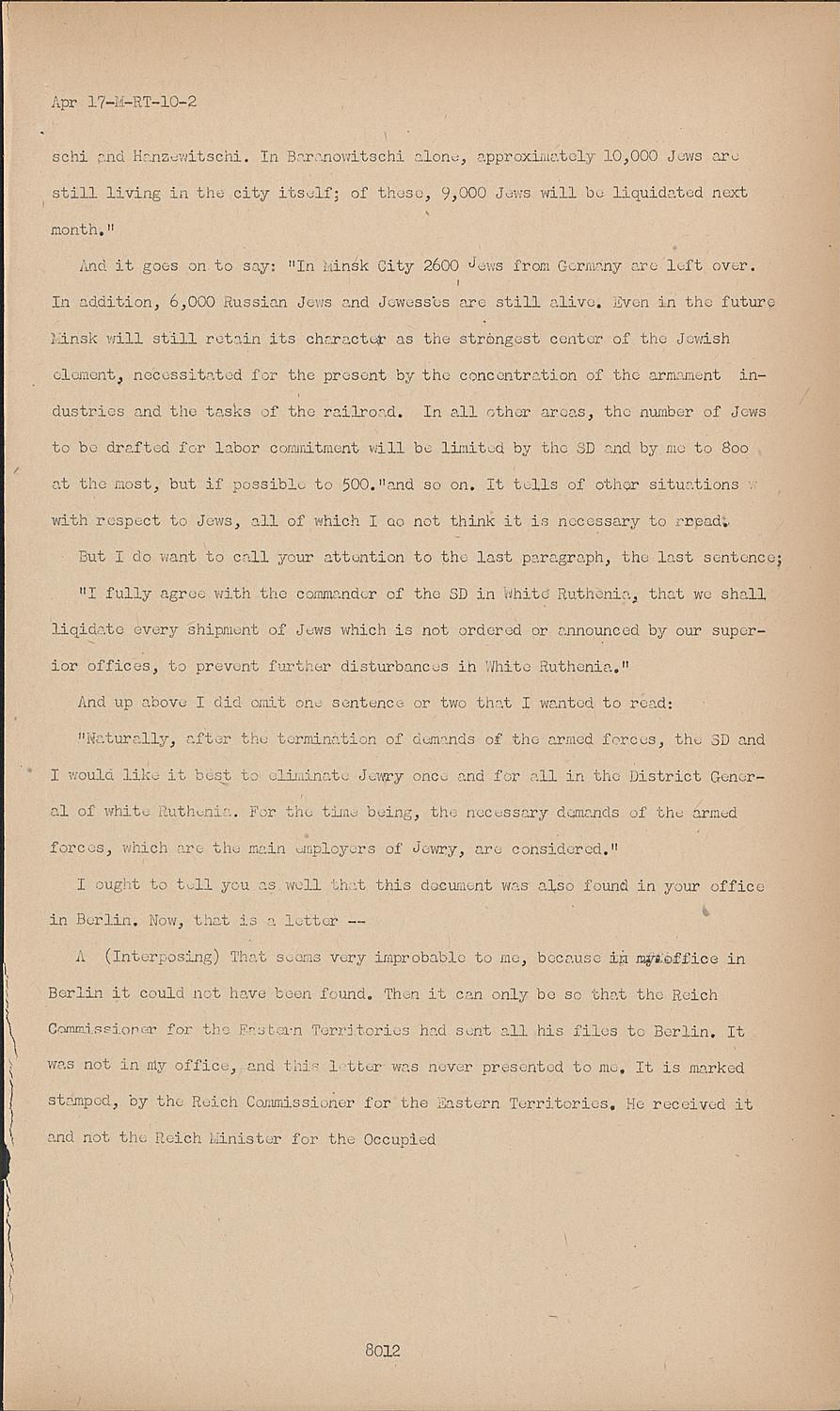
In Baranowitschi alone, approximately 10,000 Jews are still living in the city itself; of these, 9,000 Jews will be liquidated next month."
And it goes on to say: "In Minsk City 2600 Jews from Germany are left over. In addition, 6,000 Russian Jews and Jewesses are still alive. Even in the future Minsk will still retain its character as the strongest center of the Jewish element, necessitated for the present by the concentration of the armament industries and the tasks of the railroad. In all other areas, the number of Jews to be drafted for labor commitment will be limited by the SD and by me to 800 at the most, but if possible to 500."and so on. It tells of other situations with respect to Jews, all of which I do not think it is necessary to read.
But I do want to call your attention to the last paragraph, the last sentence;
"I fully agree with the commander of the SD in White Ruthenia, that we shall liqidate every shipment of Jews which is not ordered or announced by our superior offices, to prevent further disturbances in White Ruthenia."
And up above I did omit one sentence or two that I wanted to read:
"Naturally, after the termination of demands of the armed forces, the SD and I would like it best to eliminate Jewry once and for all in the District General of white Ruthenia. For the time being, the necessary demands of the armed forces, which are the main employers of Jewry, are considered."
I ought to tell you as well that this document was also found in your office in Berlin. Now, that is a letter -
A (Interposing) That seems very improbable to me, because in my office in Berlin it could not have been found. Then it can only be so that the Reich Commissioner for the Eastern Territories had sent all his files to Berlin. It was not in my office, and this letter was never presented to me. It is marked stamped, by the Reich Commissioner for the Eastern Territories. He received it and not the Reich Minister for the Occupied Eastern Territories.
I stated yesterday that quite a number of such happenings as individual actions were reported to me, and that I received reports from Luzk personally, and Gauleiter Meyer was immediately charged to protest with Heydrich to order an investigation.
That presupposes that such a general action was not assumed to be ordered for one center.
QWell, I only want to suggest to you that it is a strange coincidence that two of your top men were in communication in this tone in 1942 without your knowledge.
Did you also tell the Tribunal yesterday that you understood that most of the difficulty or a large part of the difficulty in the East for the Jewish people came from the local population?
Do you remember saying that yesterday?
AI did not get the translation.
QI asked you if it wasn't a fact that yesterday you told the Tribunal that much of the difficulty for the Jews in the East came from the local population of those areas.
AYes. I was informed about that in the beginning by returning personalities about the local population.
I knew the attitude in the East from before and could well understand that this was true.
Secondly, I have stated that I had been informed that the police took care of various other nests of resistance, and thereby a large number of Jews were stopped in various cities.
And then I have treated -
QI think you will agree that in the Ukraine your man Koch was doing all kinds of terrible things, and now I don't understand that you dispute that Lohse and Kube were helping to eliminate or liquidate the Jews, and that Braeutigam, an important member of your staff, and that Leibbrandt, an important member of your staff, was informed of the program.
So that five people at least under your administration were engaged in this kind of conduct, and not small people at that.
AI should like to point out that a decree by the Reich Kommissar for Eastern Territories -
THEPRESIDENT: (Interposing) Will you answer the question first? Do you agree that these five people were engaged in exterminating Jews?
THE WITNESS: Yes. They knew about a certain number of liquidations.
That I admit, and they have told me, or at least I have heard it from other sources.
I only want to state one thing: That according to the general law of the Reich for the Eastern Territories a decree was issued according to which--of course the Jewry there was hostile to us--the Jewry should be concentrated in certain Jewish quarters of the cities.
And until the end, until 1943-1944, I have heard that in these cities such work was carried out in Jewish Ghettoes to a large extent.
And may I point out another case which came to my knowledge?
BY MR. DODD:
QI don't want you to point out anything else. You have answered the question, and you have explained your answer.
I don't ask you further -
A (Interposing) The answer which I wanted to add was to explain part of my answer in a very concrete case.
That is to say, a district Kommissar in the Ukraine had been accused before the court that in a Jewish community, on the basis of threats, he had committed blackmail and taken furs and dresses, clothes, to Germany.
He was brought before court. He was convicted, and he was executed.
QWell, that is very interesting, but I don't think it is a necessary explanation of that answer at all.
And I would ask that you try to confine these answers.
I would like to get through here in a few minutes.
You are also, of course, the man who wrote the letter, as you told the Tribunal yesterday, suggesting the out-of-hand execution of 100 Jews in Frame, although you said you thought that--was what, a little bad judgment or not quite just, or something of the kind?
Is that right?
AI have made my statement about that yesterday.
QI know you have, and I would like to talk about it for a minute today.
Is that what you said about it, that it was not right, and that it was not just?
Yes or no, didn't you say that to the Tribunal yesterday?
AYou have to quote literally, word for word, if you want me to answer yes or no.
Q I will ask you again. Didn't you say yesterday before this Tribunal that your suggestion in that letter, in Document 001-PS, was wrong and was not just?
Now, that is pretty simple, and you can answer it.
AI have stated that it was humanly incorrect.
QIt was murder--isn't that what it was, a plan for murder? Yes or no.
ANo. The shooting of hostages, which was published by the armed forces-
I consider that an extraordinary measure necessary in warfare and an accepted fact.
The shootings of hostages were published in the press. Therefore, I had to assume that according to International Law and certain traditions of warfare this was an accepted act of reprisal.
Therefore, I cannot admit -
Q (Interposing) Well, were you talking then as the benign philosopher or as a soldier?
When you wrote this letter, 001-PS, in what capacity were you writing it, as a benign, philosophical minister on ideology and culture, or were you a member of the armed forces?
AAs can be seen from the document, I have spoken about the fact that here a certain act of sabotage and murder against German soldiers had been committed.
And in order to improve conditions, in order to poison relations between Germany and France in the future, and for the reason I have given, this letter for which I am sorry from the human point of view has been written.
Q It comes a little late, don't you think?
The witness Hoess -- you were in the courtroom when he testified, Hoess, H-o-e--s-s?
AYes, I heard him.
QYou heard that terrible story of 2 1/2 to 3 million murders which he told from the witness stand, very largely of Jewish people?
AYes.
QAlthough it wasn't brought out here, you can take it from me as being so. If you care to dispute it, you may, and we will establish it later. You know that he was a reader of your book and of your speeches, this man Hoess?
AWhether he reads my books I do not know, Anti-Jewish books have existed for the last 2,000 years.
QNow, you offered to resign in October 1944 from your position as Reichsminister for the Occupied Eastern Territories.
AOctober, 1944.
QYou didn't have very much to resign from on that date, did you? The Germans were practically out of Russia, isn't that a fact. On October 12, 1944 the German Army was practically out of Russia. It was on the retreat, isn't that so?
AYes. It was the question of my further tasks for the political and psychological treatment of several millions of eastern workers in Germany, also of refugees who came from the eastern territories and from the Ukraine to Germany, and the economic affairs which we settled. Then I had hoped that a military change would occur in the East.
QAnd everybody, pretty nearly everybody, who was informed at all in Germany knew that the war was lost in October of 1944, isn't that so? You know that the war was lost in October of 1944.
ANo, that I didn't know.
QYou didn't know that?
ANo, I did not know that.
MR. DODD:I will accept that answer. That is all. I have no further questions.
THE PRESIDENT:Dr. Thoma, do you wish to re-examine?
General Rudenko, have you got some additional questions you want to ask?
GENERAL RUDENKO: I have a few questions in connection with the activities which were carried on in the eastern territories.
THE PRESIDENT:Very well, General. BY GENERAL RUDENKO:
QDefendant Rosenberg, at what time did you begin personally to take part in the attack on the Soviet Union?
ANot at all.
QWas not your occupation of the post of plenipotentiary of the Fuehrer on questions concerning the Eastern Occupied Territories on the 20th of February in 1941 connected with the attack by Germany on the Soviet Union A That was no planning in which I took part, but the consequences of a decision which had already been made, in the deliberations on which I had not been called. A decision had been made and military orders had been given.
If I were to answer the question with yes or no, I would have to answer this, on the basis of the question, with no.
QYou don't deny the fact that this took place in April 1941?
ANo, of course not. That is evident.
QWith this nomination, Hitler gave you very wide powers. You carried out collaboration and liaison with the highest leading Nazi authorities, took care of the information, and called the meetings of the Reich authorities. In particular, you collaborated with Goering, with the Minister of Economics, and with Keitel. Please tell me briefly, yes or no.
AThere are, again, three questions. As to the first question, whether I had wide powers, plenipotentiary powers, I did not receive plenipotentiary powers at all. The answer would be no.
To the second question, whether I had confidences, the answer is yes, of course. I conferred with the highest authorities of the Reich who were concerned with the East, such as was my duty in connection with my task.
QPlease reply briefly to the following question: After your nomination on the 20th of April 1941, did you have a conference with the Chief of the OKW?
AYes, I visited Field Marshal Keitel.
QDid you have a conversation with Brauchitsch and Raeder in connection with your nomination, regarding the decisions to be taken in connection with the Eastern problem?
AAccording to my recollection I did not speak to Brauchitsch, and I also have no recollection of having had any conversation with Raeder.
QYou didn't have. Did you have a conference with the defendant Funk who nominated Dr. Schlotterer as permanent representative?