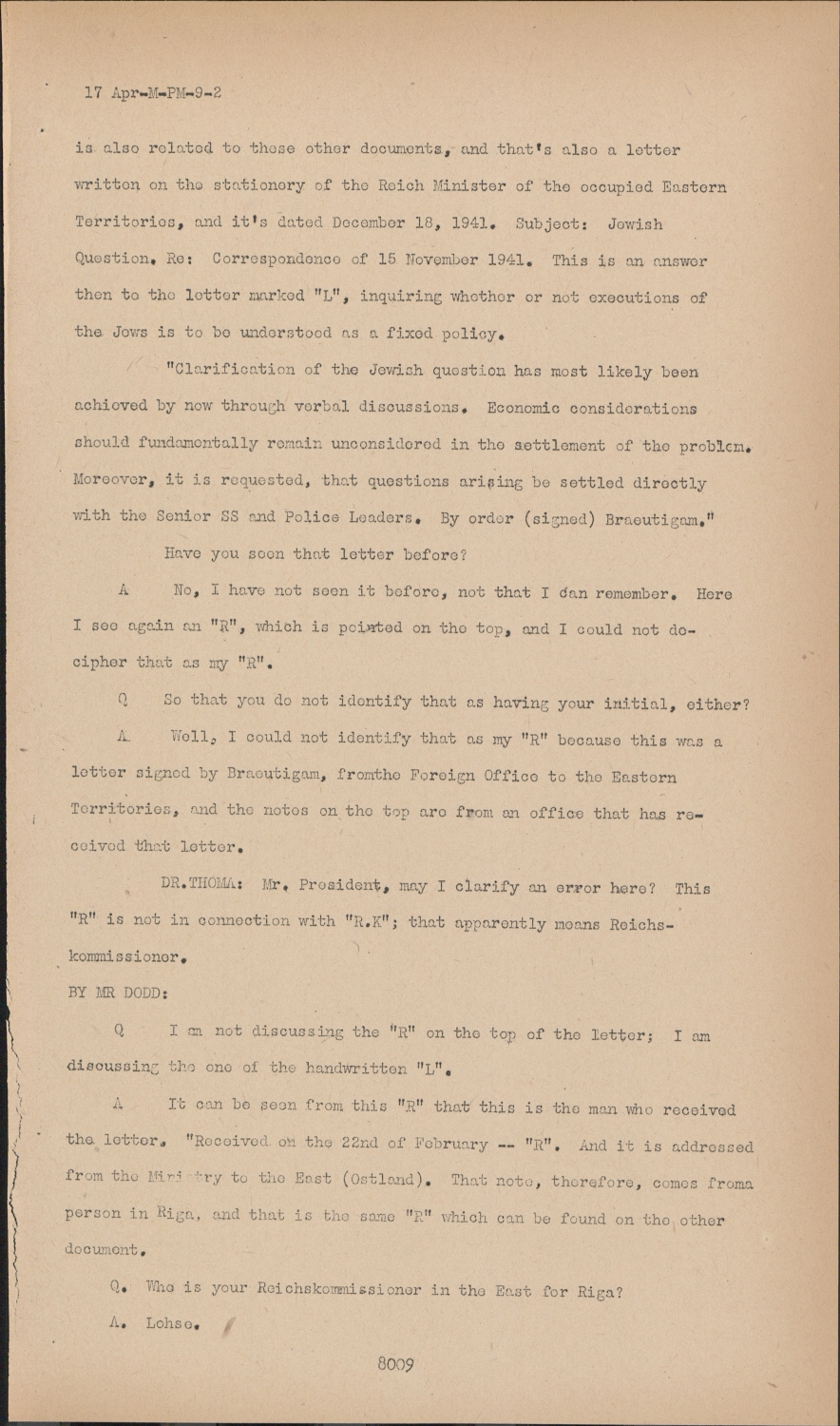
Subject: Jewish Question. Re: Correspondence of 15 November 1941. This is an answer then to the letter marked "L", inquiring whether or not executions of the Jews is to be understood as a fixed policy.
"Clarification of the Jewish question has most likely been achieved by now through verbal discussions. Economic considerations should fundamentally remain unconsidered in the settlement of the problem. Moreover, it is requested, that questions arising be settled directly with the Senior SS and Police Leaders. By order (signed) Braeutigam."
Have you seen that letter before?
ANo, I have not seen it before, not that I can remember. Here I see again an "R", which is pointed on the top, and I could not decipher that as my "R".
QSo that you do not identify that as having your initial, either?
AWell, I could not identify that as my "R" because this was a letter signed by Braeutigam, fromthe Foreign Office to the Eastern Territories, and the notes on the top are from an office that has received that letter.
DR.THOMA:Mr. President, may I clarify an error here? This "R" is not in connection with "R.K"; that apparently means Reichskommissioner. BY MR DODD:
QI am not discussing the "R" on the top of the letter; I am discussing the one of the handwritten "L".
AIt can be seen from this "R" that this is the man who received the letter. "Received, on the 22nd of February -- "R". And it is addressed from the Ministry to the East (Ostland). That note, therefore, comes froma person in Riga, and that is the same "R" which can be found on the other document.
Q.Who is your Reichskommissioner in the East for Riga?
A.Lohse.
Q. His name didn't begin with "R", did it?
A.Yes, it can be seen that it is clear that this letter passed through several hands.
DR. THOMA:May I help the Tribunal in this handwritten thing with the German "L"? You find on the left margin "WV 1/12/41", which means to be presented again. And then you can find "presented again 1/12/41 R". That appears to be a method which took place in the office of the Reichskommissar and, therefore, it was only marked with the first letter of his name.
MR. DODD:We do not accept that as being any statement with which we can prove this at this trial. I think the matter as to whose initial it is will be presented later for determination.
THE PRESIDENT:What do the words at the top mean "The Reich Minister of the occupied Eastern Territories"?
MR. DODD:That is the stationery upon which it is written. It is handwritten on this particular paper because this whole letter was handwritten on the back of the first letter. Those were both found in this defendant's office in Berlin. BY MR. DODD:
Q.Well, now, I'd like to call your attention to another document, Nr. 36.
A.I emphasize again that that initial "L" was put down by the person who received the letter, to whom the letter was addressed.
Q.Well, we'll get around to that. Document No. 36. I ask that you be shown Document No. 3428, which becomes USA Exhibit 827.
THE PRESIDENT: Give me the number again, will you?
MR. DODD:I am sorry. 3428-PS becomes 827, USA 827
BY MR. DODD:
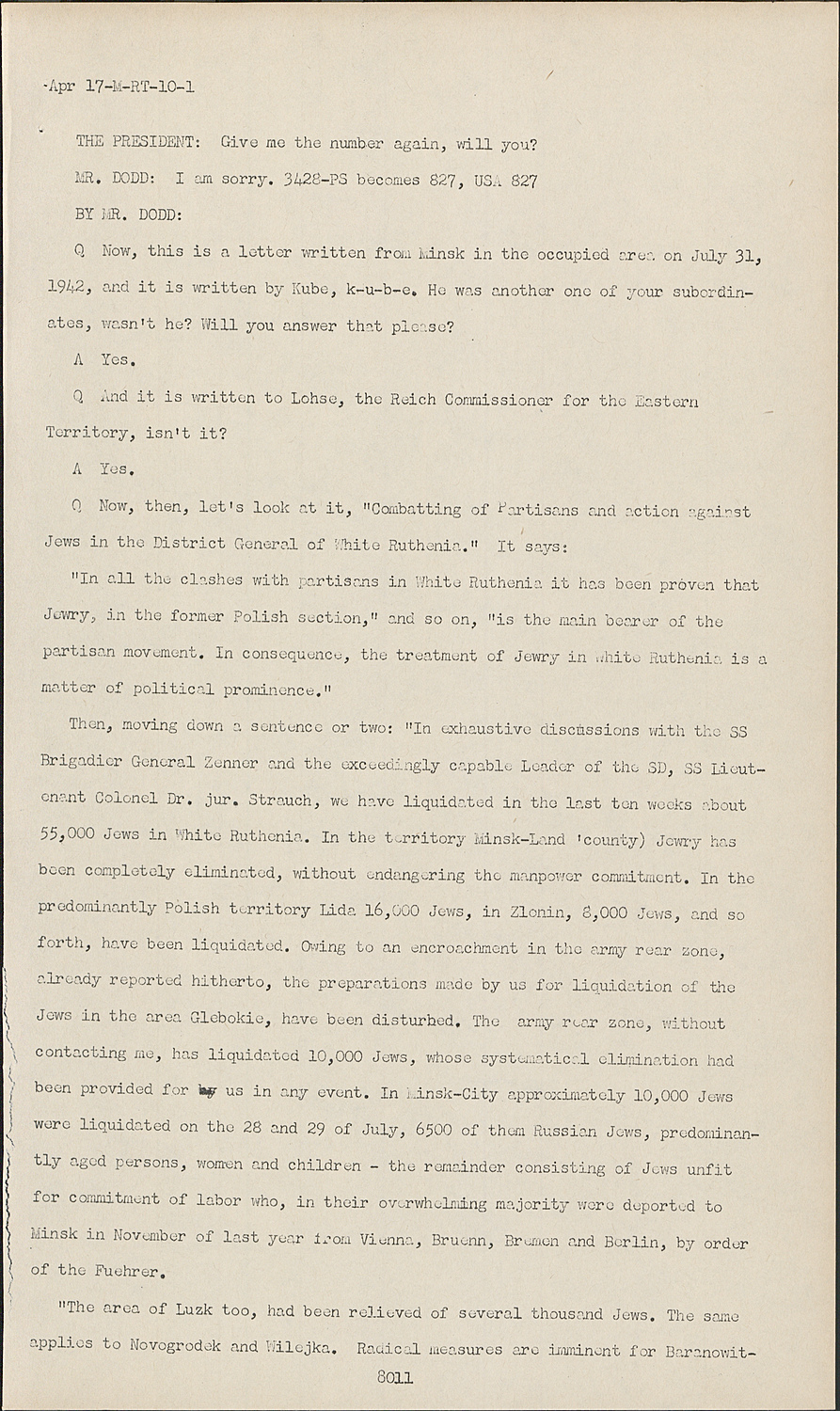
QNow, this is a letter written from Minsk in the occupied area on July 31, 1942, and it is written by Kube, k-u-b-e. He was another one of your subordinates, wasn't he? Will you answer that please?
AYes.
QAnd it is written to Lohse, the Reich Commissioner for the Eastern Territory, isn't it?
AYes.
QNow, then, let's look at it, "Combatting of Partisans and action against Jews in the District General of White Ruthenia." It says:
"In all the clashes with partisans in White Ruthenia it has been proven that Jewry, in the former Polish section," and so on, "is the main bearer of the partisan movement. In consequence, the treatment of Jewry in white Ruthenia is a matter of political prominence."
Then, moving down a sentence or two: "In exhaustive discussions with the SS Brigadier General Zenner and the exceedingly capable Leader of the SD, SS Lieutenant Colonel Dr. jur. Strauch, we have liquidated in the last ten weeks about 55,000 Jews in White Ruthenia. In the territory Minsk-Land 'county) Jewry has been completely eliminated, without endangering the manpower commitment. In the predominantly Polish territory Lida 16,000 Jews, in Zlonin, 8,000 Jews, and so forth, have been liquidated. Owing to an encroachment in the army rear zone, already reported hitherto, the preparations made by us for liquidation of the Jews in the area Glebokie, have been disturbed. The army rear zone, without contacting me, has liquidated 10,000 Jews, whose systematical elimination had been provided for by us in any event. In Minsk-City approximately 10,000 Jews were liquidated on the 28 and 29 of July, 6500 of them Russian Jews, predominantly aged persons, women and children - the remainder consisting of Jews unfit for commitment of labor who, in their overwhelming majority were deported to Minsk in November of last year from Vienna, Bruenn, Bremen and Berlin, by order of the Fuehrer.
"The area of Luzk too, had been relieved of several thousand Jews. The same applies to Novogrodek and Wilejka. Radical measures are imminent for Baranowit schi and Hanzewitschi.
In Baranowitschi alone, approximately 10,000 Jews are still living in the city itself; of these, 9,000 Jews will be liquidated next month."
And it goes on to say: "In Minsk City 2600 Jews from Germany are left over. In addition, 6,000 Russian Jews and Jewesses are still alive. Even in the future Minsk will still retain its character as the strongest center of the Jewish element, necessitated for the present by the concentration of the armament industries and the tasks of the railroad. In all other areas, the number of Jews to be drafted for labor commitment will be limited by the SD and by me to 800 at the most, but if possible to 500."and so on. It tells of other situations with respect to Jews, all of which I do not think it is necessary to read.
But I do want to call your attention to the last paragraph, the last sentence;
"I fully agree with the commander of the SD in White Ruthenia, that we shall liqidate every shipment of Jews which is not ordered or announced by our superior offices, to prevent further disturbances in White Ruthenia."
And up above I did omit one sentence or two that I wanted to read:
"Naturally, after the termination of demands of the armed forces, the SD and I would like it best to eliminate Jewry once and for all in the District General of white Ruthenia. For the time being, the necessary demands of the armed forces, which are the main employers of Jewry, are considered."
I ought to tell you as well that this document was also found in your office in Berlin. Now, that is a letter -
A (Interposing) That seems very improbable to me, because in my office in Berlin it could not have been found. Then it can only be so that the Reich Commissioner for the Eastern Territories had sent all his files to Berlin. It was not in my office, and this letter was never presented to me. It is marked stamped, by the Reich Commissioner for the Eastern Territories. He received it and not the Reich Minister for the Occupied Eastern Territories.
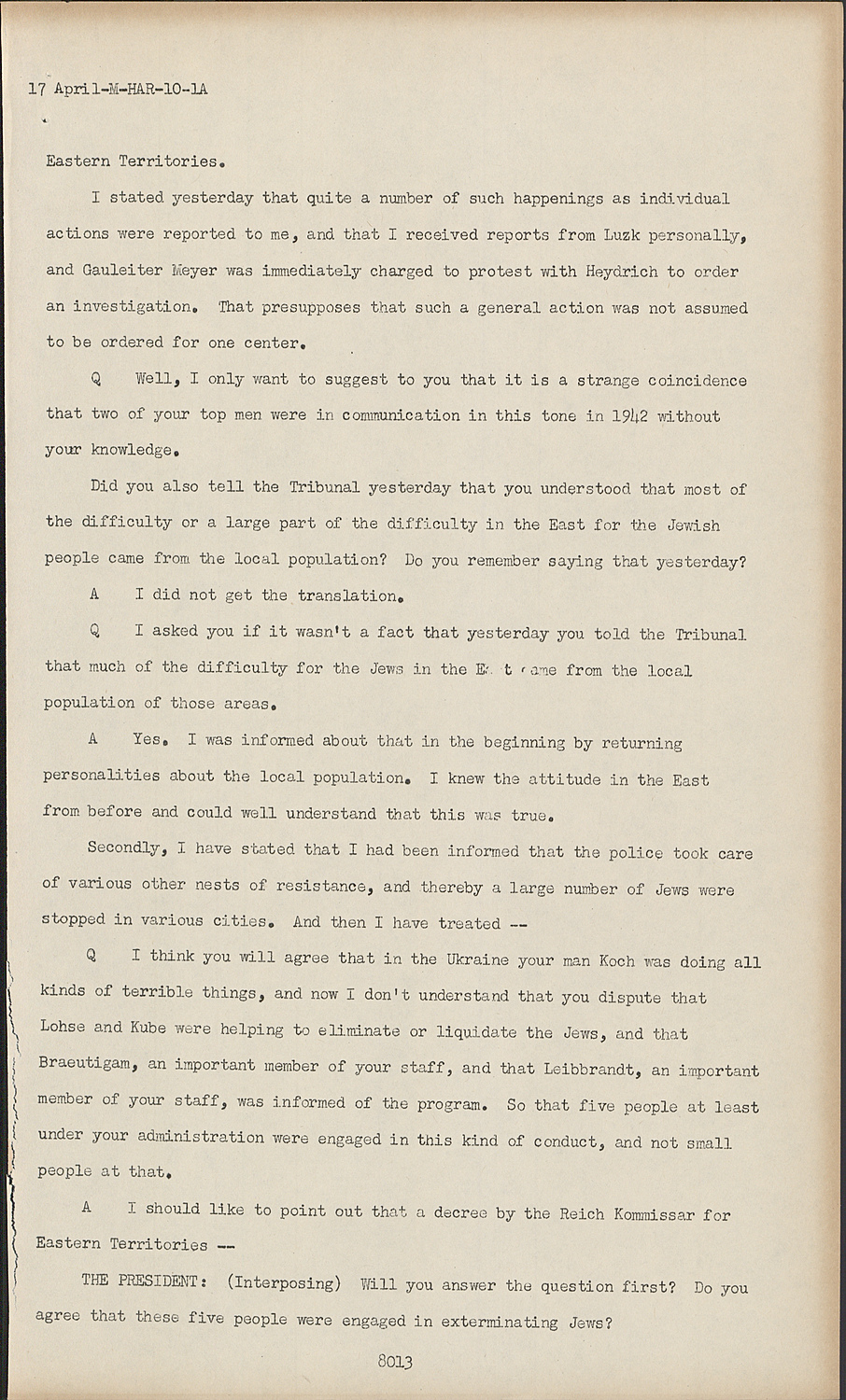
I stated yesterday that quite a number of such happenings as individual actions were reported to me, and that I received reports from Luzk personally, and Gauleiter Meyer was immediately charged to protest with Heydrich to order an investigation.
That presupposes that such a general action was not assumed to be ordered for one center.
QWell, I only want to suggest to you that it is a strange coincidence that two of your top men were in communication in this tone in 1942 without your knowledge.
Did you also tell the Tribunal yesterday that you understood that most of the difficulty or a large part of the difficulty in the East for the Jewish people came from the local population?
Do you remember saying that yesterday?
AI did not get the translation.
QI asked you if it wasn't a fact that yesterday you told the Tribunal that much of the difficulty for the Jews in the East came from the local population of those areas.
AYes. I was informed about that in the beginning by returning personalities about the local population.
I knew the attitude in the East from before and could well understand that this was true.
Secondly, I have stated that I had been informed that the police took care of various other nests of resistance, and thereby a large number of Jews were stopped in various cities.
And then I have treated -
QI think you will agree that in the Ukraine your man Koch was doing all kinds of terrible things, and now I don't understand that you dispute that Lohse and Kube were helping to eliminate or liquidate the Jews, and that Braeutigam, an important member of your staff, and that Leibbrandt, an important member of your staff, was informed of the program.
So that five people at least under your administration were engaged in this kind of conduct, and not small people at that.
AI should like to point out that a decree by the Reich Kommissar for Eastern Territories -
THEPRESIDENT: (Interposing) Will you answer the question first? Do you agree that these five people were engaged in exterminating Jews?
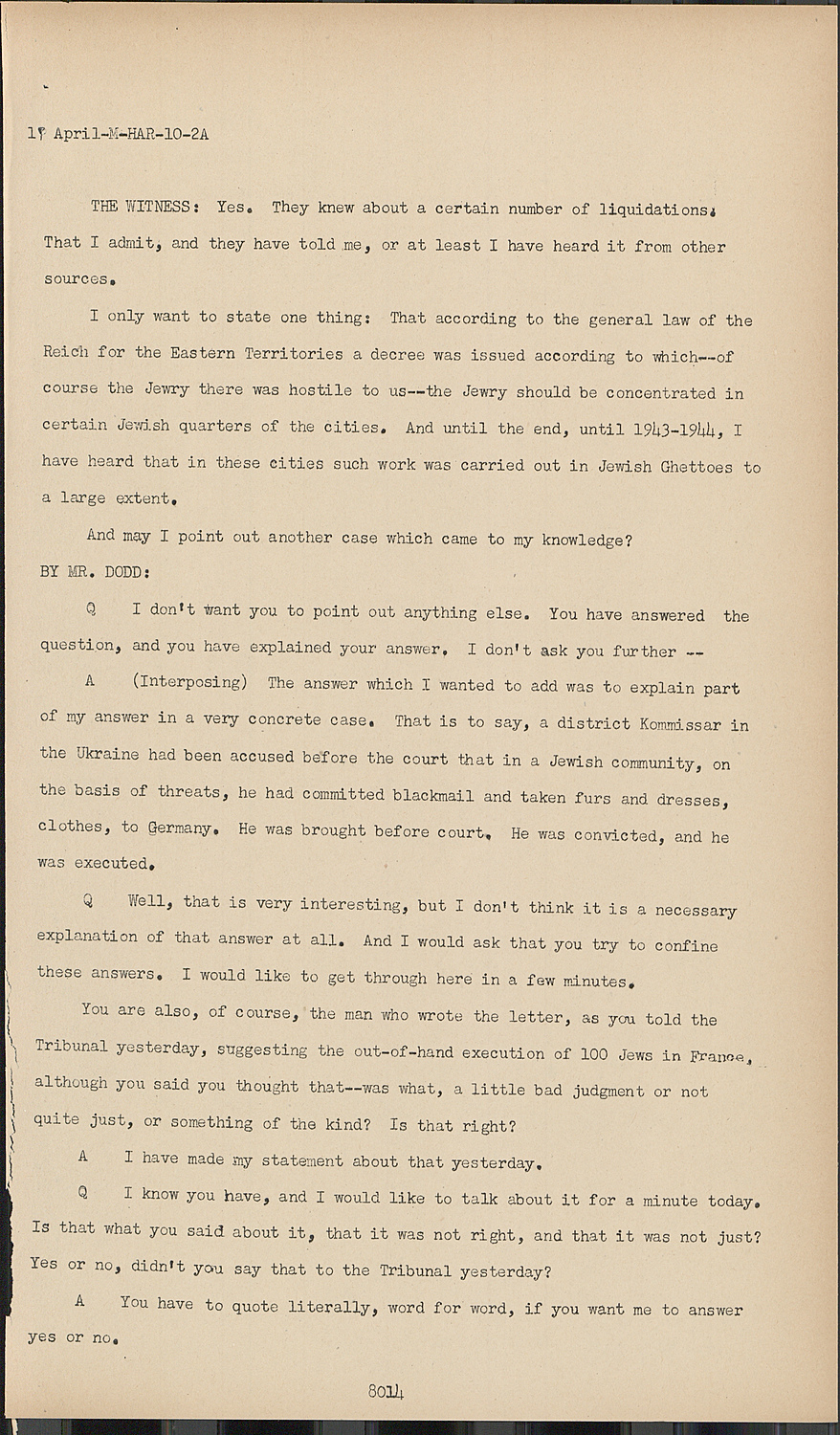
THE WITNESS: Yes. They knew about a certain number of liquidations.
That I admit, and they have told me, or at least I have heard it from other sources.
I only want to state one thing: That according to the general law of the Reich for the Eastern Territories a decree was issued according to which--of course the Jewry there was hostile to us--the Jewry should be concentrated in certain Jewish quarters of the cities.
And until the end, until 1943-1944, I have heard that in these cities such work was carried out in Jewish Ghettoes to a large extent.
And may I point out another case which came to my knowledge?
BY MR. DODD:
QI don't want you to point out anything else. You have answered the question, and you have explained your answer.
I don't ask you further -
A (Interposing) The answer which I wanted to add was to explain part of my answer in a very concrete case.
That is to say, a district Kommissar in the Ukraine had been accused before the court that in a Jewish community, on the basis of threats, he had committed blackmail and taken furs and dresses, clothes, to Germany.
He was brought before court. He was convicted, and he was executed.
QWell, that is very interesting, but I don't think it is a necessary explanation of that answer at all.
And I would ask that you try to confine these answers.
I would like to get through here in a few minutes.
You are also, of course, the man who wrote the letter, as you told the Tribunal yesterday, suggesting the out-of-hand execution of 100 Jews in Frame, although you said you thought that--was what, a little bad judgment or not quite just, or something of the kind?
Is that right?
AI have made my statement about that yesterday.
QI know you have, and I would like to talk about it for a minute today.
Is that what you said about it, that it was not right, and that it was not just?
Yes or no, didn't you say that to the Tribunal yesterday?
AYou have to quote literally, word for word, if you want me to answer yes or no.
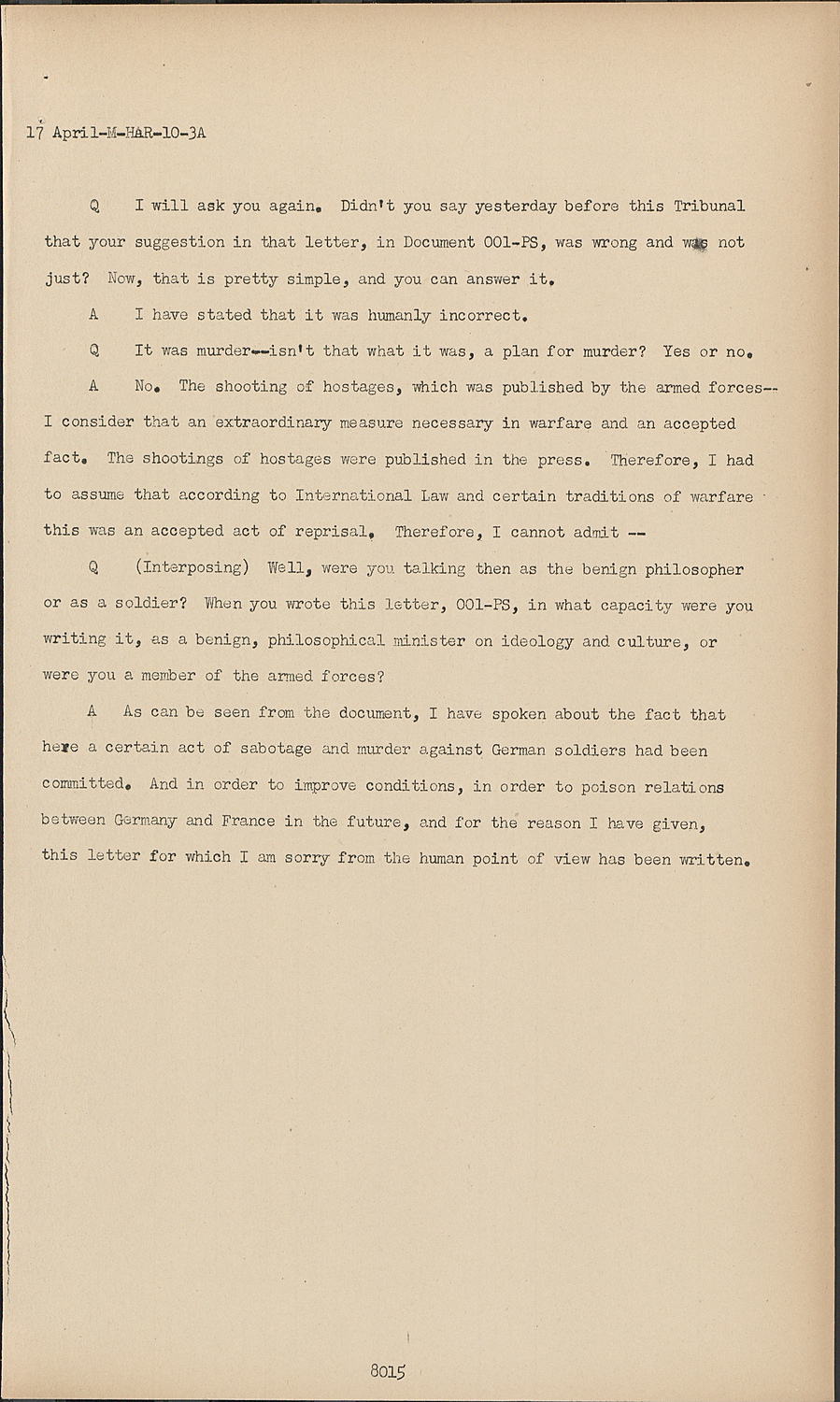
Q I will ask you again. Didn't you say yesterday before this Tribunal that your suggestion in that letter, in Document 001-PS, was wrong and was not just?
Now, that is pretty simple, and you can answer it.
AI have stated that it was humanly incorrect.
QIt was murder--isn't that what it was, a plan for murder? Yes or no.
ANo. The shooting of hostages, which was published by the armed forces-
I consider that an extraordinary measure necessary in warfare and an accepted fact.
The shootings of hostages were published in the press. Therefore, I had to assume that according to International Law and certain traditions of warfare this was an accepted act of reprisal.
Therefore, I cannot admit -
Q (Interposing) Well, were you talking then as the benign philosopher or as a soldier?
When you wrote this letter, 001-PS, in what capacity were you writing it, as a benign, philosophical minister on ideology and culture, or were you a member of the armed forces?
AAs can be seen from the document, I have spoken about the fact that here a certain act of sabotage and murder against German soldiers had been committed.
And in order to improve conditions, in order to poison relations between Germany and France in the future, and for the reason I have given, this letter for which I am sorry from the human point of view has been written.
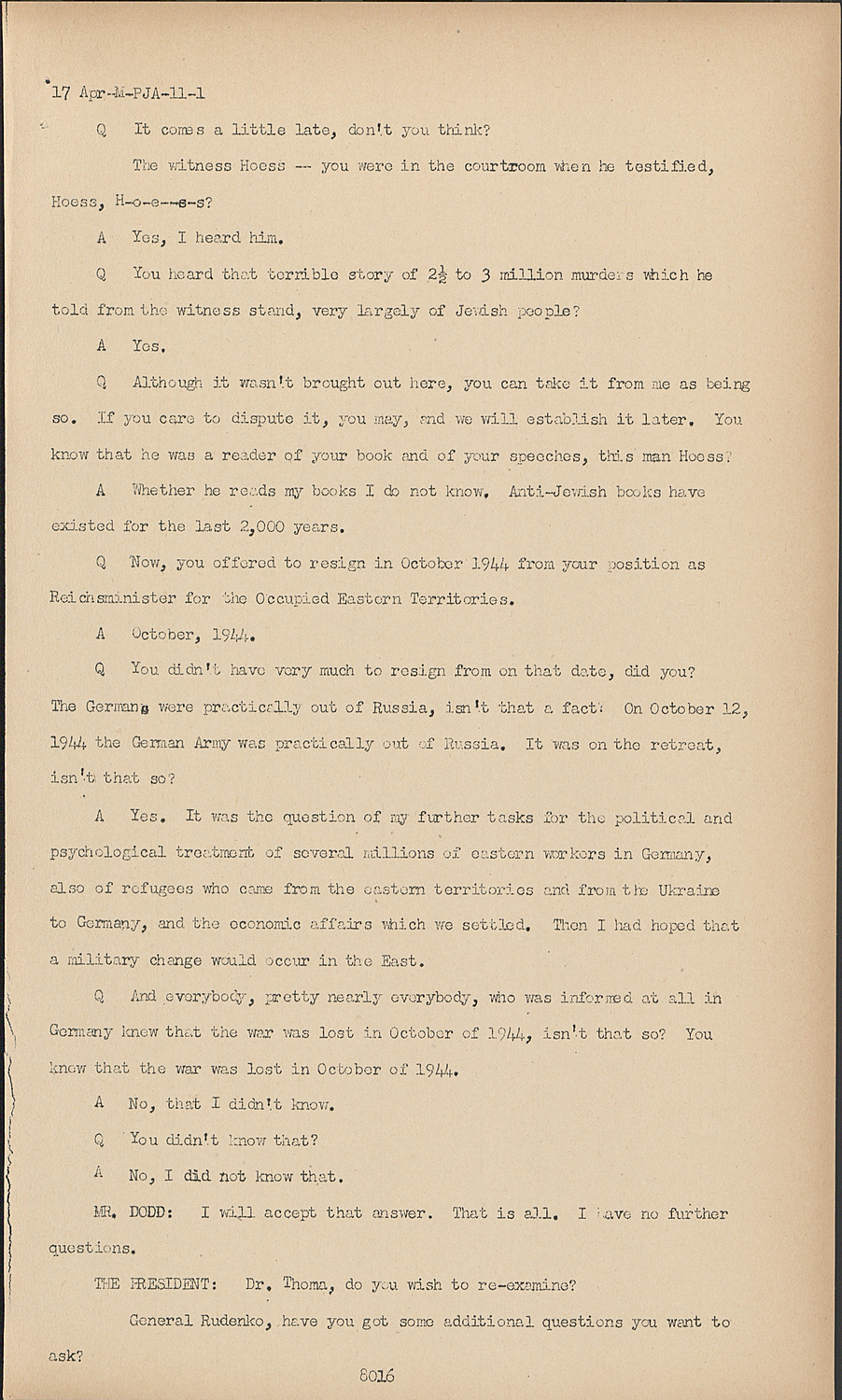
Q It comes a little late, don't you think?
The witness Hoess -- you were in the courtroom when he testified, Hoess, H-o-e--s-s?
AYes, I heard him.
QYou heard that terrible story of 2 1/2 to 3 million murders which he told from the witness stand, very largely of Jewish people?
AYes.
QAlthough it wasn't brought out here, you can take it from me as being so. If you care to dispute it, you may, and we will establish it later. You know that he was a reader of your book and of your speeches, this man Hoess?
AWhether he reads my books I do not know, Anti-Jewish books have existed for the last 2,000 years.
QNow, you offered to resign in October 1944 from your position as Reichsminister for the Occupied Eastern Territories.
AOctober, 1944.
QYou didn't have very much to resign from on that date, did you? The Germans were practically out of Russia, isn't that a fact. On October 12, 1944 the German Army was practically out of Russia. It was on the retreat, isn't that so?
AYes. It was the question of my further tasks for the political and psychological treatment of several millions of eastern workers in Germany, also of refugees who came from the eastern territories and from the Ukraine to Germany, and the economic affairs which we settled. Then I had hoped that a military change would occur in the East.
QAnd everybody, pretty nearly everybody, who was informed at all in Germany knew that the war was lost in October of 1944, isn't that so? You know that the war was lost in October of 1944.
ANo, that I didn't know.
QYou didn't know that?
ANo, I did not know that.
MR. DODD:I will accept that answer. That is all. I have no further questions.
THE PRESIDENT:Dr. Thoma, do you wish to re-examine?
General Rudenko, have you got some additional questions you want to ask?
GENERAL RUDENKO: I have a few questions in connection with the activities which were carried on in the eastern territories.
THE PRESIDENT:Very well, General. BY GENERAL RUDENKO:
QDefendant Rosenberg, at what time did you begin personally to take part in the attack on the Soviet Union?
ANot at all.
QWas not your occupation of the post of plenipotentiary of the Fuehrer on questions concerning the Eastern Occupied Territories on the 20th of February in 1941 connected with the attack by Germany on the Soviet Union A That was no planning in which I took part, but the consequences of a decision which had already been made, in the deliberations on which I had not been called. A decision had been made and military orders had been given.
If I were to answer the question with yes or no, I would have to answer this, on the basis of the question, with no.
QYou don't deny the fact that this took place in April 1941?
ANo, of course not. That is evident.
QWith this nomination, Hitler gave you very wide powers. You carried out collaboration and liaison with the highest leading Nazi authorities, took care of the information, and called the meetings of the Reich authorities. In particular, you collaborated with Goering, with the Minister of Economics, and with Keitel. Please tell me briefly, yes or no.
AThere are, again, three questions. As to the first question, whether I had wide powers, plenipotentiary powers, I did not receive plenipotentiary powers at all. The answer would be no.
To the second question, whether I had confidences, the answer is yes, of course. I conferred with the highest authorities of the Reich who were concerned with the East, such as was my duty in connection with my task.
QPlease reply briefly to the following question: After your nomination on the 20th of April 1941, did you have a conference with the Chief of the OKW?
AYes, I visited Field Marshal Keitel.
QDid you have a conversation with Brauchitsch and Raeder in connection with your nomination, regarding the decisions to be taken in connection with the Eastern problem?
AAccording to my recollection I did not speak to Brauchitsch, and I also have no recollection of having had any conversation with Raeder.
QYou didn't have. Did you have a conference with the defendant Funk who nominated Dr. Schlotterer as permanent representative?
A The then Reichsminister Funk, of course, wasinformed, and he named for purposes of liaison Dr. Schlotterer.
QYou had some conversations with General Thomas, State Secretary Koerner, State Secretary Backe, and Ministerial Director Riecke regarding the economic exploitation of the Eastern Territories?
AI do not believe that I spoke to Thomas, and I met the other gentlemen later, one by one, and I had liaison with the Ministry for the East. I met Backe later several times. Of course, that was a matter of course. I don't know whether I ever met General Thomas personally.
QVery well. Then I should like to submit a document in which you yourself stated that you had conversations with the Minister of Foreign Affairs, as a result of which Ribbentrop nominated Grosskopf for permanent liaison with your machinery, and a representative of the political section. Is that correct?
AYes, that is correct, because the Foreign Minister was informed briefly and appointed the Consul General.
QDid you receive the responsible representatives of propaganda, Fritsche, Schnitze, Klausse and others?
AYes, that may have been so. I met most of these gentlemen for the first time then, and it was a matter of course that I had to be informed about that task.
QYou led very detailed discussions with the Chief of Staff of the SA regarding your directives and nominating very important leaders of the SA for carrying them out.
AOf course I also spoke to the Chief of Staff of the SA concerning able assistance in the event of an occupation of the Eastern territories.
QYes. I deduce in connection with that that you won't deny that you were the coordinating center regarding the preparation of measures connected with the attack on the USSR.
ANot in that form, because all the tasks concerning the conflict with the Soviet Union were military. They were prepared by Keitel in the military field, by Goering in the economic field, whereas I had a political liaison office in order to tackle the political problems of the East, to discuss them and to make my suggestions about the eventual political administration to the various offices, and to direct that policy.
I did that essentially in the same sense as you can find it in my speech of the 20th of June.
QVery well. In the one and a half months before the treacherous attack by Germany on the Soviet Union, you prepared certain instructions for all Reich Commissars in the Occupied Eastern Territories. You won't deny that.
AI mentioned that yesterday. In the line of duty some preparatory drafts were worked out by myself and my assistants. These drafts which have been presented to me were not sent out in that same form.
QI shall return to this question later.
In the report which you submitted to Hitler on the 20th of June 1941 regarding the preparatory measures referring to questions on the administrate, of the Eastern Territories, you said that you had a conversation with Admiral Canaris during which you asked Canaris, in the interests of counterintelligence, to choose certain people who, while working in the counterintelligence, could also represent Germany politically and take political posts.
Do you agree with that?
ANo, that is not correct. I heard that Admiral Canaris had organized a certain group of Ukrainians for sabotage and allied purposes. He visited me once and I asked him not to mix in the political work, that is, the preparatory work, and he assured me he wouldn't.
QYou don't deny your meeting Admiral Canaris and the conversation in which you asked him, in the interests of intelligence, to select certain people. Do you deny that?
ANo -- yes, I deny that, but I do not deny that of course, if Canaris had important political reports it was correct if he informed me about it. I had no counter-intelligence organization or espionage organization during these years.
QWell, we are going to submit this document to you.
GENERAL RUDENKO: Mr. President, perhaps we can declare a recess now, because I will have a series of questions to put to the defendant.
THE PRESIDENT:Very well.
(A recess was taken until 1400 hours.)
Official transcript of the International Military Tribunal in the matter of The United States of America, the French Republic, the United Kingdom, of Great Britain and Northern Ireland, and the Union of Soviet Socialist Republics, against Hermann Wilhelm Goering, et al, Defendants, sitting at Nurnberg, Germany, on 17 April 1946, 1400-1700, Lord Justice Lawrence presiding.
ALFRED ROSENBERG--Resumed CROSS-Examination--Continued
THE PRESIDENT:The Tribunal will adjourn the herring of this case at 4 o'clock, in order to hear supplementary applications for witnesses and documents. The Tribunal hopes, therefore, that we may be able to conclude the case of the defendant Rosenberg before that. I mean, to conclude the case of the defendant Rosenberg, including his only other witness. BY GENERAL RUDENKO:
QDefendant Rosenberg, you replied to me that the conversation with Admiral Canaris did not take place.
AOn the contrary.
QThen maybe this was wrongly translated.
AProbably.
QI asked you whether you asked Canaris, in the interests of the counter-espionage service, to nominate persons who were working in his counter-espionage service, who would be able to work simultaneously as political workers.
AYes.
QWas that the subject of your conversation?
AThat is not correct.
QThat is not right? All right. Let's not go into that in detail.
I want to show you document, and I will read this part into the record.
GENERAL RUDENKO:I mean gentlemen of the Tribunal, document 1039-PS, on page 2; the part is underlined.
Q (Continuing) This is a report on the preliminary work concerning the organization of the Territory of Eastern Europe.
I read:
"A talk took place with Admiral Canaris, during which we agreed that persons of my office would in no wry outer into contact with representatives of the peoples of Eastern Europe. I asked him; in the interests of the counter-espionage work, to name persons who, whilst working as agents of the counterespionage service, could simultaneously be able to stand forward as political workers, in order that they be utilized in this way in the future.
"Admiral Canaris said that of course he would take my request into consideration and would not recognize any political groups among the immigrants, and that he intended to act in the spirit of my statements."
A. That is in accord with what I said.
THE PRESIDENT:General, I think you are going a little too fast.
Q.All right. I understand. I ask you, do you confirm this quotation?
A.Yes, in the German verbatim but not in the Russian translation. I understand Russian also and can determine that the interpretation is not entirely correct. For it says here that I, in connection with this confidential relationship, could not negotiate with other countries for a perhaps later collaboration in a civil administration, and point 2 was that Admiral Canaris had contacted groups of Ukraine or Russian people and that I was asking him beyond counter-intelligence, that is, not to do espionage work for me or that I wanted to do espionage work, that he perhaps would tell me about people whom I could use later in a civil administration -- people of other countries. That was the sense of this conversation. And at the end he agreed that he, of his own accord, did not carry out political work.
Q.Defendant, this is absolutely not different from the Russian text. What you just told us now means the same in Russian.
A.The German into the Russian interpretation must have been that. I can only recognize the text that I have in front of me not any translation which is not in accord with the sense that I mentioned here. The text is being interpreted as though I were trying to carry on espionage work. I only asked Canaris, since I could not carry on political negotiations with the eastern people, to tell me about beyond and above his official capacity what people of the eastern regions, under certain circumstances, might work in the civil administration for me. That was the sense. The translation is not entirely correct.
Q.Very well. But you confirm the German text?
A.Yes.
Q.It means you were connected with counter-espionage?
A.No, that is not correct. I only received Admiral Canaris and told him that in his official capacity which he had to carry out not to deal with political plans, for that was my sphere.
Q.All right; very well. You heard the warning of the President of the Tribunal to answer briefly, and I beg you to do so.
A.I will try to answer briefly if the question is put to me factually.
Q.Next question: I will put to you several questions concerning the aims of the war against the Soviet Union. Do you admit that Nazi Germany, having prepared and pursued war against the Soviet Union, aimed at plundering the economic riches of the Soviet Union, exterminating the people, sending them into slavery, and the dislocation of the Soviet Union? Do you admit this or not?
A.As far as questions are being put to me at one time -
Q.I ask you: Please answer briefly. Do you admit the aims of the aggression as I have put them to you?
THE PRESIDENT:You can answer that question yes or no.
A.I must answer no to all four questions.
Q.All right. Let's turn to a few documents in this connection. I have document 2718-PS, which is an account of a meeting, and a memorandum dated the 2nd of May, 1942.
(A document is handed to the witness.)
Will you please follow? This document reads as follows:
"War will last if all armed forces, after three years of war, shall be supplied --"
THE PRESIDENT:Is that the beginning of the document?
GENERAL RUDENKO:Yes. We have an English text here.
THE PRESIDENT:My copy begins "as already announced, there are transmitted the reply letter of Hitler to the Duce in the presence of Ciano at 0910 hours." Is that the document?
GENERAL RUDENKO:I do not hear the translation.
THE PRESIDENT:What is the number of the document?
GENERAL RUDENKO: 2718-PS.
THE PRESIDENT:I have the wrong document. BY GENERAL RUDENKO:
Q.Will you please follow: "War can last if all armed forces, after three years of war, will be supplied with foodstuffs from Russia. There is no doubt but that as a result many millions of people will die from hunger if we take out of this country everything that we need."
Do you deny that?
A.Neither did I write this nor did I participate in these sessions, and I cannot determine whether anyone of my collaborators know anything about this meeting. It says at the top that it was a secret matter, two copies, first to the files 1-A, and the second to GEN. Two people in the armed forces knew about this.
Q.Do not go into that in detail. You do not knew about this?
A.This document has been submitted twice already.
Q.Take the next one. Let's go on to the next one.
THE PRESIDENT:The question was whether you knew of this document.
A.No.
Q.Next document, which determines the aims of the war. This is an instruction to the cive-commissars of the Baltic countries and of Byelorussia. You state the following. I am reading now document 1029-PS. The part which I will read is marked on the m argin:
"The task of the Reich plenipotentiary for Latvia, Estonia, Lithuania, and Byelorussia must be the creation of a German protectorate, in view of later transforming these regions into a fundamental part, and an organic part, of the great German empire, by germanizing of those elements, the colonization by a percentage of the German race, and extermination of undesirable elements." Do you remember this instruction? Please reply first.
A.Yes, I am familiar with this document. I remarked already yesterday that at the beginning all sorts of drafts were made in my office which were not approved by me. The corrections were made by me.
Q.I asked you very clearly, do you know this instruction or not?
A.But I also heard the wrong translation. Nothing is mentioned about destruction, but colonization is, and the Russian interpretation again said destruction. If it is interpreted and translated that way then the question appeared in the Russian translation as an affirmation, and that is a wrong translation which is being given out which I can follow only because I speak Russian.
THE PRESIDENT:Defendant, you can be heard perfectly well without shouting.
THE WITNESS:I beg your pardon.
Q.You are only correcting an error in the translation, but as regards the rest -- germanization and colonization -- is that right? Does that sound right or not?
A.Even as that it is not translated correctly. Here it says colonization of German peoples, and now you are translating germanization and colonization. These are two substantives which give an entirely different context, and I would like to add that this draft by a collaborator of mine was not actually issued and no instructions are concerned with here.
Q.But I asked you, was there such a draft or was there not such a draft
A.I am not disputing the existence of that draft in my office and its submission to my office.
Q.All right. We pass on. This instruction concerns the aims of the war. It is an instruction for all Reich commissars of the occupied territories of the cast, dated 8th of May, 1941. This is document 1030-PS. I will only read a short excerpt, which states -- I quote on page 4. This excerpt is marked on the margin. In this instruction you stated that this coming struggle would be a struggle for the supplying of Germany from all Europe with raw materials and foodstuffs. Do you confirm this?
A Yes; as a matter of course, this document was presented in my office as a draft.
That is correct and I am not disputing that.
QI will remind you again, please reply briefly. You confirmed this point and you answered yes.
AThis document, yes.
QAll right. This statement was made before the attack upon the Soviet Union. I will not submit the document to you as it has already been presented to the Tribunal several times -- I mean a conference which took place in Hitler s office on the 19th of June 1941. This is document L-2021. You assisted or were present at this conference, were you?
AYes.
QHitler said that all the Baltic States would have to be an integral part of the Reich and the same referred to the Crimea, and maybe regions as well as the Volga Districts and also Baku area. Do you recall these statements of Hitler?
AI am just seeing this document for the first time, as a copy of Bormann's; at that time, the Fuehrer explained fundamentally with explanations of a rather pationate nature. I did not take any note of that conference but, of course, he did speak about the Crimea and he mentioned that because of the tremendous power of the Soviet Union, later, no bearers of arms should be there.
QI do not ask why. I ask you, did he say that?
THE PRESIDENT:General Rudenko, you are going to fast. You must wait until the man is finished.
GENERAL RUDENKO:He is going into too many details, Mr. Presidents that is why I interrupted. BY GENERAL RUDENKO:
QYou agreed with Hitler's idea concerning the seizure of these territories.
AWe can see from the document, and you can see from my speech, how I pictured the self-determination of peoples in a new order of States and opposite and contrary to the exposition of the Fuehrer, I did speak.
QI am asking you whether you agreed with these proposals of Hitler or whether you objected to them.