APresumably the reason is that Mr. Funk was asked, in turn, to keep it very secret, and he passed on that wish.
QDid Mr. Funk tell you that he was asked to keep it secret?
ANo, I donot remember that,
QYou do not remember; I see. Did you not ask him why it should be kept secret, "absolutely secret", as you say? I do not know whether you want to keep that up, but you said "absolutely secret".
AYes, the decree of secrecy was to be applied here, and some such duty was to be imposed on the officials.
QBut you, as acting vice president, what did you say to that?
AI did not say anything because, if that had been arranged, then that wish would have to be complied with.
QBut you do not know whether it had been arranged? What do you know about that?
AI assume that it was arranged.
QYou consider it possible?
AYes.
QAnd so, to repeat this, these articles which did arrive you did not see at all?
ANo.
QVery probably you do not even know how much it was?
ANo, I do not know that either, and, as I said before, I never saw any accounts. It was not part of our business procedure, because not every single affair was put before a member of the Directorate.
QThe reason I am asking you, you see, is that the other day when this case was discussed, it was stated that whole carloads, whole truckloads of things were sent.
AWhole truckloads?
QYou are laughing even now. You will laugh a lot more when I tell you that 47 truck loads or railway ear loads of gold were discussed which were supposed to have arrived at your bank.
AWell, I never heard of this.
Q We will then leave this point itness, and come to the next point in your affidavit of 1 May.
I think you knew this SS Obergruppenfuehrer Phol, whom you mentioned a little earlier, in 1942, did you not?
AYes, but this occasion was the first opportunity for him to come to my office.
QThis is not meant to be an accusation. It is merely an ascertainment of fact. You knew him. Presumably, this was due to the first transaction regarding some credit which happened at some earlier time.
AYes, that may be so.
QDefendant Funk says, you see, that as far as he can remember the matter-and he did not attach any significance to it at the time -- as far as he can remember it, this is supposed to have happened along about 1940. That is to say, quite some time before the second transaction. Can that he true, approximately?
AI can neither deny nor confirm it. I do not know the date of that credit
QIn your affidavit you state, with reference to this credit, that the Reichsbank had opened a credit of 10,000,000 to 12,000,000 rm. for the SS, I believe to pay off some other credit which the SS had taken up with some other bank, and now you are saying that this credit had been taken up for the purpose of financing production of material in factories organized by theSS where workers from concentration camps were being employed.
Witness, I am not so much interested in the question of the granting of this credit as such, because that is part of your business asa bank and the figure of 10,000,000 to 12,000,000 rm, was not anything particularly unusual, but I am interested in this; How do you know that these monies were to be used for SS factories in which workers from concentration camps were working How did you know that?
AThe application for this credit came from the Economic Department of the SS. which has been mentioned earlier. This department was running a number of factories in Germany, and for that purpose they needed money. The Gold Discount Bank was prepared to give this credit, but only if the business procedure for credits were employed. In other words, the borrower would have to put a balance sheet before us, and at regular intervals he would have to report to us regarding production, his general financial state of affairs, and his plans for the future, in other words, everything that a debtor would have to inform his creditor about.
The head of the Gold Discount Bank was conducting the negotiations, and on that occasion, the representatives of the Economic Department who were submitting the balances, did, of course, ment on production, which --
QSlowly, please, witness.
A -- which was remarkable f om the point of view of balances because the wage account was comparatively low. She question would naturally arise, To what is this low figure for your wage account due?
The head, of the Gold Discount Bank during a board meeting reported about this.
QYou are always talking about the Gold Discount Bank. The Tribunal will no doubt be interested to know whether the Gold Discount Bank is identical with the Reichsbank and whether it was also under defendant Funk's jurisdiction?
AThe Gold Discount Bank is an institute founded in the beginning of the twenties. It was an auxiliary institute of the Reichsbank for certain different tasks: last but not least, promotion of exports and increase of production -- its capital structure.
QNo, we are not interested in that.
APractically all the shares were held by the Reichsbank and its management -- Gold Discount Bank had a board of directors headed by the president of the Reichsbank. It had a deputy president or chairman of the board of directors and there was he vice president of the Reichsbank and then there was a board of directors whore a number of members of the directorate of the Reichsbank were numbers but also the Secretary of State, Ministry of Economy and Minister of Finance.
THE PRESIDENT:It is not interesting to us to know what the exact directors of the Gold Discount Bank were. BY DR. SAUTER:
QWitness, I have tried to interrupt you earlier. I was going to tell you that what you have just told us isn't of any significance for this trial, The Tribunal is only interested in hearing whether the defendant Funk, as far as you can remember for contain, heard of those matters and did he know what the purpose of this credit was and did he know that in those factories people from concentration camps were employed; did he know of it and do youknow so for certain or don't you know at all?
AI might assume it but can't know. At any rate, it was known that the credit was to be used for those factories.
QWitness, I can't be quite satisfied with that answer because the SSsomething which you heard in the meantime -- had certain economic businesses where there weren't any concentration camp inmates employed; as far as I know, for instance, the china (?) factory at Allach. I don't think there were any concentration camp inmates working at that, and then the entire --
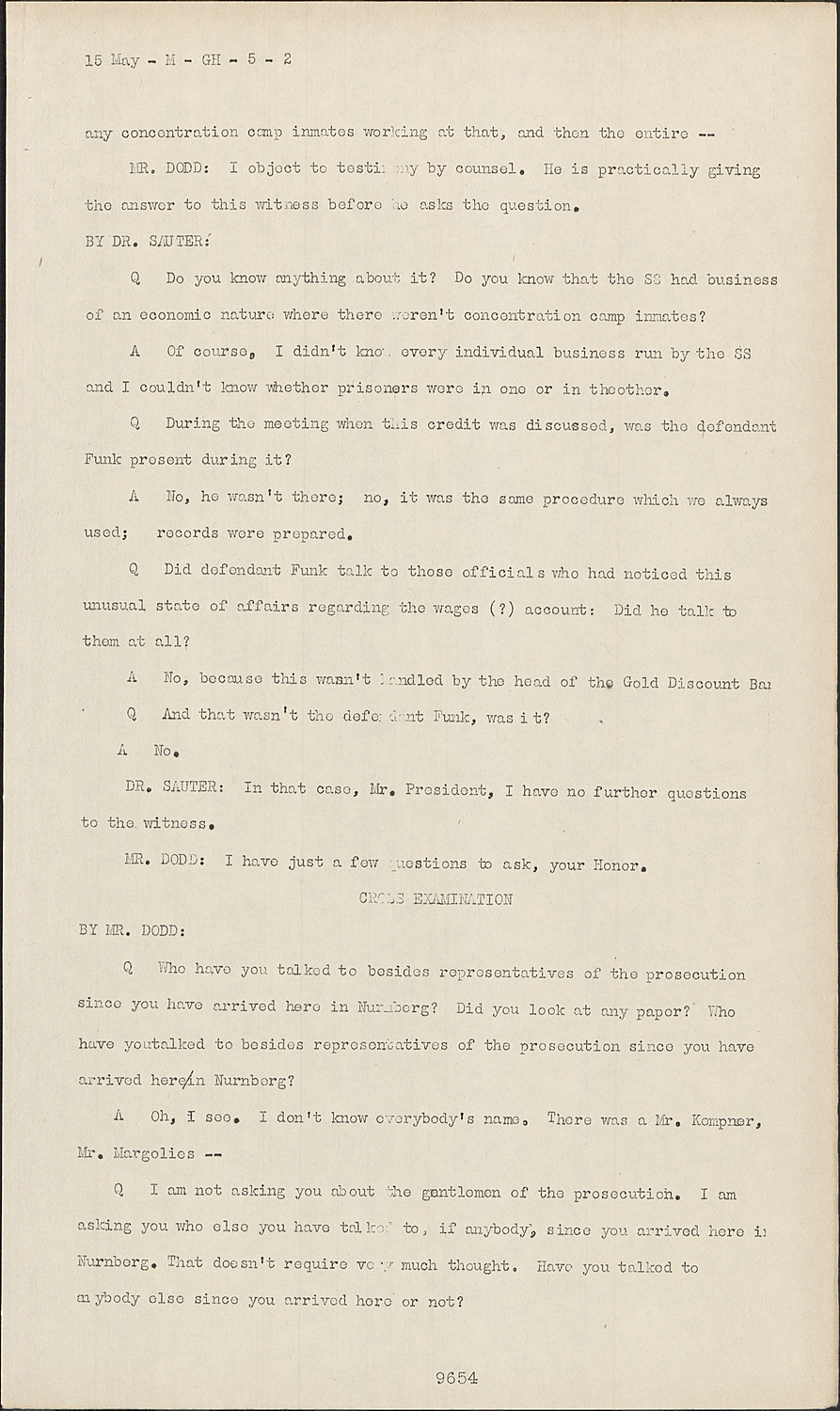
MR. DODD:I object to testimony by counsel. He is practically giving the answer to this witness before he asks the question. BY DR. SAUTER:
QDo you know anything about it? Do you know that the SS had business of an economic nature where there weren't concentration camp inmates?
AOf course. I didn't know every individual business run by the SS and I couldn't know whether prisoners were in one or in the other.
QDuring the meeting when this credit was discussed, was the defendant Funk present during it?
ANo, he wasn't there; no, it was the same procedure which we always used; records were prepared.
QDid defendant Funk talk to those officials who had noticed this unusual state of affairs regarding the wages (?) account: Did he talk to them at all?
ANo, because this wasn't handled by the head of the Gold Discount Bar
QAnd that wasn't the defendant Funk, was it?
ANo.
DR. SAUTER:In that case, Mr. President, I have no further questions to the witness.
MR. DODD:I have just a few questions to ask, your Honor.
CROSS EXAMINATION BY MR. DODD:
QWho have you talked to besides representatives of the prosecution since you have arrived here in Nurnberg? Did you look at any paper? Who have youtalked to besides representatives of the prosecution since you have arrived herein Nurnberg?
AOh, I see. I don't know everybody's name. There was a Mr. Kompner, Mr. Margolies -
QI am not asking you about the gentlemen of the prosecution. I am asking you who else you have talked to, if anybody, since you arrived here in Nurnberg. That doesn't require very much thought. Have you talked to anybody else since you arrived here or not?
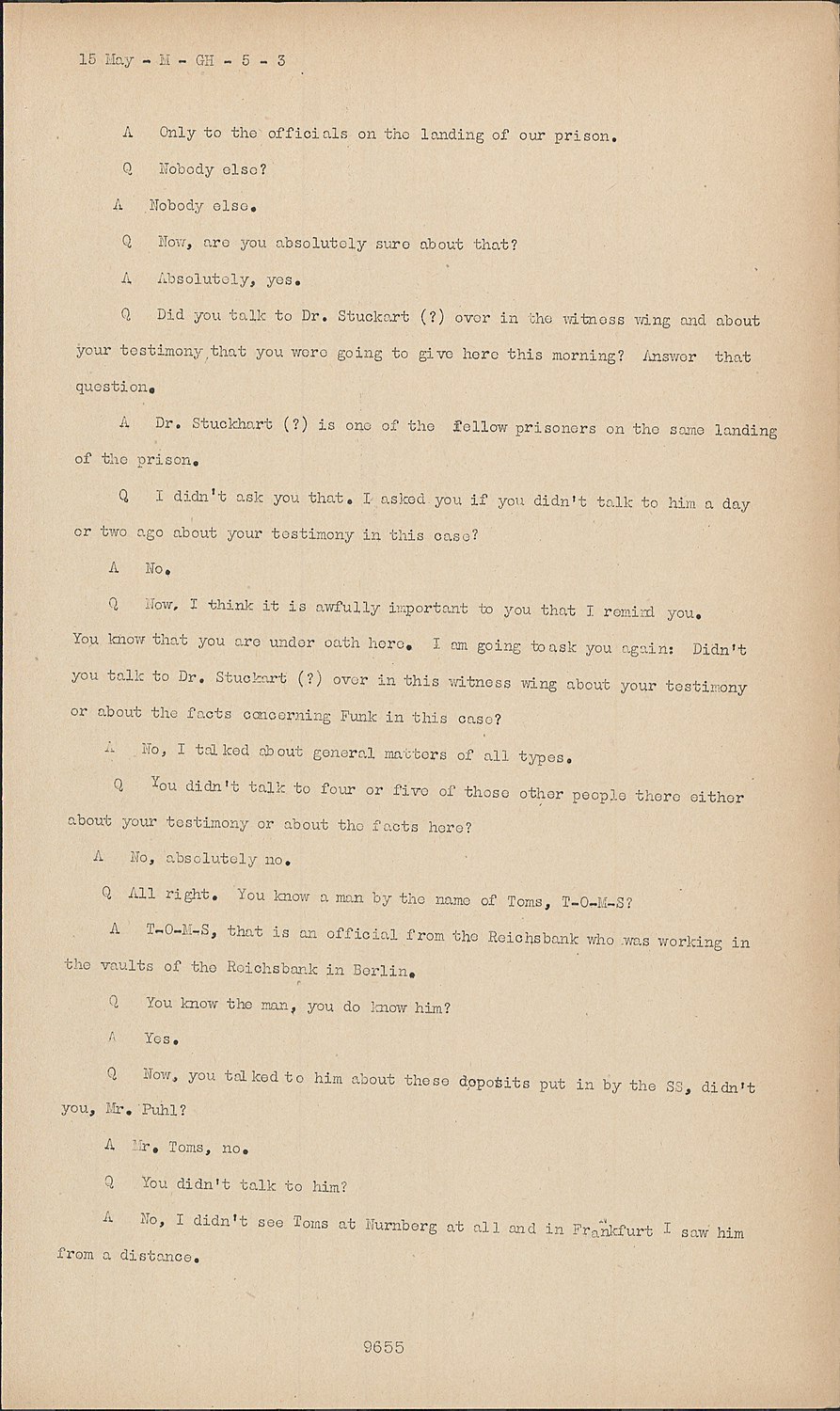
A Only to the officials on the landing of our prison.
QNobody else?
ANobody else.
QNow, are you absolutely sure about that?
AAbsolutely, yes.
QDid you talk to Dr. Stuckart (?) over in the witness wing and about your testimony that you were going to give here this morning? Answer that question.
ADr. Stuckhart (?) is one of the fellow prisoners on the same landing of the prison.
QI didn't ask you that. I asked you if you didn't talk to him a day or two ago about your testimony in this case?
ANo.
QNow, I think it is awfully important to you that I remind you. You know that you are under oath here. I am going to ask you again: Didn't you talk to Dr. Stuckart (?) over in this witness wing about your testimony or about the facts concerning Funk in this case?
ANo. I talked about general matters of all types.
QYou didn't talk to four or five of those other people there either about your testimony or about the facts here?
ANo, absolutely no.
QAll right. You know a man by the name of Toms, T-O-M-S?
AT-O-M-S, that is an official from the Reichsbank who was working in the vaults of the Reichsbank in Berlin.
QYou know the man, you do know him?
AYes.
QNow, you talked to him about these deposits put in by the SS, didn't you, Mr. Puhl?
AMr. Toms, no.
QYou didn't talk to him?
ANo, I didn't see Toms at Nurnberg at all and in Frankfurt I saw him from a distance.
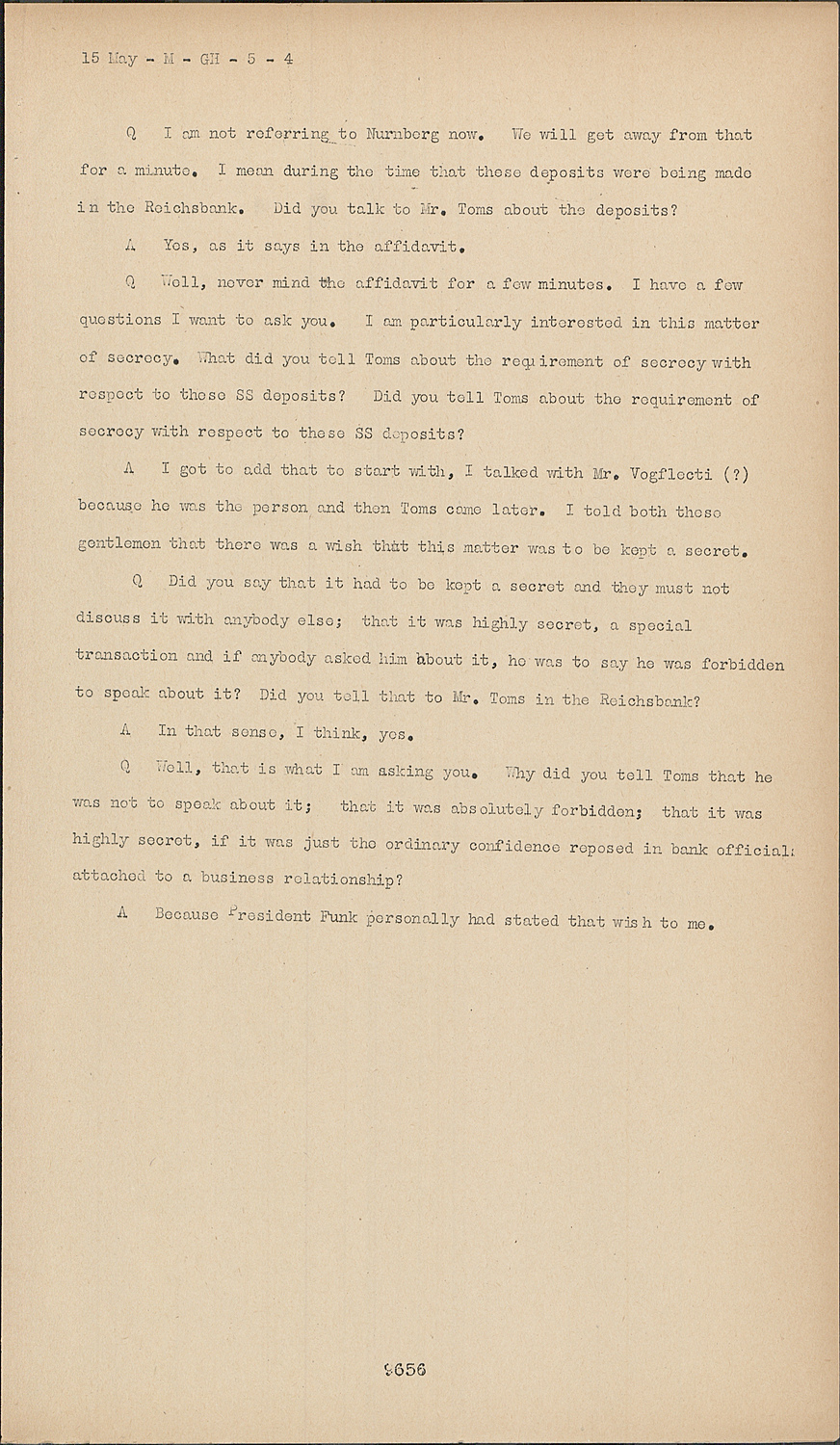
Q I am not referring to Nurnberg now. We will get away from that for a minute.
I mean during the time that these deposits were being made in the Reichsbank. Did you talk to Mr. Toms about the deposits?
AYes, as it says in the affidavit.
QWell, never mind the affidavit for a few minutes. I have a few questions I want to ask you. I am particularly interested in this matter of secrecy. What did you tell Toms about the requirement of secrecy with respect to those SS deposits? Did you tell Toms about the requirement of secrecy with respect to these SS deposits?
AI got to add that to start with, I talked with Mr. Vogflecti (?) because he was the person and then Toms come later. I told both these gentlemen that there was a wish that this matter was to be kept a secret.
QDid you say that it had to be kept a secret and they must not discuss it with anybody else; that it was highly secret, a special transaction and if anybody asked him about it, he was to say he was forbidden to speak about it? Did you tell that to Mr. Toms in the Reichsbank?
AIn that sense, I think, yes.
QWell, that is what I am asking you, Why did you tell Toms that he was not to speak about it; that it was absolutely forbidden; that it was highly secret, if it was just the ordinary confidence reposed in bank officials attached to a business relationship?
ABecause President Punk personally had stated that wish to me.
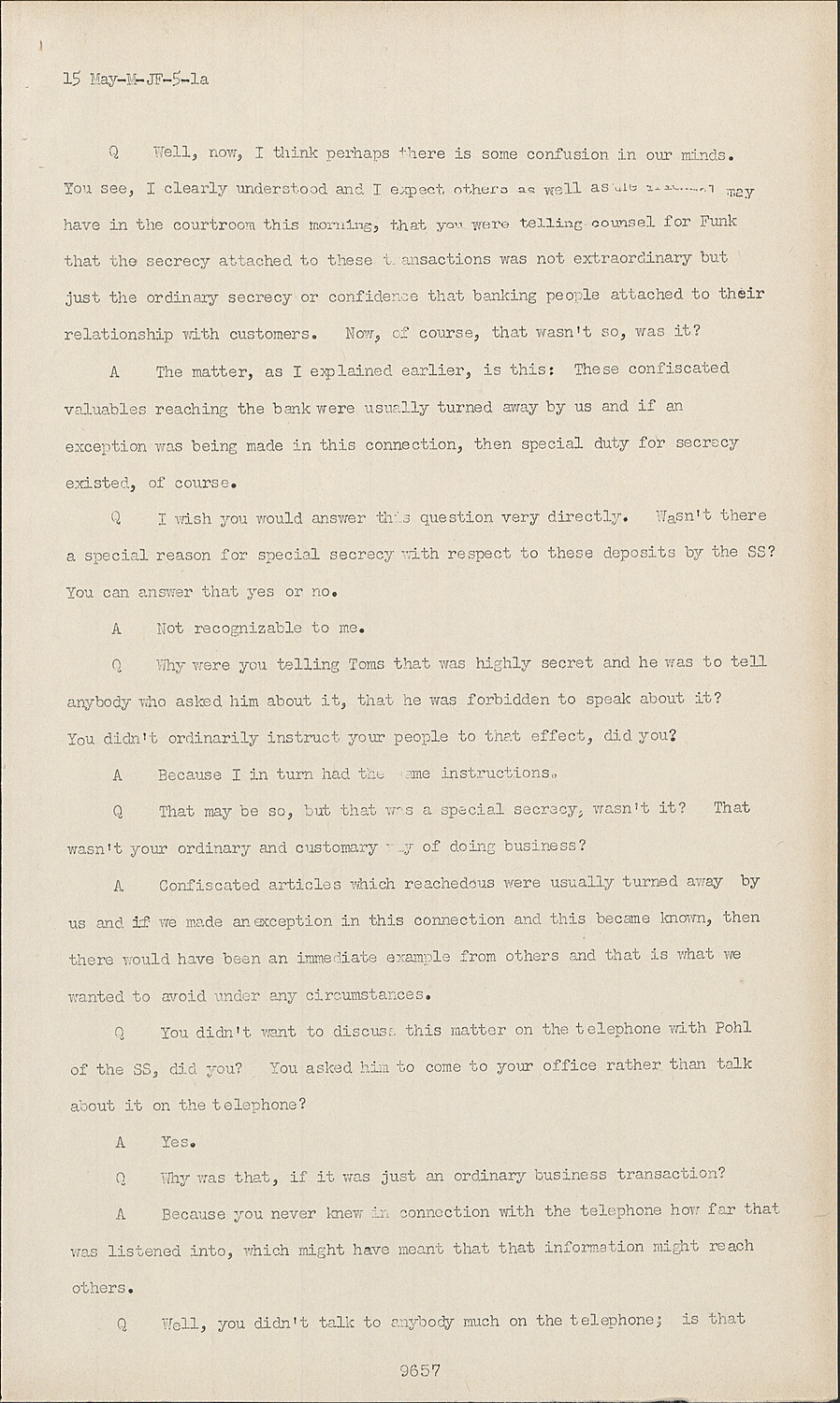
Q Well, now, I think perhaps there is some confusion in our minds.
You see, I clearly understood and I expect others as well are *---* may have in the courtroom this morning, that you were telling counsel for Funk that the secrecy attached to these transactions was not extraordinary but just the ordinary secrecy or confidence that banking people attached to their relationship with customers. Now, of course, that wasn't so, was it?
AThe matter, as I explained earlier, is this: These confiscated valuables reaching the bank were usually turned away by us and if an exception was being made in this connection, then special duty for secrecy existed, of course.
QI wish you would answer this question very directly. Wasn't there a special reason for special secrecy with respect to these deposits by the SS? You can answer that yes or no.
ANot recognizable to me.
QWhy were you telling Toms that was highly secret and he was to tell anybody who asked him about it, that he was forbidden to speak about it? You didn't ordinarily instruct your people to that effect, did you?
ABecause I in turn had the came instructions.
QThat may be so, but that was a special secrecy, wasn't it? That wasn't your ordinary and customary way of doing business?
AConfiscated articles which reachedous were usually turned away by us and if we made an exception in this connection and this became known, then there would have been an immediate example from others and that is what we wanted to avoid under any circumstances.
QYou didn't want to discuss this matter on the telephone with pohl of the SS, did you? You asked him to come to your office rather than talk about it on the telephone?
AYes.
QWhy was that, if it was just an ordinary business transaction?
ABecause you never knew in connection with the telephone how far that was listened into, which might have meant that that information might reach others.
QWell, you didn't talk to anybody much on the telephone; is that right?
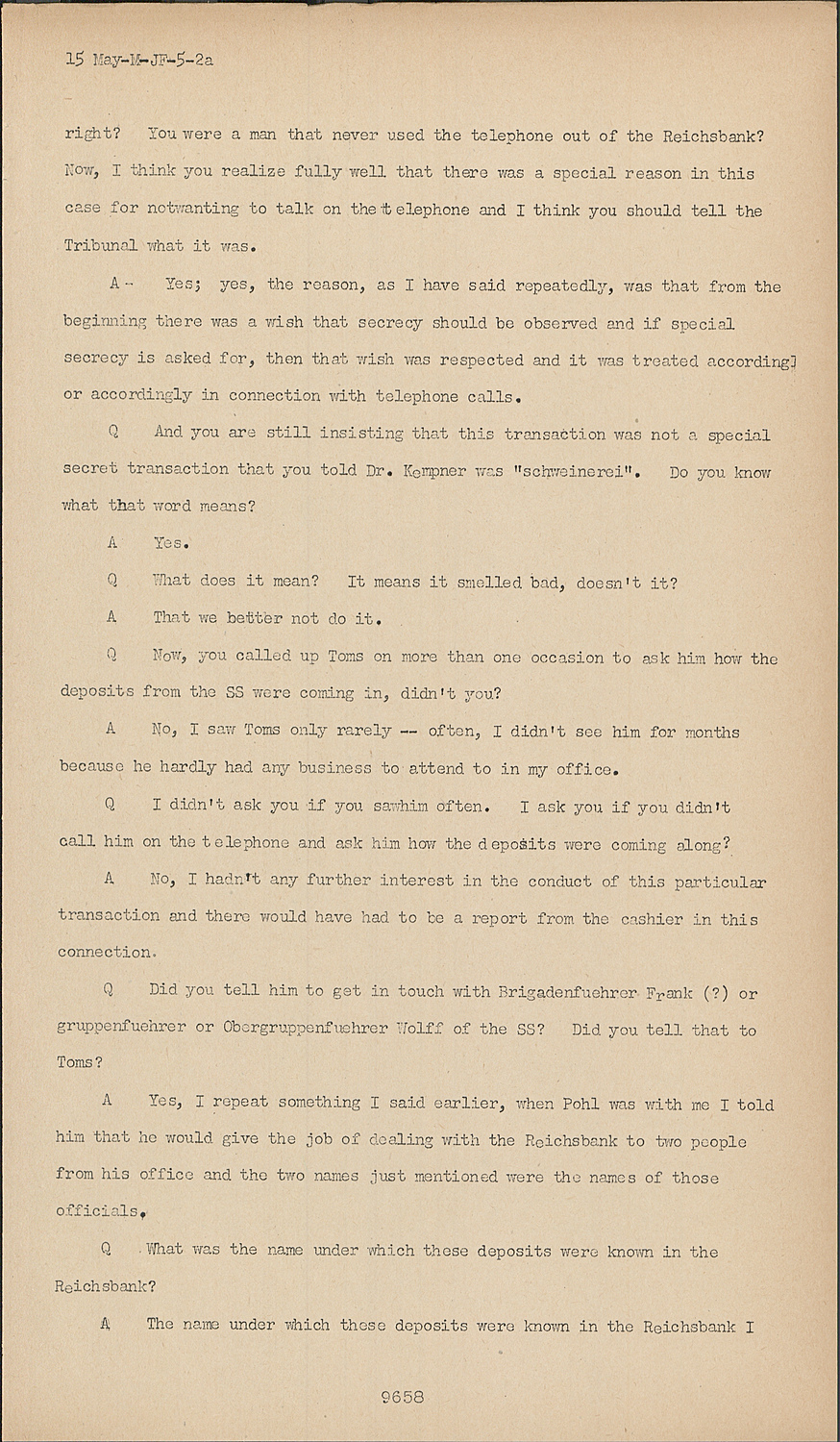
You were a man that never used the telephone out of the Reichsbank?
Now, I think you realize fully well that there was a special reason in this case for notwanting to talk on the telephone and I think you should tell the Tribunal what it was.
A- Yes; yes, the reason, as I have said repeatedly, was that from the beginning there was a wish that secrecy should be observed and if special secrecy is asked for, then that wish was respected and it was treated according] or accordingly in connection with telephone calls.
QAnd you are still insisting that this transaction was not a special secret transaction that you told Dr. Kempner was "schweinerei". Do you know what that word means?
AYes.
QWhat does it mean? It means it smelled bad, doesn't it?
AThat we better not do it.
QNow, you called up Toms on more than one occasion to ask him how the deposits from the SS were coming in, didn't you?
ANo, I saw Toms only rarely -- often, I didn't see him for months because he hardly had any business to attend to in my office.
QI didn't ask you if you sawhim often. I ask you if you didn't call him on the telephone and ask him how the deposits were coming along?
ANo, I hadn't, any further interest in the conduct of this particular transaction and there would have had to be a report from the cashier in this connection.
QDid you tell him to get in touch with Brigadenfuehrer Frank (?) or gruppenfuehrer or Obergruppenfuehrer Wolff of the SS? Did you tell that to Toms?
AYes, I repeat something I said earlier, when Pohl was with me I told him that he would give the job of dealing with the Reichsbank to tyro people from his office and the two names just mentioned were the names of those officials.
QWhat was the name under which these deposits were known in the Reichsbank?
AThe name under which these deposits were known in the Reichsbank I only heard from the files when I was in Frankfurt.
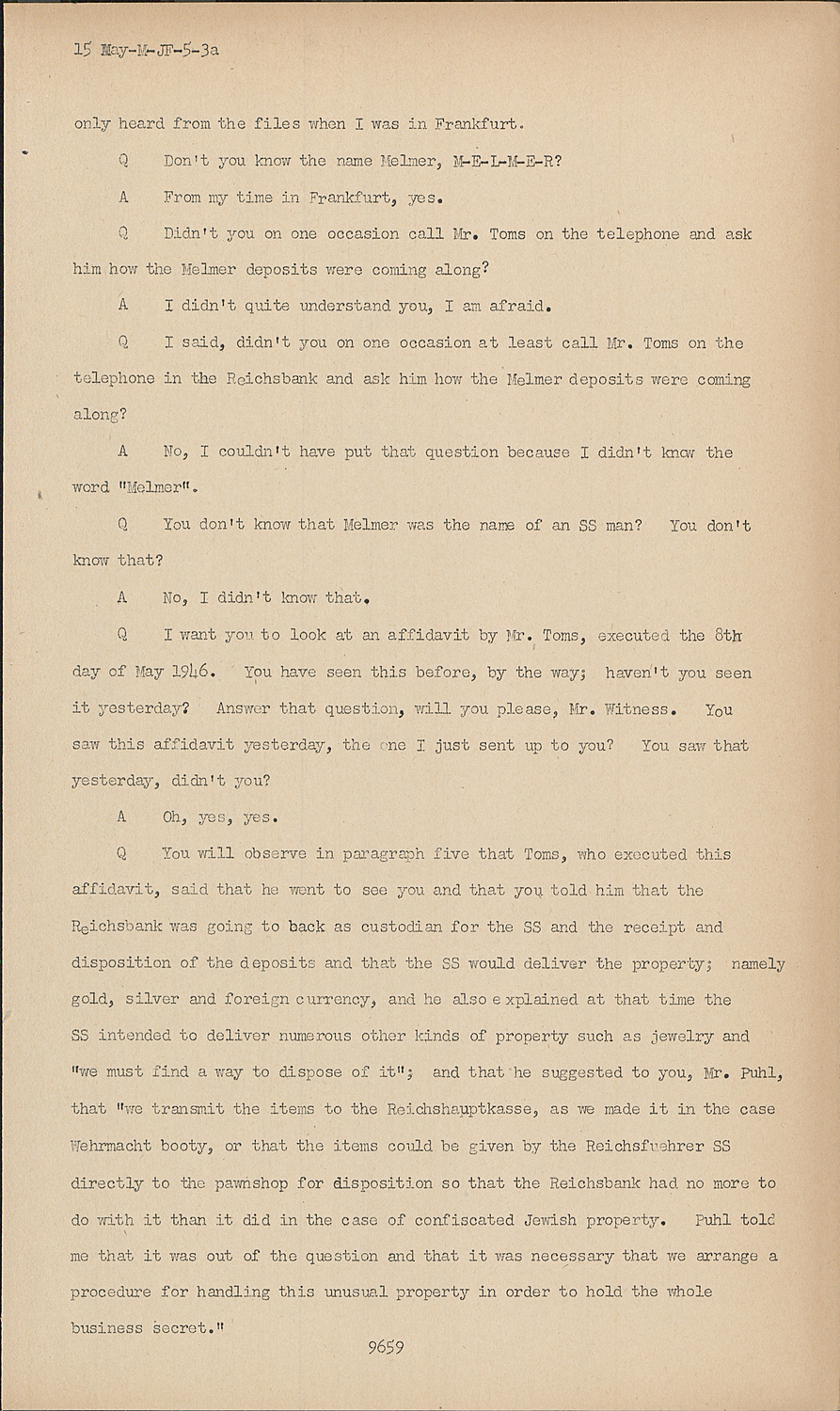
QDon't you know the name Melmer, M-E-L-M-E-R?
AFrom my time in Frankfurt, yes.
QDidn't you on one occasion call Mr. Toms on the telephone and ask him how the Melmer deposits were coming along?
AI didn't quite understand you, I am afraid.
QI said, didn't you on one occasion at least call Mr. Toms on the telephone in the Reichsbank and ask him how the Melmer deposits were coming along?
ANo, I couldn't have put that question because I didn't know the word "Melmer".
QYou don't know that Melmer was the name of an SS man? You don't know that?
ANo, I didn't know that.
QI want you to look at an affidavit by Mr. Toms, executed the 8th day of May 1946. You have seen this before, by the way; haven't you seen it yesterday? Answer that question, will you please, Mr. Witness. You saw this affidavit yesterday, the one I just sent up to you? You saw that yesterday, didn't you?
AOh, yes, yes.
QYou will observe in paragraph five that Toms, who executed this affidavit, said that he went to see you and that you told him that the Reichsbank was going to back as custodian for the SS and the receipt and disposition of the deposits and that the SS would deliver the property; namely gold, silver and foreign currency, and he also explained at that time the SS intended to deliver numerous other kinds of property such as jewelry and "we must find a way to dispose of it"; and that he suggested to you, Mr. Puhl, that "we transmit the items to the Reichshauptkasse, as we made it in the case Wehrmacht booty, or that the items could be given by the Reichsfuehrer SS directly to the pawnshop for disposition so that the Reichsbank had no more to do with it than it did in the case of confiscated Jewish property. Puhl told me that it was out of the question and that it was necessary that we arrange a procedure for handling this unusual property in order to hold the whole business secret."
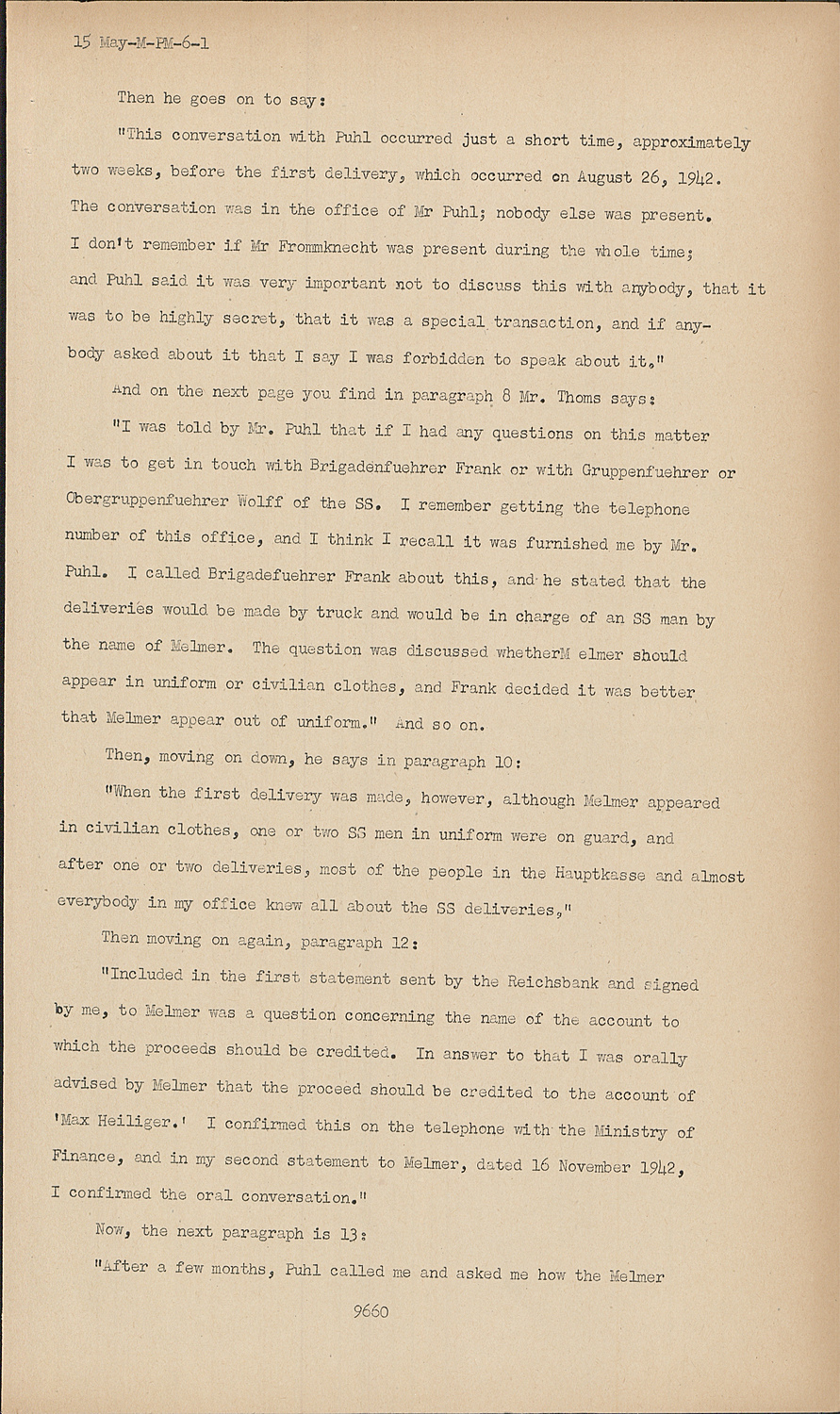
Then he goes on to say:
"This conversation with Puhl occurred just a short time, approximately two weeks, before the first delivery, which occurred on August 26, 1942. The conversation was in the office of Mr Puhl; nobody else was present. I don't remember if Mr Frommknecht was present during the whole time; and Puhl said it was very important not to discuss this with anybody, that it was to be highly secret, that it was a special transaction, and if anybody asked about it that I say I was forbidden to speak about it."
And on the next page you find in paragraph 8 Mr. Thoms says;
"I was told by Mr. Puhl that if I had any questions on this matter I was to get in touch with Brigadenfuehrer Frank or with Gruppenfuehrer or Obergruppenfuehrer Wolff of the SS. I remember getting the telephone number of this office, and I think I recall it was furnished me by Mr. Puhl. I called Brigadefuehrer Frank about this, and he stated that the deliveries would be made by truck and would be in charge of an SS man by the name of Melmer. The question was discussed whether Melmer should appear in uniform or civilian clothes, and Frank decided it was better that Melmer appear out of uniform." And so on.
Then, moving on down, he says in paragraph 10:
"When the first delivery was made, however, although Melmer appeared in civilian clothes, one or two SS men in uniform were on guard, and after one or two deliveries, most of the people in the Hauptkasse and almost everybody in my office knew all about the SS deliveries," Then moving on again, paragraph 12:
"Included in the first statement sent by the Reichsbank and signed by me, to Melmer was a question concerning the name of the account to which the proceeds should be credited. In answer to that I was orally advised by Melmer that the proceed should be credited to the account of 'Max Heiliger.' I confirmed this on the telephone with the Ministry of Finance, and in my second statement to Melmer, dated 16 November 1942, I confirmed the oral conversation."
Now, the next paragraph is 13:
"After a few months, Puhl called me and asked me how the Melmer deliveries were going along, and suggested that perhaps they would soon be over.
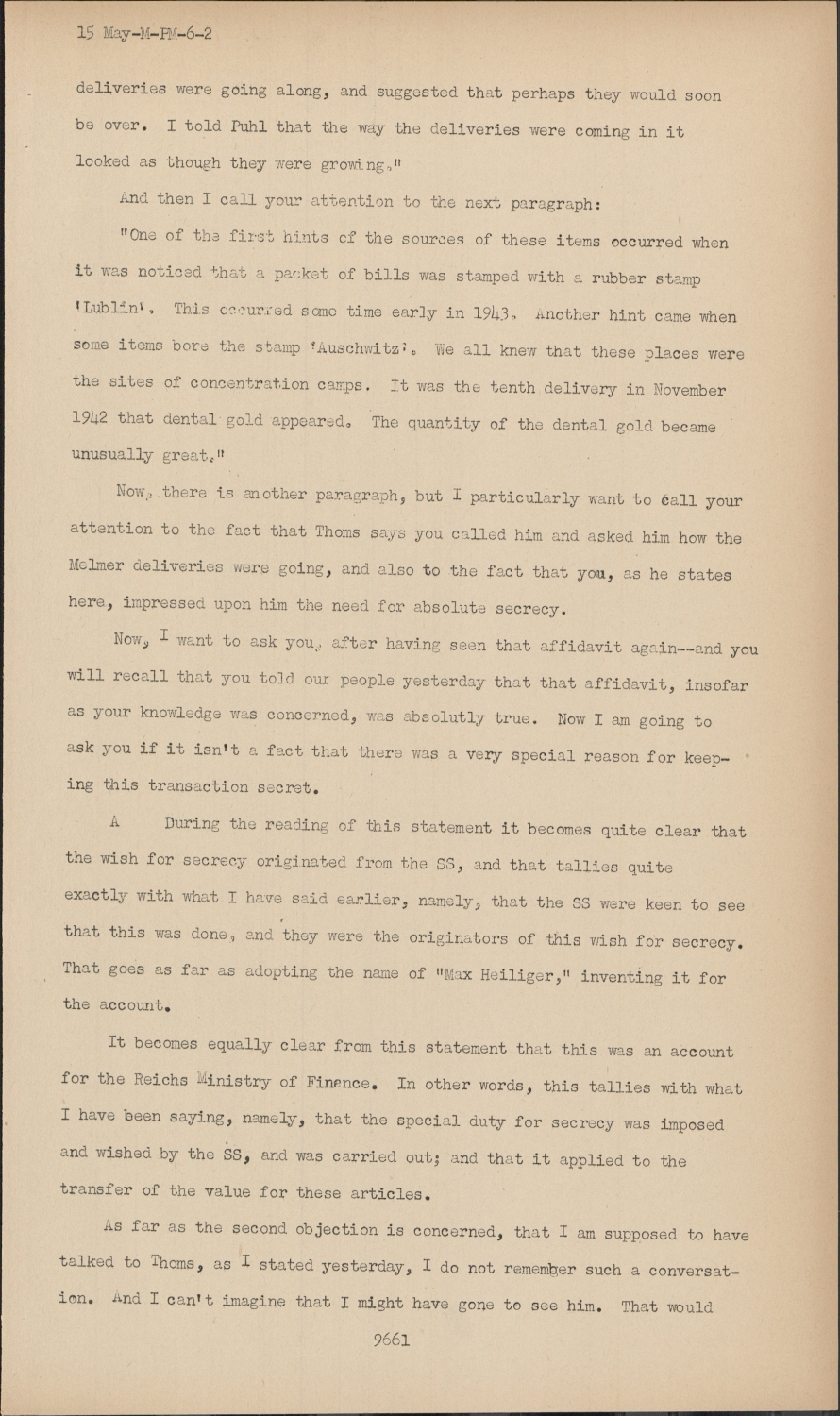
I told Puhl that the way the deliveries were coining in it looked as though they were growing," And then I call your attention to the next paragraph:
"One of the first hints of the sources of these items occurred when it was noticed that a packet of bills was stamped with a rubber stamp 'Lublin'. This occurred some time early in 1943. Another hint came when some items bore the stamp 'Auschwitz'. We all knew that these places were the sites of concentration camps. It was the tenth delivery in November 1942 that dental gold appeared. The quantity of the dental gold became unusually great."
Now, there is another paragraph, but I particularly want to call your attention to the fact that Thoms says you called him and asked him how the Melmer deliveries were going, and also to the fact that you, as he states here, impressed upon him the need for absolute secrecy.
Now, I want to ask you, after having seen that affidavit again--and you will recall that you told our people yesterday that that affidavit, insofar as your knowledge was concerned, was absolutly true. Now I am going to ask you if it isn't a fact that there was a very special reason for keeping this transaction secret.
ADuring the reading of this statement it becomes quite clear that the wish for secrecy originated from the SS, and that tallies quite exactly with what I have said earlier, namely, that the SS were keen to see that this was done, and they were the originators of this wish for secrecy. That goes as far as adopting the name of "Max Heiliger," inventing it for the account.
It becomes equally clear from this statement that this was an account for the Reichs Ministry of Finance. In other words, this tallies with what I have been saying, namely, that the special duty for secrecy was imposed and wished by the SS, and was carried out; and that it applied to the transfer of the value for these articles.
As far as the second objection is concerned, that I am supposed to have talked to Thoms, as I stated yesterday, I do not remember such a conversation. And I can't imagine that I might have gone to see him. That would have been quite an unusual procedure.
As to whether the word "Melmer" deliveries was used in that connection, I don't remember, but I suggest that it was used for simplicity's sake in this connection, and that it was used just to signify what was meant.
QIt isn't too important, but of course he says you called him on the telephone, that you didn't go to see him. However, I offer this as USA Exhibit 850.
THE PRESIDENT:This statement we have before us doesn't appear to be sworn.
MR. DODD:Well, the witness is here in Nurnberg. I will withdraw it and have it sworn to and submitted at a later date. I wasn't aware that it wasn't sworn to. He is here and available. I had him brought here in case any question was raised about him. BY MR. DO DD:
QNow, the defendant Goering knew something about these deposits, too, didn't he? Now that we are talking this thing all out, what about that?
AIt is unknown to me that Goering knew about these matters.
QI show you a document that was found in the files of the Reichs Treasury, the Reichsbank rather. It is Number 3947-PS, and it is a new document. You haven't seen this, by the way.
Now, this is a memorandum in the files, dated the 31st of March 1944, and its subject is, "Utilization of jewels, and so forth, which were acquired by official agencies in favour of the Reich.
"According to the oral confidential agreement between vice president Mr. Puhl and the Chief of one of Berlin's public offices, the Reichsbank took over the selling of loval and foreigh currencies, gold and silver coins, previous metals, securities, jewels, watches, diamonds and other previous objects. All incoming objects will be processed under the code name "MELMER".
"The large number of previous objects acquired hereby have been turned over to the Municipal Pawn Shop, Div. III Main Office Berlin N 4" -- and the rest of the address -- "for the best possible utilization after checking the number of pieces and their weight, provided they have not been smelted."
I am not going to read all of it. It goes on with more material about th pawn shop, but I want to call your attention to the paragraph beginning "The Reichsmarshal of the Greater German Reich, the Deputy for the Four Year Plan informed the German Reichsbank, in a letter of 19-3-44, a copy of which is enclosed, that considerable amounts of gold and silver objects, jewels, and so forth, at the main office of the Board of Trustees East should be delivered to the Reichsbank according to the order issued by Minister of the Reich, Funk and Graf Schwerin Krosigk. The utilization of these objects should be accomplished in the same way as the Melmer deliveries. The Reichsmarshal informed us also about the utilization of objects of the same kind, which have been acquired in the occupied Western territories. We do not know to which office these objects have been delivered and how they are utilized."
Then there is more about an inquiry and more about this whole business, the pawn shops, and so on. But, first of all, I want to ask you: In the firs paragraph it says "According to the oral confidential agreement between you an the Chief of one of Berlin's public offices." Who was the chief of the Berlin public office that had the confidential agreement about this business with you
A.That was Mr. Pohl, and it was the agreement which we discussed this morning.
Q.That was Mr. Pohl of the SS, wasn't it?
A.Yes.
Q.And there was this whole transaction; this is his transaction that th memorandum is about, that much of it is about.
A. This is a report from our cashier, and within the duty of secrecy it avoided the words "SS Economic Department."
It is using general terms, It says "The head of a Berlin public office."
Q.And in another paragraph it refers to the incoming objects to be processed under the code name 'Melmer', m-e-l-m-e-r. That is the name I asked you a few minutes ago if you recognized, isn't It?
A.I didn't understand the question.
Q.Well, the last sentence in this paragraph says: "All incoming objects Will be processed under the code name 'MELMER'" M-e-l-m-e-r-. That is the name I asked you about a few minutes ago, and you said you didn't know it.
A.Yes, and this statement shows that I couldn't have know it, because the cashier himself is giving the information that it is being carried out unde the name "Melmer."
Q.I think if you will read it you will see that it shows jest the opposite. It says according to the oral confidential agreement between you and Pohl of the SS, the Reichsbank took over the selling, and so on, of gold, silver coins, and so forth. "All incoming objects will be processed under the code name 'MELMER.'" You are not telling this Tribunal that a transaction like this was going on in your bank -
A.Yes Q. -- over which you were vice president, under a code name, and you didn't know it, and you were the man who was dealing directly with the SS man.
Are you seriously saying that to this Court?
A.Yes. The word "Melmer" was never used in my presence, but the directors had the possibility of using a code word if they preferred not to use their own name. In this connection the cashier's office made use of that procedure.
Q.You will observe that this is the second time this mroning that we have run across the name Melmer. Mr. Thomas says you used that term in talking to him, and now we find it in one of your own bank memorandums, which is a captured document. Are you still saying that you don't know the term?
A. Just because -- incidentally, the memorandum wasn't made for me.
It was made for the cashier's representative, but particularly because it was to inform him regarding the arrangements made by the cashier's office. That is the very explanation under which this code name in this transaction was being carried out.
Q.Mr. Puhl, look up at me a minute, will you. Didn't you tell Lt. Meltzer, Lt. Margolies, and Dr. Kempner, when they were all together with you that all of this business with the SS was common gossip in the Reichsbank? These gentlemen who are sitting right here, two of them at the United States table and one up here. You know them. Now I want you to think a minute before you answer that question.
A.We talked about it, that the secret hadn't been kept since it can't be kept in a bank permanently, but that has nothing to do with it. What we are discussing at this moment deals with the technical details, how this sort of transaction is being acrried out. Something which couldn't be avoided was that the fact as such became know.
Q.Now, in case you don't understand me, we are not talking about that. I think you cannot help but remember, because this is only a day or so ago, in this building, you had a conversation with these gentlemen, didn't you?
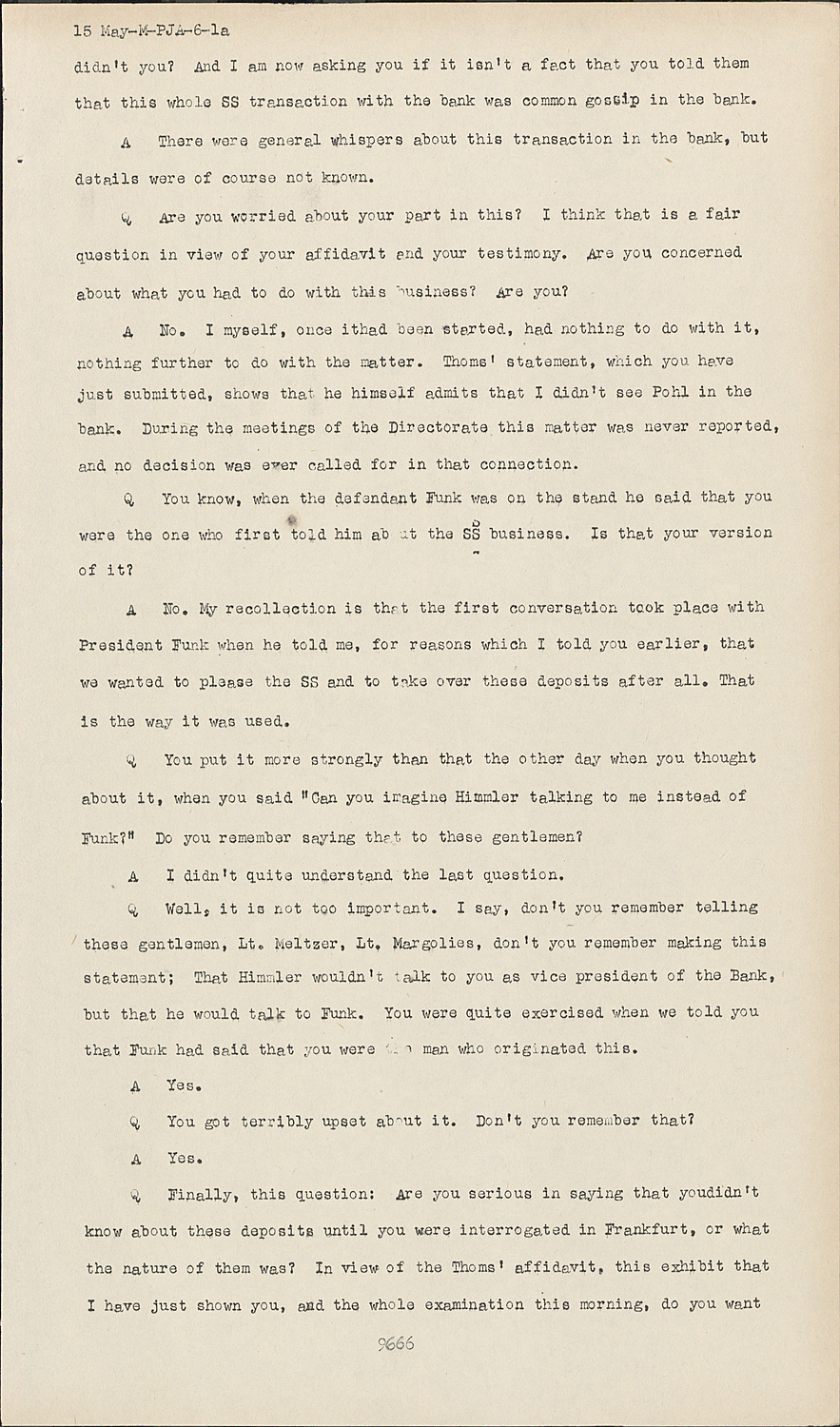
And I am now asking you if it isn't a fact that you told them that this whole SS transaction with the hank was common gossip in the bank.
AThere were general whispers about this transaction in the bank, but details ware of course not known.
QAre you worried about your part in this? I think that is a fair question in view of your affidavit end your testimony. Are you concerned about what you had to do with this business? Are you?
ANo. I myself, once ithad been started, had nothing to do with it, nothing further to do with the matter. Thoms' statement, which you have Just submitted, shows that he himself admits that I didn't see Pohl in the bank. During the meetings of the Directorate this matter was never reported, and no decision was ever called for in that connection.
QYou know, when the defendant Funk was on the stand he said that you were the one who first told him about the SS business. Is that your version of it?
ANo. My recollection is that the first conversation took place with President Funk when he told me, for reasons which I told you earlier, that we wanted to please the SS and to take over these deposits after all. That is the way it was used.
QYou put it more strongly than that the other day when you thought about it, when you said "Can you imagine Himmler talking to me instead of Funk?" Do you remember saying that to these gentlemen?
AI didn't quite understand the last question.
QWell, it is not too important. I say, don't you remember telling these gentlemen, Lt. Meltzer, Lt. Margolies, don't you remember making this statement; That Himmler wouldn't talk to you as vice president of the Bank, but that he would talk to Funk. You were quite exercised when we told you that Funk had said that you were the man who originated this.
AYes.
QYou got terribly upset about it. Don't you remember that?
AYes.
QFinally, this question: Are you serious in saying that youdidn't know about these deposits until you were interrogated in Frankfurt, or what the nature of them was? In view of the Thoms' affidavit, this exhibit that I have Just shown you, and the whole examination this morning, do you want your testimony to close with the statement that you actually didn't know what was in these deposits at any time?
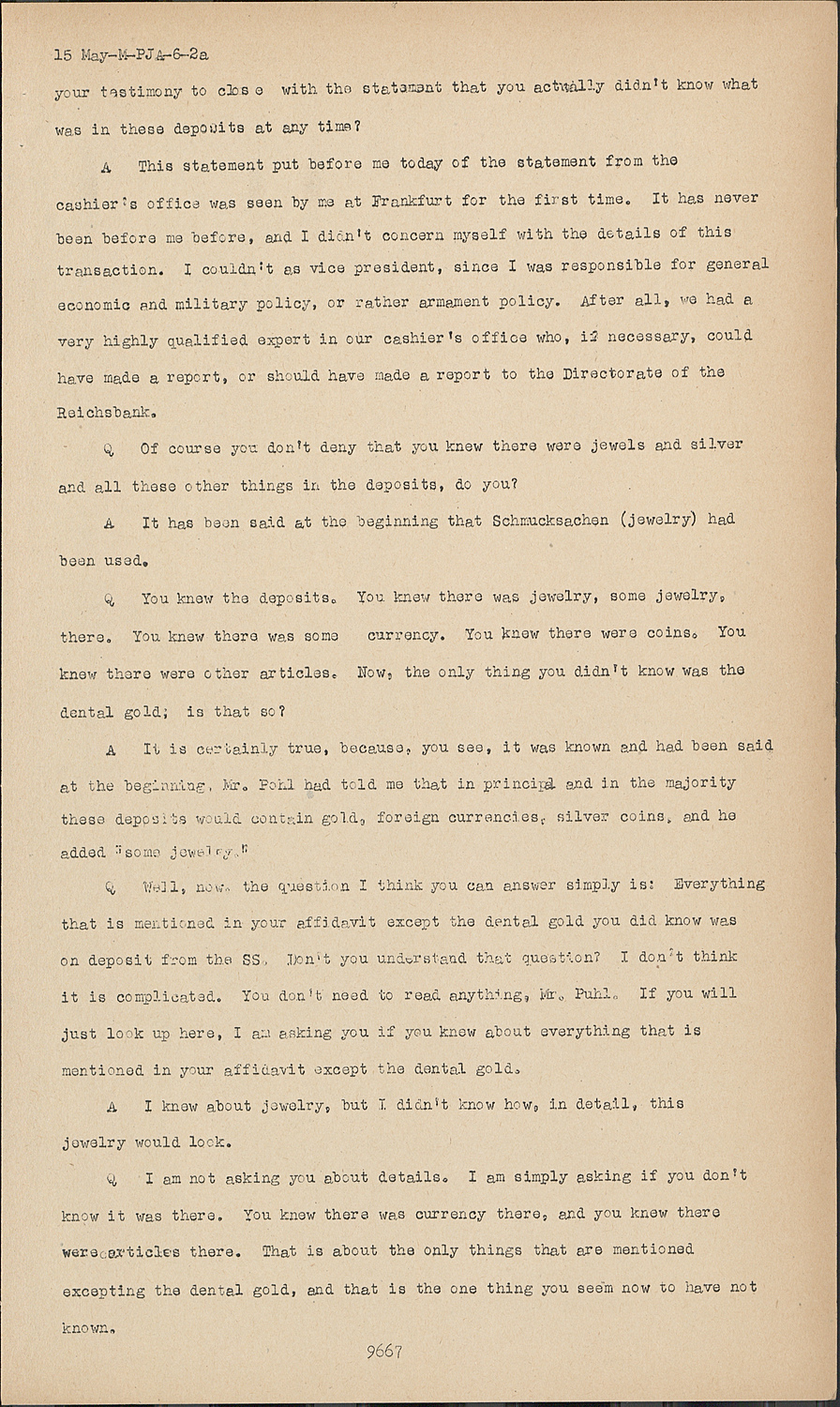
AThis statement put before me today of the statement from the cashier's office was seen by me at Frankfurt for the first time. It has never been before me before, and I didn't concern myself with the details of this transaction. I couldn't as vice president, since I was responsible for general economic and military policy, or rather armament policy. After all, we had a very highly qualified expert in our cashier's office who, if necessary, could have made a report, or should have made a report to the Directorate of the Reichsbank.
QOf course you don't deny that you knew there were jewels and silver and all these other things in the deposits, do you?
AIt has been said at the beginning that Schmucksachen (jewelry) had been used.
QYou knew the deposits. You knew there was jewelry, some jewelry, there. You knew there was some currency. You knew there were coins. You knew there were other articles. Now, the only thing you didn't know was the dental gold; is that so?
AIt is certainly true, because, you see, it was known and had been said at the beginning, Mr. Pohl had told me that in principal and in the majority these deposits weald contain gold, foreign currencies, silver coins, and he added "some jewelry."
QWell, now the question I think you can answer simply is; Everything that is mentioned in your affidavit except the dental gold you did know was on deposit from the SS, Don't you understand that question? I don't think it is complicated. You don't need to read anything, Mr. Puhl. If you will just look up here, I am asking you if you knew about everything that is mentioned in your affidavit except the dental gold.
AI knew about jewelry, but I didn't know how, in detail, this jewelry would lock.
QI am not asking you about details. I am simply asking if you don't know it was there. You knew there was currency there, and you knew there were articles there. That is about the only things that are mentioned excepting the dental gold, and that is the one thing you seem now to have not known.
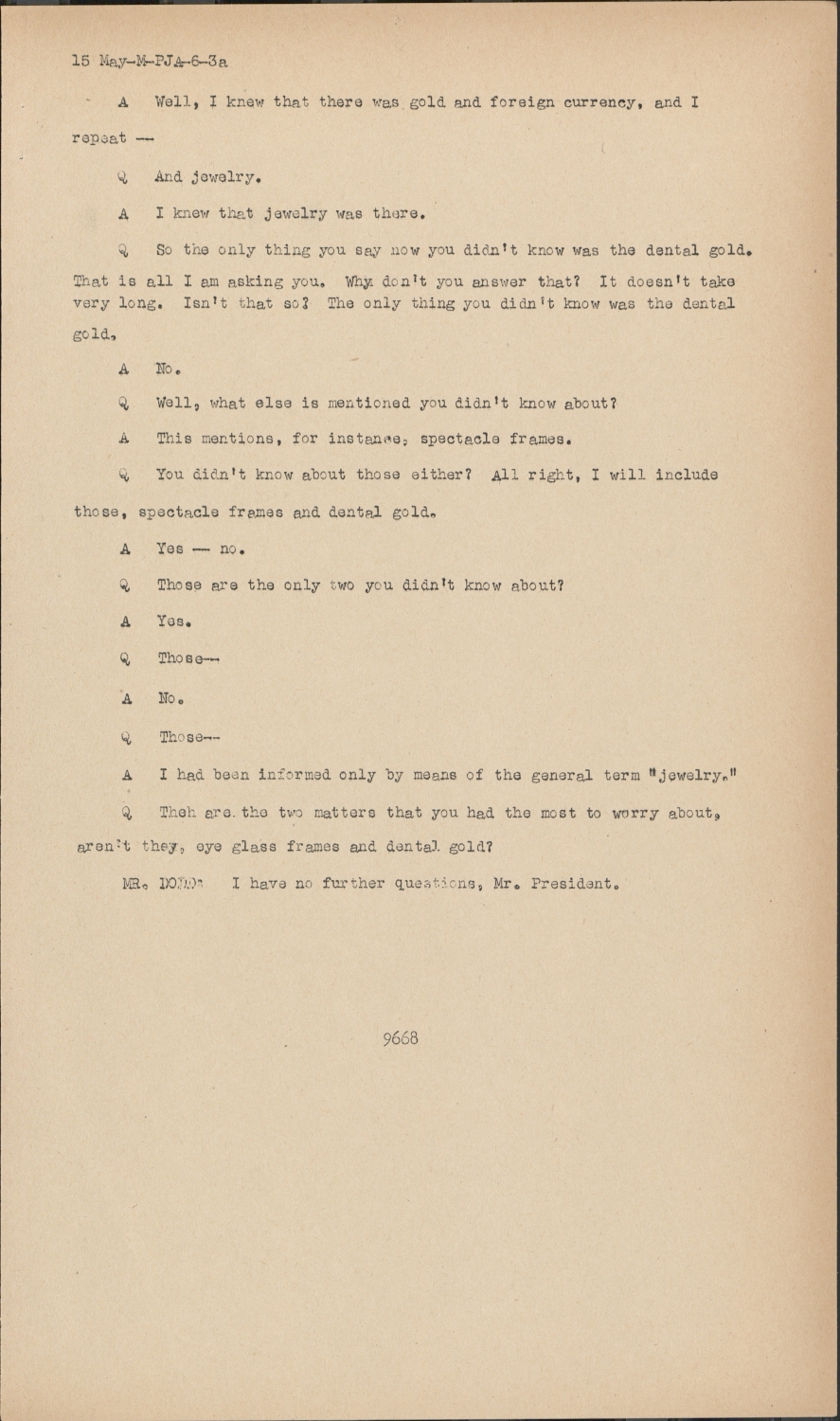
A Well, I knew that there was gold and foreign currency, and I repeat -
QAnd jewelry.
AI knew that jewelry was there.
QSo the only thing you say now you didn't know was the dental gold. That is all I am asking you. Why don't you answer that? It doesn't take very long. Isn't that so? The only thing you didn't know was the dental gold.
ANo.
QWell, what else is mentioned you didn't know about?
AThis mentions, for instance; spectacle frames.
QYou didn't know about those either? All right, I will include those, spectacle frames and dental gold.
AYes - no.
QThose are the only two you didn't know about?
AYes.
QThose
ANo.
QThose
AI had bean informed only by means of the general term "jewelry."
QThen are the two matters that you had the most to worry about, aren't they, eye glass frames and dental gold?
MR. DODDI have no further questions, Mr. President.
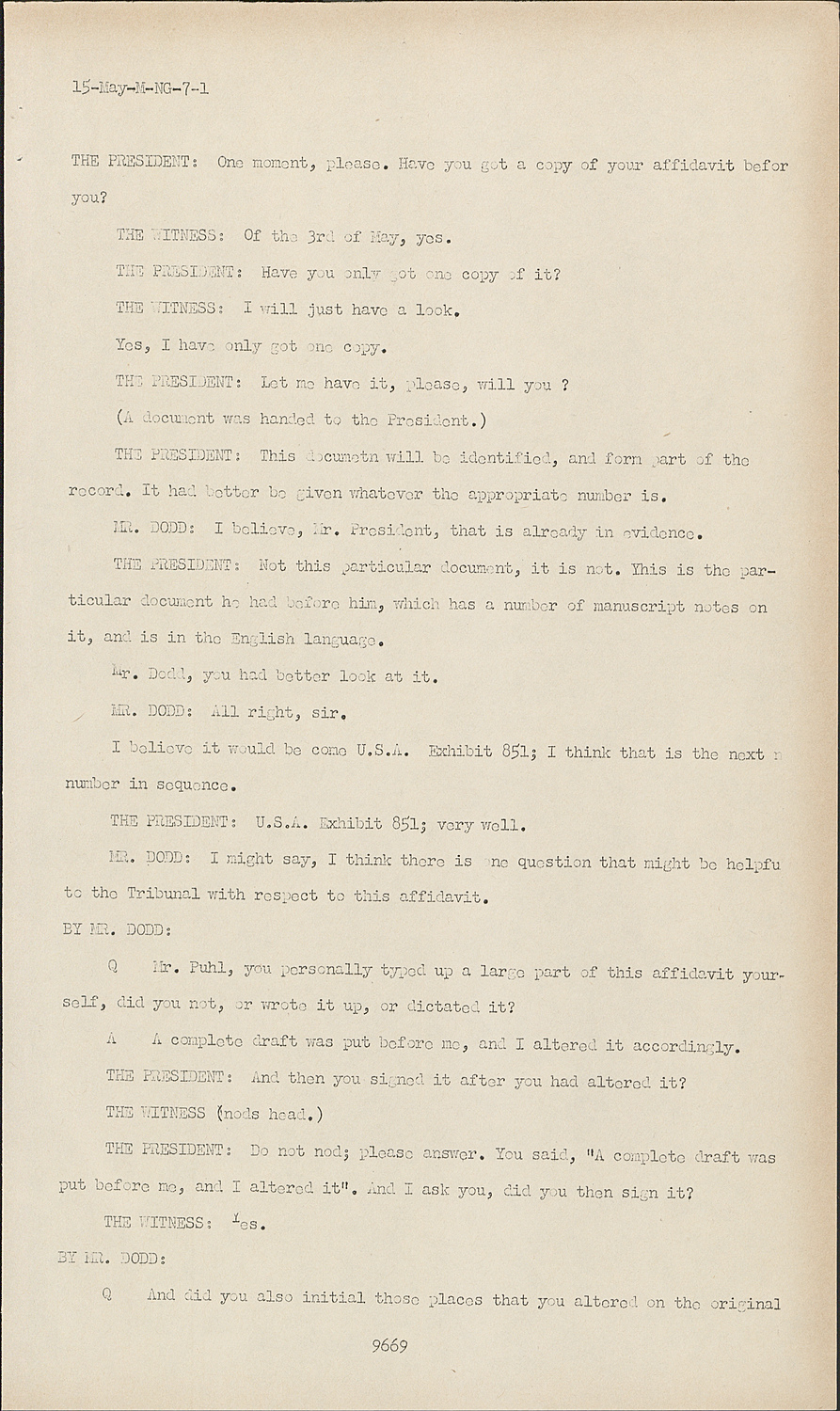
THE PRESIDENT: One moment, please. Have you got a copy of your affidavit befor you?
THE WITNESS:Of the 3rd of May, yes.
THE PRESIDENT:Have you only got one copy of it?
THE WITNESS:I will just have a look.
Yes, I have only got one copy.
THE PRESIDENT:Let me have it, please, will you?
(A document was handed to the President.)
THE PRESIDENT:This documetn will be identified, and form part of the record. It had better be given whatever the appropriate number is.
MR. DODD:I believe, Mr. President, that is already in evidence.
THE PRESIDENT:Not this particular document, it is not. Yhis is the particular document he had before him, which has a number of manuscript notes on it, and is in the English language.
Mr. Dodd, you had better lock at it.
MR. DODD:All right, sir.
I believe it would be come U.S.A. Exhibit 851; I think that is the next r number in sequence.
THE PRESIDENT:U.S.A. Exhibit 851; very well.
MR. DODD:I might say, I think there is no question that might be helpful to the Tribunal with respect to this affidavit. BY MR. DODD:
QMr. Puhl, you personally typed up a large part of this affidavit yourself, did you not, or wrote it up, or dictated it?
AA complete draft was put before me, and I altered it accordingly.
THE PRESIDENT:And then you signed it after you had altered it?
THEWITNESS (nods head.)
THE PRESIDENT:Do not nod; please answer. You said, "A complete draft was put before me, and I altered it". And I ask you, did you then sign it?
THE WITNESS:Yes. BY MR. DODD:
QAnd did you also initial those places that you altered on the original Did you not put your initials in each place that you wanted to make a change?