Q Did these people receive material promises?
ANone at all.
QIs it correct that, after the taking over of power there were Communist provokers who came into the SA?
Is it correct that especially after the taking over of power Communist provokers sneaked into the SA?
AThat was a very strange matter. After the taking over of power we acted against Communists, which they had really expected, and especially in large cities where it was easier large numbers of the organization of the Red Front entered the Party.
It was very easy for then to do that, since the then head of the SA, Roehm, arbitrarily took people into the SA who did not have to be members of the party, a prerequisite which had existed before.
Anyone could have come into the SA without belonging to the Party.
At the same time the German National Party started a political combat organization called the Green Shirts, and just like the Steel Helmets, another organization, they were taken into the SA.
I remember personally one day that four to five hundred of these people assembled at the Wilhelm Strasse to receive their membership in the SA.
I saw these people from my window and noticed that we were concerned with elements which did not belong.
I had some of the Schutzpolizei come up to check.
Ninety-eight per cent of the people had their Red Front certificates in their pockets.
THE PRESIDENT:Dr. Boehm, the Tribunal considers that this is all cumulative to what the Defendant has already said in his examination in chief.
He has given us a long account of the SA in his examination in chief.
He has added nothing in the course of what he is now saying.
DR. BOEHM:According to the Prosecution, it is stated that the SA was made up of terror gangsters, and I believe myself duty-bound to correct this statement and to clarify this matter.
THE PRESIDENT:That has nothing to do with what I said. It may be that the Prosecution may have said that.
Probably they have. What I was pointing out to you was that the Defendant Goering has been all over this ground in the evidence he has already given and the Tribunal does not wish to hear twice the same evidence.
DR. BOEHM:Yes, this may apply to my first three questions.
BY DR. BOEHM:
QWitness, I would like to ask, how did you influence the SA in connection with the Versailles Treaty?
Did you tell these people that a revolution was to be taken peacefully or by war?
AThis question is unusually difficult to answer. If in 1923 I made a speech before the SA men I could not very well use diplomatic language and talk about diplomacy.
They would not have understood me.
Every little SA man was not concerned with the "how" of things.
That was the problem of the leadership. I didn't say, "I will obligate myself never to have a war for you," that we are completely a pacifist organization, and that we are only interested, in doing away with Versailles for a protest.
But, on the other hand, I did not say either we want to march in war during the next few years.
In reality I did not tell them anything.
I said that they would have to be obedient, to have confidence in the leadership, and to leave it to the leadership just what was to be done, and that anything the leadership would do would be right.
Every SA man knew from my speeches and from my party program how I felt about Versailles, and it was the wish of every decent German to get away from Versailles.
QAccording to your knowledge beyond 1923, let us say from 1921 to 1945, was the SA informed as to the following things, that is, the leadership of the SA as well as each individual member; that the NSDAP intended after the taking over of power to rule other states, to make war with this purpose in mind, and disregard the rules of war and the laws of humanity?
AI do not quite comprehend just how the SA, its leadership, is pictured.
It is impossible that anyone can say, "Listen, we wish to dominate and subjugate all other states," and that anyone can further say that we will always make war, that we will murder and act as inhumanly as possible, and that in no case will we ever pay attention to any law of war.
I cannot imagine that anyone but an insane person would have made utterances of this nature toward the SA or anyone else.
The SA in no form was ever politically informed. The SA was told, "You will march tomorrow or the day after; you will distribute leaflets and pamphlets," and other things.
QDuring the time of the taking over of power there were frequently excesses on the part of the SA.
Were measures of individual members concerned in this, or were these measures according to the decrees of the SA leadership?
ANever, according to the decrees of even the middle or top leading officers.
In an organization of a million young people there will always be a certain percentage of rowdies, especially in large cities, as I mentioned just a little while ago.
There will always be provokers or agents, and individual or particular excesses will occur.
That is entirely inevitable.
QDid the SA leadership sanction special actions of the SA membership?
AI have already stated that I had very little to do with the leadership of the SA.
I don't believe so, however.
QIs it correct that the Police were prohibited from acting against excesses of individuals?
AIn the beginning it wasn't the case. By that I mean, on the contrary, that the police took orders in this direction.
They had strict orders to interfere, and their Police President of Berlin, who wasn't of the Party, Admiral (Retired) von Lewitzon, intervened very strongly, and the intervention may have been the reason that two years later, because of complaints of the Berlin Gauleiter Goebbels, he was replaced by the Fuehrer.
QHow was it later on? I believe you just said, "In the beginning it wasn't so."
Was it different later when the police were prohibited from acting against the SA?
ANo, it is not to be taken that way. The excesses of individual men were always curbed by the police.
Many SA men were convicted.
QIn the Prussian police system, and in the police system the other states had, were SA members used only, or wasn't it that all Germans who at that time wished and volunteered to enter the police system were examined and investigated and used accordingly?
AThere was a cleansing of the police, a cleansing according to our concept, and by that we meant we investigated which elements were very strong for the Party and which were still influenced by hostile parties so that their use was no longer tenable, and these people were no longer used.
But that was a very small percentage, in comparison with the total number of police.
The Schutzpolizei were people who were uniforms.
They were increased, and voluntary applications came from all sides.
Of course the relatives of the existing membership were favored, but many of them were taken in who were not in the organization, and those who came from the organization had to take special adaptability tests that were given them.
Some of them did not make the grade and were not taken.
This is the system as far as I was connected with the police.
What happened later I cannot tell you exactly.
QIs it correct that the SA after 1934 chiefly was used in emergency measures and in physical training, that they were used to shovel snow, to clean up bomb damage, and so forth?
AAfter 1934 the significance of the SA declined tremendously.
It can be understood, for their chief task which they had before the taking over of power did no longer exist after the taking over of power, and they were used in the activities just set forth.
During the war they had a para-military task, and after the war it was to be the chief background for the various military clubs or veterans clubs.
It was to be a melting pot of the various veterans' organizations, and that was to be its final use.
Q Do you know that the Steel Helmets, in an agreement between the Fuehrer and Sauckel, were taken into the SA reserve in a body?
AYes.
QIs it correct that similar to the Steel Helmet organizations, after 1933, through the so-called Gleichschaltung, or coordination, these riding clubs were taken into the SA?
AI believe that is correct.
QWas the SA leadership and its membership before or after 1933, or at any time, informed of the decisions taken in the Cabinet?
AI already said a few minutes ago just how the leadership of the SA was to be considered.
The answer is, of course, no.
QThe Prosecution asserts in connection with aggressive war and the participation of the SA in such a war that the SA took part in this preparation, in that before the war annually 25,000 officers were trained by them in special schools.
Do you have any knowledge of that?
AThe training of officers of the Wehrmacht was handled solely by the Wehrmacht and in Wehrmacht schools, and I cannot understand how the SA would have been technically or militarily in a position to train officers for the Wehrmacht.
In addition, it seems to me that the training of 23,000 officers a year seems to be highly exaggerated as far as the needs of the Wehrmacht were concerned.
It would have been very nice if we had had that many, but it cannot be true that the had this number for several years, and it is no more true than that the SA trained officers.
The training of officers was done by the Wehrmacht solely and alone.
Q Some men seem to have been trained. Can you tell me where these men were trained and for what purpose?
Do you knew anything about Fuehrer schools?
AYes, there were fuehrer schools for every organization. Every organization had its schools where these were trained who in their eyes were to have leading positions. I can only imagine that the Prospectuion is perhaps confusing -- or perhaps wish to say that some of the SA leaders had preliminary military training; that is, they were trained in the reading of charts, but that is beyond the scope of my knowledge.
QMay I ask you to tell me the connection of the "Feldherrnhalle" to the SA and the Wehrmacht? There was a regiment by the name of "Feldherrnhalle." can you tell me the connection:
AAfter the SA had various "Standarten" from the Fuehrer, these units were really military units, as for instance, the "Leibstandarte", the Body Unit. The SA leadership requested to be granted one unit which it might army such as with rifles, so that it might use this unit as a parade unit, and this unit was called "Feldherrnhalle". The SA leader Luetze suggested to the Fuehrer that he make me the head of this unit, as a position of honor. We considered it a position of honor to be the head of such a unit. When I saw this unit for the first time -- I believe at a Party rally at Nurnber - it impressed me especially because there were many selected and very nice looking young men.
I was not grateful to the SA for the position they gave me, for when I saw this beautiful unit I dissolved this unit and took it into the Luftwaffe and made my first paratrooper unit, so that after a brief existence, this unit was a regiment of the Luftwaffe.
I believe that this was rather unpleasant for the SA, and it was quite some time before the SA leader undertook to have another unit by the same none, "Feldherrnhalle", and he made this unit very much smaller, and they stood guard for the top SA leadership, and he did not make me the leader of this unit a second time.
QAccording to my information, personal information I received front an SA gruppenfuehrer and other information which I had through reading, the "Feldherrnhalle" was not armed until it came into the Luftwaffe. Is that correct?
A No, that is not correct. I do not believe I can say under oath, but I believe they received rifles shortly before they were taken into the Luftwaffe, just rifles, but as I said before, I can not tell you exactly.
In this connection, I would also like to mention, because the Prosecution mentioned this point -- I would like to emphasize that this regiment was a paratrooper unit which was used in the action "Gruen" and had been Intended to be used. Since this "Aktion Gruen" -- that is, the Sudetenland -- was Solved peacefully, after the occupation of the Sudetenland, we had maneuvers and had the men jump, but purely for purposes of maneuvers, and this was the landing at Freudeuthal which the Prosecution has mentioned. At that time they landed in blue uniforms, and, as could be easily seen, they were a regiment of the Luftwaffe. As a matter of courtesy, I attended this demonstration.
QIn the war, did the SA ever have a strategic or practical role when it came to the deployment of manpower?
ANo, the SA as such was never used within the Wehrmacht as an SA unit in a tactical or any other way. They were never used in combat. It may be that toward the end in the "Volkssturm", perhaps a few SA men were.
QIs it correct that the SA in the occupation of Austria, of the Sudetenland and the Czech state, that they were operating with the Wehrmacht?
AThat case was handled by the Austrian SA. They were used as auxiliary police. The Austrian Legion, which was in the Reich was, according to my express orders and according to the express wish of Seyss-Inquart, held back and not used and was used only after the absolute consolidation of the Austrian situation and was returned home. How far units of the SA were used in the Sudetenland after the zone was given over to Germany, I do not know. I heard that Sudeten Germans were involved who had to flee prior to that time and who were now returning. When the Czechoslovakian state was occupied, I can not see that closed SA units would have had any part in the marching in of our troops.
QCould the members of the SA have known that possibly, according to the intention of the SA leadership, they might be used for the execution of penal measures?
AI did not quite get the substance of your question.
Q Could the members of the SA know that according to the intention of the SA leadership, they might possibly be used to commit crimes?
AOf crimes, never.
QNow, I have a last question, but I believe that in a certain sense you have already answered that question. Were the members of the SA cognizant of the aims of the SA? Did they know them at any time, or could they be known to them, or should they have been known to them? Or could these men have known that the intention of the SA or of the leadership might be that crimes would have to be done -- things which are considered by the Prosecution as crimes against humanity and against the peace?
AI have already answered these questions.
THE PRESIDENT:The Tribunal will adjourn now for ten minutes.
(A recess was taken)
DR. BOEHM: Mr. President, I should like you to permit me to ask a few more basic questions, namely, the question of honorary leadership in the SA.
BY DR. BOEHM:
QThere were honorary leaders of the SA, namely, obergruppenfuehrers down to sturmfuehrers. Witness, I should like you to tell me what significance these honorary leadership posts had, particularly in regard to permission to issue orders to the SA, and altogether what its influence could be.
AThe honorary leaders of the SA were appointed by the most heterogeneous sort of standard. They had a loose representative function, that is to say, they functioned and represented, the SA at Party meetings. They were by no means active members of the SA and were not informed of any internal activities of the SA. Their function was purely decorative. BY DR. MERKEL (Counsel for the Gestapo)
QWitness, can one say that the Gestapo in the year 1933, when it was created by you, was a national-socialist fighting organization or was it rather an administrative organization such as the criminal police or other state organications?
AI emphasized that this is a purely state organization in order to support the police that then existed. At this time there was not even the slightest connection with the Party; the Party had no influence or command-control or any other such thing over the Gestapo. It was exclusively a state institution. The members who were present in it already or who later came into it were ordinary state officials.
QDid this condition change after Himmler took it over, until 1945, so far as you know?
AUntil 1934 it was exactly as I described it, then it became stronger as it was expanded and tock in elements of the SS. But these elements had to pass an examination, then they became officials and remained officials. Then I heard Inter that nothing changed so far as this official character of the members was concerned, but gradually in the course of the years officials, whether they wished it or not, had to take on some rank in the SS; so that leading Gestapo officials who until the year 1939 or 1940 had nothing to do with the SS and who and come from the previous time, that is to say, from previous Weimar police, nevertheless, they remained officials, that is to say, the Gestapo was an insti tution composed of officials.
QDo you know anything about whether or not Himmler, after the seizure of power in his capacity as police president, also had something to do with the leadership of the criminal police in Bavaria?
ASo far as I know and so far as I have already said Himmler was first of all police president of Munich very shortly, one or two weeks, then he called himself police commissar of Bavaria; and after a month or six weeks I don't know what he called himself, what his title was, but de fact he became chief of police of all German countries, with the exception of Prussia.
QYou said previously that the officials of the Gestapo were taken into the SS. Did this happen voluntarily or was some cohersion put on them in order to bring about this membership?
AI heard this only from individual officials whom. I had known before and who knew about this. They were not taken into the SS, but they received an official rank in the SS. It was Himmler's idea that the SS and Gestapo, both of which he was the leader, that they should be amalgamated. What the individual instances were I can not say. Perhaps I did not state this exactly correctly before, but I did to the best of my knowledge.
QYou said before that the officials in the year 1933 from the political police that existed at that time were taken into the state police. Was this done after their voluntary application or were they commanded to do so? -- simply transferred in individual cases? -- or were they agreeable to it?
AIt is not correct for you to say that the officials of the political police were simply incorporated into the Gestapo; rather in this sector, they were, because there was a political police representative there in opposition to us and that situation had to be removed. Subsequently new people came in and the number was considerably enlarged. These new officials were taker, from the other police departments; criminal, political, and other; and as I have already stated were in part brought in from the outside after careful scrutiny of their political orientation. Now, to what extent actual replacements took place, -Mueller, for instance, was replaced, -- that I do not know. I do not believe that there were many such replacements, since I had nothing to do with the Gestapo after I had once established its general policy.
Q Do you know Obergruppenfuehrer Mueller, the Chief of Amt IV in the RSHA?
AI knew him.
QDo you know that he and his immediate staff originated in the political police before 1933?
AI do not know that; I knew only that he came from Bavaria.
QDid you know that the secret police did not take part in the excesses on the 9th of November 1938?
AI have always been of the conviction that they did not take part in that, but I saw here a document which at least instructed them not to interfere.
QIf I understand you correctly, you said exactly that on the 9th of November, after your return to Berlin, you called up the chief of the Gestapo. Did this communication take place only because you wanted more precise information or did it happen because you thought the Gestapo had had some active participation in these excesses and in carrying them out?
AIf I had been of the conviction that the Gestapo had taken an active part in these activities I certainly should not have inquired of them. I commissioned my collaborators to find out through the Gestapo, because it had the necessary connections, or through the criminal police. That was indifferent to me. I could only turn to the chief of the police and commission my collaborators to provide me with a report of exactly what had happened.
Q Is it correct that when you surrendered your positon as Chief of the Police to Himmler, that such behavior was unworthy of the German Police and that drastic measures would be adopted towards police members who were guilty of such acts?
AI did, when I surrendered that office, and in my speech there are such passages in it.
QDid you know that there was an order from the RSHA, after your resignation -- that an order existed, according to which every officer was forbidden to commit any such violent act?
AWhat orders were issued after my resignation, I do not know.
QDo you know anything about the fact that there was never an order to treat prisoners violently?
AI could only say with absolute certainty that I didn't know of such order or permitted such order, but otherwise I was outside of Purria. I had no connection with what orders might have been issued then or were not issued; that lies outside my knowledge.
QDo you know anything that, contrary to this order, actually, generally in the Gestapo, such events did take place or could you say that if they did happen, could it have been only excessive on the part of individuals?
AAt that time I was immediately concerned in the Gestapo and at that time, as I often stated, such excesses did take place and punishments did take place. The officials know, in other words, that if they did such things they ran the danger of being punished. A large number of them were punished and what happened later, I cannot supply information on.
DR. MERKEL:No more questions.
DR. BABEL:Dr. Babel for the SS and SD. BY DR. BABEL:
QWitness, did it have to be the same conditions for honorary membership in the SS as in the SA?
AYes.
QDo you know what these conditions were?
ANo.
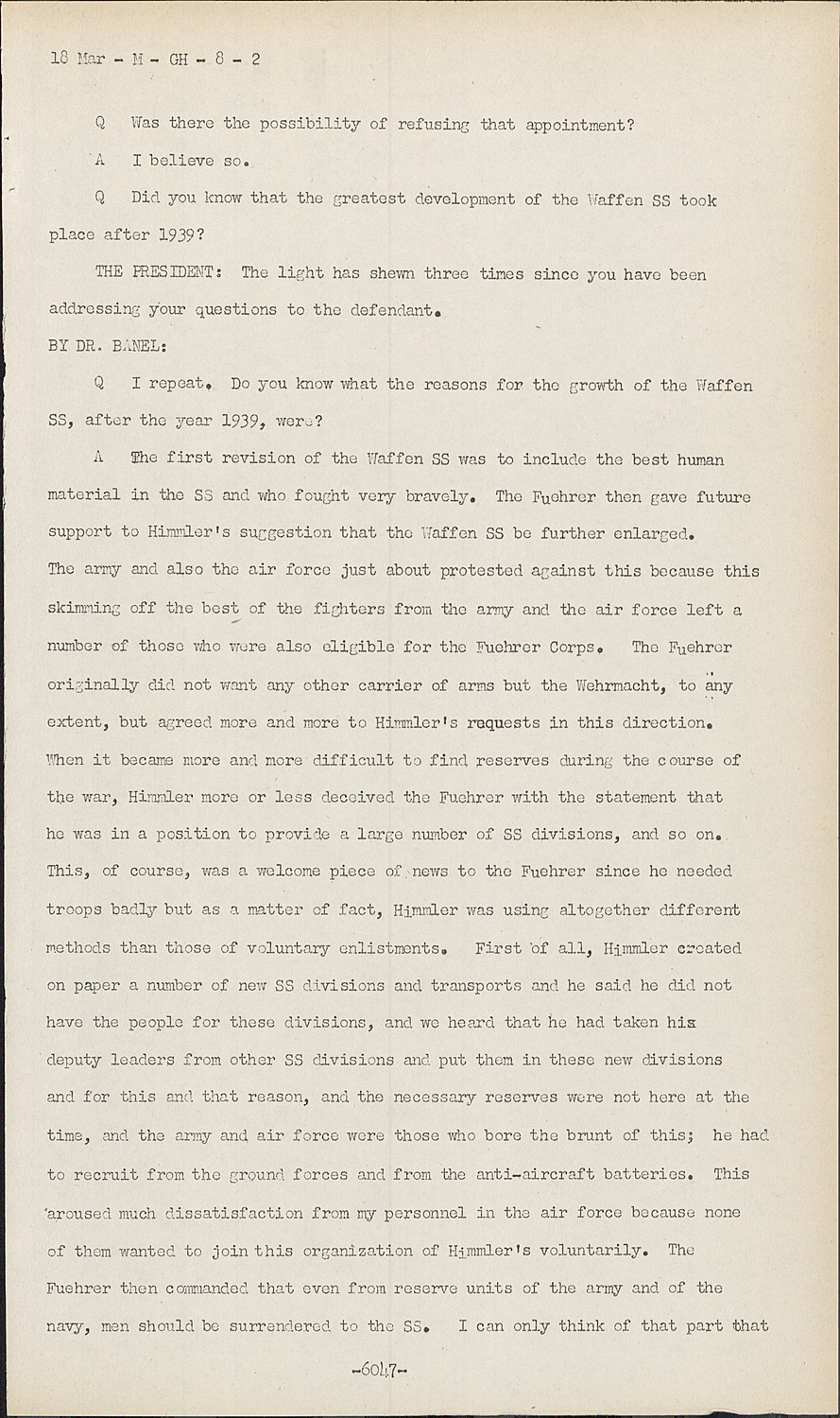
Q Was there the possibility of refusing that appointment?
AI believe so.
QDid you know that the greatest development of the Waffen SS took place after 1939?
THE PRESIDENT:The light has shewn three times since you have been addressing your questions to the defendant. BY DR. BANEL:
QI repeat. Do you know what the reasons for the growth of the Waffen SS, after the year 1939, were?
AThe first revision of the Waffen SS was to include the best human material in the SS and who fought very bravely. The Fuehrer then gave future support to Himmler's suggestion that the Waffen SS be further enlarged. The army and also the air force just about protested against this because this skimming off the best of the fighters from the army and the air force left a number of those who were also eligible for the Fuehrer Corps. The Fuehrer originally did not want any other carrier of arms but the Wehrmacht, to any extent, but agreed more and more to Himmler's requests in this direction. When it became more and more difficult to find reserves during the course of the war, Himmler more or less deceived the Fuehrer with the statement that he was in a position to provide a large number of SS divisions, and so on. This, of course, was a welcome piece of news to the Fuehrer since he needed troops badly but as a matter of fact, Himmler was using altogether different methods than those of voluntary enlistments. First of all, Himmler created on paper a number of new SS divisions and transports and he said he did not have the people for these divisions, and we heard that he had taken his deputy leaders from other SS divisions and put them in these new divisions and for this and that reason, and the necessary reserves were not here at the time, and the army and air force were those who bore the brunt of this; he had to recruit from the ground forces and from the anti-aircraft batteries. This aroused much dissatisfaction from my personnel in the air force because none of them wanted to join this organization of Himmler's voluntarily. The Fuehrer then commanded that even from reserve units of the army and of the navy, men should be surrendered to the SS. I can only think of that part that was taken from the air force by coercion and I should judge, without documentation, that there were 50,000 such men so recruited.
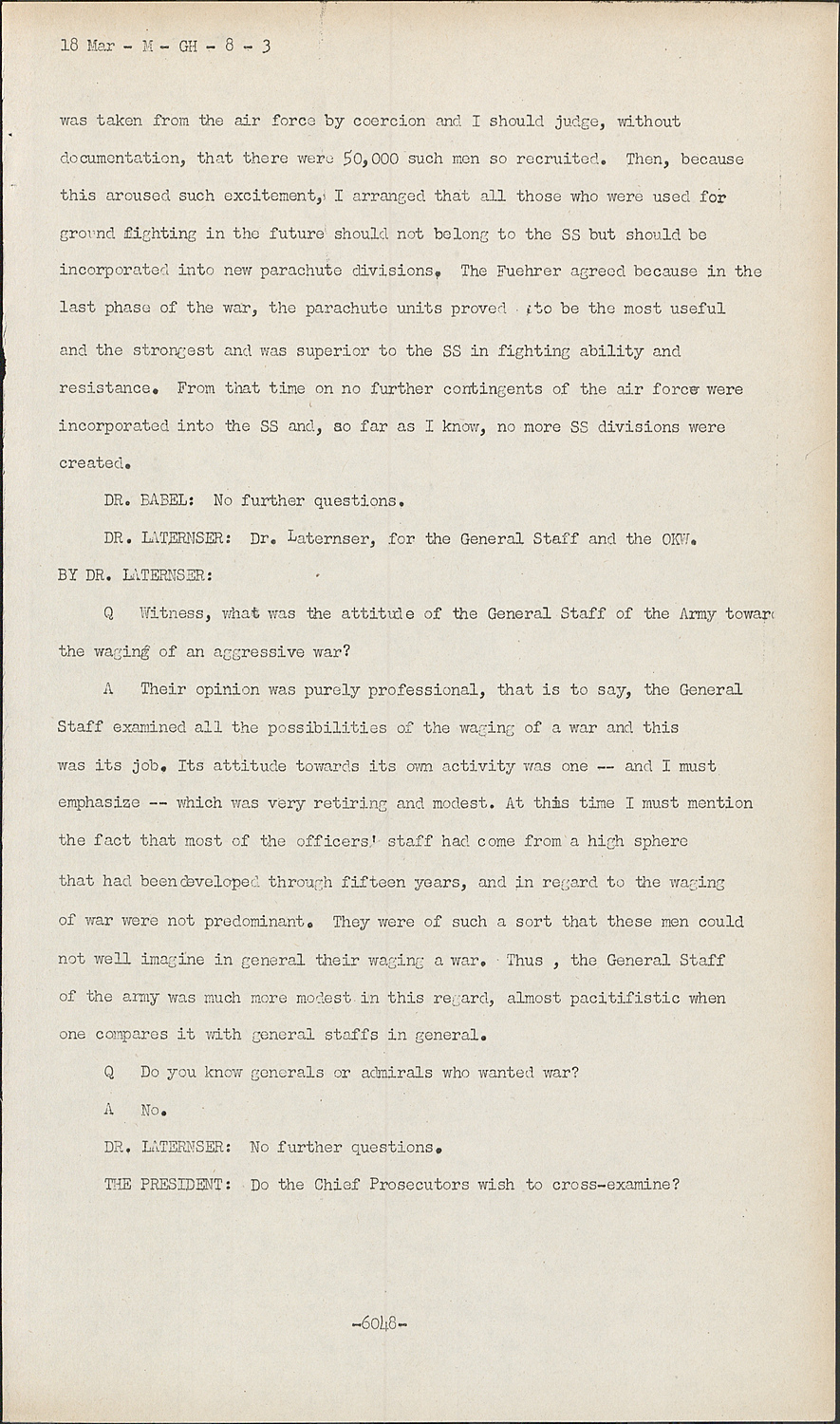
Then, because this aroused such excitement, I arranged that all those who were used for ground fighting in the future should not belong to the SS but should be incorporated into new parachute divisions. The Fuehrer agreed because in the last phase of the war, the parachute units proved to be the most useful and the strongest and was superior to the SS in fighting ability and resistance. From that time on no further contingents of the air forcer were incorporated into the SS and, so far as I know, no more SS divisions were created.
DR. BABEL:No further questions.
DR. LATERNSER:Dr. Laternser, for the General Staff and the OKW. BY DR. LATERNSER:
QWitness, what was the attitude of the General Staff of the Army towards the waging of an aggressive war?
ATheir opinion was purely professional, that is to say, the General Staff examined all the possibilities of the waging of a war and this was its job. Its attitude towards its own activity was one -- and I must emphasize -- which was very retiring and modest. At this time I must mention the fact that most of the officers' staff had come from a high sphere that had been developed, through fifteen years, and in regard to the waging of war were not predominant. They were of such a sort that these men could not well imagine in general their waging a war. Thus , the General Staff of the army was much more modest in this regard, almost pacitifistic when one compares it with general staffs in general.
QDo you know generals or admirals who wanted war?
ANo.
DR. LATERNSER:No further questions.
THE PRESIDENT:Do the Chief Prosecutors wish to cross-examine?
Correction of transcript - 18 Mar - M
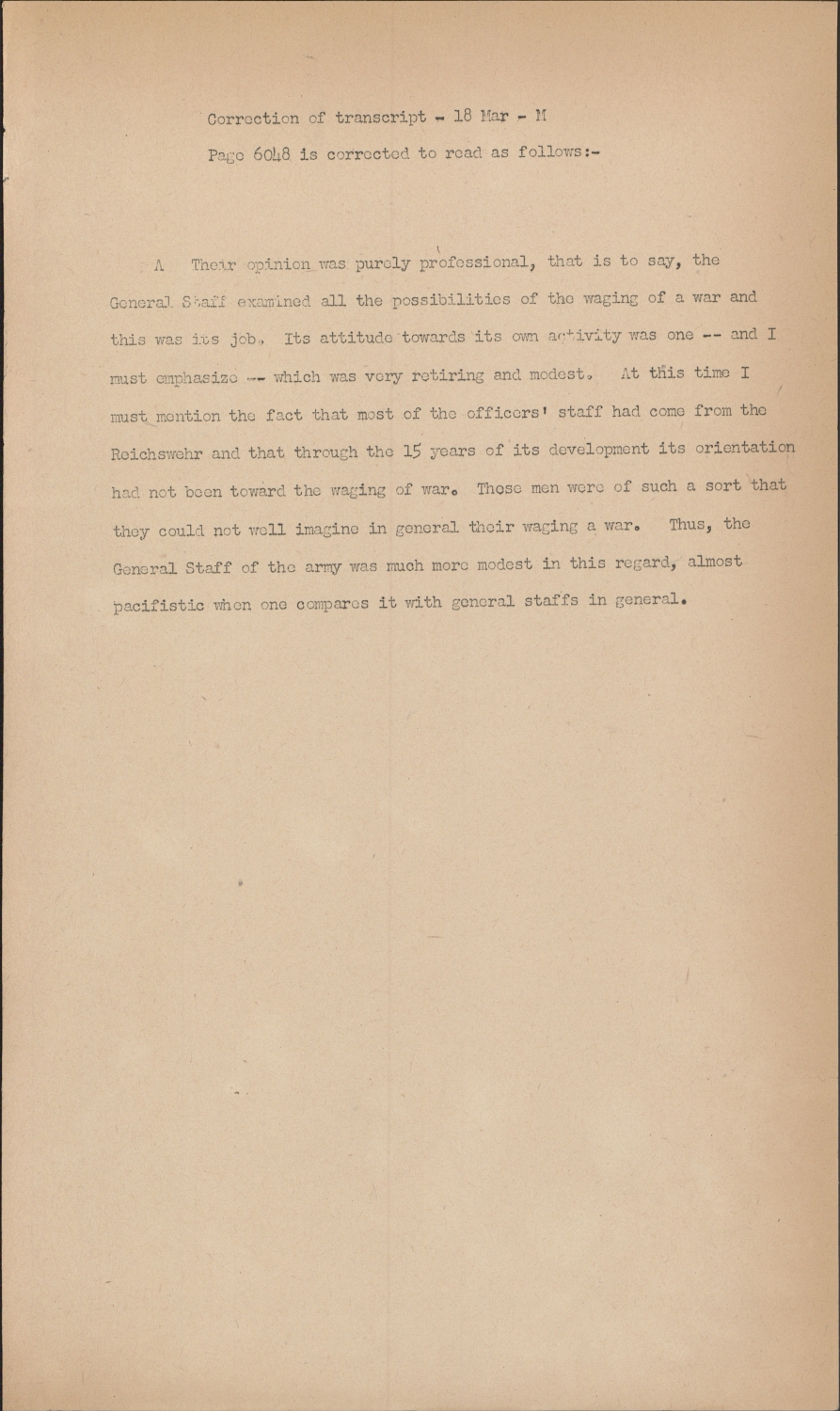
ATheir opinion was purely professional, that is to say, the General Staff examined all the possibilities of the waging of a war and this was its job.
Its attitude towards its own activity was one -- and I must emphasize -- which was very retiring and modest.
At this time I must mention the fact that most of the officers' staff had come from the Reichswehr and that through the 15 years of its development its orientation had not been toward the waging of war.
These men were of such a sort that they could not well imagine in general their waging a war.
Thus, the General Staff of the army was much more modest in this regard, almost pacifistic when one compares it with general staffs in general.
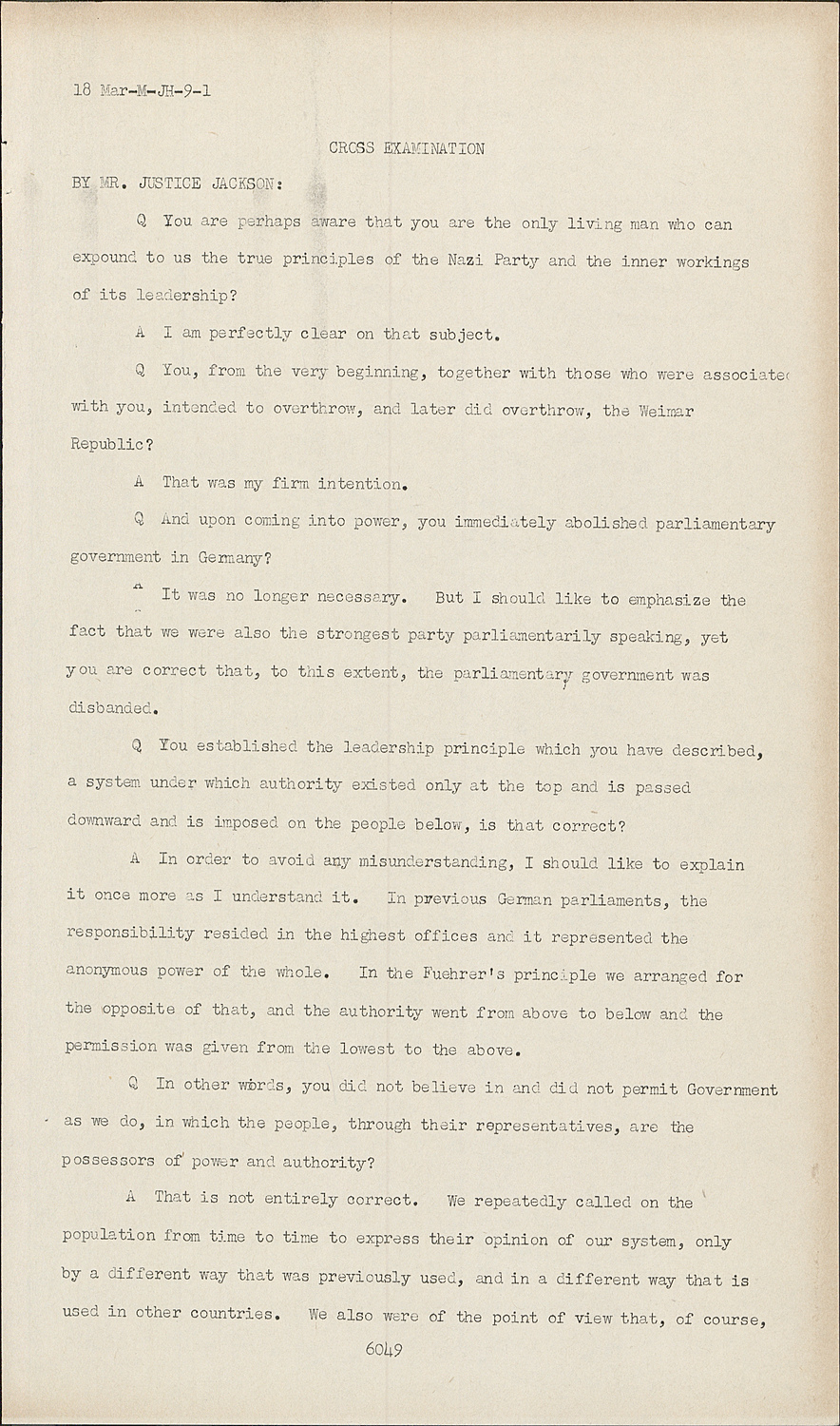
CROSS EXAMINATION BY MR. JUSTICE JACKSON:
QYou are perhaps aware that you are the only living man who can expound to us the true principles of the Nazi Party and the inner workings of its leadership?
AI am perfectly clear on that subject.
QYou, from the very beginning, together with those who were associates with you, intended to overthrow, and later did overthrow, the Weimar Republic?
AThat was my firm intention.
QAnd upon coming into power, you immediately abolished parliamentary government in Germany?
AIt was no longer necessary. But I should like to emphasize the fact that we were also the strongest party parliamentarily speaking, yet you are correct that, to this extent, the parliamentary government was disbanded.
QYou established the leadership principle which you have described, a system under which authority existed only at the top and is passed downward and is imposed on the people below, is that correct?
AIn order to avoid any misunderstanding, I should like to explain it once more as I understand it. In previous German parliaments, the responsibility resided in the highest offices and it represented the anonymous power of the whole. In the Fuehrer's principle we arranged for the opposite of that, and the authority went from above to below and the permission was given from the lowest to the above.
QIn other words, you did not believe in and did not permit Government as we do, in which the people, through their representatives, are the possessors of power and authority?
AThat is not entirely correct. We repeatedly called on the population from time to time to express their opinion of our system, only by a different way that was previously used, and in a different way that is used in other countries. We also were of the point of view that, of course, the Government could maintain itself through the Fuehrer principle that had some sort of confidence in its population.
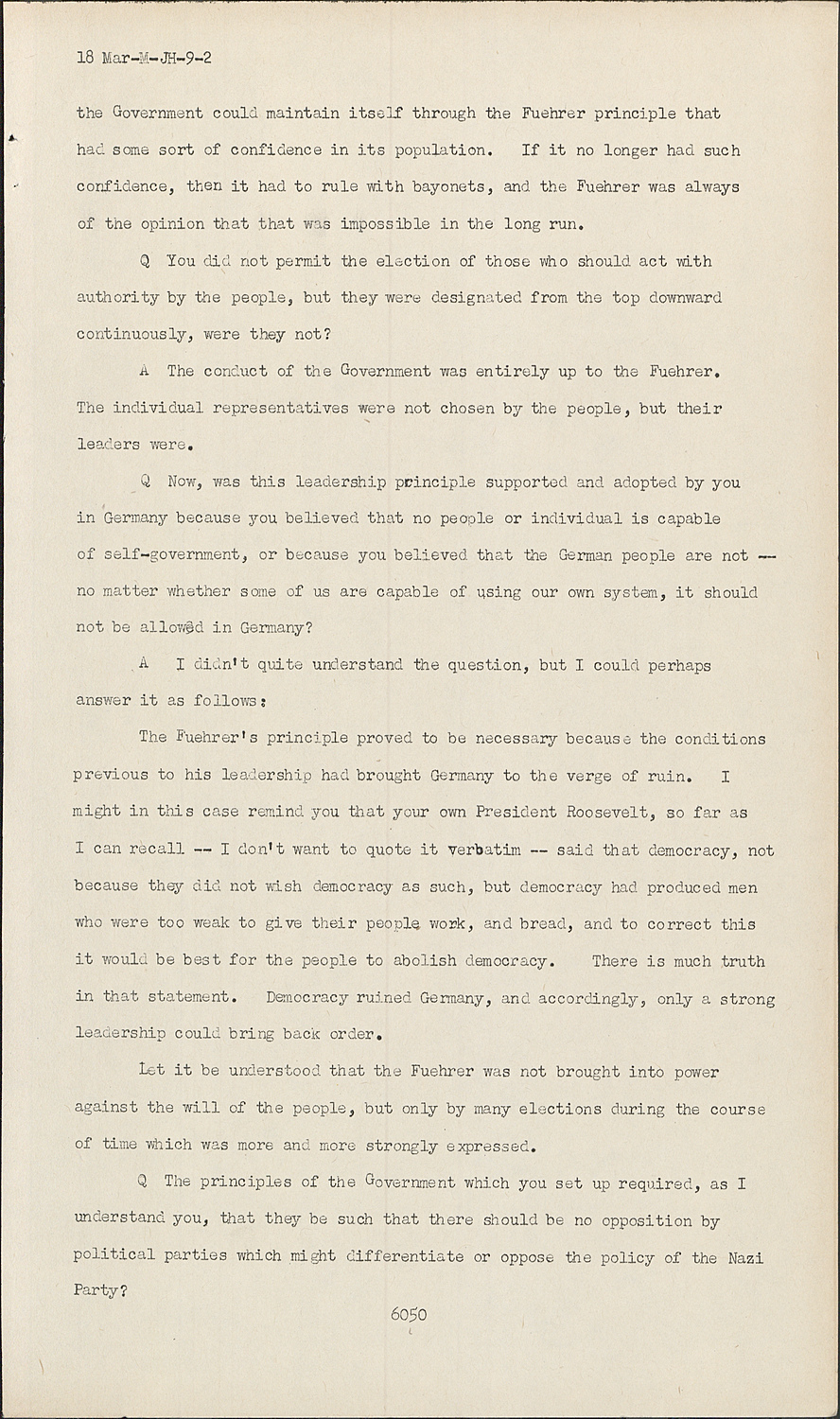
If it no longer had such confidence, then it had to rule with bayonets, and the Fuehrer was always of the opinion that that was impossible in the long run.
QYou did not permit the election of those who should act with authority by the people, but they were designated from the top downward continuously, were they not?
AThe conduct of the Government was entirely up to the Fuehrer. The individual representatives were not chosen by the people, but their leaders were.
QNow, was this leadership principle supported and adopted by you in Germany because you believed that no people or individual is capable of self-government, or because you believed that the German people are not -no matter whether some of us are capable of using our own system, it should not be allowed in Germany?
AI didn't quite understand the question, but I could perhaps answer it as follows:
The Fuehrer's principle proved to be necessary because the conditions previous to his leadership had brought Germany to the verge of ruin. I might in this case remind you that your own President Roosevelt, so far as I can recall -- I don't want to quote it verbatim -- said that democracy, not because they did not wish democracy as such, but democracy had produced men who were too weak to give their people work, and bread, and to correct this it would be best for the people to abolish democracy. There is much truth in that statement. Democracy ruined Germany, and accordingly, only a strong leadership could bring back order.
Let it be understood that the Fuehrer was not brought into power against the will of the people, but only by many elections during the course of time which was more and more strongly expressed.
QThe principles of the Government which you set up required, as I understand you, that they be such that there should be no opposition by political parties which might differentiate or oppose the policy of the Nazi Party?
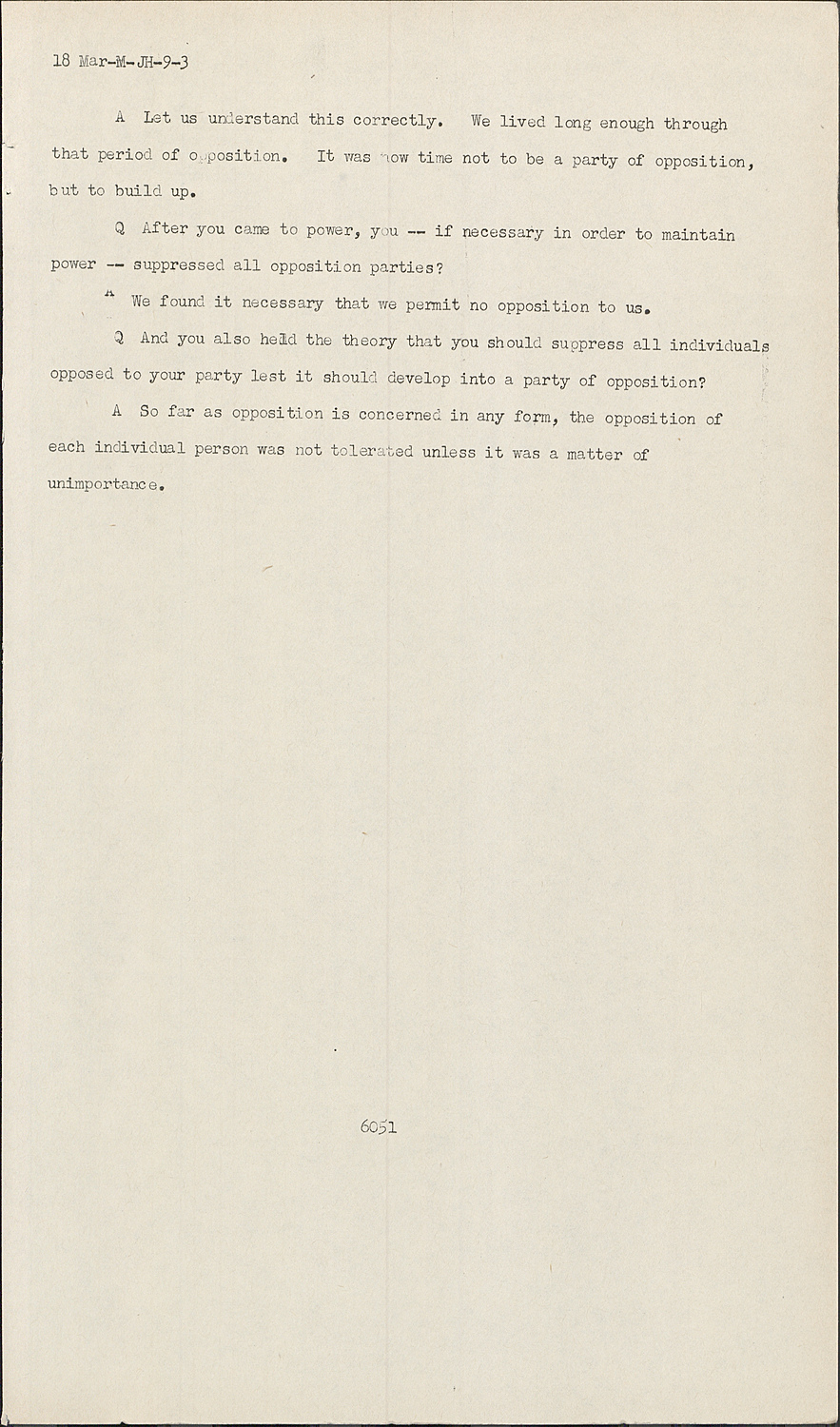
A Let us understand this correctly. We lived long enough through that period of opposition.
It was tow time not to be a party of opposition, but to build up.
QAfter you came to power, you -- if necessary in order to maintain power -- suppressed all opposition parties?
AWe found it necessary that we permit no opposition to us.
QAnd you also held the theory that you should suppress all individuals opposed to your party lest it should develop into a party of opposition?
ASo far as opposition is concerned in any form, the opposition of each individual person was not tolerated unless it was a matter of unimportance.
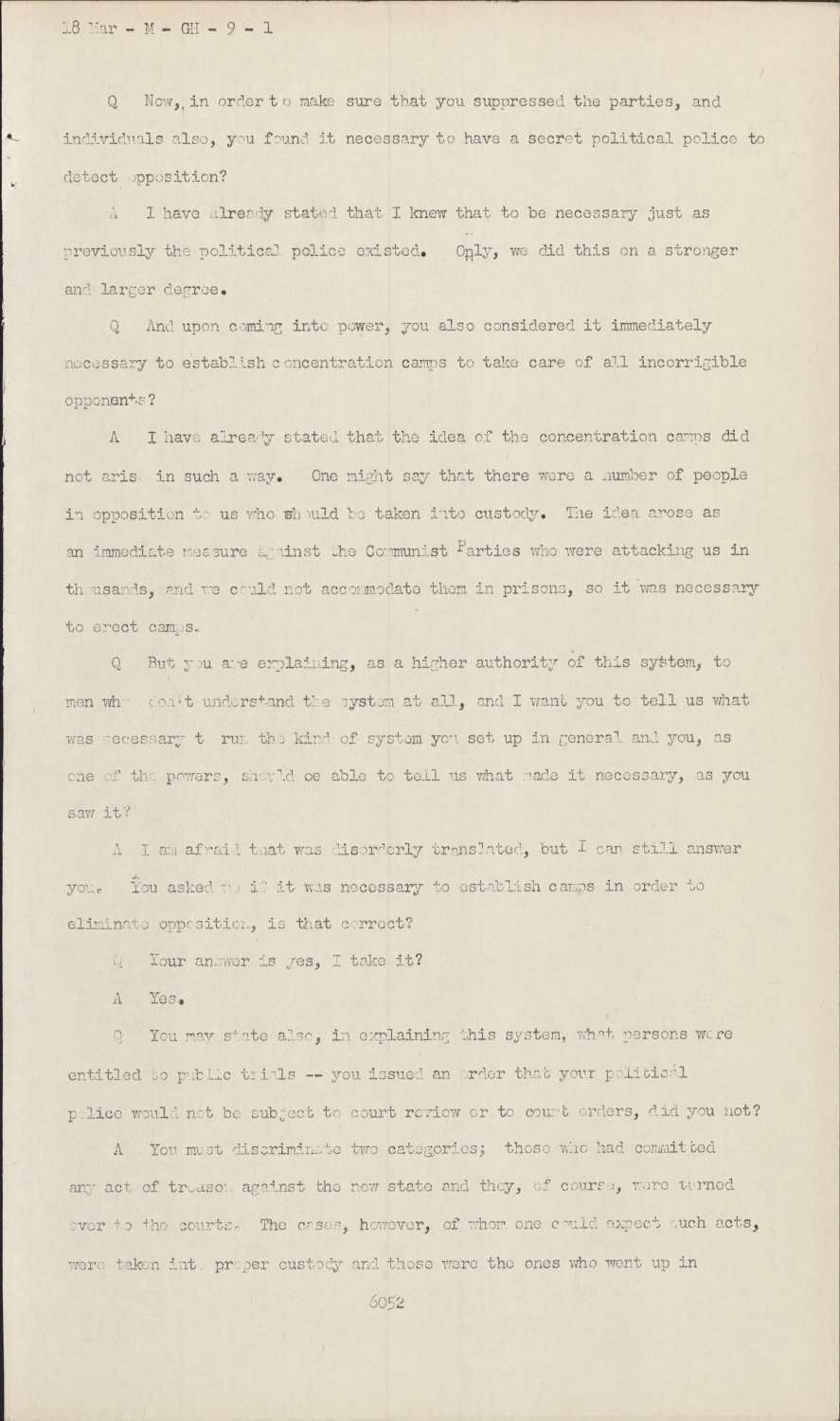
Q Now, in order to make sure that you suppressed the parties, and individuals also, you found it necessary to have a secret political police to detect opposition?
AI have already stated that I knew that to be necessary just as previously the political police existed. Only, we did this on a stronger and larger degree.
QAnd upon coming into power, you also considered it immediately necessary to establish concentration camps to take care of all incorrigible opponents?
AI have already stated that the idea of the concentration camps did not arise in such a way. One might say that there were a number of people in opposition to us who should be taken into custody. The idea arose as an immediate measure against the Communist Parties who were attacking us in thousands, and we could not accommodate them in prisons, so it was necessary to erect camps.
QBut you are explaining, as a higher authority of this system, to men who can't understand tie system at all, and I want you to tell us what was necessary to run the kind of system yen set up in general and you, as one of the powers, should be able to tell us what made it necessary, as you saw it?
AI am afraid that was disorderly translated, but I can still answer you. You asked me is it was necessary to establish camps in order to eliminate opposition, is that correct?
QYour answer is yes, I take it?
AYes.
QYou may state also, in explaining this system, what persons were entitled to public trials -- you issued an order that your political police would not be subject to court review or to court orders, did you not?
AYou must discriminate two categories; these who had committed any act of treason against the new state and they, of course, were turned ever to the courts. The cases, however, of whom one could expect such acts, were taken into proper custody and those were the ones who went up in concentration camps.
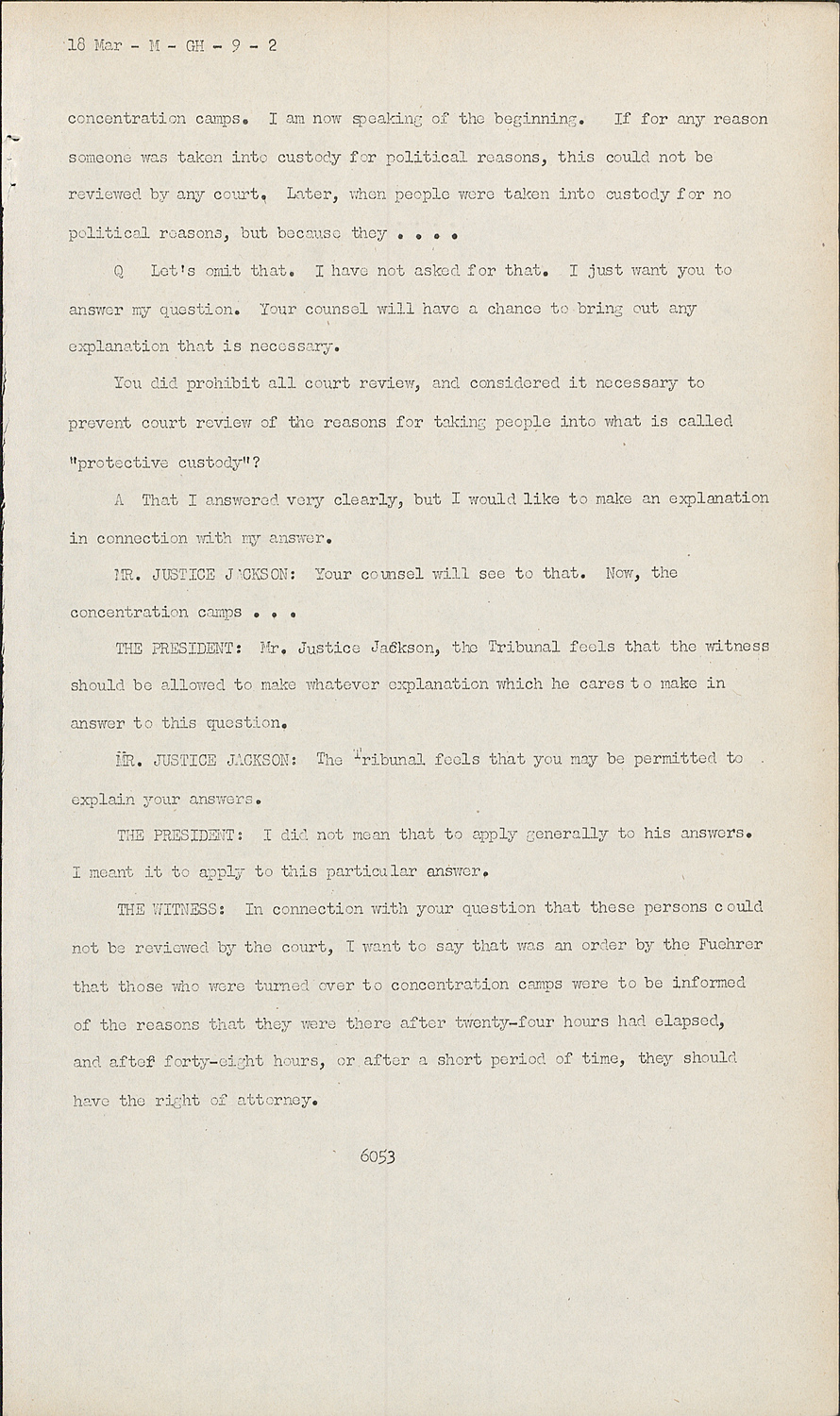
I am now speaking of the beginning. If for any reason someone was taken into custody for political reasons, this could not be reviewed by any court.
Later, when people were taken into custody for no political reasons, but because they . . . .
QLet's omit that. I have not asked for that. I just want you to answer my question. Your counsel will have a chance to bring out any explanation that is necessary.
You did prohibit all court review, and considered it necessary to prevent court review of the reasons for taking people into what is called "protective custody"?
AThat I answered very clearly, but I would like to make an explanation in connection with my answer.
MR. JUSTICE JACKSON:Your counsel will see to that. Now, the concentration comps . . .
THE PRESIDENT:Mr. Justice Jackson, the Tribunal feels that the witness should be allowed to make whatever explanation which he cares to make in answer to this question.
MR. JUSTICE JACKSON:The tribunal feels that you may be permitted to explain your answers.
THE PRESIDENT:I did not mean that to apply generally to his answers. I meant it to apply to this particular answer.
THE WITNESS:In connection with your question that those persons could not be reviewed by the court, I want to say that was an order by the Fuehrer that those who were turned ever to concentration camps were to be informed of the reasons that they were there after twenty-four hours had elapsed, and after forty-eight hours, or after a short period of time, they should have the right of attorney.